E50: Frozen Out: Silencing Black Women at Work
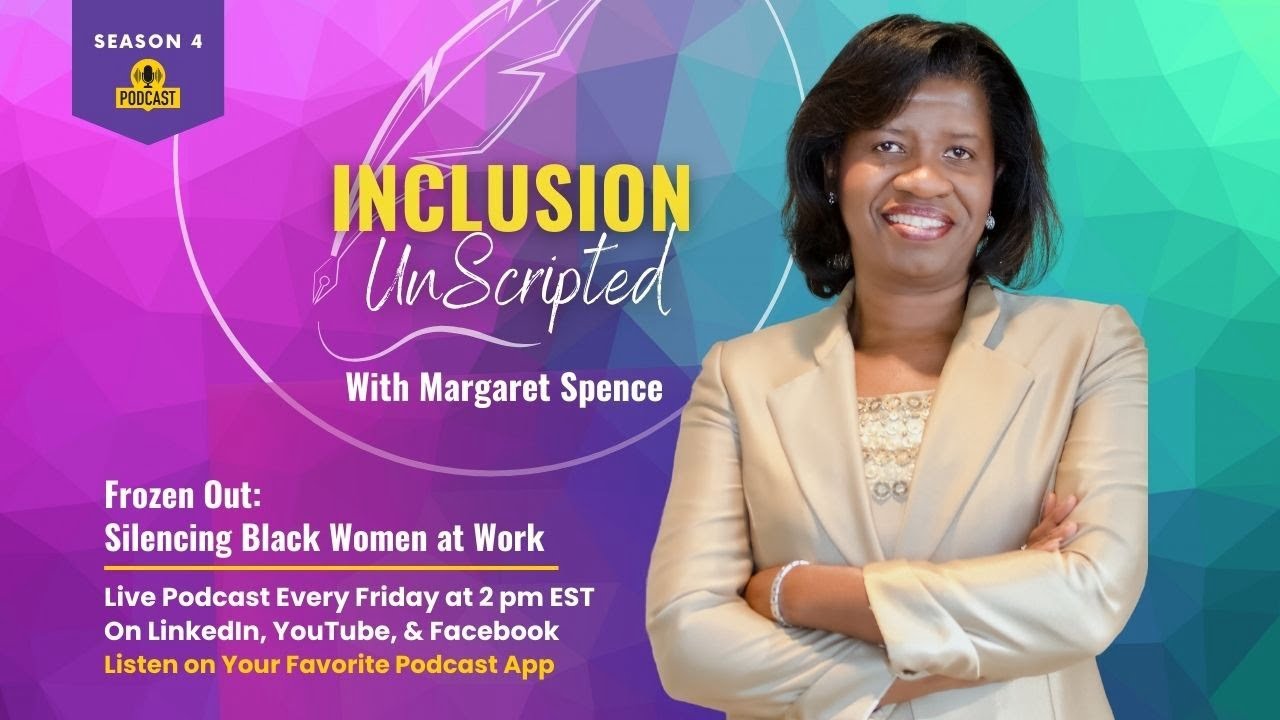
In this live Inclusion Unscripted episode, Margaret Spence, founder of the Inclusion Learning Lab, introduces the term “frozen out” to describe a systematic, subtle process by which Black women are marginalized, silenced, and ultimately pushed out of organizations. She outlines a ten‑step “frozen‑out” playbook that includes (1) playing on the employee’s psyche to make them feel crazy, (2) sowing doubt about capability, (3) giving a perfect performance review without a raise, (4) excessive documentation via email loops, (5) diluting title and dismantling reporting structure, (6) counseling about “attitude,” (7) silencing them in meetings, (8) excluding them from meeting invites, (9) resetting goals and piling on unrealistic expectations, and (10) reassigning or terminating the employee. Spence explains how these steps erode mental health, citing a recent suicide of a Black woman professor as a tragic example. She emphasizes the importance of early recognition, protecting mental health, updating resumes, networking, and seeking allies. The episode also promotes the Inclusion Learning Lab’s community, courses, and resources for DEI leaders, positioning the platform as a support system for those experiencing or combating such exclusion. The tone shifts from urgent and confrontational when describing the freeze‑out tactics to supportive and empowering when offering coping strategies and community resources.
Chapters
You're like a circle that floats around me, keeping me safe and sound. And when I fall, you tied a rope to me. You're blessing me every day. I was down with an illusion, like a sparrow with broken wings. But now I shine with your reflection on me.
Hi everyone, welcome to Inclusion Unscripted. My name is Margaret Spence and I am the founder of the Inclusion Learning Lab, and we are live today on YouTube, LinkedIn, Facebook, and Instagram for the first time. So I want to thank all of you for joining us today, and I want to talk about a subject that is near and dear to my heart. The subject is being frozen out. It's a terminology that I coined when and as it relates to women of color inside of organizations who are being frozen out. So what does that mean? What is frozen out? What exactly is frozen out? Frozen out is when you as a woman suddenly start getting critical communications at work. You suddenly realize that your expertise is being questioned. You're receiving an unusual amount of documentation from peers. You know those emails that document, that aren't really meant to do anything other than restate what was already stated, that was already told, that you already knew? You know those emails, the emails that come to you as a CYA. We want to make sure that you know that we're watching you. Those kind of emails. The emails will come from peers or your leaders, and you're getting this severe microscopic review of you, and then suddenly you begin to be frozen out of meetings, frozen out of process, frozen out of everything. If I'm describing you, This is what workplace microaggression looks like, but we cannot call this microaggression. We have to call it what it is. You are being frozen out and silenced, and ultimately you will be terminated. So deep breath. Thank you for joining us on Inclusion Unscripted. Where we're not just building inclusive workspaces, we are living inclusion every day. We dive deep into controversial issues. Controversial meaning not stuff that people want to talk about, and oftentimes you are afraid to even have the conversation. But you'll learn here at Inclusion Unscripted that we tackle things that most people don't want to tackle. We recognize that women need to understand early warning signs that you are in trouble, that you need to course correct quicker, that you need to do a more effective job of managing your career. This is part 2 of the program that I'm doing around Black women, and it comes directly from Dr. Gay's experience at Harvard University. And I think today we need to talk about how we are frozen out. So here we go with the how we're frozen out. Let's talk through this now. Let's see what this looks like. Why do this, Margaret? For those of you who don't know who I am, let me introduce myself to you for a second. My name is Margaret Spence again. I founded the Inclusion Learning Lab in 2019, and we are an online community that supports DEI leaders in the daily work that you do every day. We support the work that you do. We are here to create a community that supports you and supports you inside of the workplaces that you're working in and gives you not only the support system, but the structure, but the day-to-day help that you need to be an effective but sustained DEI leader. At work. The reason why I do the work that I do is because the position with the highest turnover on what would be considered the HR team is the DEI leader role. And in this environment, I'm gonna do a podcast episode on should we continue to do DEI as Black people, but that's not today. Today we're talking about careers, but the work that we do around DEI is specifically twofold. The first thing that we do, and we are doubling down on this, is supporting anyone who is doing the work of inclusion in the workplace. That is the first work that we do all the time. The second work that we do is help organizations build inclusive workspaces. Because it's not enough to hire you to do the work, you also need to build the process. So, so much about me. Let's talk about why we're here today. There's a professor at a university called Lincoln University that I saw on Instagram a couple days ago. Attorney Benjamin Crunk posted that she had committed suicide. A Black woman, beautiful Black woman, who had apparently been under immense pressure in her role, and she committed suicide. I am beyond concerned about Black women at work. I don't want to put the oxygen mask on anybody else except us right now because I think that's what we need. We need that oxygen mask on ourselves. Last year I did a podcast episode called Black Women, You Are Enough. I'm gonna repost that episode, Black Women, You Are Enough, because I think we need to know that we are enough and that we are enough without the pressures that's being put on us at work. We are enough without the job title, without the roles, without all of that. We are enough. Throughout my career, I have seen Black women marginalized and eventually, um, ousted from their roles and then crushed as they're going out the door. And then they, um, are trying to figure out how to pick the pieces up after they're crushed. Inside of these corporate roles. I coined this being frozen out. So I want to take you today through the 10 steps of how Black women are frozen out at work. There are 10 specific steps primarily done to Black women to exclude them from work and ultimately fire them. It's 10 subtle steps, so I'm gonna go through it. I'm gonna call people out because honestly, this is what I do on Friday at 2 PM. I'm gonna call out this process and I'm gonna call out the subtlety of how this process works. And I made notes for today, and if you've watched my my Inclusion Unscripted, you know that I don't typically write a script for this, but I want to make sure that I don't miss a point in how Black women are frozen out at work. I'm going to quickly go through the 10 things and then I'm going to unpack them one by one. The first thing that an organization does, or a leader or a team leader does to you is they play on your psyche. They play on your mental health. They make you feel like you're crazy. The second thing is they have you doubting your capability and your capacity, because it's easy—
er—
if we are intimidating them, or if they want the role we're in, or if they think that the role we're in will be better for them, and we're sitting in it, they will make us doubt our capacity. But there's a method to that, and I'm going to talk through that. Then they'll give you the perfect review, but they won't give you the money that goes with the perfect review. They'll give you the perfect review, right? So then they make you feel that you are good but not good enough. Then they document you, they document you, and they begin to document you, and you suddenly feel like you're being documented. That's a phase 4 of the 10-step or the 10 phases of the psychological attack on Black women. And then the 5th stage or step in the process is taking away your power. In whatever role you're in, they suddenly decide it's time to take your power away. And then the sixth step, because they've now taken your power and they've taken you through a couple things, and they've now gotten to step number six, and you're angry rightfully so, and they start to talk about your bad attitude. And then the 7th step in the Frozen Process is they invite you to meetings but they don't allow you to speak. They drown you out in those meetings. And then the 8th step is they stop inviting you to the meetings. They don't invite you anymore. You're now not on that email chain, and you find out afterwards that there was a meeting. And the 9th phase of freezing you out the door— because when they get to number 9, they've pretty much decided that your ass is grass and you're going out the door, right? And the 9th phase they pile on either unrealistic goals or they change your work pattern, work progress, and they begin to treat you like you're a new employee again. So this is the phase where they make you feel that you're not good enough. And then the final phase, which is Phase 10, is where they bring themselves together and say, guess what, Margaret, We really have been evaluating you for a while now, and we just don't think you're the right fit for this role. Maybe we made a mistake when we promoted you, or maybe we did something wrong, or maybe we should have let you go a long time ago. And guess what? HR has worked out an exit package for you. And oh, by the way, you're not entitled to anything on the way out the door. Um, have a good life, go away. 10 steps. I call this the frozen out process. This is how organizations freeze out Black women. This is how it's done. They freeze us out subtly, but there is a pattern. So let's dive into the pattern a little bit more. Let's talk about the first one really clear so that you as a Black woman get it clear what is happening to you immediately. The first step is playing on your psyche, making you feel like you're crazy. In toxic, horrible environments, your boss, the, the, the people on your team can be contributors to making you feel that you are crazy. And they do that by either undermining you, taking your work and putting their name on it, pretending that you didn't do the work, that they did it, calling you out for unnecessary things that's not called out for anyone else. But they subtly do this to undermine your mental health. Because that is the first way that white people know how to undermine us. And I'm not even going to go to white people because Black people do this to ourselves too. You can have a bad Black boss who does the same 10 steps of freezing you out because inside of a corporate structure It almost doesn't matter what the race is of the person who's doing the tormenting of you as a Black woman. So let me say that again. Inside of the corporate structure, it doesn't often matter what the race is of the person who is torturing you or tormenting you or freezing you out. Black people will be made to do this to other Black people. Hispanic people will be made to do this to Black women. White people will be made to do this to Black women. Asian people will be made to do this to Black women. There is no community, no community whatsoever that is excluded from being the anchor for the 10-step freeze out. There is no community, no one. Anybody in a leadership role can be charged up to become your freezer. Anyone in a leadership role can be charged up. Let me tell you how they get to start the freeze-out process. It doesn't start, um, in a vacuum. It starts by one person beginning to sow doubts about you. That person has their own agenda, and when you are not in the room, that person uses the opportunity to what I call 'but Margaret.' So someone will say, you know, Margaret's on that project, and the person will say, "But." They often don't have to say a darn thing after "but," but they say "but." Or even for me as a consultant, I will get clients butting. Margaret is great, but— once you plant that "but," now the doubt begins to pop in. To the equation. So that's how the person is doing it behind the scenes. That's how they are doing it behind the scenes. When they are behind the scenes and saying that 'but' about you, that subtle 'but' is the gateway for the beginning of the play on your psyche. Because in order for someone to run you through the frozen out playbook, they have to get someone on their side to agree that you are not that great. And so the, the way this is done is behind your back, behind the scenes, where you are not looking. Where you are not expecting. This person who shows up as your ally, who shows up as your friend, is suddenly doing the butt process behind you. And I don't mean B-U-T-T, I mean B-U-T. Butt. Margaret Butt. John Butt. Joan Butt. Harry Butt. As long as I am able to put a but behind the conversation about you, then in that vein, I am now sowing doubts about you as an individual, as a woman of color, and as a woman, period. Because this playbook doesn't play as well with men. This playbook plays extremely well with women. It's the frozen butt playbook, or the butt frozen, right? But in my— the label that I've given this is frozen out. This is the label I've given it. And for all of you who think you are so secure in your role, you are so great, the organization loves me, they would never freeze me out. Given the right set of circumstances, anyone in any role can be frozen out. What happened to Dr. Gay was she was frozen out. People started making decisions behind the scenes that she didn't even know were being made. If you read some of the articles, you'll see people were in Aspen, in Florida, here and there, and they were having sidebar discussions about her tenure at Harvard. That's what happens when you're being frozen out. There are subtle discussions going on about you in a room that you are not in, and inside of those rooms they make the decision that you are dispensable, and the process of freezing you out starts. That is what happens to women of color. That is what happens to us. And we don't talk about this stuff enough. There is a woman right now sitting in an organization who's being frozen out by her company, and she's sitting in that organization being frozen out, and you're sitting there not understanding what you should do as you're going through the 10 steps of freeze out. So let me expand the 10 steps of freeze out again. Number 1, they play on your psyche. They make you feel like you're crazy, and they do that. And you go home at night and you question yourself. You are now not sure about who you are. You feel in the pit of your stomach that something is wrong. The next is they have you doubt your capability and your capacity. They do that subtly. You apply for a job, they don't give it to you, they promise you some other thing. They put you on what I call the bullshit wheel, which is come back later, come back now, do this, do that, do the other, do the other, do the other, do the other, and if you do all the others, you'll get the job that we want to give to you. That's called the bullshit wheel, right? And Black women, we need to spot that wheel quick, bone up our resumes, and get the hell out of there. Again, I digress. The third step in the process is you get this perfect review. It's annual review time and you get this perfect review, perfect review. Great. Margaret is phenomenal. She's great. She's perfect. She's wonderful. But we're not gonna give you 5%. We're gonna give you 3% because there was a tiny little set of stuff that you need to work on next year. But you've told me I'm great because that's the hook to keep me here. The hook to keep me here is after you have made me feel like I'm crazy and you've sowed doubt about about my capability, you still want me in the building doing the work because you're not ready to let me go yet. So let me, let me give this to you straight. You're not ready to let me go yet. You still need me in the room for a couple more months, so you give me a perfect review but a not compensated raise, right? So that's Phase 3, step 3, process 3, however you want to call it. Frozen 3, right? The fourth step is the email loop. People are re-documenting after meeting with you. Now, some of those re-documenting is necessary. I just want to reiterate what happened during our meeting. No problem. But when you are reiterating and then inside of that email you're subtly making me feel like I'm not adequate, then what you're really doing is documenting me out the door. So when you get to HR, you can say, you know, here are 99 emails that I sent to Margaret about the same thing, and somehow she hasn't gotten it and hasn't made any change or adjustment. See, that is the email stream of documentation. That's what that is. And leaders do this email stream of documentation because they've already had a discussion with HR, and HR has told them, you don't have any paperwork to fire Margaret Spence, none whatsoever, and we don't want to be sued. So So make sure you start documenting what Margaret does. So the thing that they'll say to you is, we need to start having one-on-one meetings. Let's have a one-on-one together. And in that one-on-one meeting, we will be able to figure out what our next steps are. But those one-on-one meetings are documented, and then there's a follow-up email that comes from that one-on-one meeting that explains and recaps the meeting. And gives you your to-do list, and then it tells you what you didn't do. That's a documentation. So they're documenting you out the door so they could say they terminated you for cause, so they don't have to pay you severance. But I digress. The next thing, the number 5 thing, is your title is diluted and your reporting structure is dismantled. So you will know that you're in the frozen out cycle when you get to number 5. Number 5, your title is diluted. Whatever your job title is, whatever it is that you were hanging on to— I'm vice president of blah blah blah, I'm director of blah blah blah, I'm the manager of XYZ, I'm the leader of blah blah blah— suddenly there's a reorg and your title is diluted and you are no longer doing what you were supposed to be doing. But maybe they didn't change your title, but you've— they've changed your reporting structure and they've dismantled your hierarchy, and they've also maybe removed you from a person that they felt was protecting you and stopping them from firing you. Number 5, I know some of you are going through this. I know it. You are at number 5. Number 6 is when they start counseling you about your attitude. I remember working for this fiddly woman that I worked for, and it's so funny because I, I was on LinkedIn the other day and I realized that the most horrible boss I ever had in life came on to my LinkedIn, um, and looked me up on LinkedIn and viewed my profile. Like the— she had been in my life when I was working for her. But I digress again. So they counsel you about your attitude. Margaret, you got a bad attitude. Why you angry? Why aren't you smiling? What happened to that happy smile that you had all this time, Margaret? You're not coming to the outings with us. You're not doing any of this stuff. What is going on with you, Margaret? Why are you not happy? And then they start asking you, are you not happy here, Margaret? That is number 6, because now they're saying you're the angry-ass Black woman, right? So they're getting ready at phase 6 to counsel you on your attitude, right? Number 6. Is you got a bad attitude, Margaret, and we can't have people with bad attitudes on our team. But here's the thing, before you put me into the frozen process, I was happy, I was well adjusted, I was producing, I was doing whatever I wanted to, I was doing what was— what I needed to, I was producing, you were happy, I was happy. But then you put me into the frozen, um, process, and now I have a bad attitude, but you didn't do nothing to me. I just had a bad attitude all on my own. Nothing happened. I just had a bad attitude. And then number 7 is the big one. People don't let you speak in meetings anymore. They don't let you speak in meetings anymore. So the meeting will occur They'll ask other people, ask a lot of people for their input, and no one will ask you for yours. You'll sit in the meeting a little bit frustrated. You'll say something and it won't really be acknowledged because at this point, at number 7, at the 7th phase of being frozen out, they don't really want to see you in their circle anymore, but they're not ready to fire you because they haven't quite figured out who they're replacing you with. So you're not allowed to speak in the meeting. You're sort of drowned out. You get platitudes. You get, "Yeah, Margaret, that was a great idea. Next!" And they move on. Or you will say the idea, your male counterpart will steal the idea and make it his own, and you will be zoned out in the meeting. So they freeze you out in the meetings. That is phase 7 of the freeze-out, phase 7 of being frozen out, because now they have gotten all the way down to where you should be silent. Number 7 is silence. And number 8 is meetings that you have customarily gone to for years, that you have even led those meetings, that you you design those meetings, that you set those meetings up, you are now no longer on the email string for those meetings. Meetings are occurring about your work product, about the work that you are producing, about the work that you are putting out. Meetings are occurring about those things outside of you being in those meetings. And people come out of those meetings to tell you what happened in the meeting, but you were not invited to the meeting. But your job title says you should have been in the meeting. See, so number 8 is where you are excluded. It's subtle. It happens all of a sudden. Oh my God, we forgot to put Margaret on that email string. We didn't put her on the email string. We forgot about her. No, you didn't forget about me. You deliberately left me off the meeting. You stopped inviting me to the meeting. So here's a point, because I think I need to just get here right now. If you have gotten to step 7 and you are rolling into step 8 and you think that your job is secure, I have some beautiful land in the state of Florida to sell you. I have a whole island off the coast of Florida to sell you if you've gotten to number 7 and 8 and you think your job is still secure. You think that you need to still be putting in 40 hours and not job hunting, you got a mental problem. I'm sorry, I'm gonna say it to you. They have demoralized you to the point where you have forgotten who you are. That's what's happened. You've forgotten your core existence because this 10-step process is there to demoralize you to the point where you cannot function when they fire you. So when they stop inviting you to the meeting, you are now more angry than you were before. Many of you have not thought that this is the time to fill out your resume, update, update your LinkedIn, call a recruiter, dial up a friend, figure out your network, uh, figure out what to do. Um, you got a problem if you're at number 8. Number 8 is where they stop inviting you to meetings that you should be in, that those meetings govern the work that you do every day. That's number 8. And number 9 is where they reset your goals because they don't quite have enough to get you out the door. So they're going to reset your goals and pile on unrealistic expectations into your job, and they may even have you start training your replacement, and you will be happily training them and not realizing that they're the ones that's going to sit in your seat. Number 9 is the ultimate demoralizing area because you are already giving 100% before you get to number 9. You are already putting out output that is not human because they've been piling on, and you're emotionally not stable, and you're feeling self-doubt, and you're stressed out, and everything is going on with you. And then they pile on more work, or they change your, um, process and they say you have to come into the office now 4 days a week and you can only work from home 1 day a week. But this is the pile-on of the unrealistic goals that get set, and in that pile-on of the unrealistic goals, it is the last step before they terminate you. Because step 10 is where they call you in and tell you that they have been documenting for months now and they've talked to you and they've counseled you and they've told you stuff and you haven't made an adequate change and so they're going to take the job away from you. And here's the, the bad part about number 10 is if you haven't spotted 1 through 9 as an off-ramp that you need to leave the organization, when you get to number 10, they may very well not terminate you. At number 10, they may decide to change your job, change your salary, change your role, move you to a different team, do something like that. And that in itself will take you off the career track you're on, and you will not be able to progress.
Press.
That is the 10 steps to how Black women are frozen out and silenced at work. That is the 10 steps to how it happens. I know that there is a woman right now who's going through all 10 of these, feeling like you're crazy, undermining and sowing doubt about your capability, giving a perfect review but not getting adequate money, not being put in the loop. You're suddenly not in the email stream, or they're documenting and sending you emails documenting your work or their conversations with you. Your title is diluted, diluted, and your reporting structure is dismantled. They've taken away core responsibilities from you. You're being counseled about your attitude. You are no longer allowed to speak in meetings, even though, um, those are the meetings that you once led. Other people are leading them. You've been— they've stopped inviting you to key meetings that you are— that impact the work that you do. They've now piled on unrealistic goals, um, unrealistic expectations, and a greater workload, and now they're coming to you to say, we don't think you're right for this role, maybe we'll move you over here, or darn well we might terminate you. This is the psychological trauma that Black women go through at work. This is what leads us, um, to the horrible decision the sad decision that the professor made, the head of student services at Lincoln University. She committed suicide at the end of an untenable work situation. There are women who are having nervous breakdowns, there are women who are having mental health challenges, there are women who are getting sick There are women who are feeling destroyed by work, and at the same time, the organization and these individual leaders who have set out to be destroyers of Black women think it's funny. They think it's okay. They think that their end goal is better than all goals, and they don't think we're human because they don't think that we feel. And so they do this to us and they freeze us out as a way of breaking us. The challenge with this process, and what I tell women who come to me for coaching after this, is you are not ready to go even look for another job when they've done this to you. You have to take time off to get your mental health right before you even consider looking for another job. This is the sad part of this process that is done, which I call frozen out. When they freeze you out, they freeze your entire life because at the end of it they take away your financial stability, but on the way to taking away your financial stability, they affect your mental psyche. All the way through this process. This is what evil looks like at work, and we have to talk about what evil looks like at work for women, and specifically for Black women. And as we work our way to another MLK Day— I'm recording this, uh, the weekend before MLK Day as we work our way to another MLK Day, we have to understand that this process of being frozen out is detrimental to our mental health. So I'm gonna take a deep breath. What do we do as women of color? To combat this. What we do as women of color is that we see this happening to us, we recognize that it is happening to us, we do not allow ourselves to pretend that it is not happening to us. Accept the fact that you are in the freeze-out zone. Accept the fact, if these things are happening to you, that you are being frozen out. It is imperative that you protect your mental health. That is the first order of business. The second order of business is to bone up your resume. I would say to women of color We have to network our experience. We cannot not network our experience. We have to network our experience. We must get out there and find allies that we can network our experience so that when these things start happening to us, we have someone that we can pick the phone up and say, hey, this is going on for me. What do you think I should do? What other positions are out there? In this environment, no woman, no Black woman should be in the thought pattern that you are secure at work. I don't care what level you are in the organization. Your role can be eliminated tomorrow. By reorganization, by changing things around, by subtly moving the, the cheese, as he would say. We must be vigilant about our careers. We cannot be subtle about our careers. We have to be vigilant. We have to be hyper-vigilant. We have to be willing to walk away. At number 5, number 5 is They've diluted your job title, your reporting structure, and dismantled your secure system. When you go through the first 5 of these, there's no reason why a Black woman should get to number 10. Okay, I'm gonna say the 10 again. They make you feel like you're crazy. They sow doubt about your capacity. They, um, they give you a perfect review and don't give you a raise. You're not being put in the loop on emails, and suddenly people are documenting you via email. And by the 5th step, your title is diluted and your reporting structure is dismantled. When you get to 7, you're being counseled about your attitude. When you get to 8, you're no longer allowed to speak in meetings, even if they've invited you to the meeting. And number 8, they stop inviting you to the meetings. They take you off the meeting loop. Number 8, work is piled on unrealistically and your goals are reset in order to show that you're not adequate. And number 10 is where they either reassign you or terminate you. There's no reason for a Black woman to get to number 10. We need to stop at number 5 because at number 5, they've showed you who they are. And it's time for you to go. So I end on a positive note. The positive note is in 2024, we are going to ask ourselves a different question. We're going to ask ourselves about possibilities. What are my possibilities? What does that look like for me? Is it possible for me to survive whatever is going on here at work? And if it's not able— if I'm not able to survive what's going on here at work, how do I create possibilities for myself elsewhere? We cannot sit in this and let it affect our mental health. So the parting word for everyone is protect your mental health. Thank you for joining me here on Inclusion Unscripted. If you wanna know more about us, visit inclusionlearninglab.com. We have a community for DEI leaders. You can join the community for $98 a year at our lowest entry point, and you can sign up to take courses and certifications on the learning lab. So sign up for our newsletter at inclusionlearninglab.com and join me again next week for Inclusion Unscripted, where we don't just live diversity and inclusion, we don't just build diversity and inclusion, we demand inclusive spaces for everyone so that everyone, not just people of color, every single person can thrive. I do this Inclusion Unscripted for my grandson every week because I want him in 20 years to walk into a different work environment than the one we have today. So thank you for joining us. See you again next week where we'll have another hot topic to talk about in the world of work and inclusion.
You're like a circle that floats around me. Keeping me safe and sound. And when I fall, you tied a rope to me. You're blessing me every day. I was down with an illusion, like a sparrow with broken wings. But now I shine with your reflection on me.
Take care everyone, see you next week.
Bye!








