E6: Who Defines Diversity, Equity, and Inclusion Success?
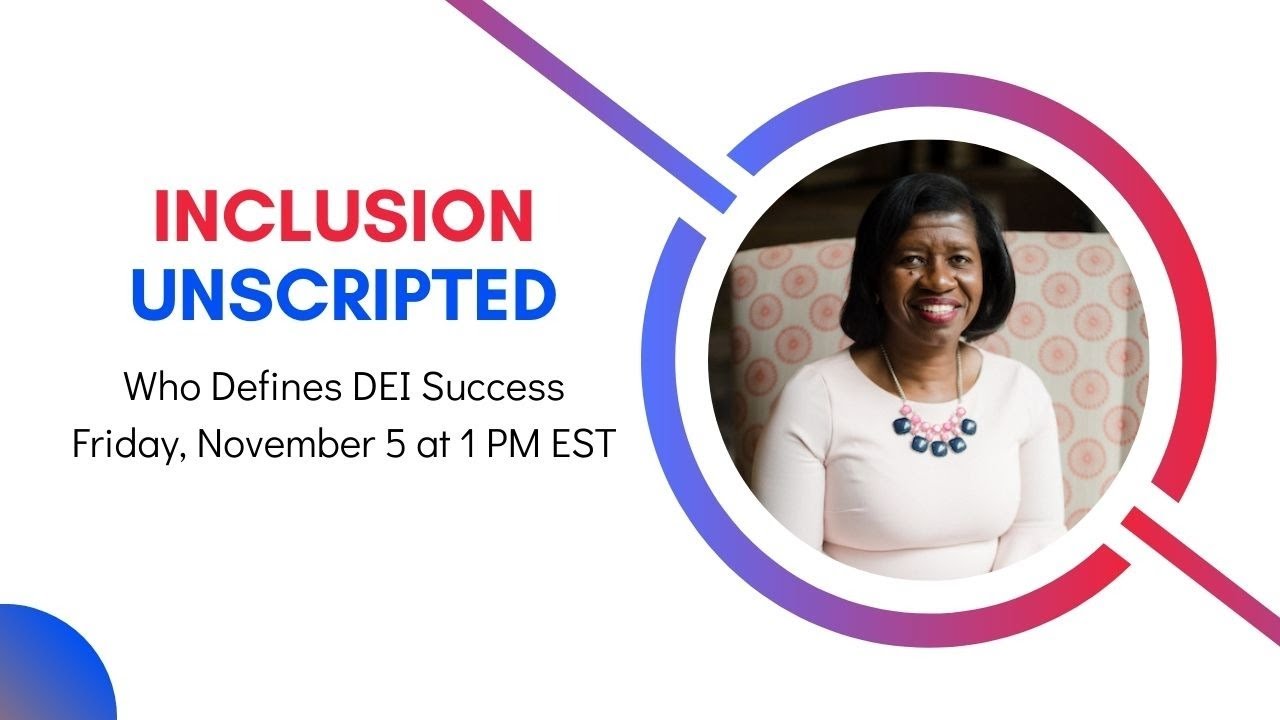
In this hour‑long live episode of Inclusion Unscripted, host and Inclusion Learning Lab founder Margaret Spence interrogates the fundamental question of who gets to define success in diversity, equity, and inclusion (DE&I) initiatives. She traces the trajectory from the 2020 racial reckoning—when many organizations made bold public commitments—to the present, where DE&I fatigue, dwindling resources, and a revolving door of DE&I leaders have eroded momentum. Spence critiques superficial gestures such as pronoun policies that fail to create genuine belonging, and she highlights the disconnect between corporate DE&I statements and the lived experiences of people of color, women, LGBTQ+ and other marginalized groups. Throughout the talk she urges organizations to shift the metric of success from executive‑driven dashboards to the concrete outcomes that marginalized employees actually experience: equitable hiring, career advancement, representation in leadership, access to high‑value vendor contracts, and a sense of psychological safety. She shares anecdotal evidence (e.g., tracking DE&I directors on LinkedIn and seeing rapid turnover) and references a recent study showing most people of color do not benefit from current initiatives. Spence offers “marching orders” for leaders: ask employees what success looks like for them, embed those definitions into program design, and evaluate outcomes through focus groups, retention data, and equity‑focused resource allocation. She also announces upcoming Inclusion Learning Lab programs on strategic DE&I planning and women’s career mentorship, and invites listeners to join the community for ongoing dialogue.
Chapters
Hey everyone, how are you? Um, welcome to Inclusion Unscripted. We are coming to you an hour early today because I actually have a program at 2, so I decided to move up our live. Typically we are on at 2 PM every Friday, 2 PM Eastern time every Friday. So welcome to Inclusion Unscripted. If you've ever wanted a place to have honest discussions about diversity, inclusion, equity, equality, women's issues, career management, this is the venue. Um, I say what's be— what needs to be said. I challenge all of you to think about inclusion a little bit differently, and I'm here to give voice to the voiceless. Those of us who are doing the work of DE&I silently, those of us who've done the work of women's leadership development silently, those of us who are looking to hand the baton off to the next generation of leaders. That is what Inclusion Unscripted is all about. We are here. I'm here every Friday to challenge you to think differently, to think outside of the box, to look at things through a new lens, So today's lens, today's big lens, because I thought, what am I going to talk about this Friday? Today's lens is pretty simple. It's really, really, really simple. Who defines DE&I success? Who defines DE&I success? And for all of you who don't know me, my name is Margaret Spence. I'm the founder of the Inclusion Learning Lab. I've been an HR workers' comp and risk management consultant for the last 22 years. I've been in the insurance industry for 37, almost 38 years, and I bring my depth of knowledge around working with clients across multiple platforms. I bring that depth to today. My company is inclusionlearninglab.com. Um, visit our website, uh, to learn more about us and our upcoming programs. Um, we have two dynamic programs coming up soon. The first one is planning your 2022 strategic and tactical DE&I initiatives, and we're going to run that as a 4-week program. And then we're also going to do a career mentorship for women for 2022. So we have 2 tracks, 2 programs coming up, and I'd love for you to join us. The information will be on Inclusion Learning Lab by next week. And the registration link should be live then as well. So let's focus on why we're here today. Why we're here today is defining success. What is DE&I success? What does that look like? Who actually determines success around diversity, equity, and inclusion? Who says this is successful? What is the definition of DE&I success? And are we building programs based on success? Are we building them based on numbers or meeting some imaginary goals or meeting some goals that we keep shifting every year because we're not necessarily meeting them? So the question for everybody is, who is benefiting from DE&I? Wow, Margaret, you actually went there. You went there. You went there and you asked, who is benefiting from DE&I? Who is getting the raw benefit from DE&I? Okay, so that's a good one. Who's getting the benefit? What benefit are we getting? Is it superficial? Is it real benefit? Is it something that I can say, yep, This is what I got from the DE&I initiative that's being run by my company. What are we getting as a, in general, as people of color or marginalized groups? What are we getting in general from DE&I? What's this big thing that we are getting as people from diversity, equity, and inclusion? And if you watched last week's live or listened to last week's live event, You heard me talk about the case where a white male sued his employer using Title VII of the Civil Rights Act to say he was reverse discriminated against. So having that as a backdrop for this week, I wanna really talk about defining success. I wanna talk about how do we show benefit of a DE&I program? Do we have to constantly sell DE&I to the people that we are supposed to be helping, or do we need to be selling DE&I to the people who are most resistant to the DE&I process? How does this frame up? How does this work in the grand scheme of things? Because I honestly can't answer. And here's, let me, before I say that, let me back up a tiny bit. We had George Floyd's murder in 2020. We had the year of racial reckoning, or 6, 7 months of racial reckoning. We had organizations putting out bold statements about DE&I. We had them wordsmithing and publishing and putting up posts on their websites, and their CEOs issuing messages, and everybody saying what they're going to do about diversity inclusion. As a consultant, what I've seen is there's a handful of companies that are truly committed and walking the walk consistently. There's a whole lot of other companies who put out the text, who wrote the information, but really didn't intend to follow through. They didn't really have an intention to follow through. They wanted to do town halls, they wanted to listen to their employees, they wanted to give what they called safe space to have courageous big conversations around diversity, equity, inclusion. They wanted to do all of that. But now we're a year past that point. We're a year and a couple months past July 2020. And what I'm seeing is a lot of diversity and inclusion fatigue, where organizations aren't as vested in the outcome that they promised us last year. The outcome that was promised, the commitments, the dollars, the resources that were pledged last year have somehow dried up in 2021. And I think that we risk not having the courage to do what needs to be done when it comes to DE&I. You know, everybody has this social consciousness. We get conscious. About what's going on from a diversity and inclusion space. We get conscious about what's happening with women. We got conscious about Me Too. We got super conscious about that, but hardly anybody talks about Me Too now, 3, 4 years down the road. We don't talk about it. We don't really say, did we fix the sexual and social injustice for women in the workforce? Did we fix it or did we just decide to stop talking about it? What, what did, what did we really do? And then you fast forward to diversity for Black people, and you, you've watched on the news the new voting rights, the new gerrymandering, the new this, the new that, all the political landscape, the critical race theory garbage that's being spewed out in the atmosphere. And then you watch as organizations and people step back from the march that they did. They step back from what they promised us that they were going to do. They step back from all of that because now they wanna say, we all have common purpose. We have commonality. Commonality is what we have. So nobody is really refocusing on the success factor of DE&I. As the months and weeks have gone away from the original outcry, like I don't have any friends saying to me, I had lots of friends calling me and say, Margaret, I had no idea that you had to talk to your sons about driving and police brutality. I don't hear anybody talking about that anymore. I don't hear anyone talking about overpolicing. I don't hear anybody talking about the lack of opportunities for Black women in the workplace. I don't hear people boastfully pushing and saying, "Our mission is to end this now." What I hear is people dancing around the edges, people making these edge assumptions now. Well, we listened. We listened to all of you. We heard you. We heard all of what you had to say, Margaret Spence. But now we're thinking a little bit differently. Maybe we should slow down what we're doing. Maybe we should do initiatives versus real substantive change. Maybe we should hear what our leaders want first. So the question for everybody is, through the lens of success, who's really succeeding at DE&I. Let me give you the other sore spot for me. Organizations have put out these bold press releases. We hired a DE&I director. We hired a DE&I, a chief diversity officer. We hired a diversity director, diversity manager, and they put out these amazing press releases. But here's what I've been doing. In the backend. Every time I go onto LinkedIn and I see that they've announced a new diversity director, I write the person's name down and I either follow them or I write their name down. So I have a long list of DE&I directors who have been appointed in the last 12 months. And what I've watched over in time week after week, because about every 2 weeks I check in to see if the person is still there. And the reality, they're gone. I, I had one amazing, brilliant woman who joined a DE&I position at one of the insurance carriers, and I was so hopeful. And then I happened to pop into her, um, LinkedIn profile recently, and I noticed that she's not there anymore. She ended her time there. So the commitment to DE&I is either being pumped up, or it's the, the balloon has got a pin in it. The pin is slowly being pulled out, the air is escaping, and the commitment to DE&I is going and gonna be gone.
It's gonna—
it's going and it's gonna be gone. So who defines DE&I success if it's not the people who have been marginalized from DE&I. If we, the people of color, the women, and the marginalized groups, our LGBTQ brothers and sisters, if we are not defining what success should look like, how do you as an organization know what success is. That's the part that I haven't been able to wrap my brain around. You know, as I was putting together this program, I'm going, wait a second, what, what is success for DE&I? What are we getting from this process? Are we better off? Let me, you know, I'm gonna go political on this one. Are we better off now than we were a year ago? Let's ask that question. Are we better off today than we were a year ago? What have we gotten in the last 12 months? Tell me, anybody who can put in the chat a concrete what we've gotten from diversity, equity, and inclusion in the last 12 months, enlighten me please, because I don't know what we've gotten. I, I'm gonna go back to the, to the, to the '60s. You know, in the '60s we got the Civil Rights Act, we got the Voting Rights Act, um, we got the rights for women. Great. But since that point, there's been a constant erosion of what we got. And a lot of us as people of color, as women, as marginalized groups have gone into our own tent and we are often fighting against each other for space. But the reality is the longer we fight against each other, the easier and the quicker it is that everybody else gets to define our success for diversity, equity, inclusion, and equality. The longer that happens, the longer we sit in these silos that we wanna name because some of us just want to have titles. Give me another set of titles that we add on, right? So I was asked by somebody, and this is not, and I want you to hear me when I say this. I was asked by someone, "What are your pronouns, Margaret?" And I said, "My pronoun is Margaret." And the person was offended when I said it. And I said, nope, my pronoun is Margaret. And the person says, no, it should be like she or, you know, or her or whatever. I said, nope, my pronoun is Margaret. Why is my pronoun Margaret? Because we are now again running a road of another feel-good thing rather than dealing with the fact that you don't help me to belong in the workforce. You don't help me to belong in society. So an organization can say, well, Margaret Spence, we gave you the pronouns, you dropped them in, you got pronouns, you should belong now because we, we're gonna give you your pronouns. But you've done nothing substantive within the organization to make me feel that I belong, or I'm welcomed, or I should be there, or you're uplifting or growing or grooming me. And we HR people especially, we get caught up in these nice-to-haves. Why did I say Margaret is my pronoun? I said it because as a Black woman, we are always called out of our name. Let me say that again. As a Black woman, We are always called out of our name. Very rarely do people use our name in the conversation. They love to say she, especially the she when it's disparaging, when it's negative. She did that. Yeah, she. So now I've given you license to she me. Because I've allowed you to drop the pronoun in, and you feel good that you've given me pronoun, but you've not ever addressed the success that I need. What do I need as a Black woman to be successful in your organization? What is the definition of success for me? How do I show up and be successful in your organization every day from the time you put an ad on LinkedIn and you take me through your hiring pipeline? How do I create success in your system? That's the, that's the fundamental square of DE&I that we don't talk about. We don't talk about that because we're not conditioned to think about the success of the person. I gave a presentation yesterday and I said something simple. Inclusion is not a policy, humans. It's not a policy. Inclusion is people. And I own that. Inclusion is people. Inclusion is people. So we have gotten really accustomed to saying, give me the soft, easy stuff that I could see, my quick wins, give me that. But we don't push the envelope to say, no, what I want as a Black woman, as a person of color, as an LGBTQ person, What I want as a marginalized group, AAPI, Native American, Latinx, what I want is for you to define with me what my success is going to look like in your organization. Now we can have a discussion about DE&I. Now we can have a discussion about DE&I. Because you've got to tell me what success is going to look like. You've got to tell me what success is going to look like. What is success in your eyes? Because I need to know what playing field I'm playing on. What playing field am I playing on? If you're driving the DE&I train, Here's a bold question. If you're driving the D, E, and I train, you're on it, you're the captain of the train, you're the train driver. When will I know that we've arrived at a destination that's mutually agreeable for me? When will I know that we've gotten to a place of success. So if you're on that train, what is the destination? What is the D-E-N-I destination that we're heading towards? You know, this is one of the reasons why we're doing this program that we're launching, um, next week around evaluating what we've actually accomplished this year and what we hope to accomplish next year. You know, we've got to really take a second to stop and ask ourselves, between July 2020 and November 2021, what have we gotten as marginalized people from diversity and inclusion? Did we get wordsmithed documents Did we get fancy slick handouts? Did we get beautiful statements on the website? Did we get CEO beautiful statements? Is that what we got? And hey guys, is that what we're accepting? Is that what we are accepting from this process? See, that's what I wanna know. Is this what we're accepting? If you're building a DE&I program and you haven't gone through your organization and done focus groups with your Black employees, your Latinx employees, your LGBTQ employees, your AAPI employees, your Latinx, all your varying categories of people that roll up under those umbrellas. If you've not sat down with them and said, what does success look like for you? I wanna know what you're doing. I just wanna know. Because if we don't have that conversation, if we don't have that conversation, what we are doing is just perpetuating a repeat So as time goes along, as I said, as time goes along, we've stopped talking about Me Too. We've stopped talking about sexual harassment for women. We've almost stopped talking in a bold, vocal way about the lack of career advancement for women and specifically for women of color. We've often stopped talking about that. We do a lot of studies and we do a lot of reports and we put a lot of stuff out, but we're not boldly talking about it. I remember when the book Lean In came out and Sheryl Sandberg did Lean In, and that book came out, it went viral. People were, oh my God, I'm leaning in. We don't even want to lean in anymore. We don't want to do that. So now that we are months and weeks past George Floyd, racial reckoning, Um, where are we going? What exactly are we doing? And that's the question. That is the question that I bring to the table today. Where are we going as people? What are we demanding still? Because, you know, it's, it's so funny. My son did a TED Talk, and I'll have to post it underneath this video. He did a TED Talk and he says, "It's not marching, it's politics." And it is politics because we have to do the political maneuvering to get what we want. But as people of color, marginalized groups, and women, we have to be clear on our messaging because here's the fear. The fear is that we'll all get together. We'll all get together collectively together and decide, wait, hold up, we're not the minority, we are the majority. I was telling one of the leaders in one of the companies we do consulting with, and I said, in America, Black and brown people have been taught that we are the minority. And this is a deep philosophical thing. We've been taught that we're the minority. And so we come to every discussion as the minority. We come to discussion as minorities. We are, we've got our plate out. And I know some of you are gonna be mad that I say this, but this is how we are viewed. Plate's out, they're asking for something new. That's what happened last year. The plate's out, they're asking for stuff new. Okay, great. We asked, we didn't get it, but then we got quiet. The reality is, if you look globally at all the diverse populations and you add them all together, we are not the minority. But because we are so fragmented, because we have been pitted against each other, because we have been pushed into corners and we've taken individual positions instead of collective voices. We are the minority because of that. We are the minority, and because of that, we don't have a collective voice around what we want to achieve. So here's some marching orders for all of you that are doing this work. We have to start from a place of, of success. We have to ask ourselves, are people of color benefiting from the DE&I initiatives being parlayed in our organization? Are they actually benefiting from it? You know, there was a study done last year, um, that showed that The majority of people, the majority of people of color and women don't benefit from initiatives that are run through organizations because first, we don't know about them, we don't participate, we're not trusting, we don't trust the process. We're being asked to layer on diversity initiatives on top of our regular jobs. And so for many of us, it's just too much. So the question is, boldly asking, and this is one of the things that we're gonna ask in the program that we're running, are people of color benefiting from DE&I initiatives? Are they benefiting? How are they benefiting from it? What exactly can you point to as an organization and say, We've done this and every other marginalized person that comes into our organization will benefit from this. Many of you can answer that hands down quickly. Most of you cannot. If I'm being recruited to your company, what changed about your recruiting process post-George Floyd than what you did pre-George Floyd? If you're reaching out to historically Black colleges to bring students into your organization, what has changed within your organization that will make their arrival in your company a success? If you're going out and recruiting more women or young people, let's talk about that because we often think of diversity and inclusion in Black and white. Young people are a part of this inclusion discussion because a lot of you are holding on to the way you've always done things. You're holding on to that. And so a young person arrives in your organization and they don't feel included. So they quickly look around, realize they're not gonna be included here, and 18 months, they're gone. I did a program on the Smart Stage at SHRM in 2016. Call 24 months and they're gone from an HR perspective. And now we're fast forwarding to 2021, heading into 2022, and we really haven't done a micro level of DE&I in our organization. How does someone walk our processes and can they feel that they're going to be successful as they walk our processes in our organization? That is a core fundamental thing. That is a core fundamental thing. What are your employees thinking but afraid to say to you? What are your diverse employees thinking and equally as afraid to say it to you? And how do you feel that there are people sitting in your organization not willing to say what needs to be said because they're living in fear of the retaliation that might occur. See, if I show up as a bold Black woman in your organization, I might be viewed as trouble. I might be viewed as loud. I might be viewed as not leadership material or not management material. I might be viewed as an antagonist. But that's the system that you created. So if you want me to be successful, you can't exclude me from the discussion around what's going on. And you can't take what I say to you about what's going on personally. You can't do that. You have to be willing, if you're truly working towards inclusion, and equality, you have to be willing to listen to me, listen and acknowledge and say, hey, we're putting that on the table. We're going to talk through this. We're going to walk through your success factors in our organization. That's key. That's critical, key and critical. But we don't do that. We don't walk success. We just don't do it because we're afraid to do it. Walking the success ladder for your employees, for your vendors. Let's even talk about vendors. Is your organization even developing a minority vendor program that allows vendors to be par— to have parity? Or are you, um, going out for your low bid things? To your Black vendors and not giving your Black vendors access to the bigger ticket items that will give them equity, that will allow their business to grow. See, this is not just a talent issue. It's a, it's a complete issue. It's your external, the things that happen outside of your organization. It's the communities you serve, your market, your customers. If they are diverse, why is your team not diverse? And what is the success factor of your sales cycle if the, if your team is not diverse? What is that? So if you understand clearly what I'm trying to say to all of you is success is at the core of everything that we do when it comes to diversity and inclusion. Yes. Trust is essential in the process. Respect is essential in the process. Creating equity is essential in the process. Building inclusion is essential. Creating belonging is more than essential. Okay, all of that. But if we don't focus in on what our marginalized groups are getting from this, what are they getting? From our process, then we are doing them a disservice. If I can't get hired in your company and see myself in leadership, then I cannot see success. If I get hired and I have no role models to look at as a woman, then I can't be successful. Every time a Black person, a minority person, an LGBTQ person, a, um, woman walks into your organization and they cannot see representation in leadership, they know that they don't matter. They know that their voice will never be heard. They know that the trajectory for them will not happen. They know this. They may hang on and they may show up all the time and they will continue to come to work. They will continue to come to work. They will give and pour into your organization, but they will also recognize that pouring into your organization has a half-life. And if you're wanting to retain people of color and marginalized groups, and you're wanting to serve us, then it's essential that you understand what helps us to feel that we can be successful in your four walls. See, yesterday I talked about equity on a program that I did, and I said equity is simply this: equity is not you giving me money. Equity is you pouring into me every day so that I can stand in my possibilities and my truth So that I can live to my full potential. And yes, the money will follow if you pour into me the right way. But if you don't pour into me, if you don't give me access, if you don't show me how to be successful, if you don't make DE&I a success factor as a part of what you do, then you're not really helping me from a DE&I standpoint. You're doing nothing for me in the long run. Because you're not considering DE&I on a success basis, on a success basis. So we have to look at the work we're doing through a different lens. If you are planning to hire a diversity director, chief diversity officer, It is, it is what I would call a rotating door. You know, I remember years ago when I was a child and I lived in New York, we used to go to Macy's and Herald Square, and the doors went around and around. And I used to be so scared to get in the door because I would worry that I didn't get all the way in and the door would hit me, and my mother would drag me into the door.. And one of the times when we got to the end, I kept going and I went around and other people came into the carousel and I kept going around and I was scared to death. The diversity director role is a revolving door if we don't define what success is going to mean for this person, because it is, again, and I talk about this on every live, it is psychologically unsafe for you to set me up for failure. Let me say that again. It is psychologically unsafe for you to set me up for failure. It is. It's not safe for you to set me up for failure. So if you are planning to create effective, proactive diversity and inclusion programs, every person that touches the program must be asked a simple question: What will it take for us to be successful? What will it take for us to be successful? What does that look like for the people we're serving? What is that? And if we can't do that, then we need to sit back and reevaluate what we are doing as corporate governance and driving DE&I success. So the key takeaway that I wanna leave with all of you is that success is driven by the people who have been marginalized. Success is driven by them. It's not driven by you. It's not your definition of success, it's their definition of success. For me to feel that I belong, for me to feel that I'm empowered, for me to feel that I could build a solid career with your organization, I also have to feel that I can be successful in your four walls. That is the core fundamental part of DE&I. So as I said at the very beginning, Inclusion Unscripted is here every Friday at 2 PM. We're here to upend how you think. Today's program is coming to you at 1 because I have a program at 2 right after this. I'm doing a training on resiliency, which is a whole nother issue. I'm doing a program on how do we create resiliency. In our programs. So that's a whole nother topic. But I want to just stress to all of you that if you want to hear about programs that are specific to inclusion, specific to how do we build a more inclusive workplace for employees, for people of color, for marginalized groups, then I encourage you to join our mailing list. @inclusionlearninglab.com. The Inclusion Unscripted is brought to you by Inclusion Learning Lab. We have a community that, um, launched and we have a community for DE&I and HR directors at Inclusion Learning Lab as well. So I wanna say to all of you, go out tomorrow, Monday, it's Saturday tomorrow. Go out? Well, let me stop. This afternoon, rethink success. Starting now, rethink success. Monday morning when you go in and you have your team meetings, ask the question, "What does it take to be successful in our office? What does it take for people of color, for women, for any marginalized group of people?" to be successful here? And if we cannot answer that, how do we define that more effectively? That is your marching order. That's what I'm leaving you with today. So thank you for joining me. Again, Inclusion Learning Lab is our website. Margaret Spence, I'm the founder of the Inclusion Learning Lab. Um, sign up there for our weekly newsletter, upcoming webinars and training programs. And join me next Friday at 2:00 PM live here on LinkedIn, YouTube, and Facebook. And have an amazing weekend. For all of you who came in live today, I thank you for the support. Take care everyone, and we'll see you next week.
Safe and sound. And when I fall, you tied a rope to me. You're blessing me every day. I was down with an illusion, like a sparrow with broken wings, but now I shine with your reflection on me. I'm getting back up on my feet.
That Thank you, and thank you for everybody who participated in the chat. We'll see you again next week, and thank you for joining us. Bye, take care.








