E8: #YouToo: HR, DEI Needs Your Vocal Presence
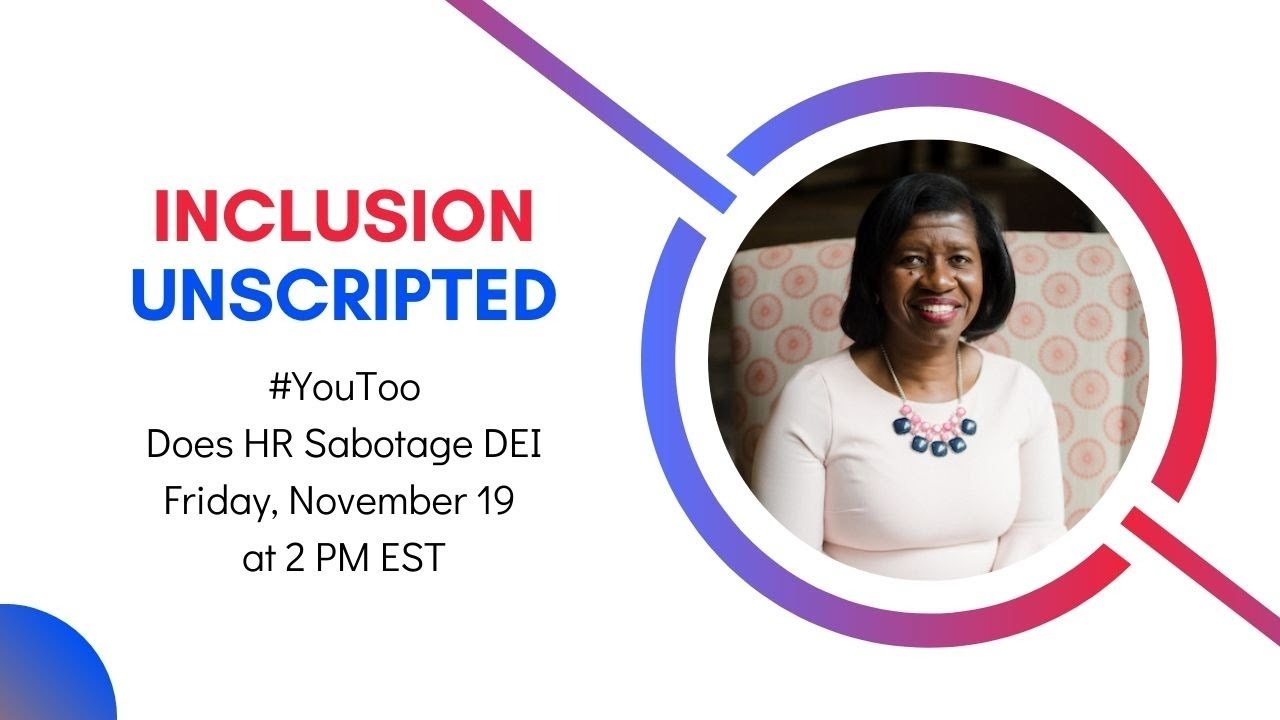
Margaret Spence tells HR professionals they need to stop talking about DEI and start actually advocating for underrepresented employees. She points out the gap between DEI policies and real outcomes, especially on pay equity, and challenges HR to ask what needs to change instead of why it hasn't.
Chapters
You're like a circle that floats around me, keeping me safe and sound. And when I fall, you tied a rope to me. You're blessing me every day. I was down with an illusion, like a sparrow with broken wings. But now I shine with your reflection on me.
I'm getting back up Hey everyone, happy Friday to all of you that are joining me live today on Insta— on LinkedIn, YouTube, and Facebook. Welcome to Inclusion Unscripted, where we have raw, vulnerable, unscripted conversations about diversity, inclusion, equity, equality, women's leadership development, career growth, all the stuff that we are afraid to talk about. We have an unscripted conversation every Friday at 2:00 PM Eastern live. And I want to welcome you to this program. If you've not been here before, my name is Margaret Spence. I am the founder of the Inclusion Learning Lab. And the host of Inclusion Unscripted. And today I'm wearing a t-shirt that says badassery. Yep, that's what I have on today. My t-shirt says badassery, and I'm going to tell you guys about that in a second and how this t-shirt came to be. So let me tell you a little bit about Inclusion Learning Lab, who sponsors the Inclusion Unscripted podcast live every week. Inclusion Learning Lab drives change through advocacy, education, and specific actions towards the greatest challenge of our time, creating a more inclusive work environment and a more inclusive world where we can all exist together. A world that we are valued for our contribution, where we are valued for what we bring to the table, We are valued for our voices in our uniqueness and our diversity. And we are allowed to have equality and belonging as a part of our growth towards this expansive world that includes all of us. So everybody's at this table with Inclusion Unscripted.
Everyone.
No one is excluded from our table.
So, Thank you for being here today.
Let me tell you, our hot topic today is you too. This episode is completely dedicated to HR, human resources managers, directors, leaders, everyone doing the work of human resources. Whether you are a recruiter, whether you are in talent acquisition, whether you are on talent recruiting, talent development, whatever your title is, HR generalist, HR business partner, it doesn't matter what your title is. Today I'm gonna talk to you. So over the last couple weeks I've been bringing a lot of different things to the table, tons of different topics. Last week I talked about the need for a chief diversity officer and how we lose chief diversity officers. But today I want to have a raw, unscripted conversation with HR. You guys, my friends, my #HR, my #HR community, you guys. So we're going to talk about diversity and the policies and procedures that you all put in place that your employees who look like me have to adhere to. And the question that I ask HR is simply this: What is your role in inclusion? What is your role in inclusion?
What should we expect from you as HR folks managing advocating for greater diversity?
What should we expect from you? But the bolder question I'm gonna ask is, what are we getting from you, HR folks? What exactly are your diverse, underrepresented groups getting from you? So that's today's big topic. That is today's big topic. Today's big topic: what are we getting from you, HR folks? Exactly, what are we getting? You know, um, today's an interesting day. I was watching TV earlier just before this started, and, um, we have the jury verdict up in Kenosha, and I'm not going to touch on that today. I'm actually not gonna spend any time talking about that, but it is impactful for those of us doing DE&I work because we always look at fairness and we look at equality and we look at all of that when we have the discussion about DE&I. But in focusing on HR, one of the challenges and the greatest challenge that I have had as a consultant is finding ways to dance with HR. You know, I'm either in a tango, a waltz, a full-on disco moment, because I'm, you know, I'm a child of the '60s, so I'm an '80s kind of gal with the disco thing, come of age during that period. Am I doing the Electric Slide with you as the HR person, or am I fighting every step of the way with you to support the initiatives fully. So the question for all of you listening to this live and listening to it as a recording is I want you all to sit back and sort of give me a clear understanding of a time. So the question is, tell me a time when you fully supported D, E, and I and you added your voice to the table so that it totally empowered me as a person who is not normally at the table. Um, tell me a time when that happened.
Right?
So tell me a time when you fully supported DE&I, you had a mission-driven process, and you headed out to make this happen, and nothing stopped your voice or deterred you from the ultimate goal of creating up, creating inclusive spaces so that your diverse employees, your underrepresented employees could feel that you are a true ally.
So I want everybody to think about that.
Think about that in the context of how should you support diversity from the HR desk?
How should you support diversity from the recruiting desk?
How should you support diversity from the talent development desk? How should you support diversity from the desk that you're sitting at that impacts me as a woman and impacts me as a diverse woman? Tell me about that, because that's the discussion that I want to have with all of you today.
Because what I am seeing out there is some HR professionals are fully vested in the process, others are lukewarm, others are giving it lip service, others are saying, yep, I'm here, but I'm not fully vested in this entire process.
I'm still trying to navigate my place, but I don't want to put my capital— I don't want to put my own capital on the line to push this forward. I don't want to necessarily, um, put my, um, full capital and my full voice to the table when it comes to greater diversity, equity, and inclusion. I wanna sit in the background a little bit. I'll give you an example of a discussion, okay? Women have been fighting for pay equity as long as I've been alive, and that's 58 years. Women have been fighting for pay equity, For hundreds of years, we've been fighting to be able to sustain our families. We've been fighting to be able to have the benefits that we need as a woman to truly show up in the workplace.
Yet HRs, we still see cases where women are not earning enough money.
Where women, every year the reports come out and say women own, earn 68% on the dollar, or they earn 70 cents on the dollar that a man makes, or we'll get the lesson that as women we needed to negotiate better for ourselves. But how about we flip that around and say, why didn't HR stand up for us as women and say, you know what, this salary is not fair because you paid John or Jake a higher amount for the same job.
See, we assume always that pay equity when it comes from women, when it comes to pay equity for women of color, for Hispanic women, for Latin women, for, for, um, for AAPI women, for Black women, we always say, oh wait, you know, we can't do anything about that.
All we can do is put out another report that says we're not getting the right amount of pay.
But who controls that process? That process is controlled by HR. By the CHRO, VPs of HR, Director of HR within organizations.
So if you're coming to tell me that you support DE&I and equity fully, then why is it that next year it'll take me as a Black woman till August to earn what my male counterparts earned by April or May?, and you will sit in the HR department and, and if you're on LinkedIn, you'll happily post the stuff on LinkedIn to say, well, Margaret and all the other Black women didn't earn enough money this period, right?
So you'll post that, but you have the power to stop it. You have the power to adjust it. You have the power to speak up and add your voice to it. You have the power, but the reality is you don't do it. So then we fast forward to the, the, when you look at the data in most of your organizations, you'll say, well, we're not recruiting enough Black people.
We're not recruiting enough Hispanics. We're not recruiting enough Asians. We're not recruiting enough LGBTQ people.
We're not recruiting Enough people. That's what we'll hear. But next year, you'll say the same thing again. Next year, you come back to the table and you do your data sets and you say, you know, we put in great policies, great procedures got put in place, but boy, we didn't have any results. So how do I, as a Black woman, trust HR? When somewhere in this process you haven't been fully allied with me? How do I trust you? How do I come to the table and say, Mr. or Ms. HR leader, you are fully vested in this? You know, when I wrote the title for this program, it's You Too, HR.
DE&I needs your Vocal presence.
Vocal presence mean your voice is in the room advocating fully for people who are not in the room. We will not get in, your line employees, your managers even will not get into the room where you are discussing the inequities within the organization. That will not happen. So how do we get you to show up more fully? What should we be asking you so that you show up fully present as an ally for us? So if I said to you, think right now at a meeting you've been at in the last 90 days where there was a discussion about equity and equality or inclusion, and you stayed silent. Think about a time when you did that.
What made you lose your voice of advocacy for me?
What made you lose your voice of empowerment for me? And what can I do to get you to show up more fully at that table? What can I do as a person who's not at the table? How do I empower you to show up more fully at the table?
What should we be doing as underrepresented people so that when we ask you to be our ally, you show up fully in the place of an ally?
So that's a question. And I don't know how to even answer that because this is the kind of question that I want you as HR professionals to start asking yourself.
It's not enough for us to go out and pull data sets around the marginalization of people in our organizations and not say to ourselves, What is the benefit that I am here in this room to offer?
What is the benefit that I'm here in this room right now to offer?
What am I offering to the people who are not represented enough in this organization?
So in this episode, we're really unpacking HR's role in diversity, equity, and inclusion. You cannot befriend the concept of DE&I and not show up fully to support it. You cannot write the script of DE&I and put out these beautiful statements and script every section of your DE&I processes, HR folks, and then expect there to be a result at the other end. What privilege do you have as HR? What privilege do you have as HR that you are willing to put on the table to support greater inclusion for the underserved parts of your organization? What does that look like? And so that's the bold question that I am asking everybody today. It's not enough. It's not enough for us to just say we are great HR leaders, we are great tactical supporters, we are great at managing the HR process without coming fully to support all of us as allies, as allies. So my question for you is, does the organization you work for have a unique and inclusive human resource practice and that is designed to help Increase inclusion.
And have you looked at that policy and said, who is this policy going to serve? And how does this policy serve these folks more effectively?
Have we had that discussion? Because I don't know that after we write the policy, after we write the diversity and inclusion practice policy, that we then have this deep introspection to say to ourselves, who is this really serving?
And is it going to give us the intended outcome that we are asking for?
And what else do we need to do in terms of the process and the people who must hand out and administer this policy? Because what I find often is that we write policies, we write them in, in, you know, in this broad context of we need DE&I strategy, we need HR strategy, we need HR policy, we need to put forth information so that there are guardrails and guardposts around what diversity should look like from the HR desk. But then do we actually go into the organization and decide that we're going to do the hard work and that HR is going to have the really, really hard discussions around what it will take to empower DE&I to actually support your underserved employees and underserved populations? Are we doing that extra work or are we stopping at the fact that, yep, look here, we've got a great policy, we have a great process, we could put out data and say, yep, we tried, we tried to make this work from the HR standpoint. We tried to recruit more Black people, more women, more Latinos, Latinas, We tried to recruit more AAPI individuals, but we just didn't have enough success. We tried though. We gave it our best effort. But here's what I'm saying to all of you in HR today.
Your best effort is not good enough.
Your best effort is not good enough. We need you to use your privilege from the HR desk to be greater and bolder advocates for us. We cannot go year over year saying the same thing. For me, I'm tired of reading the data. I'm tired of building the policy only to come back a year later and have no clear results that we can hang our hat on. Not having clear results that we could hang our hat on. You know, my team and I have been putting together a training program that we are going to launch.
We're actually going to do a series of webinars in the beginning of December to really look back at DE&I and look in the rearview mirror on 2021 Really to say to HR, what did we really accomplish this year?
What did we accomplish? Did we accomplish strategy or did we accomplish task? Did we build strategic initiatives that have long tail results or did we do tactical task-driven stuff all year? And now we're at the end of the year.
And we don't have the result that we want to have.
So I'm— we're gonna post this today.
It's a DE&I Year in Review, 2021 Through the Rearview Mirror, and it's December 2nd at 2:00 PM. And we'll post it, you'll register through Zoom for this event.
But we really want to say to all of you, we cannot go into another year We have about 6 weeks or so left in the year, maybe 5 weeks or so left in the year. We cannot take our lack of results from 2021 into 2022 and think that that is okay. I'm really challenging all of you to look in this rearview mirror of the work that you're doing for greater inclusion and ask yourself, How do I recognize when we are being successful? How do I know that what we are doing is successful?
And at what point do we need to do this retrospective review from the HR desk?
At what point do we need to look through the lens and say, hey, maybe we weren't bold enough.
Maybe the goals we set wasn't deep enough. Maybe we should be setting different goals.
So I challenge all of you to say, how is inclusion interwoven into the process, the structures, the culture within your organization? And have you walked the full process so that you could see the holes that are there because we as diverse people are exhausted. We're tired of asking you to show up bolder as allies for us. We're tired of you putting out weak, ineffective, statistically just weak goals You can't say, okay, we didn't hire enough underserved people in 2021, but we plan to hire 25% more next year. You can't do that. What is 25% more of the negative number that you have right now?
You can't say we don't know how to retain underserved people in our, work environment.
We can't say that because who is that serving? Because that's not serving us as the underserved population. That is not serving us. So if you as an HR person can't show up to be a bold, um, vocally present ally for your underserved employees, then don't pull your chair up to the DE&I discussion table. Don't pull your chair up there. Let the people who want to be bold around this mission pull their chair up to give us a voice at the table. If you are wishy-washying your process to DE&I in your organization, then Pull yourself away from that table because what we need going into 2022 is bold HR advocates who are willing to use the privilege of HR to advance us more. We are not here to create comfort zones for you as HR leaders. We are not here to create comfort zones. We're not here to create cushions around the work that needs to be done. This work is hard. It is continuous. It has to happen all the time. There isn't a point where we take a break from inclusion. There isn't a break. There's not a day where we don't get up and say, "What can I do to create greater inclusion here?" There's not a day when we should not be saying that. But if you cannot say that, it's okay, then you are not the bold advocate that we need. We have to go out now and find some bolder advocates, but it's not okay anymore for us to go another year saying that we're doing the work to advance how marginalized people are treated in the organization without effectively adding your voice and your privilege to the table. We need your voice. We need to know, HR, that we can count on you. We need to know that we can count on you. We need to ask you the bold question. Are you supporting DE&I or are you hindering the progress?
Are the people process aligned and does it fully support from the HR lens the results that we need as people of color and people who are underserved in your organization?
Or are you giving us anemic lip service from the HR desk?
'Cause let me tell you, I am personally not gonna participate in anemic HR response.
We have to fully support this. We have to fully support it. We have to support DE&I with the privilege from the HR desk because everything that happens, as I said earlier, women are fighting for pay equity, but HR controls how we get paid. HR controls how we get paid. So if HR controls how we get paid, why are we fighting for pay equity when you control our ability to earn? Your salary and compensation department is looking at salary and compensation, yet every year you get to put out the report that says Black women don't earn enough money.
And oh, by the way, we don't even get parity until August, so we're working 8 months.
And somehow nobody has called HR on the carpet for the nonsense. You can fix what's wrong in your organization. You could be the voice that is an ally. As I said in the title, DE&I needs your vocal presence. There's a reason why I said vocal presence.
There's a reason why I said vocal presence.
Vocal presence is very targeted. Google vocal presence and see what you get. It means that you have entered the room, you're using your voice and your privilege to advocate for me as an underserved woman or an underserved man or an underserved LGBTQ+ individual. You, HR, are lending your privilege and voice and your presence to make sure that in the room that you are in, where the people, process, decisions are being made, you are there to make sure that I am going to be included fully, that equity and equality is going to be standing in the presence of that room. We people who are underserved are depending on you to have vocal presence. We are not here to depend on you to be quiet and silent. We're not. So if you cannot support us fully, if you cannot lend your privileged HR status to our empowerment, then pull away from the desk and let another HR person in your team who is vocally present and committed to the success of your underserved employees, add their voice to that table. We can't do this anymore. We cannot live in a place where we're willing to put out data and statistics. Data and statistics is what we're willing to put out. We cannot put out data and statistics and then think that data and statistics is enough.
It is not enough.
We are not data and statistics. We are human beings wanting a empowered belonging experience within your work environment. That is what we want. That is what we want. We want to feel that we belong. And when we come to your office and your, your organization, and we pour our soul into your organization, that we are rewarded for being there, that we are rewarded by you pouring into our development, by you pouring into our growth. HR has to fully support DE&I because if you don't support it, it doesn't happen. We cannot do this work alone.
We can only do this work with empowered HR folks sitting at the table.
We can only do this work then. We can't do it any other way. We are dependent upon you HR leaders to say to yourself every day, what can I do to create greater inclusion here? What can I do to empower equity and equality?
What are my blinders that I'm missing about the policies that have been created?
What is the lens that I need to add to this conversation?
And how do I add it?
You know, my girlfriend sent me this shirt that I have on.
Um, let me take this off so you could see it. So it says badassery. That's what it says. And she designed this t-shirt, and then underneath the badassery is some words, and it says, the definition of badassery is engaging in seemingly impossible activities 'and achieving success in a manner that renders all onlookers completely awestruck.' And she sent this to me.
She actually mailed it.
She's in Jamaica, and she's not a t-shirt designer. She just has a company that puts out these really emboldened t-shirts, and she sent this one for me. And I'm telling you, this describes how I feel. This describes how I feel every time I do these lives on Friday. I'm here to empower and push all of you to create greater diversity and inclusion.
I want you to be an ally, an advocate. I want you to be an ambassador for DE&I within your organization. I want you to ask the bolder question. Who is this policy we've built serving?
And who is not being served by the policies we're creating? So the question is, tell us a time, HR professionals, when you fostered greater inclusion by using your voice to advocate for and on behalf of marginalized and underrepresented employees.
That's the thing.
Tell me a time when you've done that. Tell me a time. And if you haven't done it bold enough, then what I'm saying to you today is find your voice, find your vocal presence, show up in the room for us in a room that we are not in.
Utilize your privileged HR status. Because we often say, you know, there's privilege, everybody's got privilege, but there's also privilege around your job title. There's privilege around your job title.
If you're a vice president, there's a whole bunch of privilege around the vice president, unless your vice presidency is a paper tiger, meaning it mean it has no bite.
But if you are truly in a decision-making role, even if it's minor, even if it's small, add your voice. Add your voice so that people in the room have to think. You don't have to come in there and say, "This policy is awful." That's not what we're asking you to do. We're asking you to say, pretty simple, "How are we talking about DE&I?
Should we be talking about this a little bit differently?" Who else should be at this table that we should hear from before we solidify this policy? Who's missing from this table?
That's what vocal presence and advocacy means.
It doesn't mean that you stomp in there and stick a stake in the ground and say, "I need more diversity. I'm here to advocate." What we need from you is this vocal presence that forces the people in the room to think about what they're doing and why.
That's what we're asking for.
That is what we're asking for from you. Just this vocal presence that says, "Yep, I'm here. I'm here." I'd like to invite all of you to visit Inclusion Learning Lab.
And join our community.
Join our community, attend our webinars, um, come back on a Friday to sit and listen to me for 40 minutes. Um, I appreciate all of you that showed up today. Um, we've got some comments, um, and thank you, uh, Donnell, uh, for saying, I found my voice in my previous position. I wasn't in HR. I was promptly told to tone it down. That I was being too bold by executive leadership. And this is what happens. This does happen.
But here's what I would say to you.
Because someone says to tone your voice down doesn't mean that you go silent. See, here's the boldness.
You don't go silent.
You reframe. You ask the question and let it sit and walk away. You ask the question, "What could we be doing to support our diverse employees better?" And then you just be quiet. Because every time you drop a question on people, it forces them to think. See, sometimes they will silence us because they don't want to hear the boldness of our discussion. But here's what I know. When you ask bold questions of people, they can't unhear the bold question. See, even when we are entrenched and even when we don't want DE&I in the organization, you can't unhear the question that is asked. You could pretend that you don't hear it, but you can't unhear it. You can't say, "Well, I didn't hear that question." So sometimes the question is, who is this policy serving? And that's it.
That's it.
Because now the person who heard that is gonna go, hmm, this policy is serving us.
Okay.
And the follow-up is, what could we do to be more inclusive?
Because we often have to fight the fight without chopping the whole tree down.
We have to fight it without chopping the whole tree down. And, and silencing—
when people tell you to tone it down, it's their own uncomfortableness, not yours.
I want you to hear that. When people tell you to tone it down, that is their stuff. Not yours. Don't take it on because that's how they silence us. That's how they cut at our empowerment and they shake our voice. So all we have to do is reframe and come back. Reframe and come back. And oftentimes I will say to someone, tell me a time Tell me a time when you created a policy that our underserved employees fully embraced and was able to benefit from. And just drop that right there.
Tell me a time when you did that.
And normally now they can't answer the question. Because they've never done it. But you've landed that airplane right in their brain. You've landed it fully. They cannot unhear or pretend because now they're going to start questioning themselves. And if you continue to ask those bold questions, then that is what ends up happening. So thank you for that. Amazing question. And thank you, Catherine, for being here. Um, R and Michelle, um, thank you for being here as well. And Keith, thank you for being here. Um, for all of you that are supporting me on Fridays at 2:00 PM Eastern, I am really appreciative of you being here. So what I want to leave all of you with is a real thought, a thought, which is how can you support DE&I with a bolder voice? What are the questions that you need to ask that's going to get people to think in your organization? What are those questions? Here's what I know as a person who's been trained as a coach. When you ask a question, try to start with "what," because if you start with "why," people get to build a story. When you say to them, "What are we going to do to help women earn a higher salary here?" It's a whole different conversation than you saying, why are women underpaid in this company? Because when you come with the why, the defensiveness builds and they get to be defensive, and, and then they don't— they shut out the work that they have to do. So when you come with what, right? When you come with what then they are now having to say, okay, what's the what? What is the what here? How do I figure out what?
I don't know the what.
And they'll either inquire more or they'll wait for you to come back with another what question. And that is the key. That's the key to moving the bar. That is the key to moving the bar. What can you do that we haven't done before to create greater inclusion? That is an amazing question.
That's a great one.
What can you do that we haven't done to create greater inclusion? Now, if you think about that, the person has to think. Before they can shoot you down and say, nope, nope, we're not doing that. You're just being too bold. You're just being too bold. You're just being too bold. So I want to invite all of you— we're going to post this to LinkedIn today— um, to join me on December 2nd at 2 PM for DE&I Year in Review: 2021 Through the Rearview Mirror. We're going to look at what worked, what didn't work, what results we thought we had. We're also going to look at how we underestimate the resistance within organizations for real substantive change. We're also going to talk about how do we transition organizations rather than doing radical surgical change. How do we transition them from where they are to where we want them to be. Specifically designed for HR talent leaders, this program is really a deep introspective workshop that we're going to do. And we are going to do this in a town hall type setting where you are able to offer input into what this should look like and supporting the other folks doing the ENI work. We'll have some paired activities that will be a part of this program on December 2nd. So December 2nd, 2:00 PM, um, join us. It's going to be a Zoom program, not live on LinkedIn. And join me again every Friday at 2:00 PM here, live on LinkedIn, um, YouTube, and Facebook, um, for Inclusion Unscripted. And I am so appreciative of all of you that joined live today. Your voice, your voice is needed, and your vocal presence, HR, is needed at the DE&I table. Never forget that the reason you're in HR is to impact the people, not necessarily always the process. It is not about the policy. Policies don't show up to do the work. People show up to do the work in your organization and people want to be empowered. They wanna be seen, they wanna be heard, and they wanna know that you are a vocal ally for us, the underserved individuals within your company.
So thank you for joining me.
Visit, um, Inclusion Learning Lab and sign up for our newsletter, and I will see you all again Next week, um, actually we're gonna be here Wednesday instead of Friday because I know all of you gonna be doing your Black Friday shopping. So we're gonna show up on Wednesday and we're gonna do a program late in the day, um, on Wednesday. So please join me here on Wednesday instead of Friday next week.
You're like a circle that floats around me. Keeping me safe and sound. And when I fall, you tied a rope to me. You're blessing me every day. I was down with an illusion, like a sparrow with broken wings. But now I shine with your reflection on me. I'm getting back up on my feet. That you showed up was








