E9 – DEI Stands At A Fork In The Road, You Must Try Harder
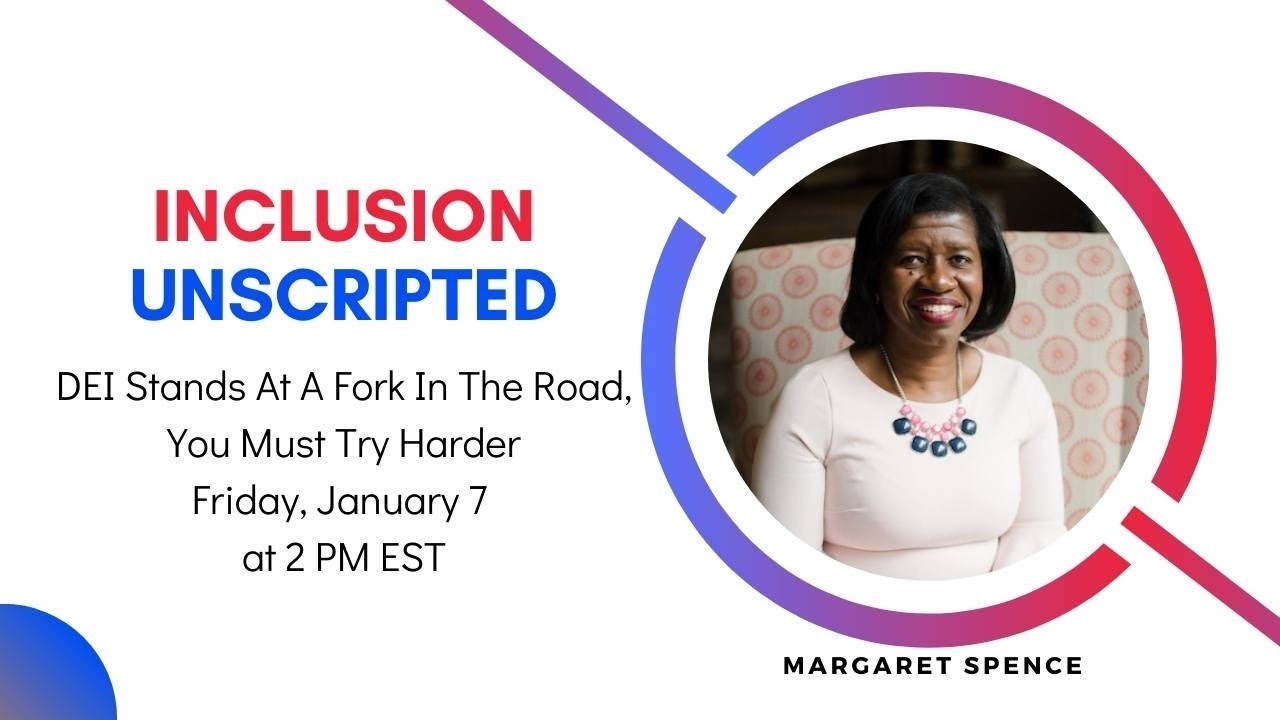
Margaret Spence opens Season 2 declaring 2022 the "Year of Possibilities" and argues DEI is at a fork in the road. She identifies ten micro-barriers blocking progress: lack of trust, missing honest conversations, fear of speaking up, uncommunicated results. Leaders must try harder to surface blind spots and align actions with values.
You're like a circle that floats around me, keeping me safe and sound. And when I fall, you tied a rope to me. You're blessing me every day. I was down with an illusion, like a sparrow with broken wings. But now I shine with your reflection on me.
I'm getting Hey everyone, happy Friday. Um, I think we could still say Happy New Year to the live cast is on, um, YouTube, Facebook, and live. Haven't joined me before, we took hiatus right after Thanksgiving, so thank you for today. Um, a little internet issues, so I'm hoping this will work for the 45 minutes, but if not, we'll see what happens. So Inclusion Unscripted is a live podcast that occurs Fridays. We alternate between 1 o'clock and 2 o'clock Eastern time. And basically what we're here to do is to ask some bold questions about diversity inclusion. Have you ever said to yourself, I want to just say what needs to be said without worrying about consequences or people thinking I'm saying the wrong thing or offending the planet because I've said it. So Inclusion Unscripted doesn't have a script. I don't write a script every week for this program. I come up with a topic and then we talk about that topic. I engage with the audience that are joining us live, and I'm so happy that you're here today. So what is our purpose? We're here to co-create an inclusive voice for everyone. We're here to co-create spaces that allow for inclusion. We're here to give everyone a voice, but we're here to tackle tough subjects that are often overlooked or smoothed over because they're uncomfortable to have. And uncomfortable conversations around diversity, equity, inclusion, women's leadership, the progress of people of color in the workplace is not easy conversations to have. What I figured out since we started this and over the last year is that the more I dive into the uncomfortableness, the more there is pushback. There's often a lot of microaggression that goes with when we find our voice. There is a lot of pushback and people get uncomfortable because we found our voice. But here at Inclusion Unscripted, we are here to find our voice. We are not going to be quiet. We're not going to be silent. And so this is season 2 for us. We did 10 episodes in season 1, and this is season 2. So I'm super excited to be starting season 2 with you. So let me tell you a little bit about me. If you don't know who I am, my name is Margaret Spence. I'm the founder of the Inclusion Learning Lab and the Employee to CEO Project, where we work to create inclusion within corporate spaces. And we also work to empower women, specifically women of color, to manage your career more effectively. And so we have a lot of programs we're gonna be launching this year. I'm super psyched about 2022. I'm excited to see how I'm going to take the Inclusion Learning Lab. We have launched officially the Inclusion Learning Lab community. It is called the Inclusion Cafe, and we will put out some things on social media about that in the coming weeks. So this week's topic is a fork in the road. DE&I stands at a fork in the road and we need you to try harder. Um, it is a fork in the road because I don't know that we have fully addressed the racial tensions that occur, not only personally, but in our workplaces. I don't know that we have pushed against the grain enough to build effective DE&I programs that show results for people of color and underserved groups. And I'm not sure that we're trying hard enough. I honestly feel that everyone is staying in their safe zone. It's safe, to not do as much as we need to do. It's safe to create long-term strategies and not immediate results. It's safe to not call people out when they are doing things that we feel is not appropriate. It's safe to create cocoons around diversity, equity, and inclusion. And so because this is such a hard topic, it's such a hard process, um, it is so ingrained, um, in what we do that I feel we need to ask ourselves to do more. So I have declared 2022 the year of possibilities, declared everything that we do this year be it through the Inclusion Learning Lab, be it through my own personal growth, be it through the work that I do with women in organizations, this year is built on possibilities. I've been asking the question, what's your possible? I'm going to ask the question from a DE&I perspective, from the lens of diversity and inclusion. When we are at our best, And let me start again. When we are at our best, what is possible for us? And that's a hard question. That's a question that requires a lot of us to think because organizations don't always operate at their best. We operate because we're a humming machine and we don't stop long enough to ask ourselves, when we are at our best, who are we? And when we are at our best, who do we wanna become? And when we are at our best supporting diversity and inclusion, who are we when we are at our best? Who are we? Do we accept our role in the inclusion process? Are we inclusive or do we create fallback positions that we're comfortable with? Do we disenfranchise others as we say and claim we're holding their hands and building progress? Do we do that? What do we really do when we are creating progress? And, and when we are at our best, when we are supporting diversity and inclusion, what is our shadow behavior that shows up in that lens? What's the shadow behavior that shows up for your employees? What's the shadow behavior that show up for your teams? What's the shadow behavior that shows up for your friends and colleagues? What is that shadow behavior and what does that look like? Because one of the things that I learned from Maya Angelou and listening to her talk and her teachings, when people show you who they are, believe them the first time. Don't believe them the second, the third, the fourth, the fifth time that they've done things. When an organization shows its minority and underserved employees that you don't value them, that you don't value their voices, that you find ways to exclude them from the table, you are basically showing them who you are over and over and over again. But what 2021 showed organizations is that for us, for me as a woman of color, I have found my voice. My voice doesn't have to resonate the way you want it to resonate. My voice is now purposeful. It is being, it says what needs to be said and it is empowering me to step into my purpose. See, we have often gotten used to people accepting what we dish out. We've gotten used to people accepting what we dish out. For our white counterparts and our organizational counterparts, your employees have gotten accustomed to what you dish out. Think of it this way. You go into the kitchen, you make a meal, and you decide there's chicken, there's rice, there's steak, there's pork, there's vegetables, there's a beautiful cake, a beautiful pie. Employees have gotten used to us deciding what part of that meal they get to partake of. And when they decide that they want the entire table, we get scared because they want the entire table. We get scared. So the anxiety that we feel, the anxiety that diversity and inclusion creates is something that organizations have to address. We have to address the anxiety that people are feeling around diversity, equity, and inclusion. We have to address the anxiety that people are feeling around equity and equality. And we have to address the anxiety that you feel when we find our voice, when we ask for what we want, and when we check you when you do something that's inappropriate. See, that voice is the one that creates the most anxiety when we push against that grain. So at the fork in the road for diversity, equity, and inclusion, we can decide in 2022 that we're going to do things as we've always done them, that we're going to slow roll the process, that we're going to not feel empowered to make bold steps and bold moves, that we're gonna take it easy, that we're going to stretch the goal, build the vision, create the mission, and expect our employees of color to hang with us. I think what we've learned in 2021 with the Great Resignation is that your employees of color aren't willing to stand with you. They are resigning. They're starting their own companies. They're deciding what quality of life looks like. And so we get a little stressed when people make those decisions. So there's some fundamental questions that I want all of you to evaluate. When it comes to diversity and inclusion within your organization. The first one is, what is the pressing issue that your employees are questioning about your commitment to diversity and inclusion? What is that? What is the pressing issue? Are they questioning how you recruit talent? Are they recruit— questioning how you develop people? Are they questioning opportunities? Are they questioning how you advocate for them in the workplace? Are they questioning that? And I don't know that we ask that question. What are your employees thinking that they're afraid to share with you? Let's start there. What are your employees thinking that they are afraid to share with you? What does that look like? And so are we asking that question? What are my employees really thinking? And this doesn't only apply to diversity and inclusion. It applies to everything. Your employees are often thinking about things that they're not sharing with you. They're sharing it with other people. They're sharing with their friends and family. And because they're afraid to share it with you, they will leave and you will be shocked when they're walking out the door. And so I think as leaders, even if we're not addressing diversity and inclusion specifically, we need to, we really need to tap in to what employees are thinking, what are they feeling, what are they anxious about that we may not be addressing? We need to tap into that and we really need to address it. The other question is, and this is just a general management question, it's not even DE&I. Some of these questions are just general management questions. Can your employees trust you to follow through when you make a commitment to them? This is a general question because oftentimes we disconnect our patterns of behavior from DE&I, or we connect DE&I without addressing our patterns of behavior, our mental models that we've already been accustomed to. So let me explain mental models to you. Your employees have gotten accustomed, at least within 6 or 7 months of starting to work for you, They've gotten accustomed to who you are because each time you show up, they build a mental model of who you are. Your diverse employees are also building mental models about their own value within your organization. And so they're asking themselves, can I trust you? That's the first hierarchical question that your employees ask. Can I trust you? Even with minor, tiny things. If we don't have trust with employees at the very beginning, then we will never have trust with the entire process. So we try to lay DE&I on top of an organization that has trust issues, and then we say we want to build DE&I. But the reality is, if you have a trust issue, you can't build DE&I. So this is where I say we have to try harder. We have to try harder to uncover our blind spots and uncover the things that are affecting us at the lower level before we start piling on the diversity and inclusion stuff. Because diversity and inclusion is sort of dressing up for a party that you haven't been invited to. But the party is already going on with all the stuff and all the people. That party's already underway. And then you throw, you bring in this really dressed up diversity and inclusion person in the room, but the party was already going and the party had a lot of issues, but we don't really want to discuss or fix the underlying issues, but we plop diversity on top of the underlying issues. And that's what I'm trying to shake you free from. That's where I'm trying to say what is possible moving forward. And yes, I agree, a golf game. Perfect, Lauren. Thank you for popping that in. Yes, similar to a golf game. So the question is, what is the seeing and doing gap within your organization? What are people seeing And what are you really doing? And what is the gap between the seeing and the doing? And what is the gap between the actions and the commitment? And this is not DE&I, this is straight up management. If your employees see a gap between what you're doing and what you're saying, then they learn not to trust you. Now, if I'm diverse, I have a whole nother set of trust issues that plop in there. Right? But we Ambitions, your, your to have greater Okay, let's see if we could try this again. I think I'm back live. Yes, I think I'm live. My internet is acting crazy, so I apologize. We're, we're bugging out a couple times today, um, and it's been going on for all day, so I'm hoping I can hang at least for an another 5 or 10 minutes and then I'll end the program today early. The question is, what have you failed to connect your actions with a solution with trust when it comes to diversity and inclusion? But in general, as a leader, have you failed to connect trust, inclusion, and actions together so that your employees really see who you are and that you are truly supporting them. What are the investments that you've made and what are the results that you've seen? We all invest in DE&I, but we have to really begin to communicate results to employees. A lot of you are doing great work, but you're not communicating that to employees so that they see that your great work is actually Helping them. The great work and your intentions and your actions are underway. So in order for us to try harder, we have to try harder to communicate better. Communicating better is an essential piece of what we have to do. And are we failing at DE&I or are we being successful? And that's a check-in question that we should be asking All of our leaders, are we failing at reaching our employees, or are we truly reaching them so that they feel welcome, empowered, included here? That's a question. And those are management questions, right? Those are management questions that we have to ask, right? But they are D&I questions that we have to hone in on. And are we acting in the best interest of our people? Are we acting in the best interest of our people? And that is the question. Are we acting in the best interest of our people? Or are we just doing things to do them? That's a question. So I want to go over sort of 10 micro barriers to DE&I success that should help you think more. So let me go through the 10 micro barriers to DE&I success. And these are leadership barriers as much as they are DE&I barriers. So before my internet quits again, let's try this. The first one is the lack of trust between teams and leaders. The lack of trust between, um, your at-risk underserved employees and the organization. The lack of trust and the individual lack of trust within your minority population. Do they trust you is the question. Honest conversations about respect is missing from the commitment to inclusion. Real honest conversations. How can I respect you more? What do I need to do to empower respect on my team? We often do team building things, but we really should do things on respect. How do we make that happen? We should have, um, address our focus and how we communicate with our stakeholders. Are we How are we core values that everybody could wrap around? Core values in diversity. What are those doable values that every— on a level that our value— we believe— permeates through our Ecosystem, we believe in the following words. This core value is going to keep us together, and it is the glue that allows us to foster inclusion, diversity, equity, and equality. If we don't have core values ironed out, then at a micro level, then we cannot really create trust and purpose and position and all the things that's needed. To foster inclusion in the workplace? Are your senior executives committed to working with the teams and providing ongoing direction, not just one-time direction, but on direction? If you are an executive, are you providing ongoing direction around the core values of diversity and inclusion? Those core micro-values. Are you continuously going back to those core micro-values and saying, "At our core, this is who we are," and then saying to your team and your leaders and your direct reports, ask them over and over and over, "When we are at our best, who do we want to become? When we are at our best, who are we?" When we are at our best and most inclusive, what will this look like? Really having those core conversations. We have to address fear. We don't often want to talk about fear. People have fear about diversity and inclusion. It's, are you coming from my space? I have fear about discussing D&I with my employees. I don't wanna say the wrong thing. There's a fear that we have to address with our leaders because we can't foster inclusion if people are afraid to have hard discussions. And also if they're afraid of getting it wrong, we will, let me pause. Diversity and inclusion is not perfect. It will never be perfect. If we are looking for perfection, we're doing the wrong thing. It's not gonna be perfect. It was never meant to be perfect. Diversity and inclusion is an ongoing evolution. We will make mistakes. We will get it wrong. We will say the wrong thing. We will get upset when somebody says something to us. But if we are inclusive, we step back and we say, hey, Maybe that person's position is correct because it is their lens that they are coming from, and I shouldn't be offended because it's their lens. What I can do is say, how do we move forward together from here? We don't get offended and defensive when people say, I don't like how you discuss that with me. That's a part of this process. It's a part of the dance. It's a part of the party. It's a part of the process. If we don't address at a micro level dashed expectations and failed promises when we try to build diversity and inclusion, people are always sitting back saying, "Can I trust you because you failed me in the past?" So in order for us to empower greater inclusion for women, for people of color, for the LGBTQ community, for any underserved group in our midst, we have to address dashed expectations and failed promises. What did you promise that you didn't deliver? What did you promise that you didn't deliver? And can I trust you now that you realize that you didn't deliver for me on a promise you made? Can I trust you? That's what your employees are thinking. But some of this is core management. It's not D&I, it's core management. If you have failed expectations and failed promises and you've not shown up the way you should for your employees, and they feel that you fail them. Now you come back and you ask them to trust you. Will they trust you? Why would they trust you is the other question. Why would they trust you? What would make them trust you? And the last one that we have to address at a micro level to think bigger is the anxiety of the majority. We have to address it. Diversity cannot exist if the majority is anxious because we need everyone. D&I does not exist in a silo. We need allies, friends, and even people who don't think it's necessary on the team. We need people that we disagree with on the team. We need people that don't, at their fundamental core, support D&I at the table. Because will we change their mind? Maybe we will. Maybe the work that we're doing towards greater inclusion will help them see that inclusion doesn't threaten where they are. So there is a fundamental core 10 things that we have to address: lack of trust, honest conversation, limited focus on how we communicate with stakeholders, unclear direction, okay, senior executives haven't committed to working it through continuously, ongoing, all the time, HR leaders and leaders who have position are afraid to confront behavioral changes that need to happen, lack of appreciation for the process. And here's a big one, not saying what we are doing well. You know, oftentimes when we do D&I, we focus on all the things we're doing wrong. What are we doing well as an organization? And how do we build on the things we're doing really well so that we are supporting our employees across the board. Because if we do talent management well, diversity and inclusion will be fostered. And yes, Lauren, thank you for that. People who are in the room when we are not, giving us voice and being able to say, I'm in the room, I agree that We need greater inclusion, but really using your voice in the rooms that we're not in to say, why don't we have so-and-so in this room? What would it look like if we invited these people in? It doesn't threaten our position. So these are core fundamentals. So what I want to say to all of you today, for 2022, it is the year of possibilities. Anything that you're currently doing as a leader, as a diversity and inclusion advocate, as an ally, as a friend for inclusion, for women's development, for women's leadership, I want to say to you, you can try harder. You can do more. There is a lot more possible if we get out of our own way and push ourselves out of our comfort zones. Renew the actions that we've committed to. Renew the actions that we've committed to because your employees need you. We need you. Those of us doing this work, which is super hard, we need you. So try harder. The fork in the road allows us two opportunities: continue to do what we're doing or work harder to create greater inclusion for everyone. So thank you all for joining me today. This has been a good kickoff to 2022. We have a lot more programs coming. Next week, I'm going to talk about internal recruiting of diverse professionals. Internal recruiting. How do we get internal candidates positioned and ready to be recruited for our positions. What does that look like? What's the dynamic? And some of it is not just getting them ready from a content standpoint, from a building their resume, it's getting people ready mentally so that they are ready to be promoted. Because I may not, you may think I have potential and I have a lot of possibility, 'cause again, this is a year of possibility. But I may not be mentally thinking that I'm ready. So how do we empower, especially women from a mental standpoint and diverse women who may not see a person that looks like them in leadership, how do we get them ready mentally to say, yep, I can be that person even if I can't see that person in my thought process. So remember, 2022, the year of possibilities. Thank you again. See you next Friday at 2 PM Eastern. Take care. Have a wonderful week ahead and happy, happy New Year. Wishing all of you continued success in 2022.
You're like a circle that floats around me. Keeping me safe and sound. And when I fall, you tied a rope to me. You're blessing me every day. I was down with an illusion, like a sparrow with broken wings. But now I shine with your reflection on me. I'm getting back up on my feet. That you showed up








