Matriarchal Leadership and Future of Feminism : Matriarchy Times Women's Day Discussion
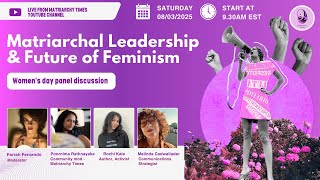
A Matriarchy Times Women’s Day panel (Mar 9, 2025) featuring Melinda Cadwalader, Rochi Kai, and moderator Poornima discusses how matriarchal leadership can be cultivated through communication and experiential learning. Melinda grounds matriarchy in communications, agency-building, and Kolb’s whole‑brain experiential learning (why, data, practice, creative adaptation); participants link repression under patriarchy to physical/mental health harms and describe writing, journaling, and pop culture (e.g., Taylor Swift) as practical outreach tools to introduce feminist ideas.
Chapters
No, I'm sure it would be fun. But we'll see when I come.
Yes, please come. I don't know if it's possible, but, Melinda, if you want to visit too, you're more than welcome.
Oh, it is a dream. That would be a dream of mine to visit.
Have you, like, do you know about Sri Lanka? Like, we are like one of the top 10 tourist destinations for the past five years.
Yes, I did read about that. I also did a study. Oh, yeah.
We're live now. Okay, we're live now. Ladies.
Good evening, everyone, or good morning wherever you are in the world. Very happy Women's Day to all of you from Matthias Times. So today we are here joined by two very special guests. We have had them with us before and they have inspired us with their knowledge and their vision. So we are going to have a discussion with them today where they will shed more light on their subjects and hopefully they will help us to understand matriarchy more and also to help us to grow our knowledge as well. So we have Melinda and from the usa, and we have Rochi from India and also Poornima, our very own moderator from SRP Times who is in Sri Lanka. So this starts a round of introductions. I'll ask my guests to introduce themselves so that they can tell you a bit about their background and their interest. Melinda, would you like to start as well? Sure.
My name is Melinda Cadwalader and I AM in the US we recently just moved across the US 2000 miles from Idaho to Georgia on the coast. And that to me was a very matriarchal move. My background is in trades, industry, education, and adult learning theories. I've taken that in different teaching opportunities and then I've started applying it to different life scenarios. So how the learning process itself can become a process for women to actually process their experience and adapt and change and transform their own life. I have a master's in communications leadership, and I apply that communications leadership theories to the subject of matriarchy and looking for ways to practice everyday matriarchy. And that is my contribution to this Matriarchy Times is to consider all the ways that we can daily live out a sense of matriarchy that that can grow and develop and become part of a bigger, more global collective of matriarchal societies.
Okay, that's looking forward to hearing about that from you today. And now can I hear from Rochi?
Hi, my name is Rochi Kai. I'm from India. I have written one book and I am working on my another book which will be my Debut novel. And I currently live in Delhi alone. So I think that's matriarchal, because I live alone. And I. I believe that books and. And words. And when we. When women write and when women read, I think that is power to change a lot of things, I would say power to change the world, because everything begins with ideas. And I try to. And I try to make more women read, more women write. I feel like. Yeah, I feel like that is. I have made that my agenda. I want all women to read a lot of books, have ideas, know about the history of women, so that we can move ahead. Knowing about the history.
It'S for us to know where to go. It helps to know where we came from. So I know from the last time that you spoke with us and you told me about female authors and how we should focus ourselves on reading female authors, I actually took your advice and I started reading more books by female authors. And I found that what you said was really true. Like, when men write about women's perspectives and, like, men are trying to write like a woman is thinking and a woman is talking, there is a huge difference when a woman writes about it. Like, a major difference, which I didn't notice before you pointed it out. So thank you for that. So now I'll tell you the book that I actually read later. I think you'd like it. So now we have Poornima, who is part of Matriarchy Times, a moderator, and also she's in charge of many of our community outreach programs as well. Poornima, would you like to introduce yourself?
Hello, ladies. My name is Puruna, and I'm a community moderator for Matriarchy Times. I joined Matriarchy Times about a year and a half ago as a content writer, but these days, you can catch me on discord, and I am utterly fascinated by the concept of matriarchy, and I am in awe of all the smart, amazing women I get to meet because of it, and that's why I'm here. And for me, matriarchy is justice. It means justice for women, and I'm looking forward to learning more about how we can get there.
Thank you for that. Okay, so we'll get. So we thought of starting with Melinda because she's going to tell us about communications as the pathway to matriarchal leadership. And what we do at Matriarchy Times is we are always communicating through our discord, through our social media, through our podcast. We're trying to communicate the message. So I think Melinda will shed some light on how communication is going to help us to achieve our goals in future. Please, Melinda, go ahead.
I think going back to real quick, something Roshi said and you said about when women write books, I discovered that that's what kind of like this light bulb came on with the idea of matriarchal leadership too. When I was researching leaderships, communications, leadership studies, all of these leadership theories that were written by men with PhDs, but it was their concepts of leadership seemed to be coming from the practices of a woman's lived experience. And I was so shocked. One of the ones that I studied was adaptive leadership. And it was literally the process of going through difficult things and then learning from it. And it felt like they were describing, like when a woman gives birth, like the pregnancy and bringing something to life and hosting these life giving qualities. And I felt like, shouldn't a woman be writing about this from her lived experience? And so even just those things in communications and leadership theories that I've been studying for the past decade, there is just so much masculine influence that the feminine influence comes off as soft skills. When really communications has been considered a soft skill. It's something the secretary does, it's something that the CEO hands off to usually administrative women. And really what we're finding is that communications is a strong suit. It's been called a soft skill because of masculine terminology, because soft is weak, it's less important. So that way it can be construed as something a little bit less valuable in the sense of leadership studies and communications. So we're looking at ways to really turn that around. But what the research is showing is that communications is rooted in a sense of agency. And agency is the right and the freedom and the power for people to think, think and behave in ways that are their own choosing. That is your agency. And everyone is born with that. But women especially are born into these societies and cultures and conditioning that over time atrophies agency. It's an arrested development. We young girls there, you know, there, there's that meme of don't call her bossy, call her, you know, say she has leadership skills, skills. But that's the conditioning of society. So matriarchal leadership in the form of communications and speaking is taking these thoughts and ideas, everything Roshi's talking about, like us reading and understanding where we came from and the way that we're processing it, that we're speaking it out, we're releasing it from inside of us and we're taking ourselves on our own process of hearing our own voice, hearing our own ideas, and then editing in the moment, in real time, and then taking what we're learning by our own hearing and listening and changing ourselves and changing our world around us. In trades education, the main adult pedagogy is experiential learning. Experiential learning is able to bring a diverse group of people together, different ages, different backgrounds, different socioeconomic status, and bring them into the same room and help everyone understand a piece of information. And so what experiential learning does is it connects the heart, the mind, the body and the human spirit to education, to some piece of a lesson that we're learning. That alignment, I have found, is what connects women to themselves. It's taking one piece of information and making sure that is it aligned with your values, your heart? Does it align with your mind and your intellect, the research and the data, does it align with practical application in your day to day life? And four, does it align with your human spirit? And can you adapt it in some way to make it your own? So that process of experiential learning is a process. And when we say women need to process trauma, we need to process our life experiences, that doesn't mean we're going on a silent retreat or we are ruminating, or we're just sitting with something. It means we have to take that experience and bring it through a process that teaches us something. And then when that lesson comes to the surface, when we need to commit to an adaptive sense of living that change out in the world. So matriarchal leadership has become, what I'm writing about is this process of learning for women themselves. Since a young age, girls are told to listen to their fathers, then listen to their teachers and their pastors, and then their husbands and then their bosses. So we've done so much listening that our agency to think for ourselves has atrophied. At least I know this for women in America, that it is such a patriarchal culture. I call it late stage patriarchy, where there's several, there's several generations now of women who really don't have that thinking for themselves skills. So experiential learning is a simple four step process of taking information and bringing it through our mind, our, our body, our heart and the human spirit to live it out in a way that best suits ourselves and our families and our communities. So that's kind of where I'm processing matriarchal leadership as an everyday matriarchy. I think it is books and reading and learning. I think education is crucial. I also think women need to understand their own values, not from somebody else's book, somebody else's playbook on life, somebody else's religion or a man made religion. It's really just getting in touch with your own spirituality. Women also need to learn how to do your everyday matriarchy in the small tasks. For us, it was moving 2,000 miles away from a culture and community that was not a healthy place for women and girls or my children. So we do what we need to do. That's what the elephant matriarch does. She leads her family wherever they need to go. And sometimes it's days upon days of no water and no food. But everyone in that tribe trusts her to lead because they know that she has their best interests in mind. And that's what that power of everyday matriarchy can be. It can be changing jobs, it can be changing neighborhoods, it can be reading a book, it can be actually hosting a book club after you've read the book. It's all of these everyday things that I think become these little clubs and these little fun self care things. But they can be everyday matriarchy if they're intentional and if they're educational and if they're creating a process for women to think, take themselves through their own process of learning and then give an output, a response to that information in the way of action, a change in thinking, a change in habits, change in behaviors. And that's where collectively I think that power lies. And that's the research that I am still working on and putting together. It's experiential learning theory, I think.
Yeah, you made me think about a lot of things. I think communication like you mentioned, like we have been taught to listen, like we are not allowed to respond in many situations. We are just supposed to listen and follow instructions. And that is the way of the Patrisha community. Like, you listen to me, you do what I say. And women have kind of lost their spirit, lost their ability to kind of communicate what they're feeling. Like even a woman who is feeling hurt, who has been abused in some way doesn't feel like she can communicate what she's feeling or what she went through because she has never been given that option.
Right.
She has not been allowed to kind of say, you know, this happened to me, and have someone listen to her. I think on the other side of communication is there should be someone to listen to you and someone to understand what you're going through. Understanding is also a weak point in the patriarchy, I think, because I feel like many patriarchal people have a victim mentality. Like as soon as you try to tell them something, they try to find. Like, why are you blaming me? Like, are you blaming me? Is this my fault? Is that what you're trying to say? I mean, so learning about communication would include finding ways to express yourself, plus being someone who can be a receptive person, someone who can listen as well.
And that is the full circle of communication.
It, it.
Listening is communication. It's a form of communication, but it's not the end, it's the beginning. And there has to be to that stimulus of listening, there has to be a response given, otherwise it's incomplete. So that's where a lot of patriarchal thinking is that speaking command, it's military, where when you think of maternal, it's. There's a stimulus and there's a response, but without that response, it's military and militant. And that's where it seems to stay in patriarchal societies. And women have gotten that atrophy of not feeling comfortable responding, not knowing how to respond, not given the space to respond. There's so much where that response is waiting to have a place. And that is, that's what we're trying to build is more space for women.
I think it actually manifests in women as autoimmune diseases. I've heard that women are more prone to developing autoimmune diseases later on in life because of all the internalized stress, like not being having a place to be free, to be safe. I think not being safe is also something that happens when you don't have someone to communicate to. Like, you feel you're alone, you feel trapped. And I think Rochi really knows about this subject as well. So I think she wants to say something. Rochi, please, go ahead.
I mean, I obviously don't know as much as her because she's developing a theory which I think is amazing. And I just wanted to talk about how experiential learning. I feel like I did that in my life because I grew up listening to a lot of women, especially in the grooming set area. Because I remember when I was very young, women around me were dating a lot of older men. But I was listening to the feminists online and there was a huge deal about not dating older men. And you should just stay away, just stay away. No friendships, no dating with older men. And I feel like, I feel like, because I listened to them and their experience, because they were talking about when they were younger and when they were younger adult men or very, very old men would hit on them and stuff like that, I think I learned. And because of their experience. And because they said it out loud, I learned. And then I was safe from that. And I would tell my friends, no, you should not do that. But because it was not my experience, they would not listen to me. But then I would show them. See, this woman said when she was 17, this happened. And so I think just because there were women who were talking about their experience, I think only that saved me lot of my friends. So what you were talking about learning from experience and talking about it, I think it is so, so important. And one more thing, like you said, women develop autoimmune diseases, right? Because they're so repressed. So there's this thing in India. There are few temples in some small parts of India there. What happens is they. Do you know about the like women get possessed thing that happens in India? Like yes, women get pos. Possessed and then they behave in a certain way. I don't know what to say it in English, but I have a very, A very weird name in Hindi, so I'm not going to say it. But like women get possessed and then they act very weirdly and people say there's some gin on them, there's some bad spirit that has come on them. And in that. And in those places there, they treat people like that. But 80% of the people there are women and women who, who are married, have kids, they did not have career of their own. So I'm assuming they didn't get. They didn't get the chance to speak, to learn. They were married off young. And when. And when all of that repression just took over them, I think this happened. It. There are YouTube videos and there are news reports about them. This is not very popular outside India, I think. But yeah, this happens. And the reason I was interested was because more there were victims were women over there of this spirit thing. Most victims were women. That is what interested me. And the just the thing that they are the women who can't speak, they are the women who don't, who are just housewives. They cook food, food for people. I. We can assume they don't. They don't get to speak that much. They have no personality of their own. And I just think, I just think all of that repression just bursts out like that one day and then they are called mentally stable and spirit and all of those things.
So it's not actually a possession situation. It's more like these women are just exploding with tension.
That is what I feel because I don't believe in possession and stuff like that. But I also feel like why 80% of the people are women? Why. Why is. Why are the spirits only possessing women.
Demographic? I'm not 100 sure about this history, but do you know anything about witchcraft and why women were considered witches? I think that has some connection to this also. Like the women who were speaking out and women who are independent were suddenly witches and they started burning them. And I think this is some similar situation.
Yeah, you can. Yeah, but it is, it is, it is what it is. The repressed women, this, these are not women who are. Who are trying to say something or who are in. I won't say they are not intelligent, but just the women who have been repressed so much that they cannot, that they cannot oppose it in any other way. I think it just comes out like that. I'll share. I want to watch it. You can put in, put it in the link if you want news channels on, on these topics. And psychologists have also spoken about it, about, about why. Why there. Why 80% people who come in these temples are women. They also have analyzed in it in that manner only that they are very repressed and stuff like that. But yeah, I feel like, like you said, autoimmune diseases, I think mental, mentally also women suffer a lot by repression, by lack of like being able to share ideas, just keeping everything inside and suffering. I think it, it will come out one way or the other, like physically, mentally, somehow it will come out. That is what I feel.
I agree with that. The lack of being able to express anything creates dysfunction in the body. And then each organ that hosts that dysfunction slowly starts to shut down. And this. There's tons of research on different somatic healing and neurological healing through the vagus nerve system. And it's all repressed nervous system responses that were not given the space to express themselves. There is even on the smallest scale I. I remember having a lot of cystic acne as a teenager and could have been my diet, but it was also very much related to the culture that I grew up in where I was not given a voice or a space to speak or respond to what was spoken to me. And I think that once I became free and independent and had a trades licensure and began building a life for my. Mysteriously that skin condition went away. And I relate so much of that experience of life and processing of my own lived experiences to the learning process where you are taking in all of the world, but you're putting it through your system and then you are literally waste. Sending your waste out and you're taking the nutrients back. What's good. What's true, I'm holding this, but the rest of this stuff, this is going away. It's waste. I'm flushing it down the toilet. And that becomes a part of our own matriarchal health ecosystem within us all. There's so much research on the health of women and repression of ideas and thoughts and feelings and emotions. And that is the root of experiential learning, which right now I work at a college of art and design and it is an international school and it is one of the most sought after creative institutions. And they are rooted in experiential learning theory because the process of art and creativity for even creative professionals. You're talking about a process. What's your creative process? There's a healing process, creative process, but you're talking about how you're receiving the world, how you're processing it in your body and then to what art form you're putting it out. Is it visual effects, is it animation, Is it art and illustration, Is it fashion? So all of these creative pursuits that are out in the world are product of our processing of life. But can we do that in the daily and not have it tied to a profession? Can we do it in our daily life and not have it be tethered to an industry or tethered to a religion or tethered to anything else other than ourselves and our communities and our. And our family?
Yes.
I feel so called out right now because I did start writing because I was feeling very, very, very heavy inside. So I felt I could. I could only take all this stuff out by writing. So like you said, I did try to convert it into my profession. Like I tried to heal through that. So you're right.
Yeah.
And I did too, in high school. I remember reading something that said, because I journaled all throughout my young adult life because I was so repressed, I did actually grow up in a religious cult. And so we had such this communal living that I wasn't able to accept, express. But I wrote journals after journals after journals because it was the only way to release it. And I remember someone telling me, sometimes paper is the only thing that will listen. And I took that and I was like, okay. And then my paper be in journals became a friend. And I was speaking to my journal with different names and sometimes celebrities, but speaking to someone who mattered, who was important. But that became that process of receiving and putting it out there.
We're lucky then. We're luckier than the people that Roche mentioned in that way because we have the ability to Write to think. Whereas maybe the women who are being accused of being possessed, she mentioned a lack of education, but I think that it's more they have been educated in the wrong way. They have been brought up in the culture that has taught them that even if they have something to say, they're not supposed to say. So they haven't been given a chance to know that it's okay. And they haven't been given a chance to kind of experience any other life. Like, most of these women are brought up inside the homes and not sent outside, just from their home into their husband's home straight away. Like, they have an experienced society, so they know only one way, and that way is killing them. And I think that we shouldn't take what we have for granted. Like, we sometimes tend to, like, sink into our worries and kind of think, like, everything is happening to us. We are so unlucky. We're so. We don't have a way out, but we honestly do. Like, just listening to you. Like, the simple act of writing in a journal, the simple act of getting our thoughts out in some way can help us to an extent that these women have no helping. So we should. We should be thinking about trying to reach out to people like that as well, I think. Poornima, do you have anything to add to this conversation?
Well, I've been listening to you ladies, and I feel like I relate a lot to what you say. And I've always considered myself to be, like, a quiet person, an observer, a listener, but I wasn't sure if that was a part of my personality or if it was just a product of my patriarchal upbringing. So, yeah, I mean, I'm trying to learn to speak up more now, especially since joining my charity times. I feel like maybe I should do that a little more.
We're always here to listen, so please practice on us.
Thank you.
So, Melinda, I was just looking through something, and I think I would like for you to explain something about whole brain thinking you have mentioned. I think it might be something that we would want to hear more about. The Kolb's experience. Children.
Yes. Kolb's experiential learning theory is called whole brain thinking. And like I said, it was designed for adult learning. So a lot of trades education uses it because it's. It is just adult learners, and it's not carrying on kindergarten through high school where there's a progression of speech, specific math and science. This is trades education. You're look, you're learning a practical craft, right? So experiential learning Is referred to as whole brain thinking. Because it takes the four quadrants of the brain that receive information. You have heart, which is the meaning where the questions are, well, why is this important? Why? It has to mean something to me. The second quadrant of the brain is the data and the logic. Well, where's the research? Tell me what it's saying. What is this exactly? There has to be some facts involved. The third quadrant that the brain receives information is the practical application. It's the tactile. It's model this for me, show me how it works, let's practice it. It has to be practical. And then the fourth quadrant of the brain is the dynamic and the creative, which says, now that I have all this information, how can I make it my own? How can I do it in my own way? Because I'm not like you, the person teaching. So those four quadrants are what teachers used to use as a model for understanding their students. Well, I know that if I have three students in class that receive information best through the why has to mean something. And then I only have two students who learn information best by data and research. And I have to make sure that my lesson I'm teaching that day is communicated in those two ways. That's great, and it's wonderful to understand where your students are and how they receive information best. But the whole goal of experiential learning is to find value in all four ways of those learning theories or those ways that the brain receives information. So that you're not just saying, I have to know the why and then I can learn better. You have to say, I need to know the why, the what, the how, and the what if. Because taking that information through the brain in all four quadrants of the brain is the learning process. And that's where we, even if we're not comfortable, a lot of creative people are not comfortable reading research or working with data and analytics. They're more color centered and patterns and text textures. And that is there's so much research that supports how different people, like the accountants and the financial people, a lot of times they have a more difficult time with colors and textures and patterns. So it's understanding that there are four ways that the brain prefers to receive information. And everyone has one specific way. But the goal is to find value in all of the ways because we have to consider the why. We have to consider the meaning and how it connects to our values and our principles. We also need to understand that there's value in the data and the analytics and the research behind this concept. And then it also has to be practical. It can't just be this big wild idea with no applicable daily ways to put it into motion. And then it also has to be personal. It has to be information that a white middle aged man is telling me this information, but I could still apply it to my teenage daughter's life, right? There has to be that personal element. So experiential learning makes sure that the information you're receiving is getting filtered through all four of those brain receptors and taking that information through a whole brain learning experience and then what comes out of that is a lesson, it's an experiential lesson. And then we do with it what we will. We adapt our lives, we adapt our skill, practice, we adapt our values. Something is adapting and transforming after we've taken the information through those four quadrants and utilized our whole brain. I think that to me is the most important thing. Because the whole brain process is how you build agency. You're not just going off of feeling and emotion, you're taking that feeling and emotion and you're adding it, adding data and research, you're adding practical daily skills. And then you're adding your own individual humanity. And you're creating something out of that, a lifestyle, a way of being a practice, that a habit, whatever it is. And that is the building and strengthening of agency. And that's the thing that has been atrophied over generations of a patriarchal society for women. We have to begin to build our own agency. And you know, there's this talk that women are so emotional emotions are actually valued. They're a value. They are not the whole value. But neither is data and analytics. It's both together. It's yes, and it's all of these four elements working together, working the whole brain that we can actually operate and think for ourselves and make well informed decisions that best suit us. And then we're given the freedom and the choice to do so. So for me, matriarchal leadership begins with that experiential learning theory of taking any experience, trauma, even amazing, wonderful experience, taking it through these four quadrants and really coming to our own place of understanding about that experience. Because we've done a process.
I think I understood it a bit more now than I did earlier. So from what I understood now, I think the process that you are talking about will be more receptive for neurodivergent people than the current education system. Because it's not that they are less than us, they are just different. And it takes people a lot to Kind of understand and accept that. Like, if someone doesn't understand something the same way that they do, they think that there's something wrong with them. But in the method that you talk about, like, every approach is covered, so something like, they will be able to get something out of every experience of learning. I think. Have I understood that correctly?
Yeah. And that's the goal, too. If you are wanting to impact a diverse group of people, you have to know how to communicate what you're saying in a diverse way that touches each person in the room, which each person has one of those four ways that they best receive information. But I think the real transformation for women comes when we ourselves can take information through all four channels for our own growth and for our own development, where we are thinking, we're feeling, we are writing or creating in some way, and then we're putting it out there in the world. So that's our own way of living through our experience and then being that living proof for other women to do the same for themselves or even just to find their own way or their own process.
I think the true freedom of speech will come only with a matriarchy, when nobody is being oppressed and nobody is being misunderstood or kind of blocked off from what they want to think and say. Okay, thank you for re explaining that. I'm sorry, I asked you the same question again. Okay, so Purnima is anything that you want to ask Melina before we go on to Roti? Okay. I think Purnima is having some technical difficulties, so. Okay, so we had Rochi with us before, and she actually is the person who made me understand, like, the importance of knowing history of feminism than just knowing what's happening right now. Because it's been a journey. It hasn't happened overnight. And there are a lot of people who have dedicated their time, their efforts and everything into making even the situation we're living in right now, me being able to sit here and talk to you online as a female, maybe this would have been impossible in the past. It would have been frowned upon. It would have been some ridiculous idea. So even this freedom that we are enjoying right now is a result of someone suffering. So, roach, you please tell us. First, I'd like to hear about your book and the one you already written and the inspiration behind it, and then we can go from there.
Oh, yeah. I mean, I definitely can relate to what Melinda said, because I also. When I was in school, I also did not think a lot of learning the way teachers taught us. I did not think it was Fit for me personally. And I personally need a lot of graphics first. I need a lot of colors and graphics and physical, colorful depictions of things to understand things first before anything else. Obviously, like you said, four things. I definitely believe in that. And I also think I learned these things from the, from the point of view of convincing people, not from the point of view of learning. But I think it makes more sense now because I thought, what do we do if we want to convince people what do we do if we want to convince women into something? Not just matriarchy, into small things like stand up for yourself, speak for yourself or whatever. So I think I looked at it from the convincing point of view, like, oh, we need to have data, we need to have history, we need to have colorful representative, whatever women understand, whoever woman understands it in whatever way, we have to introduce feminism or matriarchy in that way. And I think, like I said, I looked at it from a convincing point of view, like, how do we convince women? And I feel like my book also is a, is a way to convince women into feminism because I feel like a lot of pop culture, obviously it is called pop culture because it is popular and a lot of people consume it. And so because like I wrote about Taylor Swift, now I know a lot of women are actually interested in Taylor Swift and me included. Obviously a lot of women are Taylor Swift fans. And so I know a lot of women will come and will listen if I talk about Taylor Swift and if I try to put feminism into it, if I try to put a little bit women centric ideas related to Taylor Swift, if I explain, try to explain, explain them in a way of like, which makes them also interested in the topic, right? Like for example, if Taylor Swift was in this lawsuit because of this reason, or Taylor's would get, get slut shamed because, see, because she's a woman. And women cannot escape slut shaming even if they are billionaires, even if they are the biggest pop stars in the world. Why is that? So if even one woman starts thinking about it, okay, why is Taylor Swift getting hated on for dating so much? I think my purpose here will be fulfilled because I, I was able to convince a woman into feminism. And that is what I do on my Instagram as well. Like, I talk a lot about movies and feminist perspective in those movies. Even if, even if the movies are not feminist movies, they are general pop culture fame favorite movies, they're popular movies in Bollywood. But I feel like I still point out how the female characters were treated in those movies because then Because a lot of women are interested in those movies. They will come and then they will get convinced of feminism. So I feel like what you said about, like, how do we get more people in? How do. How do people learn things? I. What I figured out in my life was that because of pop culture, women learn things. And so I. I just started doing that. I. My whole agenda is to make women read more about feminism. I want women to think from a female first point of view, because. Okay, but why is this woman shown as someone who can't drive? But why do you want to show? So I think because of my rantings and ramblings about pop culture, I've convinced a lot of women to also look at movies from a feminist lens. And it is very fun to do it because women don't actually fight these ideas. They just accept it and they're like, true. Why are they showing women like that? It is just a general movie. They had no reason to do that. So I think, like you said, learning. I think I'm not teaching anyone anything. I just feel like I'm trying to convince women that is the way they think or the way they look at things from feminist lens, basically.
So your next book, what are you planning on writing about in that? You said you're writing some part of a novel.
Yeah. So it's.


