Disengaged Employees Can Actually Be Highly Motivated (New Study Finds)
Mark Murphy's study of 31,000 workers found that 26% of employees are highly motivated but unhappy with their company. They leave because leaders don't enforce values consistently, ignore serious mistakes, skip recognition, and dismiss problems. Motivation and engagement are different things.
Chapters
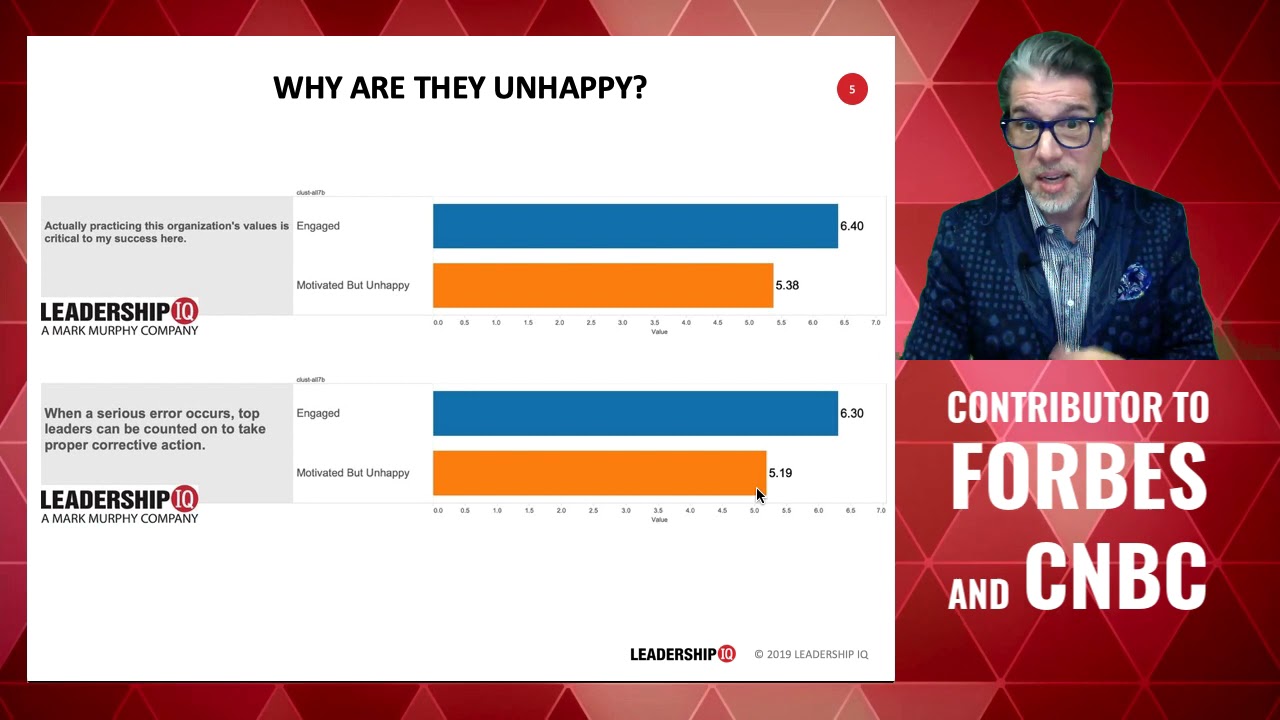
Hi, I'm Mark Murphy, founder of Leadership IQ, and on this video I want to dispel a really bad myth about disengaged employees. Typically, when we think about employee engagement surveys, the basic engagement survey will categorize people into super engaged, engaged, unengaged, disengaged, and there is this myth that disengaged employees, because they don't love the organization, are somehow automatically unmotivated, terrible, not going to give their best effort at work. And this is what I want to dispel. So we recently did a fascinating study where we took over 31,000 people and we looked at two really important questions on engagement. So number one, I recommend this company as a great organization to work for, sort of a classic engagement survey question. But then we took a second question: I am motivated to give 100% effort when I'm at work. And these are two very different issues as we'll see in a second. So what you're looking at right now is a scatter plot of these two questions and you can sort of see that there's some relationship between these two questions. But then what we did was we took these two questions and we performed what is known as a k-means cluster analysis, which is a way of statistically differentiating all of these various groups. And what you can see is that we discovered that 41% of people are what we would consider engaged. That is, they do recommend their company, highly recommend their company as a great organization, organization to work for, and they are motivated to give 100% effort when they're at work. Then there's the unengaged people, and these people are, they're, you know, kind of not really— don't necessarily love the company, not really super motivated to give 100% effort. And then there's the classically disengaged. These are people that they don't like the company at all, and they have zero motivation to give 100% effort at work. But then, and this is the real topic of this video, we discovered a group up here called the motivated but unhappy. And these are people who scored very high on the question, "I am motivated to give 100% effort at work." You can see their scores, their average scores up in here, but they do not recommend their company as a great organization to work for. So in essence, these are people that are absolutely, they're just about as motivated to give 100% effort as the engaged people, but they just don't like the company, whereas engaged people actually do like the company. And this is the, the big thing that has traditionally been missed in employee engagement surveys is we conflate engagement with motivation. And what we've done in this k-means cluster analysis, and it's the first time anybody's ever actually done this before, is we've separated out engagement and motivation. And what this shows you is that there is about, out of 31,000 people, 26%, so over a quarter of the average workforce is in this motivated but unhappy. These are people that are super charged up, absolutely want to give 100% effort every day, but they are annoyed or unhappy with things that the company is doing. And these folks cannot be treated like your typical disengaged employees. These might be some of your absolute best employees. They're coming in and giving maximal effort every day. But there are things the company is doing that they are unhappy with. So what makes them unhappy? Why is it that they are super motivated to give 100% effort but don't like the company? Well, we dug a little deeper in this study and we discovered a, a host of issues, over a dozen issues, but I wanna highlight 4 big ones here. Number 1, when it comes to practicing the organization's values as a determinant of success here, they see inconsistency. So put it another way. When we ask them, does actually practicing the organization's values, is that critical to your success? Like, do you have to live the organization's values in order to be successful? Well, engaged employees, they think, yeah, absolutely, we're totally bought in. We see that the application of our corporate values is consistent and everybody has to live those. But the motivated but unhappy employees, they see hypocrisy, they see inconsistencies, they see that some people don't have to live the values and they still get ahead. That you might have some people that are having very successful careers, but are not particularly living your company's values. And that is one major source of dissatisfaction for them. Another issue, when we ask the question, when a serious error occurs, top leaders can be counted on to take proper corrective action, your engaged employees, they think, yeah, great. If I see a mistake being made, top leaders, they jump in and they fix it. Your motivated but unhappy people, nope, they do not see top leaders jumping in to actually fix these issues. So again, they're seeing inconsistencies, they're seeing maybe it's hypocrisy, Maybe it's a turning a blind eye to these issues. Whatever the exact nature of it is, what they see is that, yeah, we're not actually solving all the problems we really need to solve here. A third issue, and this was a biggie, you can see the differences here. Engaged people believe that, yeah, my leader does encourage and recognize suggestions for improvement, but your people that are motivated but unhappy, again, they're motivated to give 100% effort, but what don't they like about the company right at the moment? What they don't like is they don't see their leader Encouraging and recognizing suggestions for improvement. And think about it, if you're somebody who's coming in every day and you're giving 100% effort and you're coming up with great ideas, and yet you look at your boss and you're like, why aren't you listening to any of them? Why, why don't you ask me for more of my ideas? That's going to wear on you after a while. And then finally, we ask the question, when I share my work problems with my leader, he or she responds constructively. Engaged employees, they think, yeah, my leader responds pretty constructively. But motivated but unhappy employees, They do not think that their leader responds constructively. So when we think about employee engagement, one of the big points here is that engagement and motivation, A, are not the same thing. That you can be engaged and motivated, sure, but you can also be motivated but not particularly engaged. You can be motivated but unhappy with the company. Interestingly, a topic we'll address in a different video is the people that are happy but unmotivated. These are people that love their company, but they are not at all motivated to give 100% effort. But for dealing with the motivated but unhappy people, in a normal engagement survey, this is a group that we would just lump in and call, oh, they're disengaged. They are not disengaged. These are some of your best people. Yeah, they are unhappy with things at the company, but if you take a look at some of those big issues and start to address them— could we respond more constructively? Productively? Could we listen to more of their ideas? Could we be more consistent and actually living our corporate values? Yeah, all of a sudden you might take this 26% of your workforce that is motivated but unhappy and make them motivated and happy. And that could be a huge win-win for your organization. So what's your next step? Well, listen, there's a reason why HR Tech Outlook magazine named us one of the top 10 employee engagement survey companies in the world. Our questions are more actionable. We never ask questions you can't fix. We use artificial intelligence, machine learning, and regression analysis to immediately pinpoint the exact survey issues that you should be working on, and that are going to give you the biggest bang for the buck. We also, because we're such a well-known leadership training company, we package the training in with your engagement so your leaders actually know how to improve engagement, not just stare at a bunch of scores on the screen or a piece of paper. If you are ready to take that quantum leap in your employee engagement, to not just measure employee engagement but actually improve it as well, as well as take advantage of some of the cutting-edge techniques like K-means cluster analysis and separating out engagement from motivation to really truly diagnose your culture, well then, give us a call, reach out to us, shoot us an email. We'd love to have a chat with you.










