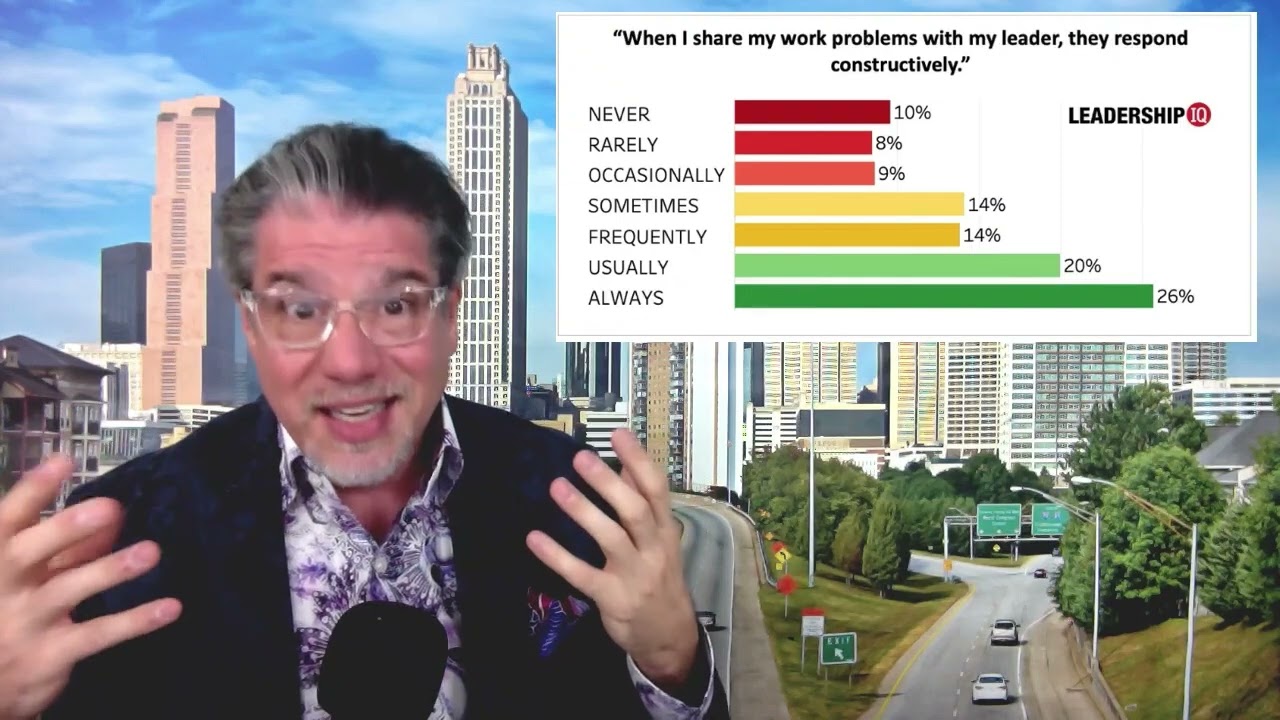
Mark Murphy defines toxic positivity as excessive positive thinking that ignores real problems. Only 15% of employees say their company openly shares challenges, and just 26% report leaders respond constructively when problems are raised. Even 82% of senior leaders admit to sugarcoating the truth.
Chapters
Hi, I'm Mark Murphy, CEO of LeadershipIQ. Does your company suffer from toxic positivity? Well, before we can kind of test your company, we probably need to define what toxic positivity actually is. Okay, toxic positivity is— it's not optimism. It's an excessive and distorted form of positive thinking. It's basically putting a positive spin on everything, no matter how bad it is. So if you ever feel like your company's leaders are just really trying too hard to pretend that everything's just okay. Or if you read your company memos and there's never any discussion of tough topics, or even in uncomfortable conversations, a manager might say, for example, well, let's not dwell on the negative. All of that is what's known as toxic positivity. Now, there are monumental problems for an organization that suffers from toxic positivity. And side note, most organizations suffer from at least some dose of toxic positivity. I want to share with you 3 quick tests you can use to figure out if this is something that afflicts your organization, and I'm going to do it by actually sharing some of Leadership IQ's research. So Leadership IQ is both a leadership development and training company but also a research company. And while I write books and I write a column for Forbes, The truth is that our research gets quoted pretty much everywhere. So I'm going to share with you some of our studies, but to basically give you a test for toxic positivity. Okay, so the first issue is whether or not your organization openly shares the challenges facing it. Now, in one of our studies, what we just found was that only about 15% of employees say yes, always this organization openly shares the challenges facing it. Now, a lot of CEOs will look at this and say, well, I don't want to talk about the bad stuff because then people will just have a negative perspective. The problem is that most frontline employees are closer to the customers than most CEOs are, so they see the problems. So when an organization refuses to openly talk about its challenges, A, we don't have the opportunity to fix them, but B, it makes leaders look like they're a little clueless. One interesting thing about this is that when an employee says, yes, my organization always openly shares the challenges facing it, they are literally 10 times more likely to recommend that company as a great employer than somebody who says, nah, we never share our challenges. And that is actually more people than those who say we always share challenges. A second issue is Would your employees say that if they were to share their work problems with their direct leader, or when they share their work problems with their direct leader, that leader responds constructively? This is one of our famous studies where we ask people, when I share my problems with my direct leader, they respond constructively. What you can see is only 26% of people say yes, always my leader responds constructively when I share problems with them. And one of the reasons is toxic positivity, right? Leaders are inclined to say, well, I don't want to hear about the problems. Now let's just put a positive spin on everything. It's, let's not dwell on the negative, let's just focus on the positive. Meanwhile, the employee's saying, but I have a real problem here that I need your help with. Interestingly, when an employee says, yeah, when I share my work problems with my direct leader, they always respond constructively, they are literally 12 times more likely to recommend this as a great organization to work for. But it's not just the front lines. It's not just middle managers where this shows up. In one of our studies on executive team effectiveness, we asked only senior executives— CEOs, COOs, CFOs, etc. We asked only C-suite executives, on our executive team, do we sugarcoat the truth no matter how bad it is? And you can see here in the data, only 18% of top executives say, yeah, you know what, on our executive team, we just never sugarcoat the truth. Again, if the executive team is sugarcoating the truth, if the executive team has to put a positive spin on everything, this becomes a serious problem for people on the front lines and in the middle management ranks. Again, there is a big difference between toxic positivity and optimism. The irony is that optimism generally requires acknowledging that there is a bad thing happening so that we can be optimistic about the resolution. Of that bad thing. Toxic positivity takes that to an extreme. It basically says, nope, I don't even want to hear about the bad thing. So this is how you can test if your organization suffers from toxic positivity. And by the way, if you have a hint that maybe your organization is suffering from a dose of this, we have lots of alternatives, lots of ways to help your organization address it, from employee engagement surveys to executive team training to middle manager training to tough conversation training for employees. There's lots of ways we help organizations overcome toxic positivity. But as you might imagine, step 1 is just acknowledging maybe we've got a dose of it. Step 2 is then clicking one of those links, like the Talk to Us link on our website, and having a quick conversation with us. Hope you found this useful. Hope you overcome toxic positivity. And remember, it's not optimism, We have to acknowledge the bad stuff so that we can overcome it and fix it. Talk to us, chat with us. We'd love to help you with this issue.