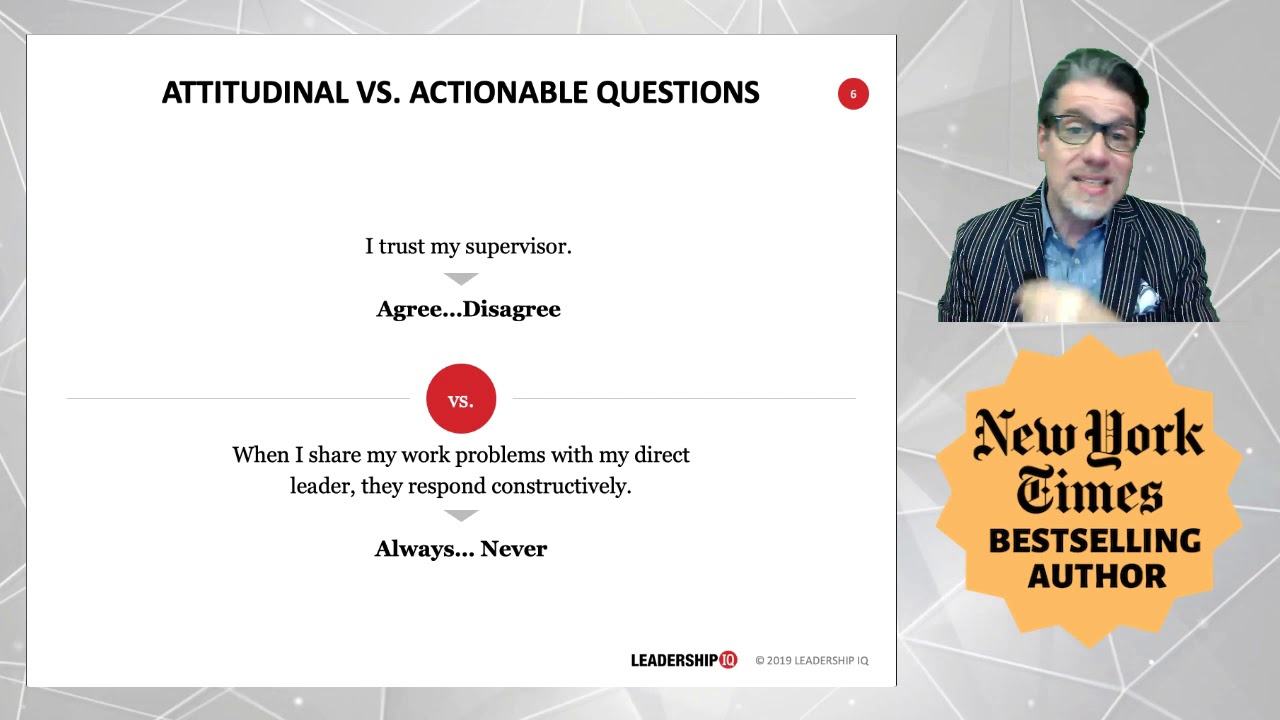
Mark Murphy of LeadershipIQ argues that employee engagement surveys should only ask questions you can actually fix. Vague questions like "I trust my boss" waste time. Instead, ask specific things like "When I share work problems, my leader responds constructively," then deploy a 30-minute town hall or coaching session to improve the score.
Chapters
Hi, I'm Mark Murphy, founder of LeadershipIQ, and HR Tech Outlook magazine has just named us one of the top 10 employee engagement survey companies in the world. Now, why? Well, there are a lot of reasons, but one of the reasons is that we live by the rule, never ask a question you don't know how to fix. Now, this sounds like a ridiculously simple approach, right? Well, turns out a lot of companies do not operate this way. So if we think about kind of a lot of normal employee engagement survey questions that get asked, I have a great friend at work, I like my boss, I trust my boss, my boss trusts me, et cetera, et cetera. These are questions that don't have a really clear path to action. And what that means is if I ask the question, I trust my boss, and it turns out that employees say, no, I don't really trust my boss. Okay, well, what am I supposed to do to fix that? Like, what am I supposed to do to improve trust and employees' trust in their boss? Well, there's truly 100 different things that a leader could do to try and build trust. There's 100 different things a company could do, an organization could do to try and build trust. If I don't know what the path to action is, then I'm left fumbling in the dark amongst these 100 things, because I don't know exactly what it is I'm supposed to do to fix it. If I take a question like, I have a great friend at work, well, what am I supposed to do if it turns out that we get a really low score on this issue? Well, should we send everybody to a ropes course? Should we make them work on interdisciplinary teams? Well, I mean, either of those could potentially work, but I don't know exactly which of those I should do, which means I risk fumbling around in the dark for 6 to 12 months hoping that something I do actually works. If I get dinged on the question, my boss cares about me as a person, well, what am I supposed to fix? Am I supposed to bring my employee cookies every day? Am I supposed to sit down and do goal setting with them? I mean, all of these things, they sound nice. I'd like cookies every day, but I don't know exactly what it is I'm supposed to do. At LeadershipIQ, and one of the reasons why we got named to one of the top 10 survey companies in the world, is that we ask highly actionable questions. We do not ask a question like, I trust my boss, or I trust my supervisor. Instead, we'll ask a question like, when I share my work problems with my direct leader, they respond constructively. This is a question where if we find out that this is a major driver of our employees' engagement, Oh, we can fix that in a 60-minute training session. We know exactly how to fix that. Trust? Ah, that's such an amorphous, blobular kind of concept. I don't know exactly what I'm supposed to do. But when I share my work problems with my direct leader, they respond constructively. I know exactly how to fix that. And that's when I say every question has to have a path to action. That's exactly what we're talking about. You can see these are— this is just a small sample of the kinds of questions that we ask on our survey. Yes, we do customize questions on our survey, but these are some of our core set of questions. Constructive feedback from my direct leader has helped to improve me— to help me to improve my performance. Okay, if it turns out that's a major driver, poof, I can fix that in an hour. I know whether my performance is where it should be. This is sometimes a big driver of employee engagement. Employees don't know whether their performance is where it should be. I can fix that in probably about 2 hours. Senior leadership has clearly explained their vision for the future. Again, I can teach a CEO how to fix this in a 30-minute town hall. Every single one of these questions has a crystal clear path to action, meaning I know exactly what it is I am supposed to fix if it turns out that one of these questions is the major driver of my unique group of employees engagement. So when we answer the question, why did we get named one of the top survey companies? Well, one of the basic answers is that we just ask better questions. I don't want you fumbling around in the dark for the next 6 to 12 months. I want you to know when you get dinged on a question, if it turns out that this is a statistical predictor of your employees' engagement, I want you to know exactly what you need to fix immediately so that you can see improvements in engagement in weeks, not months or years. Now, if you'd like to take a look at our survey and what we could do for your organization, of course, reach out to us at any time. Give Jill Sutherland a ring, send her an email, give her a call, and we can set up a time to chat with you and talk about how we can use these questions to help you significantly improve employee engagement at your organization.