Mark Murphy explains why 89% of new hire failures are attitudinal, not skill-based. He shows how standard interview questions miss attitude red flags and teaches CEOs to write questions that reveal linguistic cues of low performers. His research found 46% of new hires fail within 18 months.
Chapters
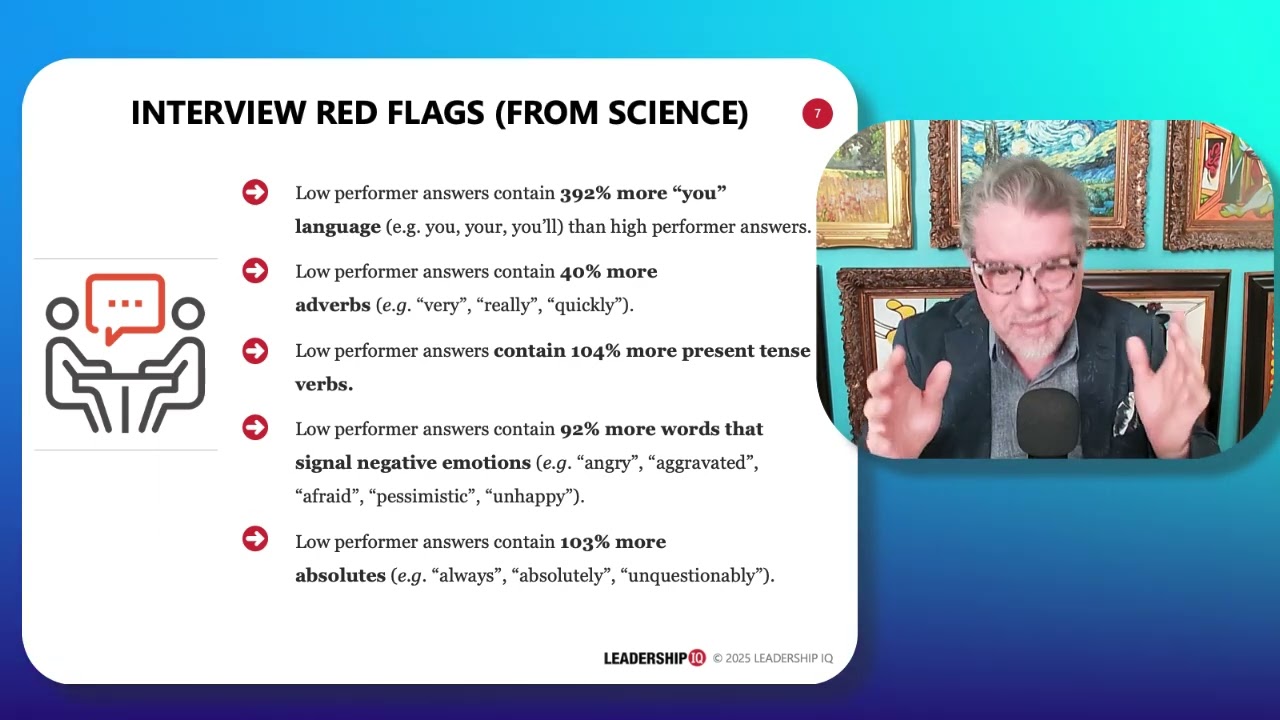
Hi, I'm Mark Murphy, author of Hiring for Attitude and a bunch of other things. I want to quickly talk to you about how to help your company never again make a bad hire. Now, everybody's familiar with the concept of hiring for attitude, but most people don't know what the research actually says, and it is this: 46% of new hires will fail within 18 months, and when they fail, 89% of the time it's going to be for attitudinal reasons, not for lack of technical skills. Skills are easy to test for. Attitude— things like coachability, emotional intelligence, temperament, motivation— that is more difficult. So how do you do it? Well, listen, I've spent decades now helping organizations hire for attitude, and I want to give you— just because I know you're a busy CEO— I want to give you a couple of quick tips to show you how this actually works. Number 1, if you're going to hire for attitude, stop asking the normal interview questions. Could you tell me about yourself? What are your strengths? What are your weaknesses? Well, I'm a motivated self-starter. I love individual accountability, but, uh, you know, sometimes I work too hard. Listen, that stuff, those canned answers, is not going to help you hire for attitude. Now, how do you do it? Well, you're going to need attitudinal interview questions, right? So even with attitudinal interview questions, most people still make a giant mistake. Let's take the interview question, "Could you tell me about a time you made a mistake at work?" Okay, great interview question. Now here's what most people do with that. They say, "Could you tell me about a time you made a mistake at work and how you overcame that and how you solved that and how you bounced back from that?" Whenever you add those little words to the end of your interview question, you essentially give away the right answer to your interview question. You ruin the interview question. Think of it like this: there are two kinds of people in the world— problem bringers, problem solvers. When you ask a problem bringer about a problem, they will tell you about the problem and nothing more. When you ask a problem solver about a problem, they will tell you about the problem and automatically, with no prompting from you, They will tell you how they solved it. If you want to instantly figure out if somebody is a problem bringer or a problem solver, stop asking how they solve the problem. Ask them about the problem. They will reveal their personality to you, their attitude to you instantly. Take every interview question your hiring managers are currently asking. Think about something like Tell me about a time when you had to balance competing priorities and did so successfully. Maybe they didn't balance those priorities. Maybe they had competing priorities and they sat there paralyzed. You could ask somebody a good interview question, could you tell me about a time you faced competing priorities? And they might say, yeah, man, it happened every day. That's— it was terrible. I just sat there frozen all day long. That's why I'm interviewing with you guys. It was awful over there. That's great. That's exactly what you want to hear. Now, I mean, that's a terrible answer. You wouldn't hire that person, but it's brilliant because they instantly told you who they are. But look at your interview question: Tell me about a time when you had to balance competing priorities and did so successfully. And did so successfully is a dead giveaway. It ruined the interview question. It told the candidate, don't tell me about your failures, only tell me about your successes. But there's also another problem in there, which is the word balance. I don't want to know when you balance priorities. I want to know when you faced competing priorities, but I want you to tell me whether or not you balance them. Now, we build interview questions for companies all day long, but we can fix this, right? This is an easily fixable problem. We just have to figure out what attitude you want to hire for and then build you interview questions that reveal those particular attitudes. Let's dig a little deeper though. Once you get an answer to the question, the next challenge becomes, can you determine and discern between bad answers and good answers? Can you actually figure out the difference? I'm going to give you a real-life situation. This is an interview question. Could you tell me about a time when you were asked to do something you didn't know how to do? This is a real-life answer. Okay, could you tell me about a time you were asked to do something you didn't know how to do? Candidate says, oh, that's easy. I was always learning on the fly at my last job, mostly because we didn't have a lot of processes in place. Customers were always complaining that our billing system was seriously flawed, and yeah, they were right. I got stuck with way more tough problems than anyone else because my boss knew that I was really good at problem solving. So what do you do? Reaching out to a manager is one place you can start, or you could look for examples from how someone has solved things in the past. You know, I remember one time when a customer had a billing issue and my boss told me to check with my coworker Sam to see if he had any knowledge of the case. Sam had nothing. In situations like this, I will take it upon myself to track back into the customer's records to find clues, or I will call the customer to see if something was missed. Okay, now in your head, rate this answer on a 1 to 7 scale. Now I can tell you, because we do this thousands of times, that Most people skew positive. Around two-thirds of people, generally speaking, like this answer. On a 7-point scale, they're giving this candidate a 5 or 6 or a 7. Okay, fair enough. Now let me share with you a little science for a second. I promise I'll keep this light. Low-performer answers contain almost 400% more you language. Literally, they use the word you. When you face a situation like this, what you should do is blah, blah, blah. Low performer answers contain significantly more adverbs. They can contain significantly more present and future tense verbs. They contain more words that convey negative emotions like I'm annoyed, I'm angry, stuck, etc. And low performer answers contain almost 100— well, 103% more absolutes: always, never, impossible, unquestionably, ever, everyone, etc. Now, the little dose of science, and we got this by analyzing tens of thousands of actual interview answers. Okay, now given that science in mind for a second, just kind of stick that in the back of your head. Let's go back to this answer. Okay, I was always learning on the fly in my last job. Really? There's never a moment where you weren't learning? Listen, I learned for a living. Believe me, there are days where I'm not learning, I'm just doing. Customers were always complaining. Really? There was never a customer that didn't complain. I got stuck. Well, that's not good. With way more tough problems. How many more tough problems did you get assigned? Well, okay, that'd be an interesting twist on this, but that's not what they said. They got stuck with way more tough problems than Anyone else, nobody else on the team, literally nobody else on the team got as many tough problems as they got. Now, did they actually answer my question? Okay, could you tell me about a time you were asked to do something you didn't know how to do? You can start, you could look, in situations like this I will take it upon myself. Notice that they never actually answer my question. I mean, it sounds like they did. They do say, I remember one time You know, when a customer had a billing issue, my boss told me to check with Sam, but Sam had nothing. So they sort of tease me a little bit. Maybe they're going to give me a specific situation, but no, they, they don't actually give me a specific situation. So what they're giving me is hypothetical nonsense. Now here's the deal. Ultimately, when I train a manager, a hiring manager, how to diagnose and listen to candidate responses, they will quickly pinpoint, instantly pinpoint what good and bad answers sound like. But the key is having an answer key. You gotta know what good and bad answers sound like. So when we work with an organization, we do a number of things. We give them the interview questions to ask and exactly how to ask them without messing them up. We give them an answer key so they instantly know how to discern and instantly pinpoint good versus bad answers. We help them choose the right attitudes they should be hiring for in the first place. We give them the training to be able to to pinpoint this stuff immediately. Listen, this is just a tiny little taste. I know you're a busy CEO. You don't have time to go into all of the weeds on this, but if you are interested in helping your company never again make a bad hire, if you have recognized the pain of hiring somebody who looked great on paper but turned out to have a miserable attitude, I would strongly encourage you to reach out to us. We have programs where we walk you through this step by step and give you the training. We have programs where we literally diagnose your culture, figure out which attitudes you need to hire for, build you the interview questions, build you the answer key. We also have a turnkey system, which is kind of a quick start program. But all of it starts with just a very quick conversation. Talk to us. We can find a program, a solution that fits your timing, that fits your budget, and that is going to help your organization make hires that actually have the right attitudes. You listen, we've all been through the pain. You just can't afford to have somebody that is an emotional vampire that is sucking the energy out of you on a daily basis. Don't do that to yourself. Talk to us and we can figure out the best way for your company to start hiring for attitude.










