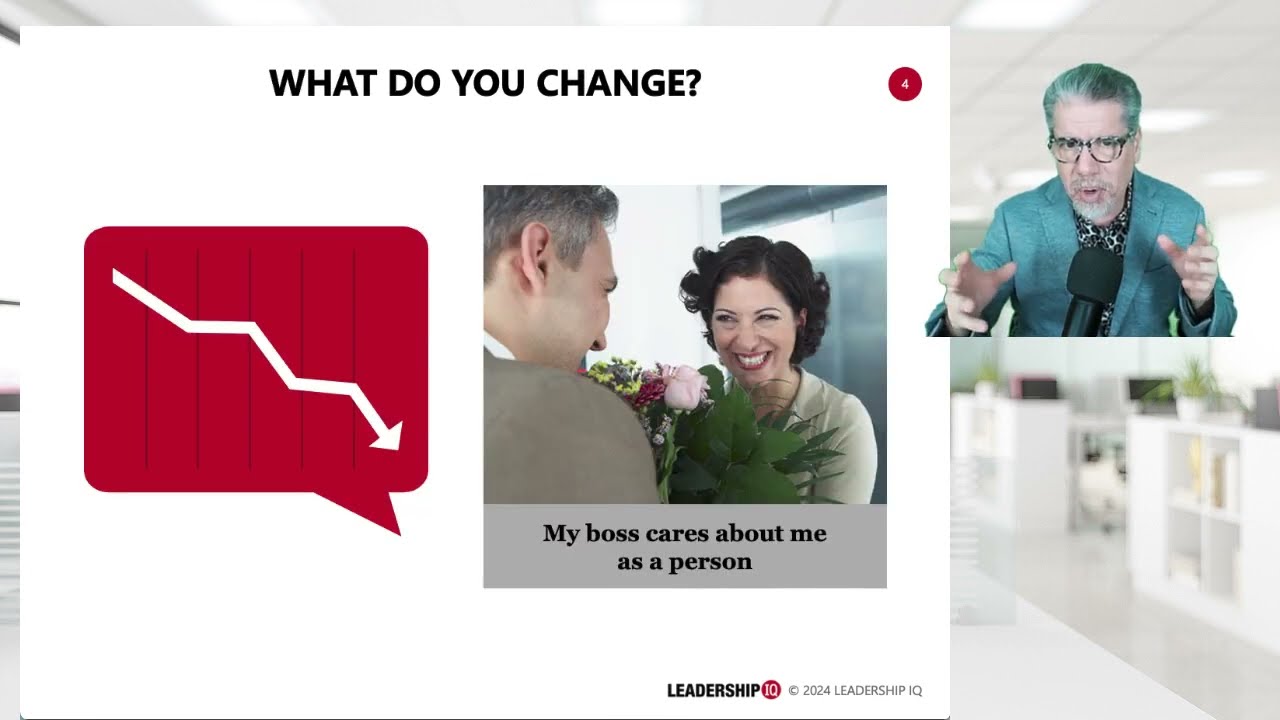
Mark Murphy, founder of Leadership IQ, explains why most employee engagement surveys fail. Ask only questions you can actually fix, and replace vague items like "my boss cares about me" with specific behaviors: "when I share work problems with my direct leader, they respond constructively."
Chapters
Hi, I'm Mark Murphy, founder of Leadership IQ, and I want to share in this tip a couple of questions that are absolutely ruining your employee engagement survey. One big thing to note is that the basic rule for survey questions is never ask a question you do not know how to fix. Why? Because every question you ask implies a promise that you are gonna do something with the answer. And if you don't know what to do with the answer, you don't ask the question because you have essentially then just broken a promise to your employees. Let me give you some real-life examples here. Okay, imagine we ask a question like, "I like my boss," or "I trust my boss," or "My boss cares about me as a person," or "I have a great friend at work here," or "I trust senior leadership," or "I feel supported by my manager," or whatever. All of these questions fall into the same bucket. Every one of these questions lacks what we would call a path to action. Let me give you a real-life example. Okay, let's take the question, my boss cares about me as a person. Very common survey question, employee engagement survey question. One of the problems with this is, what do you fix? So imagine you've got a group of employees who feel kind of beaten down or or at least a couple of employees that feel kind of beaten down. And what they're looking for is a bit more positivity. Well, okay, when they say, "No, my boss doesn't seem to care about me as a person," what are they looking for? Well, they're probably looking for some positive reinforcement, right? They're probably looking for like a bit more optimism and upbeatness. But imagine that across the hallway, there are a bunch more employees that are like, "No, we're highly ambitious. We just wanna climb the corporate ladder. We wanna learn everything we can. And I feel like my boss is too warm and fuzzy. I actually need some constructive feedback. I need to know what I could do better because I want to get ahead in my career. So when they say, no, my boss doesn't seem to care about me as a person, what do they want? Well, they want more constructive feedback. Do you see the problem here? We've got some employees want like more positivity, other employees want more constructive feedback, but we have no idea what to tell the manager to fix simply based on the question, my My boss cares about me as a person. So instead of asking something like, I trust my supervisor, or I trust my manager, we'd be better off asking a question like, when I share my work problems with my direct leader, they respond constructively. We want to narrow in that question and make it much more behavioral. And you'll notice too that when I ask something like, I trust my supervisor, usually it's on a Likert scale, an agree, disagree, strongly agree, strongly disagree. By the way, it is Likert, it's not Likert. Um, the guy's name was Rensis Likert. It's on a fuzzier scale, but when we ask a question like, when I share my work problems with my direct leader, they always respond constructively, they respond constructively, we can put that on an always to never scale, which means we are now in a much more behaviorally rooted scale. And again, this is something that if it turns out you get dinged on this question and it's like, okay, we really need to fix this issue This is a very easy thing to fix. I mean, at Leadership IQ, we literally have a training course on how to respond constructively when employees share their work problems with you. This is not a hard thing to correct. So with every one of your questions, what we want to do is tighten them up and make sure you know exactly what you are going to do if it turns out you get dinged on that question. So instead of asking a question like, I believe that my direct manager is a great role model, We could ask questions like, "Constructive feedback from my manager has helped me to improve my performance," or "My manager thoughtfully considers my ideas," right? One's a little more positive, one's a little more constructive. Or a question like, "This company's mission makes me feel like my job is important." Okay, well, I, I don't know exactly what I'm supposed to do to fix that, but if I ask a question like, "I understand what specific actions I need to take in order to be successful in my career at this organization," Now I know exactly how to fix that. By the way, these are actual questions that we use at LeadershipIQ in our employee engagement survey. This is just one of a dozen ways that we help organizations with their employee engagement surveys. Obviously, we conduct a lot of employee engagement surveys, and if you'd like help with your next survey, please reach out to us. We would love to talk to you about implementing a survey where you've got real actionable questions so that when you get the results back, and you get them— you get the results back quickly, when you get them back, you know exactly what actions you're supposed to take so you can see immediate improvements. Way too many organizations say they wait around for months to get the results, and then after they do get the results, they don't know what to do. So another set of months go by where nothing really happens. When you do a survey, you should see results quickly And one of the best ways to do that is to start with questions that lead to immediate improvements.