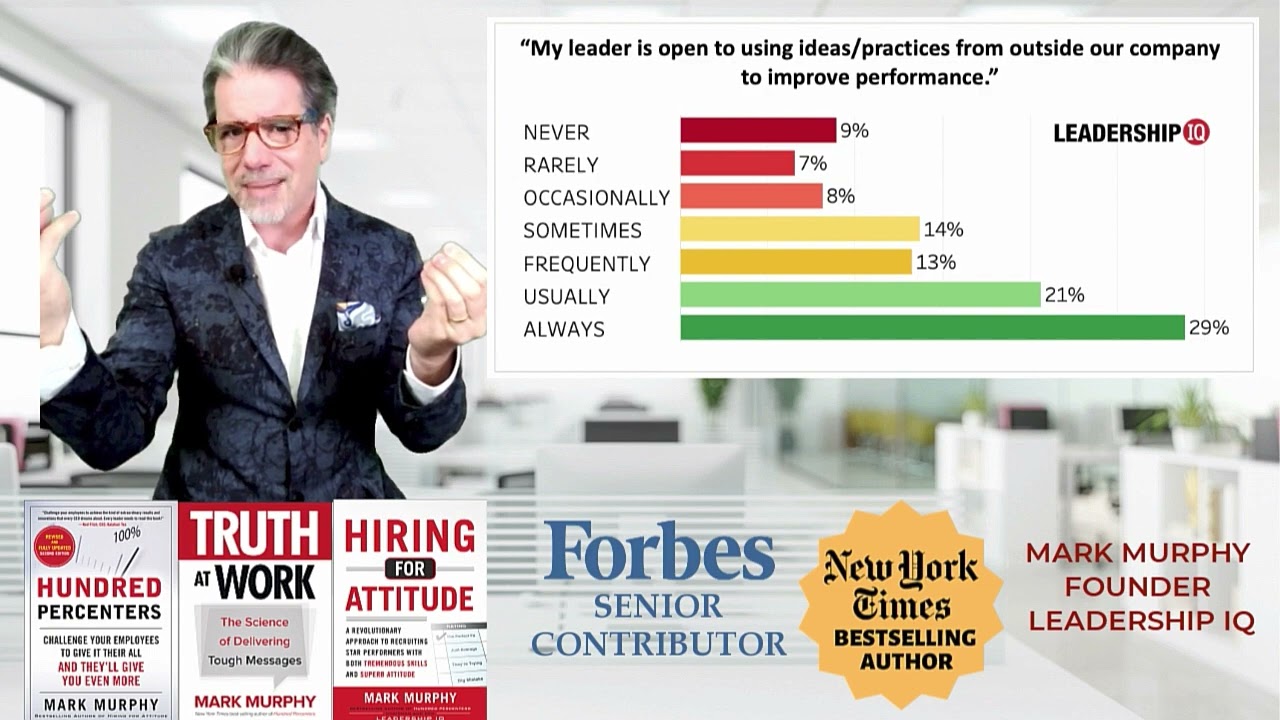
In this presentation Mark Murphy reports on a large employee‑survey (21,008 respondents) that evaluates how well leaders are performing on five critical behaviors: aligning their vision with the organization’s, being open to external ideas, developing employees’ full potential, responding constructively to problems, and encouraging/recognizing suggestions for improvement. Across the board, only about a quarter to a third of leaders are rated as "always" effective on each behavior (vision alignment 29%, openness 29%, development 20%, constructive response 26%, encouragement 27%). Regression analyses show that higher employee ratings on each behavior strongly predict greater inspiration, effort, and trust, indicating that these gaps directly undermine productivity and organizational success, especially in the current recession‑pandemic‑racial‑justice‑protest‑laden economy. Murphy argues that traditional leadership‑development programs have failed to teach these skills and proposes using the study’s data as a roadmap: design curricula that target the identified weak behaviors, and measure impact by employee perception rather than merely training completion.
Chapters
What is the state of leadership development? Well, short answer is not so good. This new study reveals that leadership development has really not adequately prepared leaders to deal with what is arguably the most stressful economy in 100 years. Recession, pandemic, racial justice protests. This is a really difficult time to be a leader. And one of the things that leadership development must do is give leaders the skills to communicate transparency, encourage innovation, align their vision, and so much more. The way we conducted this study is we actually asked 21,008 employees, "How well is your leader performing on these issues?" Why did we choose this methodology? Because frankly, this is the customer-driven approach to assessing leadership development. Sure, we could ask organizations, "What activities are you undertaking?" But the reality is the truest measure of whether or not leadership development is working is to ask the people who are the direct recipients recipients of that leadership development, and that is the employees themselves. Let's take a look at some of the key findings from this study. When we ask the question, is your leader's vision for the future aligned with the organization's vision for the future, what you can see is that only 29% of employees say yes, always, my leader's vision for the future seems aligned with the organization's. Now think of this like— this is terrifying, but think of it like this. If Manager of Department A is fully aligned with the organization's vision, but Manager of Department B is not fully aligned with the organization's vision. Well, what that means is you could have half of the leaders in the organization out of alignment with the organization's vision. Now, if you're the CEO, can you really achieve your vision of the future? Can you really achieve your organization's goals if half of the leaders in the organization are out of alignment with your vision? And the answer, obviously, is There's no way you're going to achieve your strategy if people are out of alignment. And frankly, one of the foundational elements of any leadership development program is to make sure that every leader is in full alignment with where this organization is trying to get to. But it's not just the strategy. If you look at this regression line, what you can see is that the more an employee feels like, yeah, my leader's vision is in sync with the organization's, the more likely they are to say, I am inspired to give my best effort at work. And how much more successful is your company going to be if every employee feels like, yes, I am absolutely always inspired to give my best effort at work? Of course you're going to be more successful. And yet you can see that again, we are falling far short on this. If we take a look at the question, my leader is open to using ideas and practices from outside our company. Again, you can see only 29% of people say yes, always my leader is open to using new ideas and practices. And again, let's say Mark Murphy, Manager of Department A is completely open to using new ideas, says, "Bring it on. I need more innovation. I need more great thinking." But Manager of Department B is like, "Nah, I don't want to. I'm in that never or rarely category. I don't want to listen to stinking ideas from outside the company." Well, that again means you could have half the leaders in the organization are fully open to using new, great, innovative ideas to solve what are unprecedented amounts of problems. And the other half of the leaders are not open. And what if one of the leaders that is not open to using new ideas and practices from outside the company happens to be in one of your most mission-critical departments? How successful are you going to be there? Clearly, a foundational piece of any leadership development program is going to be helping leaders learn how to grow and develop their employees' full potential, right? I mean, that's one of the things employees come to us and we hire them into the organization. But now it's up to us to get them aligned, get them focused, get them trained, get them onboarded, and help them grow and get even better. Because most organizations have unbelievable amounts of untapped potential amongst their people. But you can see, if only 20% of our leaders are always helping people grow and develop their full potential, companies are leaving a lot of inspiration, engagement, motivation, and effort on the table. Because again, look at the regression line here between these two variables. The more an employee says, "My leader absolutely takes an active role in helping me grow and develop my full potential," the more likely they are to give their best effort at work. So you want more productivity, you want more effort, you want more attention to detail, you want better quality from every employee in the organization? This is a critical piece we need to start developing leaders to solve. In the crazy economy within which we're existing, there is no shortage of problems. It could be something as simple as, "My people are working remotely and there's a million problems coming up. They don't know how to handle it," to more fundamental concerns about, "Is our business even going to exist a year from now?" And yet, when we ask people, "When you share your work problems with your leader, do they respond constructively?" you can see only 26% of people say, "Yes, my leader always responds constructively when I bring them problems." You can see from the regression line, not only is this a major predictor of employee engagement and inspiration and their willingness to give effort, but in a previous study we did, we found that this question was actually the single biggest predictor of whether or not an employee was going to trust their leader. So for all we talk in leadership development programs about, we have to build trust with our employees— fastest, most direct way to build trust with employees respond constructively when they bring you problems. And clearly, with only 26% of leaders always responding constructively, this is another big area we need some work on. Clearly, any organization that is not just going to survive but actually thrive in this world right now is going to be an organization that is constantly pushing the envelope, looking for new, better, different ways of doing things. And again, this needs to be a foundational piece of any leadership development effort. And yet, when we ask employees, "Is your leader encouraging and recognizing suggestions for improvement?" 27% say, "Yeah, this is— my leader is rocking out on this issue," which means we got, you know, in the neighborhood of around 3/4 of leaders are not really doing a great job of encouraging and recognizing suggestions for improvement. And this speaks to 2 really powerful issues. Number 1 is the obvious: are we actually engaging with people, listening to their ideas, and soliciting their ideas? That's one, but the second issue is that if we're not going out and actually asking people for great ideas, what it says is there's a very good chance that we're kind of stuck here, that we're actually not thinking about new ways of doing things, period. And if we know anything about stressful economies like the one we're in, it's that we need new and better and more creative ideas if we are going to solve this issue. And clearly Our leadership development efforts are just not giving these skills to leaders right now. So where do you go with all of this? Well, if you simply take all of the data in this study, and I've just given you a short little couple snippets of what's in the study, if you go through and look at all these charts, what we've basically given you is a roadmap for what sorts of things should be in your leadership development program. You can see in the regression lines how powerful these issues are in terms of actually getting inspiration and best effort from your people. And if we can train leaders how to solve these issues and then actually measure the effectiveness of our programs, not just ask, "Did they go through the training course?" but actually, "Did they learn the skills necessary in the eyes of their employees? Are they actually practicing these and doing these things?" Well, now we could actually take what is a fairly sad state of affairs for leadership development and We can turn this around. We can make leadership development significantly more effective simply by focusing on some of these key issues.