Mark Murphy explains how saying "I could really put myself in your shoes" boosts likability by 19% based on UCLA research. The phrase increases empathy 78% and donation likelihood 59%, but most people fail at empathetic listening and use phrases that actually reduce how much others like them.
Chapters
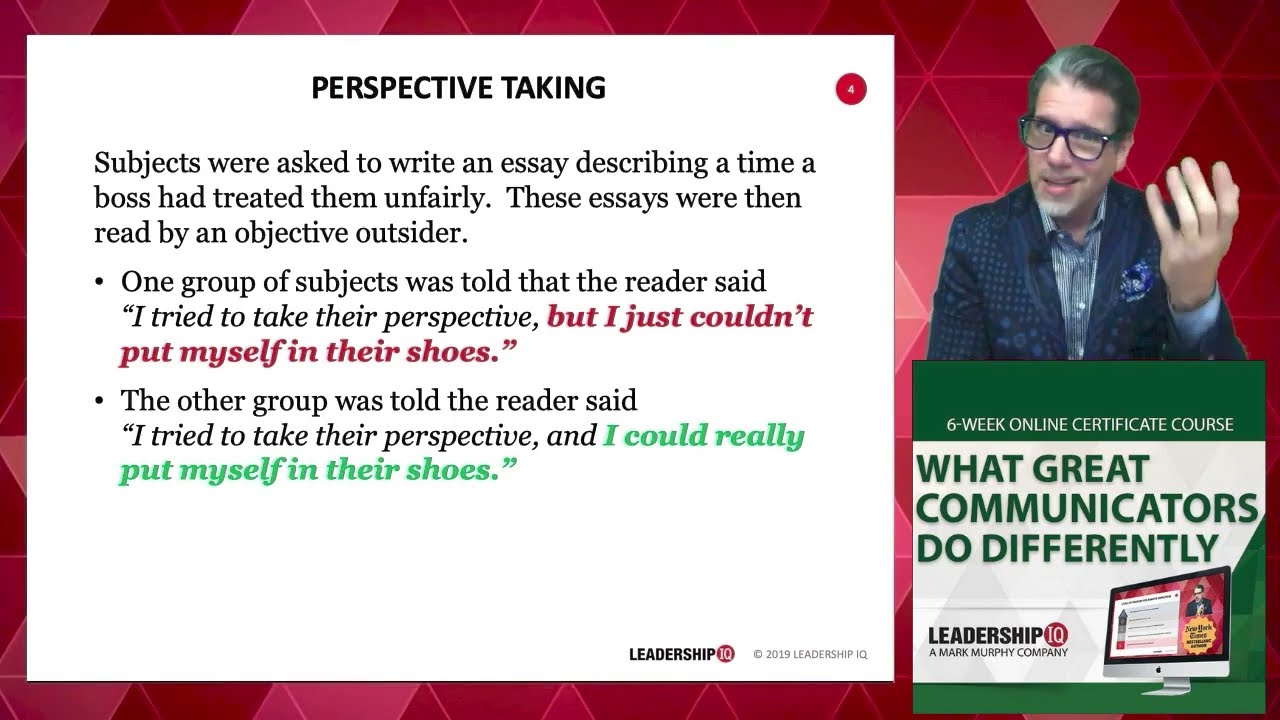
Hi, I'm Mark Murphy, founder of Leadership IQ. And I think we could probably all agree that being likable is a good thing, right? The more likable we are, the more influence we're going to have, the more power we're going to have, the more able we're going to be to get our employees and our colleagues to do the things we want them to do. And in this little video, I want to show you one sentence that can actually instantly make you 19% more likable, and I want to show you the science behind it. So the first thing we have to know is that what I'm gonna show you is based on the idea of perspective-taking. What is perspective-taking? Well, if you remember To Kill a Mockingbird when you were in middle school, um, one of the folks says, "You never really understand a person until you consider things from his point of view, until you climb into his skin and walk around in it." There was a study done out of UCLA. People were asked to write an essay describing a time where a boss had treated them unfairly. All right, so you write an essay about a time a boss has treated you unfairly. You then turn your essay in and it goes to an outside reader. This outside reader then reads your essay and comes back with one of two responses. Either they said, "I tried to take their perspective, but I just couldn't put myself in their shoes," or they were told, "I tried to take their perspective and I could really put myself in their shoes." So you write an essay, here's about a time I was treated unfairly, this is bad. I give it to somebody to read and they come back and they said either, I just couldn't put myself in your shoes, or I could really put myself in your shoes. Here's the kicker. When people were told that this other person, this reader, could really put themselves in their shoes, when they came back and said, I could really put myself in their shoes, they liked that person 19% more instantly. They felt 78% more empathy towards them, and they were 59% more likely to give them money in subsequent interactions. So What does this basically tell us? What it tells us is that if we're having a conversation with somebody, we want to be listening empathically, not sympathetically. I don't need to feel their feels, but I need to be able to, A, see the world through their eyes to understand their perspective. And then you know what I need to say to them? I could really put myself in your shoes. I could really see what you were going through there. I need to say something, and this is your one sentence. Just say, "I could really put myself in your shoes when you were telling me that," and instantly the likability goes up. Now, sometimes people will look at this and say, "Well, I'm already super empathic. I already do this." Well, let's slow our roll for one second because more than 20,000 people have taken our test, "Do You Know How to Listen with Empathy?" And you can see the scores on the test here. 100%, that's awesome. You're rocking it. You know how to listen with empathy. That's 5% of people. 88%, Okay, not bad, that's a decent score. That's 12% of people. But then when we start to get down to, I'm getting less than 2/3 right, I'm getting less than half right, you can see the vast majority of people are not doing well on this test of listening with empathy. Why? Because a lot of the things we say are not going to make us more likable. Well, you know, I know that was a tough situation, but it's a blessing in disguise. I know that was a tough situation, but don't worry, you'll get over it. You know, I know that was a tough situation, but you know what, it's all for the best. That's not empathy.