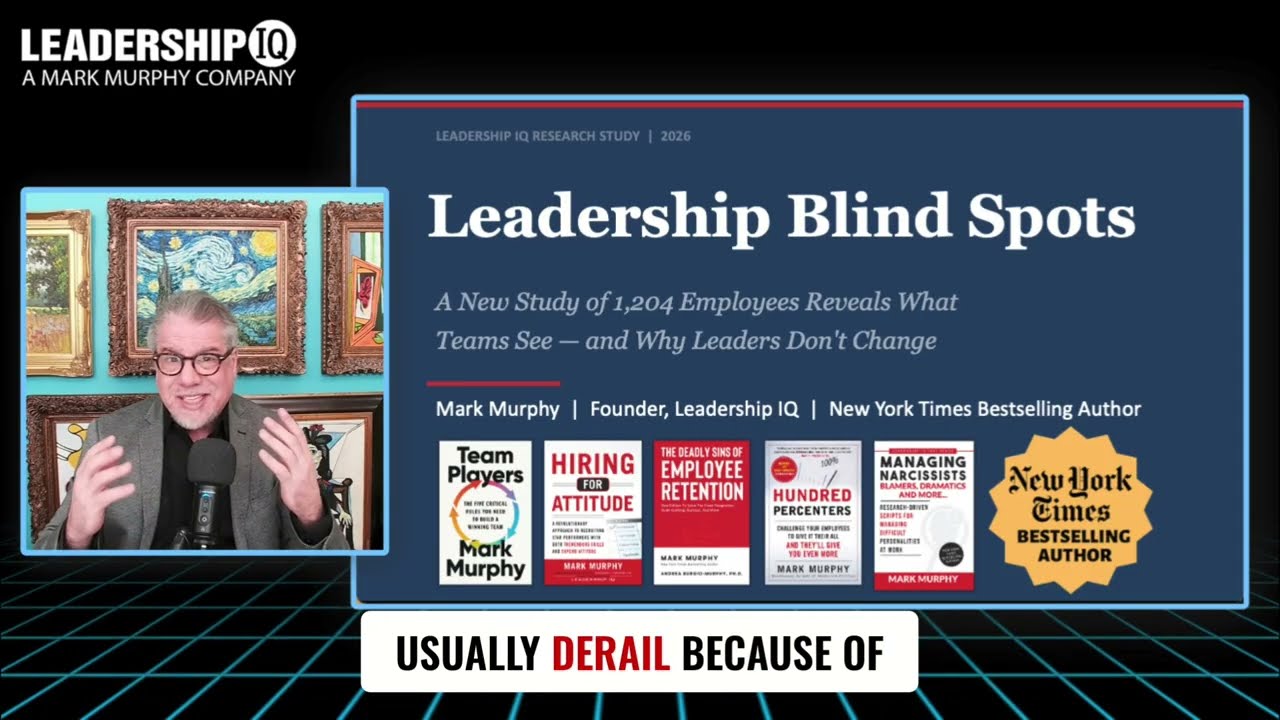
Mark Murphy studied 1,204 employees and found the average leader has 3.6 blind spots. Despite feedback, 84% of leaders don't change, mostly because they lack concrete tools, not stubbornness. The most damaging blind spot is failure to follow through, affecting 65% of employees daily.
Chapters
The best CEOs and senior executives want a candid assessment of risk, not just market risk, not just competitive risk, but leadership risk. Specifically, where am I vulnerable in ways I might not see myself, right? As the smartest leaders know that careers don't usually derail because of one dramatic mistake. They derail because of blind spots that quietly compound until someone else connects the dots first. And that's what this study is about. We surveyed 1,204 employees, managers, and executives and asked them to evaluate their direct boss. What leadership blind spots does your leader have? Does the team see them clearly? Has anyone ever told the leader? And if so, did anything actually change? This wasn't theoretical. We went straight to the people who experience leadership behavior every day. And thus, we revealed the blind spots of CEOs, executives, directors, and managers. Here's the first number that should make any executive pause. The average leader has 3.6 blind spots their team sees clearly. Not one, not an edge case, but a cluster. Employees don't experience leadership problems in isolation. They experience patterns of behavior, and those patterns are usually very obvious to everyone except the leader. The most common blind spots weren't exotic or extreme. They were very familiar: lacking structure, planning, or clear processes; overestimating their own performance; missing team tensions and relationship dynamics; getting defensive or dismissive when challenged; communicating in ways that confuse or demoralize people. Most leaders recognize at least one of these. What they often don't realize is how many are happening at the same time. Now, here's the finding that really challenges conventional wisdom. 84% of leaders showed no improvement even after being directly told about a blind spot. Only 16% actually changed. What I can tell you is, after working with leaders for more than 2 decades, I've learned the difference between the 16% who change and the 84% who don't. It's, it's never intent. It's whether they're given tools concrete enough to actually use. This isn't about stubbornness or ego. Most leaders are told what's wrong, but they're rarely shown how to change in a way that feels immediately practical. Right? And so real change happens when leaders are taught tools and techniques that are so usable, they know exactly what to do, what to say, and how to say it starting that day. Without that, even well-intentioned leaders stay stuck in that 84%. And ironically, this becomes even more pronounced at senior levels. C-suite leaders were 77% more resistant to change than leaders at other levels. Not because they're worse leaders, but because their senior roles naturally filter out honest feedback. Fewer people challenge you, fewer people feel safe being fully candid, and over time, certain signals just stop getting through. We also looked at impact. Which blind spot actually hurts teams the most? Interestingly, it wasn't lack of vision, it wasn't poor strategy, it was failure to follow through. When leaders drop commitments, don't close loops, or fail to execute consistently, 65% of employees report significant or severe daily impact, the highest of any blind spot we measured. Execution failures don't look dramatic, but they quietly destroy credibility. And one of the most important insights from the study is that blind spots tend to travel together. Disorganized leaders often struggle with follow-through. Overconfident leaders often get defensive when challenged. And one combination is especially damaging: overconfidence paired with dismissiveness. About 1 in 4 leaders has both, and when they do, employee-reported damage spikes sharply. Feedback alone simply can't penetrate that particular combination. So the takeaway here isn't that leaders are broken. It's that awareness without tools doesn't create change. Most leaders aren't ignoring feedback. They just don't know how to translate vague input like be more structured, or listen better—into concrete, repeatable behavior. And the more senior the role, the more likely it is that these gaps go unaddressed. Blind spots are dangerous not because they're rare, but because they're invisible to the person who has them. By definition, the executives who protect their careers and their organizations best are the ones who assume blind spots exist and then actively go out, build systems to surface and correct them before they become liabilities. And that's really what this study is designed to help leaders do. If you want some help assessing and fixing the blind spot of your organization's leaders, just visit leadershipiq.com and go to the click Contact Us and schedule a call.