Imposter Syndrome Is a Symptom, Not a Flaw: A Deep Dive Into Authentic Leadership with Markus Neukom

In this Biz Blend Podcast episode, host Sana (Sarah) interviews leadership coach Markus Neukom to reframe imposter syndrome. Markus argues that imposter syndrome is not a personal flaw but a symptom—a "pseudo‑imposter syndrome"—that arises when a person’s external role or achievements are misaligned with their authentic self. He uses the metaphor of a "little gremlin" that programs self‑fulfilling prophecies, reinforcing fear and limiting belief. The conversation explores how this misalignment manifests in leaders, affecting hiring decisions, culture, retention, and overall organizational health. Markus highlights that the syndrome disproportionately affects high‑achievers and perfectionists, while those who are lazy or disengaged rarely experience it. The root cause is a lack of self‑knowledge; the first step to healing is admitting "I don’t know myself as well as I thought." He outlines a realignment process that involves deconstructing past successes, identifying core ingredients of personal capability, and cultivating stillness—a coherent state of mind and heart that allows the soul’s voice to emerge. Stillness is presented as an active, listening practice rather than mere quiet. Markus also shares practical coaching advice, emphasizing the need to give up limiting beliefs, accept reality, and reconnect with one’s original design. The episode concludes with a call to action for listeners to connect with Markus via LinkedIn for further coaching.
Chapters
Welcome back, listeners, to another interesting conversation on the Biz Blend Podcast, the show where we untangle the hidden forces shaping how we lead, build, and grow in business. I'm your host Sarah, as always, and listeners, today we are going to dive into a conversation that goes. Deeper than the usual hustle and mindset talk. Well, we are exploring imposter syndrome, but not as a confidence problem to fix, but more profound, more insightful. Now, and this question comes to my mind, and I imagine it will come to your mind as well. What if those feelings of being a fraud, are actually a sign of misalignment with your original design. And listeners, let me introduce my guest to you. My guest today, he has spent over 2 decades helping leaders, founders, and visionaries step beyond the old patterns and feel like a homecoming or a return back to who they truly are behind closed doors. He has guided high-level clients to lead with more clarity, presence, and influence as well. And now he's bringing those insights into the open for us. So if you have ever wondered why you can look successful on paper, but you still feel like you are wearing a mask, this conversation is for you. So listeners, meet my guest, Markus Neukom. So Markus, welcome to the show, and I'm really, really honored to have you here with us. Thank you.
Oh, the honor is all mine, Sana. Thank you for having
me. Markus, let's talk about imposter syndrome. You'd say that it can be a signal, it's not a flaw, which personally I initially used to believe like something is wrong with me. This is, and it's not going to go away anywhere. whatever I do, how much ever effort I put into rectifying it. So that is really a very interesting insight. What does it actually reveal about how we are operating versus who we truly are?
That's a very loaded question, Sanam. So let's start at the following point. Imagine You have a little gremlin and the little gremlin sits at the mixing desk of your beliefs. That's the little gremlin, right? So the little gremlin knows you have imposter syndrome. So guess what the little gremlin does? The little gremlin totally programs you so it becomes a self-fulfilling prophecy. Hmm. It's the worst thing with imposter syndrome. And you know, when you, when you heard me talk with Avik, I said that it is a pseudo imposter syndrome.
Yeah.
Because imposter syndrome becomes a problem because we make it a problem. But imposter syndrome itself is a symptom, literally a symptom. But the grave thing is the actual cause of imposter syndrome is way more dangerous than any listener actually believes imposter syndrome to be, way more dangerous. And that is why the little gremlin makes sure that you never start questioning imposter syndrome. You know, you say yes to imposter syndrome. You speak with your friends about imposter syndrome. You believe in imposter syndrome. And the little gremlin loves these conversations, by the way. And he doesn't, or she doesn't love our conversation so much, I can tell you, because we are talking about truth, whereas imposter syndrome is basically an illusion.
Wow. Wow. I mean, you have given, you have explained it with such an interesting example in there. It's like it's feeding off our fear, insecurities, and it's just getting that satisfaction. Seeing, you know, us suffer. I mean, I'm really painting a very grim picture of it because that's what I can imagine.
Reality, Sara. It's reality. It is reality. You know, if you look at people who suffer from so-called imposter syndrome, are they happy? No. Are they fulfilled? No. Do they believe that they're doing what they could do? No. They feel there is always more, but they can't access it. Oh yes. So imagine to live a life like this. You know it, I know it, how it feels. It is terrible. It is terrible. That's why I made it part of my work to debunk imposter syndrome so we can talk about the real underground issue, which leads to that pseudo imposter syndrome. So people actually can change. So people can have, like you have it in your logo, a healthy mind. And as you know, Sanne, a healthy mind leads to a healthy life.
Yeah, absolutely.
So it's basically all buried in what the Western and sadly the Eastern Hemisphere have more and more in common. We are so mind-driven. We are so brain-driven, and when we are brain-driven, we are left-side driven, and in left is logic. So imagine if I give you a diagnosis, you come to me, I'm a psychotherapist, and I say to you, Sana, after 20 minutes, the diagnosis is pretty clear. You are suffering from imposter syndrome.
Mm-hmm.
You just leave my practice. Wondering what's that? It sounds terrible.
Yes.
Nobody really can explain it to you. And if you actually buy into a syndrome, pardon my French, my direct language, you are screwed. You are screwed. If you believe in imposter syndrome, you're screwed. Because imagine like this. When you are believing in imposter syndrome, Sarah, and everyone who listens, you limit your potential 100% where you believe it has to be limited.
Yeah.
And imposter syndrome, the little gremlin, oh, they make sure, it's actually more than one. They make sure that that limitation doesn't get heightened. It actually gets even more lowered. Because it leads you into situations where you fail. And as you know, with imposter syndrome, if I fail, I'm a failure. Yep. So it basically cements that belief with every single day and every single action you take. In the beginning, you are more daring, you try things out, but then when you so-called fail, what do you do? You say, oh no, I burned my fingers. I'm not going too close anymore to the heat.
Well, I think that's—
Believe me, Sana, at that heat, that's where the freedom lies. And people get afraid of the heat because they don't learn how to deal with the heat and they stay in the cold. And sadly, if you walk around wherever you are in the world, you can see the results of it. There's not much sun, there's not much light, there is Not so much happiness anymore as he could be with a healthy mind.
Definitely. That's really powerful. That's really powerful. And Markus, what's the reason, the root cause behind it? I mean, is it, does it happen to any specific person? Like, are there any childhood or any past experiences? something ingrained in subconscious that leads to this, or it can happen with anyone?
So let's start at the end. It can absolutely happen with and to anyone. Let's look at it like this. I have never seen a lazy person suffering from imposter syndrome. Never. It just doesn't exist. So it needs to be someone, Sana, who is driven.
Hmm.
It needs to be someone who is an achiever. And, you know, when I started researching the topic, the subject, I realized the higher up in the echelon I go in society and as well in business, the more prevalent imposter syndrome becomes. So there's a reason why, let's say, someone who is working at Let's say where they just take stuff and package, you know, like manual work. They just take one part, put it into package, close the package, send the package, take the part, put it in the package. Those people probably won't really suffer from imposter syndrome because they actually rather suffer from the opposite. They never get to the level they actually could. But somebody who is a curious mind, somebody who has the privilege, and I call it the privilege to try out things where you really feel inclined to, those people absolutely will sooner or later suffer from imposter syndrome. It's almost a given. And by the way, if somebody actually feels, oh, I've never suffered from imposter syndrome, Be warned, CEOs who believe that they know everything and have everything and can do everything, guess what, Sana? That's the worst form of imposter syndrome.
Wow.
That is so important to understand. So you see, this so-called pseudo-imposter syndrome presents itself in so many different faces. In one way it comes across as, I am nobody. If somebody knew who I really am, they wouldn't love me anymore. And then the opposite is, I can do everything. I know everything. I have no problems at all. You know those people, Sanaa? They're not real. They're trying to hide who they really are behind a totally different mask.
Exactly. Yep.
And once we understand that, we actually start looking at society and at people quite differently.
Hmm. Yeah. That really lends some clarity in here. And you are absolutely right, Markus. I mean, I have never, it's not possible that you know everything. I mean, it's like, As you exactly, you know, said those words, like masking your insecurities and your fears. No one is perfect. No one is perfect. No one can know everything.
You see, Sanaa, that's one of the faults I call them in our society. Nobody should be perfect. It's the worst. I sometimes look at my friends who are perfectionists, right? And I say, my friend, you're screwed because it doesn't matter how good you become, you will never be good enough in your own eyes because perfectionism does simply not exist. There's only always more, always more, always more, always more. And I just look at them and think, gosh, if they just could live for one minute of their lives instead of striving for something.
That's bold. That's bold. And Markus, so there's definitely a misalignment. And, you know, when I— now I'm reducing the focus of discussion here. So How does this kind of misalignment actually play in areas like leadership, branding, hiring, you know, other strategic aspects? I mean, where do you see it cost leaders the most?
I can tell you, I don't see an area where I don't see it. And that's the gravity of it. So picture this. I suffer from imposter syndrome. I don't feel like I deserve the best. What do I do? I hire mediocre people because my little gremlins will absolutely make sure that I say no to the best, but I will hire the mediocre person. That's one thing. Now it goes a step further. Now I hired that person. Now this person has some character flaws like we all do, right? Instead of reminding that person nicely, calling it out, you know, with feedback, I pretend I don't see it. Guess what happens? It has its own ripple effect in that department. So you see where it goes. It goes into leadership. I don't dare to speak out. That's one thing. I don't dare to reprimand an employee who has a behavior that is not acceptable. And sooner or later, everything gets more and more poisoned. You know, let me give you an example. An organization calls me and says, Markus, we have a problem with retention. So as a consultant, as an executive coach who I was, I would go into the company and say, okay, let's look at it. So, okay, I can help you with retention. Let me help you with hiring the right people. So I give them all the processes, train them, teach them the interview questions, everything, right? So then I leave. Guess what? It doesn't take long and the situation is the same as it was before because the person behind it, the person behind the processes is the issue. Not the processes.
Mm-hmm.
Makes sense, right? So you hire the wrong person as the owner of the business, and this is a very crucial, pivotal role. Guess what? This person is going to hire their people based on their beliefs, and those were not fitting with the company in the first place.
Yeah.
So guess what? It's a ripple effect of a very, very big scale. So I always say, look, if I go into a company, I say, look, what I wanna do is I wanna talk with the departments. I wanna have some random conversations. And quite often, Sana, I meet somebody who I identify as the cause of the high retention rate, high turnover rate. And then I go to the boss and say, look, you have somebody in this department who's almost like poison. It's so subtle. It's so, you know, it's almost like in small little droplets, that negativity, but it leads to a psyche, I would put it like almost like psychopathic atmosphere somehow. It becomes toxic. And then the boss says, oh, I'm so glad I heard that from you. Okay, what can we do with this person? I say, sorry, the person is not the problem. Who is? And then I would love to actually open a little mirror and put it in front of her or his eyes and say, here you are. This is the problem. You are at the helm. You are the one who has enabled this culture. You are in charge of the hiring culture. You are in charge of the hiring procedures and everything. You are the one who is in charge of culture per se. Like when people tell me, look, in Europe we have this saying, like the fish stinks at its head. And it's true. If you don't have a good leadership, how can you expect that in the lower feels, it'll be different. And that's what it comes down to. And you see, the thing is, what I always say, why is it pseudo-imposter syndrome? And actually, why is it so easy to solve? Because it is. Once I admit, I have to admit one thing, which is so hard, Sanaa. I don't know myself. As much as I believed I did. That's the first step. I don't know myself as much as I thought I did. And then that's when we start working with that person. You know, when they feel like, I don't know if I have what it takes. What if they find out who I really am? That's when I start taking, let's say, 2 or 3 of the successes they had. Maybe it's just one that comes to mind. And what I do is I dissect that one success. I do a deconstruction of that one success. So all the single elements, all the single ingredients, like remember when you're cooking, you have these amazing ingredients and you get to know these ingredients and you get to know how to use these ingredients. So with time, you know, I'm sure your mom taught you You have this amazing repertoire of all these herbs and everything. And with time, you can mix that as a little monster. And this is what it's all about in terms of imposter syndrome. The problem is an authenticity struggle. I am not authentic. How can I be authentic if I don't know myself? And that is the first thing somebody has to admit to themselves. I do not know myself. And that's when everything changes. That's when simply everything changes. Then they can say, you know what? This is pseudo. Imposter syndrome is absolutely pseudo. Sorry?
Yeah. So, you know, here what I can imagine is, you know, talking from the viewpoint of the leader, the person who is responsible for the hiring, the culture, the entire structure of the company, he or she is like the mind of that company, the head of that company. Mm-hmm. It could be a catch-22 situation for them, you know, because first of all, the fact that they are the problem, they need to do a course correction, they need to know how smartly they are and acknowledge the fact that, you know, the problem is definitely kind of originating from there. I think that really becomes difficult. And, you know, Suddenly, we would get into that rabbit hole of, you know, that, oh my goodness, I need to do a complete overhaul of everything. So how do you help them embrace that realization?
Yeah, absolutely. And this is something which I always say, look, you do not require a total overhaul overnight.
Okay.
Because Rome hasn't been built overnight. That's just what it is. But you see what is so interesting, and you touch something really, really vital, Sanne. What happens is what people are really afraid to ask is, what does it cost me if I start looking at the real reality? And believe me, it's not money. It's not money. Mm-hmm. It's giving up illusions, giving up beliefs. Oh, I believe I was. Giving up, it's generally beliefs and illusions. And the one thing you gain is reality. And if you look at my work, this is one of the reasons, Anna, why I'm not doing much consulting work anymore. Because consulting work gets me already into the nitty-gritty of a business. I work with high achievers who run businesses, but they come to me as people. They don't come to me as CEOs. They don't come to me as business owners. They come to me as people because, you know, those are the people, Sana, who wake up at 3:00 AM in the night. And it suddenly is a little voice that says, Markus, is this it? Isn't there more to my life? And that voice gets louder and louder and louder and louder. And you are not surprised quite often by me appearing on podcasts like with you now speaks directly into that person's situation. And I can say to everyone who listens right now, there is more and this is not it. But you see, when I start helping them in the company, it doesn't solve the actual problem because the actual problem is, it's not even a problem. It's they have to remember who they really were before the world told them who they have to be. And that happens at a very young age, by the way. Hmm. So as soon as somebody remembers who they really are, you know, it starts by looking at real successes, by seeing what they have accomplished and say, you know what? Of course I can do that. And yes, if I can do this, then I can do even more. And even greater things. And that's what it comes down to in the end. Once they start to understand who they really are, they begin to understand their unlimited potential. And this is why I love to do what I do, working with people who say, is this it? Like, it must be more to my life. This can't be it, right, Markus? This can't be it. I say, no, it can't be. There is more. And yes, I can help you to find more because more is going back to who you once were before the world defined who you have to be.
Exactly. And before we wrap up, Markus, once someone realizes they have built success around strategies or roles that don't match their true design, what does the process of realignment look like? I mean, where do we even begin?
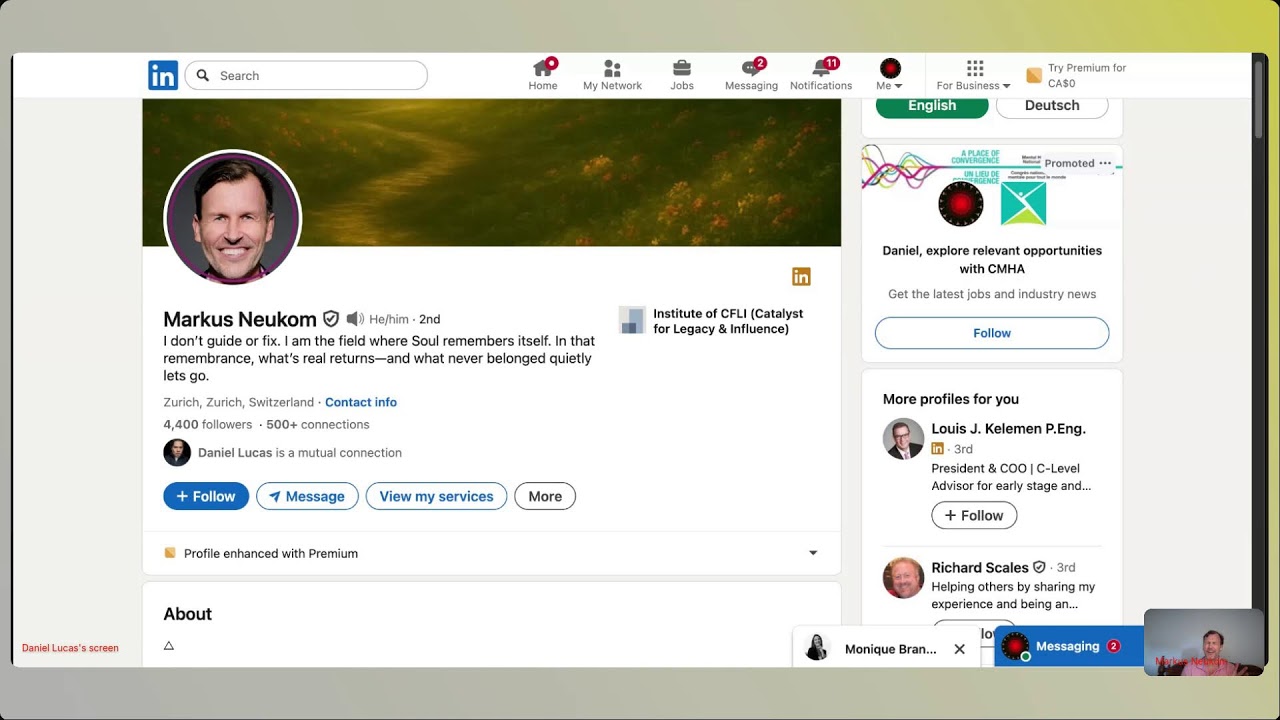
So the most important thing is being willing to become still. And still, Sanna, is not like going into a yoga lesson or doing a meditation because that's still, that's being quiet, being silent. But stillness is a coherence between your thought, your heart. And when this is in coherence, then the soul, the channel to the soul begins to open up. And all people actually have to do is become still, let the thoughts and the heart come into coherence. That's usually when they shut out everything outside and just go into stillness and then actually just listen what their soul begins to tell them. So I'll give you an example. When somebody meets with me, and I welcome anyone on the call to go on my LinkedIn profile, first name, last name, and book a call with me to experience this. Because when people come on a call with me, I am stillness. So when they get into a call with me, anything outside suddenly becomes nonexistent anymore. All the noise they had, all the thoughts they had, all the criticism they had, all the fears they had, everything is just gone. It's just stillness. And all I do is I'm just quiet. But stillness is not void of action. Stillness is very active. So you realize even when I am quiet, when I listen to you, I speak because it's my soul that speaks. So when somebody comes into stillness, quite often it's the first time that they actually hear their soul speak to them. And that is a very powerful, life-changing moment. But somebody has to have the willingness to say, not more, less is the key.
That is quite profound. And, you know, you really actually focused on shifting the perspective towards stillness, because, you know, generally we think of it as, you know, just sitting quiet in a room without any noise, just empty. But there's a lot happening. You know, it's like the the Pacific Ocean. It's quiet on the outside, but deep down, there's a lot of turbulence within, and you're just trying to kind of having a mindful approach towards settling that turbulence.
If you'd see me now, you would see me smiling, and you're probably hearing it in my voice, and I tell you why.
Okay.
You have just given me a confirmation for something that has been birthed just a couple of days ago. Oh,
wow.
I am actually going to run my own podcast. Guess how it's going to be called? Sifting Perspectives.
Oh, wow.
You just used those 2 words, shifting perspectives. It's about remembering what the world taught you to forget. So my conversations will all about be remembering what the world taught you to forget. So you nailed it. It's all about shifting perspectives.
Mm-hmm.
And that willingness, Sana, you would say if somebody's ill, they want to be healthy. Don't kid yourself. So many people have become in love with their illness. And they will fight you tooth to nail to not to become healthy because they have to give up identity and they don't know what's coming when they have been healed. Who are they? Do they still be loved? Because, you know, right now they're being loved because they have problems. They're loved because they're in constant pain. They are pity. But what happens if You actually give up that false identity. What if that imposter syndrome goes away? That is the thing which people have to be aware of. It will change your life. And for that, people have to be ready.
Oh, brilliant. Brilliant, Markus. So if our listeners, once again, because I will be mentioning all the links in the show notes. So for that, if our listeners who would like to connect with you, what would be The best way?
Yeah, the absolute best way is go on LinkedIn, simply send me a connection request and send me a message. You know, even, yeah, say in the connection request that you heard me speak on Asana's podcast and that you'd love to get in touch with me. And then we can book a call and get to know each other.
Brilliant. I'll make sure to mention that in the show notes, Markus, and This was, you know, I think it's absolute proof that, you know, our perspectives can be different. And this definitely gives a different lens on imposter syndrome, personally for me as well. And instead of seeing it as a weakness to overcome, we can start asking where we are out of alignment with who we truly are and how it Exactly. That's impacting our leadership, our brand, even the way we hire, scale, grow, and build. So thank you so much for this profound conversation.
You're welcome. And you can imagine it goes into family, it goes into friendships, it goes into everywhere. It's basically imposter syndrome is poison. Yeah.
So to all the listeners—
Thank you. My pleasure.
Thank you, Markus. So to all the listeners out there, who resonated with what we explored today. This isn't just about fixing confidence. It's about building businesses that actually feel like home to you. Until then, this is BizBlend, and I'm your host, Sana. And to connect with Markus, just refer to the show notes. And while connecting with him, just mention that you heard him on BizBlend. And yeah, that's it. With that, until next time, keep building boldly. but stay anchored in who you are. Thank you.
More from Markus
From Noise to Knowing: The Stillness That Transforms Business, Leadership, and Life w/ Markus Neukom