Mental Health 101 in its first season, featuring Markus Neukom as my guest.
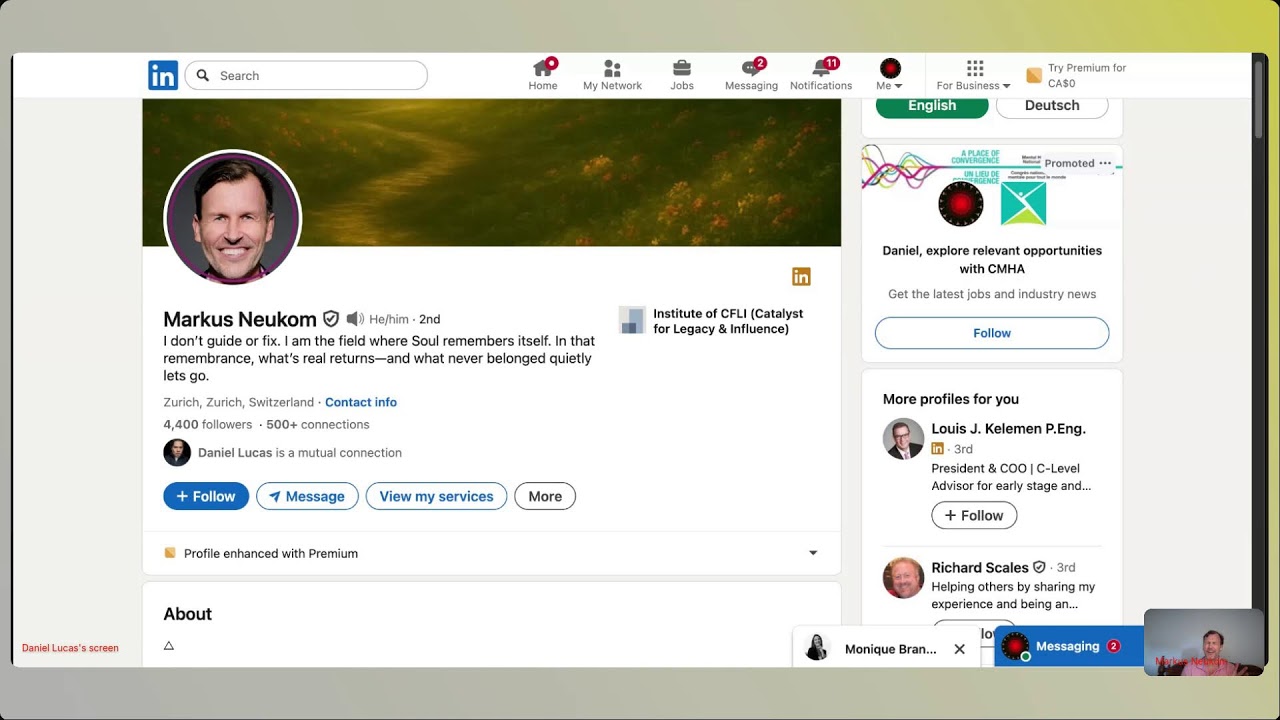
In this episode of the Mental Health 101 podcast, host Daniel interviews Markus Neukom, a former business consultant and executive coach who now focuses on helping people reconnect with their authentic selves. Markus shares how the COVID‑19 pandemic triggered his first experience of deep depression and burnout, leading him to question his role as a public motivator. He describes a turning point when he turned to meditation, inspired by Sadhguru’s Inner Engineering, which helped him align his thoughts with his heart and hear his soul, forming the basis of his coaching practice. The conversation explores imposter syndrome as a key mental‑health challenge, the pervasive stigma surrounding mental health, and the harmful myth that imposter syndrome is an insurmountable flaw. Markus argues that honesty, peer support, and self‑acceptance are under‑utilized resources, often more effective than immediate professional intervention, though he acknowledges the need for professional help when depression deepens. He advocates a ripple‑effect model: one person’s courage to admit “I’m not okay” can inspire broader cultural change in workplaces, schools, and society. The episode concludes with a clear call‑to‑action for listeners to embrace vulnerability, reach out to trusted contacts, and connect with Markus via LinkedIn.
Chapters
All right, that's Mental Health 101. Sorry for that, people. Welcome, welcome to Mental Health 101, featured with Graved, to have mental health awareness. And today I have my special guest, special guest indeed. He is a visionary thought partner and a steward of the Institute of— CBT. No other than Mr. Markus Neukom.
Welcome. Hi, Daniel. Great to be here again.
Welcome, welcome, Mr. Markus. And can you please introduce more about yourself?
You know, I'm a former business consultant and executive coach, and I still do it. but on a different basis. So what I'm doing today is I'm helping people to remember who they once were before the world told them who they had to become, which I personally believe, Daniel, is so connected to mental health. So I'm in the US now. I'm originally Swiss. I'm married to my wife Holly, and we've been married for 15 years. Which is a very important aspect of mental health as well. And, um, I just learned mental health is not something that's been given. It is something you really have to do something for and on a daily basis. So I'm so happy to be here with you, Daniel.
Yes. And thank you so much for sharing your knowledge and wisdom to the world, Mr. Markus. And can you share a personal experience that shaped your understanding of mental health?
Oh, absolutely. And I believe this is one that everyone can relate to, and that goes back to when the pandemic hit the world. Um, pretty much everyone in my environment was already depressed, and probably because I was doing my work working with people on purpose, working with people on positivity and helping them to develop their potential, I lasted quite long without depression. But then I remember, literally out of the blue, it hit me and I was down. So it was the first time when I really felt like, will I ever get out of this again? You know, I went through burnout, so I know very much what this means, but I always knew the next step will come. But as you remember, when the pandemic hit, it wasn't so much anymore my own mental health. It was very much connected with not knowing what comes next. None of us had ever gone through a pandemic. None of us ever knew whether it was dangerous. whether what people told us was true. So I personally said, you know what, I'm a contingency-thinking person, and if there can be a threat, I'll take it serious. So that's pretty much what, what I've done. And I remember it got to the point, Daniel, where I literally asked the universe, should I actually continue posting on LinkedIn, for example, and spreading the message? Because I felt like, what do I have to share? I am depressed myself now. Like, like, who am I to go out into the world and say, you know what, there is hope? And then it was so interesting. Then the universe gave me a beautiful answer. It said, Markus, Especially because of how you feel right now, you need to go out and give people hope, because people have to see that someone like you who has been in the spotlight quite a bit before actually deals with the exact same thing like them, and that there is hope by you actually speaking out. Look, you're not the only one. I am in the exact same boat. So let's actually get through it together. So then I reached out to ChatGPT and asked ChatGPT, what shall I write about? And so I received 10 recommendations, and number 7 was imposter syndrome. And as you can imagine, Daniel, and everyone who listens and, you know, sees us, imposter syndrome has a lot to do with mental health. Because, you know, mental health itself is a very delicate thing, and if you add the thing of imposter syndrome to it, it literally screws you up. So I got to the point where, for the first time, I experienced imposter syndrome in my life, where I thought, who am I to tell the world or to tell anyone what to do? if I am myself at such a low point? So that was an absolute turning point when depression hit during the pandemic.
Mr. Markus, how do you prioritize your own mental well-being while advocating for others?
You see, what's really interesting, I was looking for answers at that moment, as you can imagine. And I never meditated before. Like, I just knew I have the attention span in terms of meditation of maybe 1 or 2 minutes maximum, and then I get fidgety. I need to get up, need to move. But then I found Sadhguru, and Sadhguru is somebody for me who is not a guru. He is someone who bases his stuff on science. So when I studied his stuff, I suddenly realized his Inner Engineering talks about the mechanism that actually builds the foundation for mental health. So I understood if I actually get to know myself, if I get to know what's going on in me, then I will absolutely probably be able to heal myself. So I started meditating. I became a very avid meditator and meditated twice a day. For half an hour. So it was an hour in the end per day. And I did this for many years. So I believe meditation was the foundation for me to get to that place where I was able to say, you know what, let's just zone out the world for a moment. Let's just close my eyes. When I got in in the morning, I just sat here like I sit here now. I just closed my eyes and I just went into stillness. And at that moment, I don't think I knew actually what I was doing with stillness, because, you know, stillness quite often, it's like, is it when you meditate, when you do nothing, when you just calm down, when you silence yourself? And I realized, no, no, I don't think I was actually doing nothing. It was the moment when my thoughts, which can be very crazy as we know, and my heart became coherent, when it became like one stream, when not my thoughts actually governed what I was doing, but my thoughts became the servant of my heart. So it wasn't anymore that my mind dictated how I was feeling, by my heart. And when the soul— sorry, when this heart and my thought became coherent, it opened something which is really interesting. It opened the channel to my soul. So I suddenly, when I was meditating, I suddenly heard my soul speaking to me, which was an incredibly beautiful but at the same time quite challenging experience. Because, you know, when you meditate, you think it's like empty, like there's nothing. But I actually heard my soul, and that's when I understood this is what my clients need. My clients don't need more noise. They don't need more strategy. They don't need more tactics. What they need is something that helps them ground themselves. And that's when stillness was born. And this is what I'm doing on a daily basis with my clients— get them into a place where their thoughts and their hearts become coherent. And that automatically— and Daniel, sometimes for the first time in their life— opens the channel for their soul to speak to them, which is an absolute beautiful thing to experience.
Beautifully, beautifully articulated, Mr. Markus. Totally empowering. So let's talk about the breaking and the stigma. What— why do you think mental health stigma still exists, and how can we combat it?
I believe it has pretty much to do with our society. Um, you see, mental health, I believe, is stigmatized because it shows a mirror to a reality which our society doesn't want to accept. If you look at TV, if you look at media, if you look at advertisement, Everyone looks younger every single day, so you can tell from a mile how many surgeries this person had. And basically it's all about the outer appearance. So imagine, as long as you can, you prevent to be fine, and now you meet somebody who reached the threshold where they cannot pretend anymore. Because their soul started talking so loudly and saying, you know, something is off. This is not healthy what's happening right now. So that's when the, the mental health stigma actually comes into play. Because can you imagine, I was a business consultant and I went on LinkedIn one day and I said, you know what, I'm really done. I'm effing done because I have to pretend to be just fine I have to pretend to be on top of everything. But if I talk to my clients, this is not the one they know. The one they know is the one who shows up and says, you know what, I suffer just like you. I have doubts just like you. I have fears just like you. And guess what, Daniel? This is the foundation for the trust. people bring toward me almost immediately when they meet me, because, you know, I am transparent. I said to myself at that moment, gosh, I am just done pretending. And I believe this is a huge issue in this world because we are drifting toward a point where the soul will not shut up anymore. Because there is so much damage taking place to the soul by trying to keep up the appearance that everything is fine. And now imagine suddenly someone comes and says, you know what, I am depressed. That doesn't fit into that image anymore. I'm not sure whether you know that movie, but there is a movie where everything was black and white. And then 2 young children were actually moved into that world. It's like a sci-fi movie, into that world through a TV, and they were colorful. So suddenly they were black and white as well when they landed, but then more and more emotions, more and more the soul started speaking to them, and they actually started developing color on their skin, whereas everyone else was black and white. Can you picture that?
Yes.
So sooner or later, they actually became quite the threat for the rest of the people. Because if I am used to pretending, and now you suddenly, Daniel, show up and dare to speak about your pain, dare to speak about something is wrong with me, or I am scared The other people who try to pretend— and sorry, that's our entire society and economy is built on that, on pretense— you suddenly become quite a disturbance. And I believe that's why stigma is here, because people try to silence somebody who has mental issues. And, you know, mental issues is not like that they are insane. It's literally My soul is sad, and if I don't express it and if I don't follow through, guess what happens? I become depressed. So mental health is something that's not talked about because it shows a mirror to others who try to pretend to just be all right all the time. And I know this is probably quite an unpopular opinion, but, uh, this is one I totally believe in: the fear of having to look into your own mirror when you actually see the mirror image of somebody else.
Mirror, for sure. Mr. Markus, what's the most harmful myth about mental health you've encountered and why and how do you address it?
So was your question the most harmful mental— oh, myth. Oh, I get it. Okay. Oh, I believe it's absolutely imposter syndrome, that people believe that imposter syndrome exists, and if they suffer from it they're basically screwed. Because, you know, let's face it, imposter syndrome comes into play when you do not believe that despite of all the proof you have, of all the experience you have in the past, that you still doubt you have what it takes. So if you go on Merriam-Webster and if you look into imposter syndrome, it literally says Despite of knowing you have what it takes, you still doubt yourself. So why is that? Why is that? It's literally because we do not know ourselves in ways we believe we do. So you see, in terms of mental health, I believe if People would start talking about it, if people would dare to be honest and open about how they feel, guess what, Daniel? So much less mental health issues. If you bottle it up and you keep it inside, it becomes cancer. Literally becomes cancer. So if we dare to Speak out. You know, I, I just challenge everyone who listens to this show here, reach out to one person who you trust and start sharing openly how you're really doing. And I can tell you that one act can literally change your life, and I totally believe in that.
Definitely. And Mr. Markus, How can we encourage more open conversations about mental health in workplaces or schools?
You see what it is, um, I don't think it can be demanded. I don't even think it can be encouraged. You know what it is? It starts with you, and it starts with me, and it starts with the person who listens to our conversation, because I believe it is almost like a ripple effect, like dare to be that little pebble that dares to be open about how they feel. You know, you don't have to share like your entire mental health story, just share that you are not always okay. And this actually will encourage other people to do the exact same thing. So you know what happens if a pebble gets thrown into still water? The ripples start moving. And imagine now more and more pebbles fall into a huge, you know, thing of water, more and more ripples, and in the end they're actually becoming waves. So it starts with one person who dares to say, you know what, no, I am not okay all the time. And no, I don't like what just happened. And actually, before it becomes, you know, like, like really bad, dare to speak out. I think it literally starts with every single If I wait for you, Daniel, to do the first thing, oh, it never will happen. So it takes courage. But I can literally— I want to encourage everyone here. If you take that courage, I promise you it will change your life. Will there be some people who don't like that because of that mirror image I mentioned before? Of course. But it will help you to stay healthy. And with time, you get to the point where I am at right now, where I honestly, I don't give a flying F what other people think if I express how I'm feeling, because I believe this is my birthright, to feel how I feel and to be honest about it. And by that, giving somebody else the permission to be the exact same thing. And I believe if more and more people start with that in small little steps, we actually give permission to the world to be okay with how they feel. Because pretending to not feel and pretending to be much better than we are, I believe that leads to the mental health pandemic we are in, in this world right now.
Very well said, Mr. Marcus. Totally, totally. Let's talk about the support and resources. What are the most underutilized resources for people struggling with mental health?
I believe it's exactly what I said. I don't think we need to go to psychiatrists or psychologists or psychotherapists. I believe if we just start being honest at first to ourselves and with ourselves by acknowledging and say, you know, I listen to this Markus guy and it really feels good for him to say he's not always okay and he suffers, he's in pain. He went through depression and it seems to be really freeing him. So what if I actually start admitting, only to myself at first, it is okay not to be okay all the time? And then literally start reaching out to people you trust. Start confiding in other people. Because exactly what I said before, if it would happen, it will literally be ripples throughout the entire world. What starts in a very small, intimate way will change the world. You know, the grassroots effect, right? It starts with one person who has the courage to look into the mirror and say, Markus, you know what? It is okay not to be okay, and at least not all the time. And by becoming okay with not being okay, guess what? That mental health stigma suddenly becomes absolutely normal. Like, some of my people, they say to me, Markus, like, it is so refreshing to hear you speak about mental health, and it's so refreshing and Healing to hear you speak about depression, because somebody of your stage does not admit ever, ever having suffered from depression, because that would be the killer of the, of the, uh, career. And I just said, honestly, I don't care if that's the price to pay, to be cast out. I'd rather be cast out but healthy. And guess what, Daniel? The opposite was the case, absolutely opposite. People came to me and said, Markus, thank you so much for being a role model. Thank you so much for being a beacon of hope, of speaking out. And then they came and said, you know what? This is exactly how I feel. How you explained it, how you described it, It felt like you're talking about me. So guess what? If more like me are out there, more like me dare to speak out, admit that they're not always okay, and say to themselves, you know what? It is okay not to be okay. And guess what? This not to be okay is okay. And that's the beauty. I never felt like I'm ill. I never felt like I'm damaged because I understood it's yin and yang, it's duality. There is sadness, there is joy, right? There is peace, there is fear. So the duality actually belongs to us human beings. So once each individual understands and admits It is okay not always to feel okay. I believe that's when the world starts changing.
Mr. Markus, what advice would you give to someone hesitant to seek professional help?
You know, the thing is, it's a very thin line in terms of when to seek professional help, like a psychiatrist or psychotherapist or a psychologist. I believe if somebody reaches out soon enough, To somebody else and talks about how they really feel, most likely the journey to a psychologist can actually be avoided. But it's almost like if you wait too long and if you are already in a depression, that's when I personally would recommend to either get the recommendation recommendation of a friend or of somebody you know who has experienced a psychotherapist or a psychologist. But this is something I can tell you, even if my friends ask me, you know, do you have someone who you can recommend? Honestly, I don't have too many. So if you do actually reach out to psychotherapists Or even psychiatrists, then I recommend you reach out to about 3 people and then literally listen to your soul, because your soul will tell you. Because it is such an intimate relationship, I call it. Like, you need to be understood. You need to feel that somebody really wants to get you. It doesn't even have to get you at first, but they want to get you. Because, you know, let's be honest, you have the answers in you and not the professional. The professional can guide you toward your own answers and toward your own truth. And as I said, if it really gets to the point of depression, then it's probably worthwhile reaching out to a professional who is a, you know, a medical doctor, psychiatrist. Because yeah, that definitely has to be looked at, uh, in a serious way.
Mr. Markus, before we wrap up our discussion for today, I'm inviting you to please listen to my other podcast, people, my other podcast, because my Abstract Essay is already in 5th season, Abstract Poetry in 2nd season, and my Book 101 review in 5th season too. Comedy 101 in 2nd season and My Food 101 in 5th season as well. Geography 101, 4th season. And my baby podcast Law 101 and Mental Health 101. Love Letters in the 3rd season, and Movie 101 Review and Music 101 in 4th season, and Science 101 and Sex 101 in its 1st season. Please listen to them wherever you listen your podcast. So, Mr. Markus, if
you
could— You're a good guy. Yes, if you could leave our audience or listeners or viewers with one message about mental health, what would it be?
Essentially, have the courage to believe and have the courage to admit it is okay to not be okay all the time. I really believe it starts with that, to have the courage to say, oh, I'm not always okay. And it's okay to not always be okay. And then reach out to this one person I said, and have an open, honest conversation. And you'd be surprised how the other person reacts by saying, you know what, Daniel? Thank you so much for sharing. This is really how I personally feel as well.
Totally, totally empowering, Mr. Markus. And thank you so much for being part on Mental Health 101. Thank you for sharing your knowledge and wisdom to the world. So can you please invite our listeners to support your advocacy or whatever projects that you're doing right now?
Yeah, the easy thing is really like reach out to me on LinkedIn, Markus Neukom, last name, first name, and basically connect with me and reach out. I'd love to have a conversation.
Yes, people, reach out to Mr. Markus Neukom because you reach out for sure. You, you will answer all the things you want to be answered. So, Mr. Markus, thank you so much for your time.
Thank you for having me, Doc.
Morticon people, see you soon!
More from Markus

Imposter Syndrome Is a Symptom, Not a Flaw: A Deep Dive Into Authentic Leadership with Markus Neukom
From Noise to Knowing: The Stillness That Transforms Business, Leadership, and Life w/ Markus Neukom