Overcoming Imposter Syndrome and Embracing Authenticity with Markus Neukom

In this Expert Insight interview, host John Golden talks with leadership coach Markus Neukom, known as the Authenticity Alchemist. The conversation reframes imposter syndrome not as a primary problem but as a symptom of a deeper "Authenticity Struggle"—the gap between a person’s perceived success and their true self‑knowledge. Markus explains how labeling oneself as an imposter creates a self‑fulfilling syndrome that paralyzes action. He outlines his LEAPS Leadership Playbook, which deconstructs past successes into a personal playbook, builds authentic confidence, and encourages small, concrete habit changes. The dialogue explores the paradox of fear of success, the role of self‑awareness, and the impact of distraction (e.g., smartphones) on personal growth. Markus shares practical tactics: brief daily walks, cohort‑based peer support, focused 5‑minute encouragement calls, and coaching tech‑focused A‑players (the “divas”) to help them lead beyond technical expertise. The interview also touches on cultural and educational factors that leave high‑achieving professionals unprepared for real‑world leadership, and how failure can be reframed as learning. Throughout, both speakers maintain a conversational, supportive tone, emphasizing empowerment through authenticity and incremental action.
Chapters
All right. Hello and welcome to another Expert Insight interview. My name is John Golden from SalesPOP!, online sales magazine and Pipeliner CRM, joining you as usual from actually a very, very sunny San Diego. I can't believe it's middle of December and it's 80-something degrees out. But today, I'm delighted to be welcoming Markus Neukom, who's in probably a little chillier Boston on the other side of the country. How are you doing, Markus?
I'm doing great. Thanks so much for having me, John.
Yeah, absolutely. Markus is, as you can see, the Authenticity Alchemist, a leadership coach who helps professionals break through mental barriers like imposter syndrome. He works with leaders to transform from technical experts into visionary leaders using his unique LEAPS Leadership Playbook. And what we're going to talk about today is that subject, imposter syndrome. Because Markus, isn't it kind of fascinating how human beings, how we're wired, right? I mean, for instance, you can want, say, a promotion and you can want to move up in the company or whatever. And you can really feel like, I'm the best for this job and I really could do it and I could do all these great things. And then you get given the job, right? And immediately all of that confidence and all the reasons why you ran for the job suddenly goes out the window. And then you start focusing on, well, Am I that good? Do I really know? Are they going to find me out? All of that. Why is it that imposter syndrome is so strong, even in people who on the outside look so confident?
So let me start with a question, John.
Yes.
Have you ever found a lazy person who suffered from imposter syndrome?
A lazy person? No, actually, that's a good point. I don't think so.
Have you ever Met someone who suffered from imposter syndrome who is a mediocre person?
Nope. Again, you're correct.
You see, I did some research, and what I found is that 95% of my clients actually suffered from imposter syndrome without me ever calling it out.
Right.
So the thing is, the higher up in a hierarchy you go, The more qualified people become, the more prevalent this thing called imposter syndrome becomes. So the thing is, and you know, it actually leads me directly into, into our conversation.
Yep.
I found out that imposter syndrome itself is not a problem. It is actually a symptom of a much, much deeper problem. which I'm extremely passionate about, as you will realize.
Yeah,
it is called The Authenticity Struggle, and that's where the problem really lies.
The Authenticity Struggle. That's, that's, that's interesting. So, um, so tell me, why is it, why is it, why is it the authenticity? Because, I mean, as you— is it that as you move up or you get these opportunities, you push yourself out there? Is it that people start to Maybe they don't understand who they really were. Maybe they never really examined who they really were, or they feel like they have to evolve and mold themselves to this new reality.
You actually hit the nail on its head. It's as well as, as well as, as well as. So it literally is. And you see, and that is why it's so interesting to look at imposter syndrome. If someone actually allocates imposter syndrome to themselves, And pardon my French, John, but they're screwed. Because doctors, psychologists, psychiatrists take many different symptoms, put them together, and it becomes a syndrome.
Right.
So now you feel like an imposter and you have a syndrome. You're literally cooked. So I realized allocating myself with that label actually makes me almost disabled.
Hmm.
It makes me paralyzed. So what is interesting, when I talk with my clients or with other people and I tell them, do you know what actually the term imposter syndrome means if you look it up, let's say Merriam-Webster? Despite of knowing you have what it takes, Imposter syndrome kicks in and you feel you do not have what it takes. So it has to be someone who has the quality, has the qualification, has the experience. So now you see, once I have debunked imposter syndrome, and this is actually what I'm doing, I debunk imposter syndrome on a daily basis. And I say, look, let's use you, John, for an example.
Mm-hmm.
You are up for a new project. And we get to talk. And you say, Markus, I really do not know if I have what it takes for the next step.
Right.
I said, John, let's talk about your past career. Let's talk about all the milestones you've reached. Let's talk about how you actually got there. And you see what it is? It's the how.
Yeah.
So as soon as we actually start identifying and dissecting how you got to the last success, They know. And now we take all these past successes, we deconstruct everything,
right?
And we make a playbook out of it for you. And guess what? Suddenly, you know, here is this thing which I never really know what it's called, but here you have the space and here you have the atmosphere.
Yeah.
So now you go up, imposter syndrome kicks in, and you shrink. But my thing is, as soon as you have developed this authentic confidence, which comes from actually knowing yourself, understanding yourself, you have the courage to push through, and you're suddenly in space. And in space, as you know, everything is possible.
Yeah, no, no, that would— that's a beautiful way to put it. And so, so, um, just to go back to what you said, so if Once I apply imposter syndrome as an identifier to myself, I pretty much— for me, it pretty much confirms it inside of me, and I start to go, okay, that is me. I am an imposter. So I believe what I put on myself.
And, you know, if you would just say, I'm an imposter, that will probably not be that difficult,
right?
But because if you apply it as a Syndrome. And the syndrome is quite a tough term, by the way.
Yeah.
If you look it up, it's not just something you sneeze and it's gone. A syndrome usually stays with you for life. So, you know, when I was talking to friends, they suddenly said, Markus, I totally identify with the symptoms of imposter syndrome, but I cannot identify with imposter syndrome itself. And that's when I realized it is actually an authenticity struggle. And why authenticity struggle, John? We have to admit that despite of all the successes we have, despite of age, experience, we do not know ourselves as well as we believe we do.
Hmm.
And that's the authenticity struggle. To admit, you know what, John? I have been in business for 30 years. And now I'm reaching a new pinnacle. I do not know what it takes.
Right.
Please help me.
So
you see what I'm doing with my clients? I'm aspiring partners today.
Yeah.
Yeah.
Yeah. I think, Markus, I think, I think that is what you just said there. I think that is one of the— there's a couple of, a lot of things I want to come back to, but I think that's one of the most liberating ones there is when you When you like look at something and you go, I want to do this, but I don't have all the skills. I don't have all the knowledge, but I know people. I'm a smart person. I'll be able to figure it out if I get the right people to help me.
Yes.
Yeah?
Yes, 100%. 100%.
And you're saying about authenticity, and I think this is so critical because people are talking about authenticity all the time, many times in quite inauthentic ways. But But I feel, Markus, like today is because people are so distracted and they're distracted by, you know, social media, by all these other things going on, that actually going on a journey of self-discovery or self-awareness or even taking time out to try and figure out who you are, who is your authentic self, is something that is passing most people by because they're so distracted or they're just The idea of taking time out to be with yourself frightens the heck out of a lot of people.
Absolutely. If you think about how many people actually fear just having to spend half a day by themselves, and now combined with introspection.
Yeah, exactly.
And I can tell you, I work with caliber who I would say, gosh, they must be thrilled about that journey. And no, I'm actually really freaking out.
Right.
Because I don't know what I discovered. And, you know, authenticity means I look at the great parts and I look at the not so great parts.
Yeah, yeah.
And the not so great parts are usually the potential for success.
Mm-hmm.
Right? So it's literally authenticity struggle is, I believe I must have figured it out already. And admitting Even to myself, that no, I have not figured it out yet. There is room for improvement. You know, that's why most people always go to this glass ceiling.
Yeah.
And then they go down again. You know what happens, John?
What's that?
The term, it's as good as it gets.
As good as it gets. Yeah, yeah, yeah. I mean, I mean, and I think, is that, and I guess that's part of it, Markus, is that if you have maybe a finite view of life, finite view of, you know, you don't see the world in abundant terms, you see it in finite terms. And maybe you think, well, that's it, as good as it gets. I've got my little slice here. I'll just hang on to it.
It's sadly, and you know, it's so much societal and education as well as upbringing.
Sure.
Especially here in the US. People say, you know, it's the land of the free and everything, but I realize there are so many people, they have been taught, you know, let's say, John, you are capable of doing anything you want to, you have all the chances, but then actually doing it, you've not been equipped.
Yeah.
I speak with people who are coming from MIT and from Harvard. He said to me, Markus, when we left, we felt like the navel of the world. And then we figured out, goodness me, we are not equipped for the real world. Yeah.
I tell you, Markus, I had a good dad. There's a friend of mine and he had this other friend who was a very successful business person. And my friend asked him one time, he was in his office one time and he had 2 things on the wall. He had his Harvard MBA and he had his first Chapter 11 Uh, uh, you know, when they went bankrupt or whatever. And he said, you want to know which one of those taught me more?
Chapter 11.
It was Chapter 11. To your point, it's that it's, it's, you learn, you, you learn in the real world and you learn through adversity. And yes, a lot of times people come out with the knowledge but not the, you know, not the skills to be able to, you know, operate in the real world. You know, theory into practice is
I would love to add a beautiful nugget, which actually I found out through my own healing and through my own discovery. It was that imposter syndrome is actually a compliment by life because it says you are surely onto something worthwhile.
Yeah. And I think, and I always think, Markus, authenticity and honesty are obviously very, very important. very connected, right? I mean, and particularly about being honest about who you are and being on, as you said, to achieve a level of authenticity, then you have to know the rough bits as well as the good bits. And I think, yeah, I think if you get to that stage where you are questioning whether you're starting to discover that imposter syndrome, it means that you're knocking on the door of something, right? You're trying to push yourself forward.
Yeah. And, you know, this is one of my biggest projects for '25 ongoing, to really get out there and to talk about debunking imposter syndrome. It's not about healing imposter syndrome. It has to be debunked as a symptom of something much, much deeper than imposter syndrome ever could be. Yeah.
Yeah. And so how does imposter syndrome, when you work with a lot of people, how How does it manifest itself often? I mean, because it's not— it's different for different people.
Yes, I would say quite often, almost all the time, it's as good as it gets. That's the first thing. Because people, you know, if you go back to this metaphor, people go up, but then they realize, I should probably not even go up that high anymore, and they shrink way sooner, right? It becomes even more that thing. So what it often shows is in doubt, questioning yourself, making yourself smaller than you actually are.
Mm-hmm.
It's quite often combined with not going for what you actually would want to. at the beginning it's like, gosh, I wish I would.
Yeah.
And then it even gets to the point, oh, you know what, I'm not even interested, you know.
Yeah.
So it's basically all the, um, the self-debilitating, everything with the, uh, you know, the— what is called the minority complex, all these psychological things which you see out there which you think Why is that? It is exactly because people do not know themselves, walk into imposter syndrome, and then they shrink.
And I always think that, you know, I mean, a lot of people fear failure. Sure, that's the thing. But I always think that the people who suffer imposter syndrome often suffer not from fear of failure, but it's almost like fear of success. It's because, like you said, oh, you know, I want this. But then if I get it, you know, I'm at a different level. I may have to make adjustments. I may— then I may, you know, then people may see some gaps in what I do. So suddenly, it's not even that you feel like you're going to fail. You feel like, if I am successful, it might expose me to even more things.
Because, you know, what's interesting, and I work and speak with a lot of women, and especially women experience that Gosh, if I am actually chosen for this role, what if I'm being found out as an imposter? So the question, John, is not if, the question is when I'm found out.
Right.
So you know what? I just experienced enough in my life, in my career. I've been chastised because I was a woman, because I was a woman. I'm not going to put my neck out there anymore.
Yeah.
And I say, you know what, what is so interesting? Fear of failure and fear of success, by the way, are going hand in hand. Because if I say, look, even if you fail, what happened? You're right.
Yeah.
Will you die? No. Okay, so go for it. Because if you don't die, it will be worth it.
Yeah. Well, because everything is a learning experience. And as we said beginning, as I said from my, from my example, from my friend, I mean, the Chapter 11 was a disaster, but hey, it taught him, it set him up for success in the future.
Absolutely. And you know, if you don't fail, I say you have not dared enough and you don't have lived enough. Simply.
Yeah.
And what is failure? Failure is learning. You see, we have to start debunking all this— pardon my French— but this BS.
Yeah.
That if you fail, you are a failure. No, if you fail, you're actually a winner. But it's about what you do with this so-called failure, with these lessons. That's what makes the difference.
Yeah. And that's what I'm— as I said, Markus, I fear in many ways. I mean, it's great that you're out doing this work because I think it's very necessary because I think the way we're so distracted right now with all this stuff that, that unfortunately, not enough people are allowing the space for themselves to grow and to get to know themselves. So I think your work is really, really important. And as I said, I mean, I think that's the toughest thing today is, is just getting people to take, take some time out.
Yeah. And, you know, when, especially when, when people tell me, but Markus, how much time does that take? Can I afford it? I say, to be honest, you cannot not afford it.
And it's even like, and even like, I mean, I would say to people, like, baby steps. How about you put your phone away for 10 minutes and go for a walk? You know, it's 10 minutes down the street and come back without your phone, or your phone switched off. Don't think, just look, look around, see what's going on, see the birds and the trees or whatever. Just try, try something simple.
Yeah. And when I work with someone, I favorably go on walks with them on the phone.
Right.
Literally, I say, look, get out of the house.
Yeah. I mean, I think that's so critical. Get your head up out of your phone. And like, we're all guilty. I'm not trying to pretend that I'm any— believe you me, if my wife heard me saying this, she'd be going, your head's always in your phone. Don't be a hypocrite. But, but, I mean, I do. I just think, like, you know, just get, get your head up out of your phone for a minute and look at the, look at the world out there and then realize that, yeah, I think sometimes people think that, you know, self-discovery or developing self-awareness, like, it's this huge, long, ongoing project that you have to undertake to make yourself over. No, it's all, it's all baby steps.
Yes. That's how it starts. You know, when, when this elderly woman was asked, How were you able to run a marathon? She said the hardest thing was the first step.
Yeah.
And then it was one foot after another.
Yeah. Exactly. And, and I'm, I interviewed on here a while back, a guy who does the ultramarathons, the 100-mile ones. And I'm like, and here, here's the interesting thing, Markus. Here, he told me you can't train for a 100-mile Marathon, right? You can't, you know, it's like you train for a marathon, you train, you go 5 miles, then you go 10 miles, then you build yourself up to the marathon. So you can't do that. So the only thing you can do is that when you do it is just, it's one mile after another. It's not 100 miles. It's one mile, then another mile, then the next mile. So it's the same concept.
Totally makes sense. Yes, absolutely. And, you know, we have, we have come accustomed that everything has to be perfect.
Mm-hmm.
Um, I become a CEO. I have to know what the heck I'm doing.
Yeah.
No, I do have certain skills available and the rest is learning by doing.
Yeah. Yeah. And,
and, and part of the authenticity comes into, you know.
Yeah, absolutely. And the big part of it is, uh, is knowing where to find the, the skills or the people to, you know, augment where your gaps are, or because you can't do everything anyway. And that's silly to even try. So yeah, I think, I think that's—
yeah, that's when I came to Boston, I decided to actually start, um, little cohorts of 10, 15 courageous women and men who say, you know what, we actually want to break through the glass ceiling. Let's do it together.
Mm-hmm.
Because if you have someone, let's say you have Susan, you can reach out to Susan and say, Susan, do you have 5 minutes? Do you hear me? 5 minutes. Does not take more.
Yep.
And you can share, say, hey, can you give me a word of encouragement? Can you remind me what I said at the last meeting? What my success was? Thank you. And that's all that's needed.
Yeah, well, I think that's great, Markus, because I mean, that's another great point there to end on. It's just that idea of people thinking that everything has to be, you know, so time-consuming, but it's It's 5 focused minutes of encouragement is worth like 3 hours of unfocused chatter.
Imagine I have 15-minute client calls twice a month and that's it. And the rest is impromptu sessions.
Yeah, yeah, exactly.
I mean, yeah.
So the great message to take away here is, folks, you have the time. You have the time. You may not think you have the time, but you have the time. It doesn't, you know, you don't have to, you don't have to go and like become a hermit up a mountain for 2 years or something. You know, you can start with 5 minutes. Well, listen, Markus, this has been fascinating. All of Markus's information will be below the video. But before we go, Markus, please do tell people a little bit more about you and your work.
So what I'm doing is I'm an advisor and I decided to work with tech people. And the reason why I do work with tech people and love it is they couldn't be more different than me. Tech people are usually no BS. They know what they're doing and they're experienced. However, I found out, John, they often lack the skill of talk human.
Yeah.
They have to lead people suddenly out of the cubicle. It's not technical anymore. It's human. So, as a former HR director, I am very skilled in helping companies to help hire the right people and then retain them. Because the retaining is much harder than hiring the right people, right?
Yeah.
And the other thing is, which I love doing, is my pet peeve, is working with A-players. A-players, put it this way, you go to the opera and you have the choir. That's the usual team. And then you have the soloist.
Yeah.
The soloist, male or female, is a diva. And to actually tame a diva, to manage to lead a diva— it takes a diva, by the way, to be able to manage a diva. So I teach my clients how to manage those A-players so they actually can literally break through the glass ceiling and thrive and You know, bring the companies to new heights.
Yeah, no, it's fascinating, fascinating work, Markus. By the way, you just reminded me of something when you're just saying about tech people. Just reminded me of many years ago when I was in Silicon Valley and we had our offices in Redwood City and Redwood Shores overlooking a marina. It was lovely. It was actually Steve Jobs's, the old NeXT computer building we had taken over. And These lovely offices overlooking the marina, and the one next door to me was empty. So one of the heads, the head of development came over from Dublin, top techie guy, right? His office looks out over the marina. Beautiful. First thing he did, pull all the shades down, and then he covered all the glass on the inside of the windows looking into the office so his office could be in complete darkness and he could just have his screen. And I was like, when anybody asked me, I would say, do you want to know the difference between us and tankies? I said, that's it.
Wow. That's a beautiful analogy.
Here's me.
I'm like staring at it. It is the case, you know?
Yeah. But here's me. I'm looking up at my computer and staring at the lovely boats and thinking, oh, it'd be great to afford one of those. Meanwhile, he's just in his darkness with his X's and O's, you
know? Wow. And you know, you cannot, you cannot blame them because, you know, that's where imposter syndrome sets in. They believe they must know how to hire and how to retain talents. It's like, no, it's an art form you have to learn.
Yeah. Yeah.
It's not their fault, you know?
Yeah, absolutely. Well, listen, thanks again, Markus. This has been fantastic. Thank you for watching and listening.
Thank you, John, for having me.
Yeah, absolutely. And I'll see you all again soon. Thank you.
More from Markus

Imposter Syndrome Is a Symptom, Not a Flaw: A Deep Dive Into Authentic Leadership with Markus Neukom
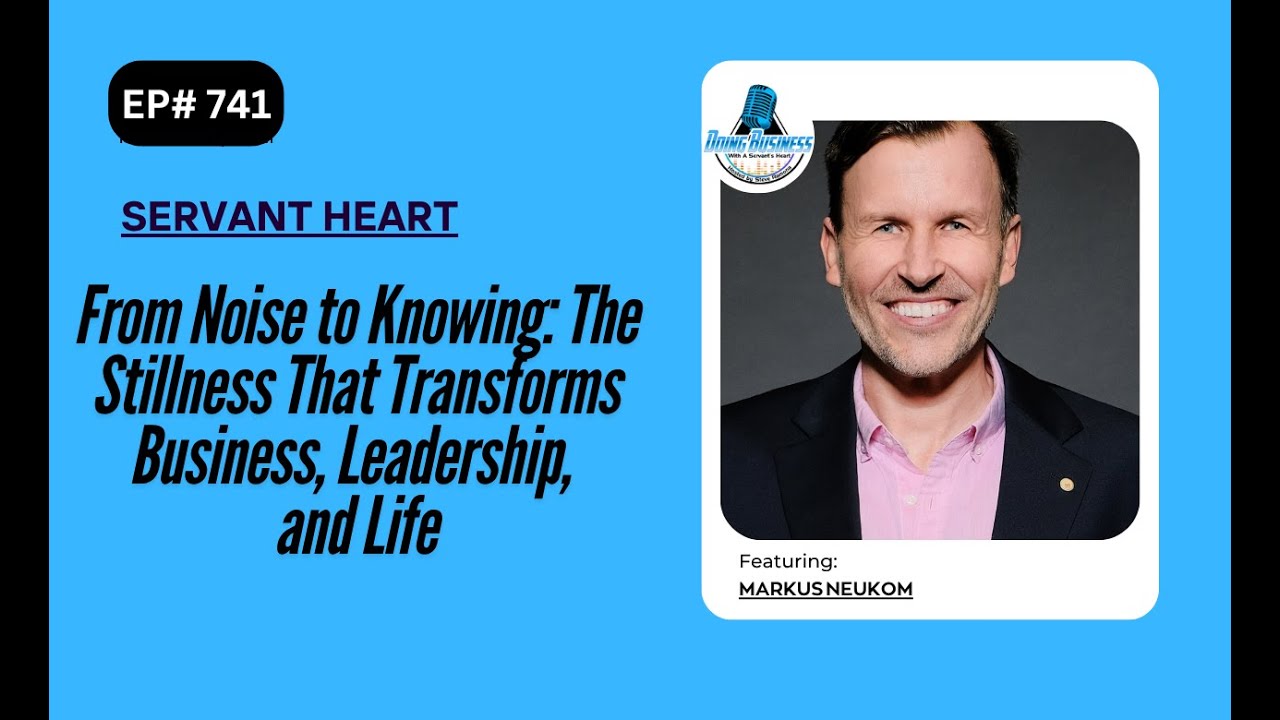
From Noise to Knowing: The Stillness That Transforms Business, Leadership, and Life w/ Markus Neukom