#47 - Thinking Upstream: Strategic Legal Leadership with GC Matt Campobasso
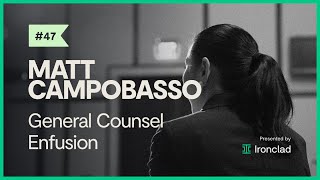
A recorded interview (YouTube, June 19, 2024) in which Mary O'Carroll interviews Matt Campobasso, General Counsel & Corporate Secretary of Enfusion. They discuss Matt's evolution as a GC (joined Enfusion Sept 2020; became GC Nov 2022), his leadership style (humble, curious, business-minded), the importance of building trust and getting into meetings to add strategic legal value, hiring for ownership and cultural fit on a lean legal team, mentoring/learning-by-doing for junior lawyers, and a proactive "upstream" approach to legal risk (prevent problems rather than only extinguish fires).
Questions this video answers
September 2020
November 2022
18 years
45 years old
June 19, 2024
Chapters
Hello and welcome to Pearls on Gloves All.
I'm your host, Mary o' Carroll and with me today is Matt Campelbasa. Matt serves as General Counsel and Corporate Secretary for Enfusion, a publicly traded fintech company that offers global high growth software as a service focused on transforming the investment management industry. Matt spends his time overseeing the legal function which which involves securing the company's interests and understanding and managing legal risk at all levels of the company. As a firm believer in the ethos that a problem prevented is better than a problem solved, Matt is the primary legal advisor to Infusion's business, including to Infusion's board of Directors, Chief Executive Officer.
And across executive leadership.
I loved our conversation and was very excited to have Matt on the show today because his approach to being a general counsel and to leadership generally is distinctly business minded. He really shows steadfast commitment to not just navigating the complexities of the law, but as he puts it, thinking upstream, anticipating challenges, being proactive, taking initiative, and forging those strategic pathways that safeguard and advance business interests.
I think Matt brings a real growth.
Mindset into the role and excitement in learning, building and leading. It's an attitude that I find unique and I'm happy to bring him on the show today to showcase it as I think we can all learn a lot of lessons from his style. I hope you enjoyed this conversation as much as I did.
Hey, Matt, good to see you again.
Yes, Mary, nice to be back.
So we meet again because we already got together and recorded what was possibly the best podcast episode of all time and then realized that it somehow went missing and I don't know if it didn't record or it just got deleted, but so, so sorry about that. And these things happened, but you've been very gracious to come back again and we'll treat that as what, like our practice round?
Absolutely. And how can I be upset about it? Another chance to sit down and talk with you so.
Well, when you put it that way, it was a really great conversation. What we talked about was a lot of your background, your approach to being a general counsel, your just forward thinking mindset that I think you and I agree stands out in the world of legal and general counsel and clos as being just really innovative and progressive and always challenging the status quo and we don't get a lot of that. So I'm super appreciative that you're willing to share your experience and how you see things and do it for the second time.
Yeah, of course. And who knows, maybe I'll Think of something even more profound this time around. So.
Yeah. So. Well, let's just start with as a gc, as a leader of a department, I guess. Tell me how you would describe your style of leadership and how you approach running a department.
Yeah, I think my style has evolved, Mary. I've been in this role now since November of 2022, so a couple months away from two years, and I think it's evolved during that period. I've learned a lot about what it takes to be a dynamic executive general counsel. And I think what that is, is it's not being afraid to not know. I bring a lot of experience. I've been a lawyer for 18 years, but half the time I bump into an issue during the day. I'm learning, and I may know 80% about a topic, but, you know, stopping to listen, stopping to ask questions, not being so prideful that you are unwilling to look to others to say, hey, help me understand what I'm not seeing. It's gone a long way because I think there's a. Probably a lot of general counsels and executives go into situations feeling like, well, I have to be the voice of authority here, and I have to be the person who tells the company how we're going to do this, and I have to be confident. And you know what? There's a time for that, no doubt. But I think the best thing to do is stop, listen, assess, make sure you're. You're considering all of the relevant information and then acting and then deciding. So that's something that I try to do as a general counsel to varying degrees of success. I really strive to my team, like, listen, we need to be leaders, but we also need to know when to lead and when to learn. And in a company like Infusion, which is. It's constantly growing. We've been public now for. It'll be three years in October. We're a. We're a young. I don't want to say immature. We're a young, maturing company, and every week we're bumping into something that we've never really thought about critically. So as lawyers, we're out there ahead of the company, trying to understand what. What is the company not seeing? What do we need to be thinking about? So when I lead, I definitely would say, I don't want to say I lead by committee, because I think that's maybe a little bit inauthentic when decisions have to be made and it's on me to make them, I will make them. But I'm always happy to have other smart, intelligent, you know, intelligent, committed, reasonable people in there with me, lawyers or otherwise, helping decide what makes sense for the company. Because there's really. My job is to focus on legal risk, and I put that in quotes because legal risk is business risk. I often hear lawyers trying to differentiate between the two. And it's like all risk that Infusion deals with is business risk. Some of it is a subset, and it's legal risk. And that's where I need to be a louder voice, but also, I'm not supposed to be the only voice.
Yeah, I think that's. I think your approach is great, and I agree with you. It's really good to be authentic and just be transparent about what you know and you don't know. And it's. No one's hiring you to be the smartest person in the room at all times. It's an awareness of what your strengths are, and then surrounding yourself with people who are, you know, possibly stronger than you in other areas and leaning on them.
Absolutely. Yeah. I mean, the old saying, if you're the smartest person in the room, you're in the wrong room. And it's an impossibility for me to know everything about everything. And that's something that's taken me a couple decades of practicing to realize. I think when I was in my 20s, I thought, oh, I'm incredibly smart, and I'm just going to teach everyone everything. And as you get older, you realize I don't know most things, but other people do know those things. And knowing how to build strong relationships and collaborate is such an important skill, I think. And again, it's something that I really emphasize to my team, and I see it reflected in our stakeholders that we work with. And the winner is Infusion.
Yeah. And. And I want to pull on that thread because that's a lot of what we talked about last time. The last episode of the podcast that just published before yours was with the communications expert, and he talks a lot about how you have to bring sort of a natural curiosity to the conversations you're having, and that helps really build relationships with you. And I had talked in our first run about the importance of building those solid relationships, and that is how you have been able to really penetrate the leadership suite and act more as a leader and an advisor to the company and be more strategic. And that's been your secret weapon to success, is building that trust and building those relationships. Can you tell me a little bit more about how you've been able to do that and what that Means in your environment?
Absolutely. I think I'll limit my answer to Infusion because I have seen the pendulum swing in both directions here. Now. When I joined Infusion In September of 2020, we were a private company. I was the third lawyer to join. We were growing quickly. Our revenue was increasing significantly quarter over quarter. And it was a founder led company owned by a few PE companies and a few individuals. And quite frankly, nobody really wanted to hear from the lawyers. They wanted us to draft contracts, they wanted us to make sure we didn't get sued. But no one saw legal as like a voice that needed to be in conversations about where our business is going. And quite frankly, when I joined, I was very concerned about whether this was the right opportunity for me. I'm not really someone who likes to give up. I'm pretty stubborn when I feel like I'm trying to do the right thing. And so I put my head down and I just said, you know what? I'm going to bring value any and everywhere I can. I'm going to force myself into meetings diplomatically and I'm going to, I'm going to ask to join a meeting. The first, the second, the third time, the fourth time, they're going to ask me to join because they're going to say, you know what, When Matt's here, he brings a different perspective. He helps us consider things that maybe the rest of us who are, you know, more focused on operations, aren't considering. And so that was a journey that I would say probably took about 18 months. Then I started to realize the team grew. I stepped into this role. I was very adamant and very vocal about, like, look, we're lawyers, but we're business people and we're not going to make a situation worse. At a minimum, we're going to be a part of it and we're going to listen. And if there's nothing for us to do, we'll step away. We're not going to get in your way. Usually we're going to get involved. We're going to bring the outcome to a better place and we're going to protect the company at the same time. And those are all great ideas. And I just thought, okay, we have to demonstrate that value, though. We have to show people that we're not just telling them that situations are better when we're involved. Situations actually have to be better. And so because of myself, because of my eight other lawyers on my team, our commitment to doing good things, working hard, when I stepped into this role, our CEO said, hey, Matt, I think you need to be on our executive committee. You need to have a top down understanding of our complete enterprise. There's no other way for you to really appreciate and understand where we're going as a business. And again, as a lawyer, I think any lawyer listening to this would agree if you don't know what's happening, you can't understand the risk. And so I been very fortunate to go from somebody who couldn't get invited to a meeting to someone who gets invited to meetings probably that I don't need to be on. But insofar as that spectrum is concerned, I would rather join a meeting, listen for 20 minutes and say, hey guys, I'm going to step away, than wonder what was discussed in a meeting and what did I miss and how is the company now at risk in a way that I can't understand? So that is something that my entire team has done. It's something that I've tried to do individually and not for the title or the accolades, but rather my effectiveness is directly correlated to my ability to be in the room listening and having a voice.
I'm so glad you're sharing this story because this is the question that I think we get asked the most from GCs, from close, even from legal ops. Number one, how do we demonstrate value to the business, how do we get closer to the business? And how do I become more strategic as a partner to our leadership team? And I think so many of us sit around and wait to be tapped, wait to be asked, and then sort of complain that, well, they presented the job this way, but no one is inviting me into the room, I'm not part of that conversation and therefore I can't do anything. But I really want to be more strategic. And what I love about this story that you've taken is I talk a lot about on this podcast is this victim mindset and the triangle and like taking initiative, empowering yourself instead of just blaming others is what can you do about the situation? And you weren't asked, nobody tapped you, and nobody defined your role as it is today. And so you, you've made that happen. I'd love to hear like, was that scary? Was that hard? Did that take sort of quiet confidence?
Like, yeah, I think it took confidence. It definitely was scary at times and not necessarily because I thought I can't do this, but more like does this? Is the company going to get to a place where they want this from somebody who's in my role? And I'm a big believer in kind of inevitability in life and not to say that everything is pre planned, but in my mind, if I just did the work and proved my value, it was inevitable that I would eventually be brought into those rooms. Whether I sat on the executive committee or I was made the general counsel, that's. To me, that was not part of a long term vision. It was more be effective, do your job. And look, as I've gotten older, I'm 45 years old, I started practicing when I was 26, 27, and my priorities have shifted entirely. I want to walk away from my desk at the end of the day because I'm foregoing time with my kids. I'm foregoing other things that I enjoy in life. It needs to feel fulfilling. And if I was at a company where they wanted me to sit in a box or sit in a room and knock on the door and say, hey, we need you to look at this contract, that's not fulfilling to me. I'm at the wrong company. So I am incredibly fortunate. That infusion our current CEO, our board not only were comfortable with, but it looks like once they realized what I could be and what my team could do, they were like all in. And our CEO, he's a very vocal supporter of legal. And sometimes I'll joke with some of the more tenured members of my team. We'll say, do you remember three years ago and we couldn't even, you know, why are you involved in this? Why are you in this meeting and today to be like, where's Matt? Or where's so and so. And it was scary for sure, just because I didn't know how that would be received. And you don't want to have like an organ rejection, right? And so yeah, yeah. My advice to anybody, any in house lawyer or an ops person, anyone who's like, hey, there's my job description, but then there's what I think I'm capable of doing. Air it to the direction of what you think you're capable of doing. If you're not needed or not wanted, you're either at the wrong company or maybe you misunderstand your value proposition. But don't just sit in the box. Don't just look at your piece of paper that says this is why we're hiring you and say, you know what? This is all I need to do. Look, there are plenty of people in the world that they do that and they earn a living and they retire and they, they go play golf. Lawyers, in my experience want to be the best version of themselves. And so don't be afraid to stretch, have confidence, believe in yourself. Don't take a door getting shut in your face as the end. Build resilience, build grit, and just do good work and let your work speak for itself. I. My son, he was preparing a speech. He just graduated from eighth grade, and he was preparing a speech earlier this year, and he was talking about how good he is at speed. He's a great kid. He's 14. But I was telling him I'm a Chicago guy, a Chicago Bears fan. Walter Payton, the Bears running back in the 80s and 90s, one of my first, like, heroes when I was younger. He has a quote that is maybe my favorite quote of all time, which is, when you're good at something, you tell people. When you're great at it, people tell you. And I tell my team, be great. Let people come find us because they see our value. Don't walk around saying, I make this better or I'm smart or I have my jd. No one wants to hear that. Right. They want you to come in, demonstrate your value, and guess what? The next time they feel like you can add value, they're going to pick up the phone and call you and you've got a seat at the table.
Yeah. And that's the key, though. You've got to demonstrate it. So as you said earlier, you weren't sure if this is what they wanted. A lot of the job is showing them and is proving to them and is demonstrating to them that not only is this what they want, but it is what they need.
Exactly right. Exactly.
And they didn't know it yet until you took the initiative to show them. And what I want to emphasize is, because what I'm coming out of, clock, coming out of so much, I've realized there's a lot of people who are really, really good at their jobs and they're struggling to get to that next level of strategy and leadership, and they're, they're really good at what they do. And they, they put their head down and they're saying, look, I do everything I'm asked and I do it 110% and I deliver it awesome every time. That's only going to get you here. And what you need to do to take it to the next level is to stretch and to push and to get into those meetings and to. And deliver that value and demonstrate it, like you said, so that they see it and it cannot be ignored.
Exactly. You hit the nail on the head with your, with all of those comments. But the first thing you said, which was, I remember thinking I don't know if this is what they want, but I remember, I think what got me through those tough conversations or those tough days was me thinking, yeah, but this is what they need and they just don't know it. And again, when I start to demonstrate my value, if people can take pride and set it aside or take their preconceived notion of. Of what a lawyer can do, if I'm in there and I'm smart and I'm adding value, then what's the problem? Right? And I think it is exactly right. People sometimes don't know what they need. And again, just, I put my head down and I did the work. And thankfully, they were receptive to that. And obviously, I think the company is in a much stronger position from a legal perspective now today as it ever has been.
Yeah, you have a pretty unique background in that you weren't the traditional did law firm, went in house. You've done some other things. Tell me a little bit about your other roles and maybe how they have affected the way that you do your job today.
Yeah, so I've been practicing, like I said, for 18 years. Right out of law school, I was a criminal prosecutor in a county in Illinois county just outside Chicago. My uncle is a. Is an attorney. He's retired, but he was the general counsel of the local AAA Automotive Club. And in law school, I was talking to him and I had good grades, but I didn't have the grades where, like, every big firm was knocking on my door saying, hey, come be an intern summer. And I said to my uncle, like, what are some paths towards, like, growth, Immediate growth. And he said, some of the best lawyers I ever worked with were prosecutors first for a year or two, you get thrown in the deep end, you fall on your face, you make a million mistakes. You see a case evolve from, like, a charge to a jury verdict. And there's just volume, right? It's just repetition. And so I did that for two years. I fell on my face a lot. I won some cases, I lost some cases, and I decided, okay, you know what? I've cut my teeth on trial work. I feel like I have that mentality. And then I transitioned to a litigation attorney at a law firm in Chicago, Freeborn and Peters. And I was there for almost 11 years as an associate and then a partner, primarily a litigator. And so one of the reasons that I was drawn to that firm was because they didn't require you to elect to be an employment litigator or a shareholders litigator. They just said you know what, you want to litigate? We have all sorts of clients. We have huge clients, we have little clients, and we're going to give you opportunity. Which again, was an extension of what I had as a prosecutor. So I litigated hundreds of cases, I tried dozens of cases. And I learned quickly how to be dropped into a matter and just absorb what was happening, learn the subject matter, become proficient about a company's cap table or how an industrial boiler was built, or 1800s railroad law that the Illinois Central Railroad used to acquire land to build out the transportation system when Abraham Lincoln was their lawyer. And it was incredible, and it was overwhelming in the beginning. But what I realized was I found how to quickly get up to speed on complex issues and then to think about them analytically. So I did that for a long time. I liked it. But one thing for me, Mary, that really was a recurring question I asked myself was, okay, even as a litigator, you get a phone call from a client, something's on fire, right? And they're like, hey, grab a bucket. Help us put this fire out. Whether they're the plaintiff and they're trying to recover something, or the defendant and they're trying to prevent liability, something's on fire, it's burning. My time was expensive. They're paying me. There's some uncertainty around how this is going to be resolved. And I thought, even when I am successful and I put out that fire, everything is still burnt, right? And people are unhappy. And I felt like I'm not getting a chance to intervene early enough. And so I would talk to peers and they would say, you know what? In house law, in house lawyers, you get a chance to be in the room, have the conversations, early intervention. And so it just. That stayed with me for years. And then eventually I moved to a legal technology company called Elevate. I did some outsourced in house work for a couple companies. I fell in love with it because I realized, oh, I'm at the. I'm here now in the room when these ideas and these initiatives are being born. And if I see something concerning, I can say, hey, this might turn into that thing that we don't want. Why don't we try it this way? And so I did that for two years. I became the GC of a small consultancy, private company. I was there for six months. I thought it was going to be where I spent my career. That was during COVID The owners said, hey, you know what? IBM's been trying to buy us. Covid is a little bit scary. We're going to go to sell ourselves to. I come along and I considered it, but I thought, you know what? I at that point had started to be more of a leader within the business, have a more of an executive voice. And I really liked it. And so no disrespect to IBM and their lawyers, I just said, you know what, this may not be the right path. So that's what I synced up with Infusion. And what I brought to bear to go back to your question was my ability. I've seen, maybe not at all, but I've seen a lot in my career for a variety of reasons. And what I've realized is as a litigator or someone with a litigation background, I don't know that I would consider myself a litigator anymore. But I have the ability. Half my day is phone calls that I answer the phone or I get on a zoom and I have no idea what's coming. And I need to very quickly understand what questions to ask, how to gather information, what's irrelevant, what's material, and then to provide feedback in real time to our board, to our executive team, to my team. And so those litigator muscles, those being dropped in the middle of something with no notice and having to become proficient and an expert and have a loud voice have translated so well. I know there's almost like a stigma around litigators going in house. Unless you're going to be an in house litigator managing litigation. And to anybody listening who is litigating or who's in house currently and you're thinking about filling a role, I would definitely recommend to give a litigator a close look because I feel like there's a very amorphous skill set that they bring that isn't maybe necessarily apparent on paper.
Yeah, I think that's right. And between you and me, I used to always tell the litigators at Google, they're my favorite because when you talk to litigators, you know exactly what they're thinking. They just, they just tell you exactly what is on their mind. You're. You described a day in the life of a general counsel just putting out the fires, moving quickly, needing to make decisions quickly. This is another question that comes up a lot. There's folks who are at law firms or junior folks in house who aspire to be a GC or a CLO one day. And their question is, what is it really like to be a gc? What makes it so different? What is a day in the life and what, what's really important to be focused on.
What's different is at a law firm, you are a subject matter expert or you're a specialist and you get a phone call. And for that client, that's the most important thing. When I pick up a phone and call an outside counsel, it might be something that is number one on my priority list. But more likely than not, it's number 57. And I've exhausted internal resources, and I just need someone who knows this to spend a couple hours, come back to me, sanity check, something point me in the right direction. As a law firm lawyer, I didn't appreciate that. I thought, well, this is very important to me. I'm assuming it's just as important to you because it's your company and not that it wasn't important to the general counsels. And I've learned on this side of things, these things are all important to me. But when you're dealing with 200 issues a day, you have to be able to quickly assess, okay, how severe is this? If this goes poorly, and what's the probability that this is going to go poorly? And then you have to prioritize from there. That, I think, actually lends itself to answering your question about my day. Every single day is different. I know that's a cliche. A lot of people say that. As a litigator, my days were very similar. Review discovery, review documents, do some research, take a deposition, go to court for a status call. Again, meaningful work. There's people that do it and they need to do it. It's help. It's part of our justice system and our legal system. That is not my, my day now. I mean, just to use today as an example, I woke up and I had two scheduled calls on my calendar. I looked right before this. I've been in 13 calls. And so. And I don't have when my CEO calls or when our. The chair of our board calls, or our CFO or our coo, all of which have called me today, I have to answer because I can't say, oh, well, my boss will get this right. My boss is who's calling me and. Or my team is calling me because they've taken something as far as they can and they need me to weigh in. What I've realized is I've got to work in the margins when I need to get something done from a time perspective, because more often than not, I'm just being pulled in a million directions. But then to go back to my. To your question about what I think has made me successful, is I thrive there. The cognitive ability to switch from a contract dispute to a contract negotiation to an employment issue, to board governance. I mean, that could be 20 minutes for me. And initially, like, I'll be honest, it was very overwhelming because I thought, okay, how do you, how do people do this? And I just realized you take things as they come. You don't let the day speed you up, you slow it down. And again, being able to prioritize, what do I need to spend an hour on? What's a five minute conversation where I tell somebody something and step away? And so every day there's a couple things that I need to spend meaningful time on and there's a dozen things where I'm just like, here's my two cents. Good luck, come find me if something goes wrong. I don't want to leave somebody in the lurch, but like, I don't have the ability to be everywhere all at once. And obviously that's, it's not realistic. But, you know, enjoy it. I mean, I enjoy this. It sounds, When I first stepped into the role, I thought, okay, like how do people do this? And I have friends who are GCs. And I called them and I said, hey, how do you like, balance everything? And every answer was different. And so what I realized was I just need to figure out what works for me. And so I do my best. I'm sure I make mistakes obviously, but yeah, I mean it's, it's incredibly rewarding. I've told people I've never worked this hard in my life as a lawyer and I've never been as happy as I am. So I mean, if those two things can be true at the same time, like, I feel like I'm pretty fortunate. So God willing, this will keep going the way it is.
Yeah, I, I, I find the same. I am most happy when I'm working the hardest and, and it, it's, it feels satisfying. Like those somehow go hand in hand. I, I think a lot of what your job and, and in house teams and GC's role is also trying to constantly balance the short amount of time needed to make a decision with the amount of information that you have and, or need. And at some point you just got to make the call, which, which is very different than being in a law.
Firm where you have time, it's night and day, and not to turn this into a stump speech about the billable hour, but at a law firm, if you can spend 10 hours doing something and it actually adds value to your clients, what your client needs, you Justify that, and it's good for your business, right? That's generating revenue. And look, lawyers are bound by ethics. And I know lawyers generally, in my experience, are very good about spending the time that's needed to spend, but it's not a clear line, right? It's like, okay, well, I spent four hours. I could probably spend three or four more and get, like, a really solid answer and go back to the client with great confidence, rather than, I think so. And guess what? It also puts an extra $5,000 on.
An invoice, and it might be too late.
Right? Exactly, exactly. I mean, I. I tell people, like, we are not law. A lot of the lawyers on my team are former law firm attorneys. And I said, look, this is not about perfect. This is about using, Utilizing your judgment and your experience to get as close to a certainty as you can while facilitating the business and their ability to be strategic and to execute. Right? We need to facilitate the business, not slow it down. We should never slow it down. And I tell my. My team, be brief, be brilliant. Get in, get out, Spend the time you need to. Right? Don't be efficient just for the sake of being efficient, but balance that efficiency with that effectiveness. And it's night and day with how law firm lawyers think about that. It brings me to something that I think we talked about last time. Every year, I pick a book for my team to read. And two years ago, the book we picked was a book called Range. And it's about generalists. And you think about the world and people that want to be a specialist, right? You want to be the doctor who specializes in cancer of the legs or the lawyer who is the deepest knowledge of the foremost expert at antitrust law. I may have to pick up the phone and call that lawyer. And I need them to be aware of all aspects of antitrust law. But that's not something that is good for me. And I have told my team and I have emphasized we need to demonstrate range, right? We need to be able to understand and see the whole playing field. Because when we're brought into a situation, the business partner may say, hey, you know what? I have a question about X. And great, you can answer the question about X. But I would love them also to say, hey, you know what? You're not asking the questions about Y and Z, and that's range. It's the ability to see something. And I tell my team, you don't always have to be the person who can answer the question about Y and Z, but just enough to know, hey, there's more here than I was presented with. So we need to go find one of the colleagues on our team or we need to go to outside counsel. I do have specialists, I have lawyers that are securities lawyers, I have lawyers who are commercial lawyers, I have lawyers who are employment lawyers. But I tell them first and foremost, you're lawyers and so, and you're business people. And so for us in 2022, range was like the epitome. It drove our entire year, all of our strategic goals. And I have heard feedback from the business now over the last 18 months. Man, I'll bring your team in for one thing and they highlight five other things and they don't just say, hey, these are other things you need to solve for. They own that and they help solve for them. And so that is something that I think an in house lawyer has to be able to do and is to just demonstrate broad vision and to not ignore something because again, it's not what was brought to you. We don't have that luxury.
You mentor a lot, know that you are very passionate about training the future generations of great lawyers and GCs. That's got to be changing the way we train our young associates. In light of everything that's happening in our industry, our space, AI law schools, law firms, it's all getting disrupted. And as we think about what we need for lawyers of the future and even like how legal departments are run in the future, what, what is your view on how we train young attorneys and is it more mentoring, is it more apprenticeship? Do you have thoughts on. You talked about you've got thrown into a lot of fires and did a lot of like drop in and figure it out in your experiences. Is that still the way and I think so, yeah.
I mean, far be it for me to say what's the right thing for the profession as a whole. What I have found in my own personal experience is getting dropped in the deep end is a pretty powerful learning tool. It can be scary, but there's a way to do it where things aren't ever like truly at risk. We have lawyers on my team like myself who have almost two decades of experience. We have lawyers with 10 years, we have lawyers with three years of experience. And we don't have the luxury of 50 lawyers to throw at every single thing that comes up. So we have to be very selective and deliberate about how we use our time. And so some of the younger lawyers, like we give them things that they've never done. Now the key is we stay involved. We're here to answer Questions. We may sanity check something before it goes out the door or before we message it outside of legal. But forcing people to stretch requires them to think critically about what they're doing and not just saying, hey, do this thing, this defined task. Because again, there are lawyers who are like, hey, I'm going to go do this and I'm going to write discovery and that's going to be my existence. Again, I don't have the luxury of that. My team doesn't have that luxury. So in my experience, especially in an in house role, putting people out there in a position where they're uncomfortable, again, not to be punitive, not to make them feel uncomfortable for the sake of that, but putting them in positions because uncomfort is growth, right? It's requiring them say, I've never done this, I need to figure this out. I remember being in law school and saying, hey, okay, this is great. Conceptually. That's one of my big criticisms. And I know I'm not alone, is law school doesn't really do a great job of training people to be lawyers. They train people to think like lawyers, right? To be a lawyer, you have to be a lawyer. And so it's scary. Again, I said, as a prosecutor, I fell on my face so many times. Just horrifically embarrassing situations. But guess what? Every single time I go back to my office and think like, okay, well I can't let that happen again. That was. And you learn those lessons the right way rather than having someone say, hey, you shouldn't do this, don't touch that stove, fire's hot. You touch that stove, it's hot, you're never doing that again. And so with young lawyers, in my experience on my team, the most effective way to train is just through repetition, experience and mistakes. And one of the things that myself and other leaders on my team really preach to our team is, look, go out there, do your best. If you make a mistake, I'll own that. When you deliver and there's glory, that's yours. And I think giving people that confidence that like, look, if things go bad, you're not alone. This is in a law firm, that's not always the case. People at law firms are very like, I'm about me, I'm my own brand. And look, my team, I trust all eight of the lawyers that work for me implicitly. And there's a power in that because we feel confident that like, look, if we get out there and do it, we're going to have each other's backs. And again, for our young lawyers Knowing there's a safety net there. And the worst version of this is we learned some lessons the hard way. To me, that's, that's optimizing the ability to learn.
And, and you look like you're home or I am a corporate office, so I assume you're some sort of remote or hybrid work environment.
Hybrid.
So many of us are hybrid or remote now. And young associates or lawyers who need to be trained. So much of it in the old days, sitting in the room, watching, learning from the partners. Is it harder now that it's all remote? And like, how do you make sure that everyone's getting mentored and learning in the same ways if they're not able to see.
Yeah.
In real life?
That's a great question. I think that I'm, myself and others on my team are very deliberate about spending time on zoom with each other. And sometimes it might be getting on a zoom and redlining a document together, one of us controlling the document, one of us voicing over, hey, like, when I've seen this, this is what. Or I've seen this in a trial go horribly. And this is why. And look, it's, it's a different, it's completely different than it was sitting next to somebody in a war room for eight hours. But I think that you can still extract the same sort of value. You just have to be deliberate about spending time, I think, on Zoom. In a zoom culture, especially during COVID you get onto a meeting, you talk business, everybody hops off, and then you're by yourself, right? And there's going to always be people who dig in and learn and teach themselves. But the most important things I've learned in my career, I've learned from other people. And so there's no substitute for spending time together. So my team has a one hour weekly meeting where we just get together, we have an agenda, we talk through things. Everybody has a chance to talk about, to brag a little bit, to say, hey, I learned a tough lesson this week. It looked like this, hey, this is what I'm seeing over in the business over here. I have a weekly leadership. I have three direct reports. We meet once a week. I have one on ones with each of them. And then some of the junior lawyers on my team, I have recurring scheduled meetings with them just to say, like, hey, you have a manager and I'm sure they're giving you what you need. How can I help you? Because the more effective they are, the more successful they are, the more effective our team is, and the stronger our team is and the better off infusion is. So those are the things where we invest our time that doesn't have maybe necessarily an obvious and direct roi, but in the long run we're developing a culture and this kind of mentality of like, hey, we're a team and I've got you and you've got me and you're going to learn and you're going to be supported and you're going to make mistakes. But if we're all doing this the right way, we're going to end each week better off than we started it. And that's, that's the goal.
So, yeah. Are there skills that you look for or skills or attributes that you look for when you're hiring? I know you have a lean team and I want to talk about that as well. Like you've been able to do a lot with a lean team because of the way you've established your culture and you're hiring the right people. Like, are there things that you look for in these individuals and what makes them successful in your world and how have you been able to keep it lean?
Yeah, well, we've kept it lean because I'm very specific and deliberate about hiring. I never want to hire for work I think I'm going to have in six months. That would be great. It's not a luxury that we're a small cap public company and resources are allocated. We're a technology company. Right. We're spending money on technology. Legal's here, but we have to be very economic with how we spend dollars on legal. And so myself and others on my team have to extract every ounce of value we can from the dollars that we have. When I go to hire, we'll see. We'll post an in house role and we'll get 200 resumes. And you've got your Yales and your Harvards and Princetons and those are great schools. And I have nothing against them. I did not go to one of them. They wouldn't have me. It's okay. But I think that more than like, hey, I am a 4.0 student at a prestigious Ivy League school. That's great. But I need someone who's going to come in and roll up their sleeves. And not to say that lawyers from those schools wouldn't do that. I need someone who's going to say, hey, I want to jump in and be more than a lawyer. Because that's the profile of what our team has established. And so I've had roles come down to two or three people and Mary, ultimately, what has been the deciding factor for me is, do I like this person? Do I trust this person? Are they a nice person? Again, my priorities have shifted so much over the last 20 years. Not that I didn't value being nice and nice people when I was 25, but to be effective in our role, people have to trust you. And it's great if they like you and if they want to spend time with you, because in spending time, they're teaching you about their day in our business. And so I want somebody who has a baseline of intelligence and academic experience and qualifications. And then obviously, if we're hiring for a securities role, I want somebody who's done that. But If I get 20 people who have securities experience, my odds are I'm going to go with the person that I feel like, oh, I could spend two hours on a zoom with this person, really digging into something and enjoy that time. And again, it goes back to what you said and what I said earlier, which is, I don't mind working hard. In fact, when I'm doing stuff that I really like with people that I really like, time flies. And I find it's a lot easier to give that extra 10%, which can make the difference in the long run.
Yeah. And each hire is so much more important when you're a small team because they affect so much of the culture and the way the team operates. So it's important to get it right. Is there one skill that has, you think, allowed you and or your team members to be most effective in this role?
There's a few. I think one that I would love to emphasize for today would be, I don't know if it's a skill or kind of a guiding principle, but it's just ownership. I feel like a lot of times in corporate America, it's baton passing and people, okay, I did my part. Here you go. Take it from here. My team, part of it's me, I think, hopefully, leading by example. Part of it's just innate in the fortune I've had in hiring good people. But I hear repetitively from our business man, once your team is involved, they stay involved. Like, I would think, oh, they're going to get involved and solve for this issue. But they actually see it through to the end. And the whole time that they're involved, they're adding value, and if they do step away, it's because there's nothing left for them to do. And so that level of ownership and willingness to see something through to the fruition or to the end has been Incredibly, I think, impactful for our business, and it has allowed my team, again, to continue to be effective and to be welcomed into situations. The other thing I would say is it's more perspective than it is a skill, necessarily. But to my point, about the books that we read this year, we're reading a book called Upstream, and it's by Dan Heath. It's about being proactive rather than being reactive. And to go back to what I was talking about 20 minutes ago at a law firm, you are reactive because you don't know what's happening until your phone rings and again, you put out a fire. Things are burned. Even in a. Even in a good situation, being proactive is so important because you identify patterns, you identify rhythms, and you say, hey, you know what? We've dealt with pain from this issue six times. If we go back two steps and we make this change, we might not deal with this anymore. I read the book. It was actually a gift from. To me from a mentor of mine. And it opens with a short. We'll call it like a parable or a story. And I read it, and within, like, two minutes of reading it, I. I was reading it more personally, and I thought, this is the book for my team for this year. The story goes, two people, two men are fishing on the bank of a river, and they see a child floating down the river, like, flailing. And they drop their fishing poles and they swim. They grab the kid. They swim out, and they look at each other like, whoa. And the kid's drying off on the bank of the river, and they look back, and there's another kid. And they go out and get him, and then they swim back, and then they go out and get another young woman and then another young boy. And the fifth time, one of the fishermen's, like, swimming out there, and he's out of breath, and he's like, what is happening? And he turns to his friend to say, hey, what is going on? And his friend's not there. And he looks up, and his friend's, like, running down the riverbank, and he's like, where are you going? And he said, I'm going to find the maniac throwing kids into the river. And it's like, how many times do we have to swim out and save a kid before we go find the root cause? And so that's very rewarding, because the best problem, in my opinion, is the one you never have. And. And what's funny, I like to use fire as an analogy a lot. I'm not a pyromaniac. It's just, it's such a. To me it's risk, right? And it's uncontrolled. Risk is the potential to have more widespread damage. And you think about who are the heroes when it comes to fire Firefighters. They're the ones who put out the fires, right? They have parades and kids stop and they wave. The electrician who installs good wiring, no one throws a parade for him. But guess what? If he does his job well or she does her job well, there's never a fire to fight. And so I tell my team, let's be electricians, let's be home inspectors, let's be the people who are putting in smoke alarms so that there's never a problem. Or if there is, we catch it early, we extinguish a spark and we move on. And again, there's not a lot of glory in that, but there's a tremendous amount of self satisfaction.
Yeah, that reminds me, I used to tell my ops team at Google the same thing. We're like the bomb squad and we make sure everything is running smoothly in the background and it's totally thankless. Oh, so thankful nothing goes wrong. There's no emergencies and that's a good thing.
But you didn't save us. Well, there was nothing to save you from, but you're welcome. And it's again, I'm a big analogy guy, as you can. I'm sure people can tell at this point. I was meeting with our board last year to do an annual like state of the legal union at our company. And I told them, I said, look, I envision my team's role kind of two ways. We are the bomb squad or we're the bomb sniffing dog who's out there ahead of the company making sure that the path we take is as safe as possible. But at the same time, we're also a suit of armor on the business. So if we miss one of those bombs or mines and we step on it, the damage is minimal. But then we have to make sure that the suit of armor is nimble and fluid so the business can be effective. And so it's a. There's a lot of analogies in there. So hopefully I did a decent job explaining, but that's in my opinion, like you're never going to avoid all risk. And so you've got to be thinking proactively, but you also need to be able to react quickly and decisively. And then in doing so, that radius, that blast radius can be contained as much as possible. And again, at the end of the day. That's my job as a general counsel and my team's job, which is just maniacally protecting our business and our shareholders investments.
So you talked about the ownership mindset. I, with our founder and CEO Jason. We talk a lot about, we call it the founder's mindset because it's like the owner's mindset, but it's almost another layer or another level of initiative.
Right?
Because it's like you, you go fix everything and there's nothing that's not in your lane when you're a founder. I think I recall the last time you and I talked as well about taking initiative. It's also the ownership mindset of things that are not in your lane. And I think you gave an example of you saw something that was broken and nobody owned it and you went out and fixed it and it wasn't even your responsibility. And it's not like a cool, sexy project, but you went out and did it. And that's important.
What we talked about was our procurement function, which when I joined Infusion, we did not have. And I remember thinking like, hey, I just reviewed this contract that we're, we're going to spend a hundred thousand dollars. Like, who owns this? And people are like, I don't know. And I'm like, I have questions, I have concerns. And so I went to our CFO and he's, he's no longer with us, but incredibly smart guy. And I was like, look, I have some thoughts on how we can evolve this and mature it. And he was like, oh, okay. And I think he was more like, aren't you a lawyer? Like, and I thought, hey, but if something's broken, why do I have to be only a lawyer? Can I just be an employee who cares and who wants the company to be as effective as possible? And that's how again, there's a big thread running through here. I think I've been able to demonstrate my, my effectiveness for the business. And it's a double edged sword sometimes because people are like, let's invite Matt, or let's invite someone from Matt's team. They'll own this. And it's like, hey guys, I would love to. I'm owning a bunch of legal stuff. I will be involved. So it's, it's the old adage of you give somebody a fish, you teach somebody to fish, right? And so I have to be very selective in where am I going to be the fisherman and where am I going to give somebody a fish? And it depends on the situation in the day but early, early infusion days when we had no sense of what a procurement program looked like. I don't even know if many of the people knew what procurement was. I said, hey, you know what, like we're going to be better off because of this. And self servingly my, my life will be easier because there will be people who are accountable. And I set out and I built something and then we later went and brought someone in to run procurement and I remember him saying like, oh, this is a pretty mature system for a company that never had a procurement department. And I said, you're welcome. Like again, not for the glory. It made my life easier, but it made the company better. My job isn't just to focus on the law here. My job is to be an employee who brings value to my employer and that can take so many different shapes and forms. And again, to your point about lawyers who are like fearful about stretching or forcing themselves into situations, be diplomatic about it, be thoughtful and self aware, but don't be afraid to try. And even if you make mistakes, just do the work. You're going to get it right more often than you're going to get it wrong. And over time people are going to realize you're someone who cares and you can bring positive change to the organization. And any company who doesn't celebrate that probably isn't going to be around for very long.
Yeah, I, I, most of my jobs that I've had have come with no job description and, and I love to hire people who are so comfortable with the idea that there is no job description because they want the job that they can create, that they know what they want to do. And like, like we said, convince you, the leadership team, the company what is needed and show that value and mold themselves into doing more than what's on that paper.
Yeah, I, you know, it's funny you should say that because I was in another role before this and I had an opportunity to go to IBM and if you would have gone back 15 years of my career as a law school graduate and said, hey, someday you can have a job at IBM, I would be like, yeah, when do I start? And it wasn't that I didn't want to go work there, but in my interview for my prior role here as deputy general counsel, the general counsel said look, we were a one lawyer shop for a really long time. We are thinking about going public. I don't know what a law department looks like. I need someone who's been there and seen that to come in and build it And I thought, absolutely, like, I want to put my fingerprints all over this. And I've been fortunate to be able to do that. Sometimes you think about a job as an opportunity to do that, and then it doesn't necessarily turn into that. I have been so lucky to help shape what our law department is, and I think my fingerprints are all over it, and my team as well, because I am very much like, look, you guys have been other places. You've seen what works well, what empowers you and what you enjoy. Like, let's do this together. Let's collaborate. But, yeah, the idea of being able to build this team, I'm proud of the work we do every day. But like I said, last year, I sat down with our board and spent an hour talking about our department. And after the meeting, one of our directors came up to me and said, I have never heard a lawyer speak so passionately about what they do. Like, you must be so, like, rewarded. And I'm like, I am. And I'm like, you still have to pay me, please. Obviously. But I love what I do. And so, yeah, it's a great thing, and I'm incredibly fortunate. And it doesn't. Even on the hardest days, I have to remind myself of that. There's again, if I go back 17 years, 16 years, to the mat who was coming out of law school, working as a Prosecutor, people stealing TVs and packs of gum. Again, not to diminish that. That's a. It's a required, necessary part of our society. But it's been a pretty incredible journey, and I'm very grateful, and it's clear.
That you love your job, and I think Infusion is extremely lucky to have someone like you. So thank you. Thank you for your time. I feel like I learned a lot. We all learned a lot. You shared some great, great approaches, and I love the way that you're leading your team.
Well, thank you, Mary. And it was really nice to be back. And even if this one takes and you want to have me back sometime, I would love to chat again.
Sounds great.
We'd love to do that. Everyone, thanks for listening.
More from Mary








#56 Ending the Billable Hour Chris Grant’s Mission to Transform Legal Services


