In this HIT Lab symposium session, Alexia Priest interviews Maryam Nabavi, co‑founder and CEO of Babbeli, a digital health startup focused on early speech and language development in preverbal children. Maryam shares how a personal experience with her own son’s delayed speech sparked the creation of Babbeli, which uses AI to analyze infant vocalizations and classify developmental milestones. She explains the high variability in pediatric speech trajectories—due to prematurity, bilingual environments, gender, and socioeconomic factors—while noting that preverbal babbling patterns are universal across languages, enabling a broad‑scope machine‑learning model. The conversation highlights AI’s strength in large‑scale pattern detection, positioning it as a decision‑support tool for clinicians rather than a diagnostic replacement. Maryam describes the challenges of building a clinically validated dataset, hiring speech‑language pathologists to label infant utterances, and the current focus on accurate milestone tracking rather than definitive risk prediction for conditions like autism. Looking ahead, she envisions providing continuous, objective data to speech therapists to monitor therapy effectiveness at home. Funding and commercialization hurdles for long‑term pediatric AI projects are discussed, emphasizing the need for investor patience and a hybrid approach that pairs AI with clinician expertise. Finally, Maryam raises concerns about equity and inclusive AI, noting the high cost of collecting diverse data and inviting collaboration to address these challenges.
Chapters
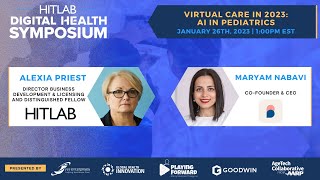
Alexia Priest joined HIT Lab last year after a long and distinguished career at Boehringer Ingelheim, and she helps HIT Lab technology companies who are in our studies develop strong relationships with payers, providers, pharma, and others for distribution channels and other types of licensing. Applications of their products and leads the BD&L strategy practice at the lab. So Alexia is going to be joining us today and interviewing a CEO and co-founder of a disruptive digital health company, Maryam Nabavi. And so looking forward to this tremendous interview around what's going on, what we heard at JPMorgan relative to virtual care and pediatrics. So handing the virtual microphone over to you, Alexia.
Thank you, Stan, and thanks for the introduction. Now I don't have to do it. Thank you very much. I appreciate that. Hello, everyone. It's a pleasure to meet everyone virtually. I want to thank HIT Lab for conducting the meeting and for the HIT Lab team and all their efforts in putting this together. I don't have to introduce myself, so I can skip that whole segment. And so at this time, I'd like to welcome our guest, Maryam Nabavi. And Maryam, would you kindly give us a brief introduction of yourself and your company?
Absolutely. Thank you for having me. So I'm co-founder of a company called Babbeli, and we are parents' source of support for everything related to their child's speech and language development. I started this company as a result of a personal experience with my son. He, between his first and second birthday, and I was a first-time mom, I noticed he wasn't really talking much. As it turned out, and going to my pediatrician, Googling, going to Facebook groups, asking other moms wasn't really helpful. I was getting very different answers in terms of whether this is okay or not. That process led me to really understand the variability when it comes to developmental milestones and what we think is source of truth versus actually being source of truth and how much anxiety parents go through. So after about a year, we started to get coached by a speech language pathologist, and that completely changed my life and his. He went from being a nonverbal 2-year-old to putting short sentences together within 6 months. And that inspired me to really think about how can I provide the support tools to other families who are probably struggling with the same questions so that they don't have to go through the process that I did.
Oh, thank you for that. That's, that's probably— you're so passionate about it and that's terrific. Thank you so much. And with respect to your company, can you describe or share with us any information that you found related to variability in pediatrics? And also including with that the variability that you may have seen in developing AI?
Yeah, so before I answer that, what we have done in the past few years, we have developed an AI that's able to take a child's, a preverbal child's voice as an input and classify the type of milestones and utterances that they have. So while there are lots of variability in the 0 to 5 years, and I can speak in terms of speech and language development, of course, you know, being a preterm child completely changes the trajectory of a child's development. Whether children are born into bilingual homes, gender of the child can have some variability, It's not as much as parents think. And even so, things like socioeconomic condition of the family can have an impact on how different a child's speech and language trajectory is versus their peers. The good news is, at least for the preverbal age, what we found was the patterns of speech that children go through are universal regardless of their first language. So a Japanese-speaking family who has a newborn that newborn will go through the exact same patterns of speech or babbling as a baby that's born into a German-speaking family. That allowed us to build ML models that are able to classify the utterances of preverbal children from a very broad sample when it comes to the first language that are spoken in their homes. However, when it comes to other things like, you know, again, preterm children and, you know, whether a child has been exposed to a certain amount of language per day does create a lot of variability, and it makes it really hard for families and sometimes even clinicians to say, you know, I believe this child is delayed with certainty and that you need to seek further help.
Wow, interesting. Thank you for sharing. How can AI in pediatrics help to improve speech delays and speech impediments? What do you see is the strong suit or why there needs to be attention paid to AI?
Like any other tool, AI is not perfect, but I think what it can do better than humans is to really recognize patterns at large scales. So, you know, every parent, especially new parents, have limited experience and exposure to the developmental stages that a child goes through. So the problem is our healthcare system largely depends on parent observations to report whether they believe a child has reached a certain milestone or not. And that's fine when we're asking parents whether their child is able to sit independently or crawl because the amount of subjectivity in that report is fairly limited. However, when you get into the nuances of different speech patterns, it's really difficult for a parent and even, like I said, sometimes for pediatricians. And I saw a comment about apraxia. Even pediatricians Clinicians sometimes either don't have the time in their child well visits or don't have the expertise to really differentiate between what's typical versus atypical speech patterns. And that's where AI can be really helpful in becoming a partner to the clinician to really, you know, differentiate between the typical pattern versus atypical.
And plus, I guess you would also have some solid data that's documented, if you will, and you're not relying on different and varying people's interpreting whatever is going on, I would imagine. I bet you that would be helpful in diagnosing, correct?
Yes. To answer the first part of your question, part of the challenge of the work that we did was to really get a training dataset that was clinically validated. The dataset for children's utterances was very limited in terms of what was available when we initially started. So we invested a lot of our time in hiring clinicians who were listening to and who were trained to really differentiate between the different kinds of utterances in infants. And that's how we got our first MVP started and continue to invest on that. In terms of diagnosis, I want to say that we at Babbeli are right now in the phase of being able to track accurately what are the milestones that a child has, a preverbal child has reached. We're not there in terms of saying whether this child is at risk of, you know, with confidence at risk of autism versus apraxia or stuttering or other conditions. That's something that I think, you know, speech alone is really difficult to just rely on speech alone to draw those conclusions. But it's a really important piece of the puzzle for clinicians that want to diagnose.
Super. And what is your outlook on digital health for the new year? Look like for you? If you can comment for you with respect to implementing AI in pediatrics.
I think what I'm excited about is we want to go beyond just tracking the milestones of the child and reporting that back to the parents or the clinicians and really understand what are the things that clinicians, will value and will be helpful to them. So I'll give you an example. A speech therapist who might spend, you know, 45 minutes on a weekly basis in person or virtually with a parent of a young child may not necessarily know exactly how the strategies that he or she is giving the family is generalizing at home. So as a result of that, again, he or she has to rely on the family's self-reporting of whether the child is making progress. What we want to do is to give the clinicians continuous data so that even, you know, they can really understand how the program or the plan that they have developed for their patient is being— what are the, you know, impacts that it's making and whether the child's, especially when it comes to expressive language, which is something that we can track and measure, it's having an impact on, you know, number of words or amount of back-and-forth turns that they have with the family.
Yeah, and with respect to this, it almost seems like, given the fact that the patients are so young, right, it takes quite a bit of time. And since this is a session too also on JPMorgan, Is it because it takes time, is it more difficult to get large funding given that, i.e., it's a pediatric indication and then number 2, the time that it would take to put everything together?
Yeah, I think that's always a challenge with technologies that require long-term investments. I think we have been lucky to work with investors that understood the effort that it takes to get this type of AI off the ground and really understand that this is a long-term bet that we are making. And we have also, I think, through trial and error, understood that we can't just rely on AI as our path to commercialization. So we are working with clinicians and using the AI as a way to, you know, expand their understanding of a child's development. But we understand that, you know, the path to commercialization cannot just rely on this, these type of R&D heavily funded projects that require long-term support.
Understood. Maryam Nabavi, thank you so much for your time today. We really appreciate it. And is there anything in closing that you would like to add?
I guess one thing I wanted to say is I was in a panel with other founders who were really passionate about equity and inclusive AI, which is something that, you know, keeps us up at night. And we have found that it's really expensive to collect data from families if you truly want to build a generalized AI that's inclusive. So I would love to hear from anyone who has ideas on that. I'll leave my information in the chat if anybody had any thoughts and ideas on that. I would love to hear it.
Perfect. Thank you so much for your time. We appreciate it. Thank you.
And thank you, Alexia, for a phenomenal interview.