This Week in Voice LIVE - Episode 14 - Maryam Nabavi and Carla Margalef Bentabol of Babbly
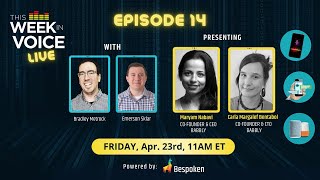
In this live episode of This Week in Voice, hosts Bradley and Emerson open with a discussion of recent voice‑AI news, contrasting Bank of America’s Erica—a large‑scale, internally built virtual assistant—with Amazon’s Alexa Custom Assistant, arguing that the market is shifting toward independent, non‑Big‑Tech voice solutions. They then explore the rapid emergence of high‑fidelity voice‑cloning technology, citing a Witcher 3 fan mod that uses a deep‑fake voice model and a corporate earnings‑call example where synthetic voices replaced executives, raising ethical, labor‑union, and regulatory concerns. The conversation moves to a plug for the Open Voice Network as a potential collaborative forum for addressing these issues. The core interview features Babbly co‑founders Maryam Nabavi (CEO) and Carla Margaleff Bentabol (CTO). Babbly aims to become the world’s largest data platform for tracking infant development during the first thousand days by analyzing babies’ vocalizations. They explain how the app records baby sounds, maps them to developmental milestones derived from scientific literature, and presents the information to parents in a low‑anxiety, gamified format. A therapist‑led coaching program augments the AI, giving clinicians a richer view of a child’s progress and enabling personalized guidance. They discuss the biggest pushback—concerns about data privacy, over‑diagnosis, and the need for careful presentation to avoid parental anxiety. Babbly is launching a two‑year longitudinal study with the University of Toronto to validate early vocal markers for neurodevelopmental disorders such as autism, hoping to enable detection far earlier than the current 4‑5 year diagnostic window. The episode concludes with a light‑hearted Jackbox “Dictionarium” game where participants invent and define new words, providing a casual wrap‑up before the hosts thank the guests and share contact information for Babbly.
Chapters
Foreign.
Bradley. Good morning, Emerson.
How are you?
I am doing great. How about yourself?
Doing fine. Doing fine. I'm in casual mode, as you can tell.
Yeah, yeah. Been a busy couple weeks for you.
This is the first that I have not had to think about travel since I believe in January. So first, I haven't been in some packed airport in 2021, so I'm enjoying the time off the road.
Hmm. And my, my second COVID vaccine, I will be fully vaccinated or fully immunized, I guess, in about a week and a half. And so I'm now finally starting to think again about, about travel.
There you go. There you go. It's a beautiful thing, isn't it?
Yeah. Yeah. It's been, been a wild year. Looking forward to getting back in the swing of things and good, good morning, good afternoon, good evening to everybody that is out there in the audience. Happy Friday. We have a super special episode today. It's going to be, going to be a lot of fun in terms of agenda. We're going to start out with our normal news. We have the two co founders, Mariam and Carla from Babbily, which is just a delightful and fascinating unique use case in voice. So bring them on to do the interview and then keeping in line with the theme of the day, both voice and speech and language development, going to be playing dictionarium again so everybody out in the audience can get ready and head, head to Jackbox TV and help help us judge as we create new words. So let's dive in. Bradley, you want to go first?
Sure, yeah, I'm happy to. And you want to leave the music? You want to leave the music on or
we'll bring the music back.
Okay. All right, cool. So, yeah, I want to take a minute to talk about, you know, a story unto itself, but then what I think the bigger story is that's been discussed this week. So if you go on voicebot, I don't think it's a top story anymore, but it's one of the top stories about Erica, which is bank of America's virtual assistant. There's some interesting new data there about the growth and usage of Erica and the adoption. And I think it's, it's a really good story. It's a well put together story. And it's also a good story, which is great. You know, what I spend time thinking about is sort of comparing and contrasting that to the information, you know, from about a month ago, three, four weeks ago about Alexa custom assistance and how that was rolled out and at the time you know, right at the time I wrote, hey, this missed. This missed the mark. It didn't, doesn't feel right. It doesn't seem right. I don't even understand who the, who the customer is, like, what the, what the purpose of this is. Because in my mind now, and this is what I think the story is, I think that we're now going to be able to see very clearly this delta between Custom Assistant of Big Tech and even though bank of America is a bit, you know, just as big of a company as some of these, we still call it an independent voice and AI. So you got a custom assistant offering from Big Tech alongside independent, you know, an independent voice and AI assistant. And I think this is just the beginning. You know, to me what the takeaway here is that this is just the beginning of adoption and gravitation toward independently owned solutions. And when I say independent, I, I strictly mean not owned by Big Tech. The, the growth of those and the diminishment of offerings offered by Big Tech. And I think that the work, I've said this before, I think the work that Alexa and Google and to a slightly lesser extent Microsoft and Samsung and Apple are going to have to do to keep growth and to keep user adoption going, I think the work is rising by an order of magnitude that they're going to have to do.
Oh, absolutely.
Results well.
And I do think that the, like Erica is a great success story. But bank of America has been working on Erica for a very long time and they have a huge team dedicated to it. That is one of my concerns with the Alexa Custom Assistant is that if you, you're not just going to snap your fingers and get it to work, a team is going to need to dedicate a lot of muscle to both implementing initially and then tuning and maintaining it in the future. And it does make me wonder how much people are going to be willing to put in that effort with one of the big players if they could put in the same amount of effort with something that is truly custom, something like Erica, and have much greater control over the experience, much greater control over the data that's flowing through the system.
Well, that's right. And I think the question becomes for the companies making these decisions, which are driven by the users, you know, what's to be gained. What do I gain by using Alexa Custom Assistant? I know I lose a lot of credibility. So do I gain user function back? I better, because if I don't, then the calculus is all wrong. And I think that's actually the situation we're in. So that's the takeaway for me here, is that we're about to have a lot of comparables side by side as we enter into the next chapter in our lives on big tech versus independent. And is it going the way we think it's going or. I think that's a real showdown. So that's a good way to start.
Yeah. And that actually, that's pretty interesting because I wanted to talk about, talk about something near and dear to my heart still in the gaming world. Witcher 3, for anybody that is not a gamer out there, is one of the most successful video games of all time. It's also been out for a long time. It's on every single platform. Comes out of a delightful Polish studio cd, Projekt Red. There was a new fan mod that just came out yesterday or the day before that is an expansion to it that uses a company called Cybervoice, which I was not familiar with, to do a custom deep fake dynamic voice model of the primary character in the video game. So the original game has tons of voice acting and they use that as the source data to train their own. To train their own voice model. And there's a company, a Florithmic, that released a couple days ago a video of Albert Einstein that they trained it on some old videos and they have Albert Einstein with a sort of CGI face. And it sounds pretty good, but it's, you know, has a bit of a flat affect. There's some pauses in there that make it perhaps in the uncanny Valley. But I gotta tell you, the custom voice in this fan mod is virtually indistinguishable from the real voice actor himself. And that was, you know, that was technology that was not available to small companies, not available to startups, certainly not available to fans of a video game that are working on a side project even a year ago, even six months ago. It does make me wonder though, like, what does that mean for the video game industry? What does that mean for voice actors? Like in this case, I assume there's no attribution that goes back to the, to the real, the original voice actor. I assume there's no monetary incentive for him. But then on the same side, maybe it is an incredible opportunity for somebody like that when the new Witcher comes out, for them to lend their voice, sort of like the Samuel L. Jackson thing, lend their voice so that the video game developers can create something that is totally custom and fluid without them needing to individually record every line.
This, I've been hearing about this since probably a Decade ago, being in Nashville, Tennessee. So in Nashville, Tennessee, you've got not only, you know, a lot of music recording, but you got a tremendous amount of other types of recording, like audiobook recording and other things that require voice actors in many cases where the original author's not voice voicing the work. And there's been an ongoing discussion because it's also, you know, Nashville's an interesting sort of mix between red and blue. And you've got a lot of union presence with regards to these type of folks and anybody related to entertainment. And the union people have been talking about this for. For a long time, it seems like. I hear about it a bunch and they're very concerned. I would be, if I. That were my job. I would be real concerned too, because if they're not careful, they'll easily get just paved right on over. I do think it's wildly inappropriate for somebody to not be paid for this work.
Oh, absolutely.
You know, and for someone's voice to be used. And we've seen. We've seen little fragments of this here and there. You know, Liarbird AI before they got acquired, had a whole thesis written about this. But, you know, it I just heard again, I heard it for the first time when they did it. But Sarence's earnings call that they did in November of last year, where Sanjay and I think the CFO both had a large chunk of the earnings call read and not their authentic voice.
But that's. Yeah, that's neat.
Yeah. And it made all sorts of news. And you. It would be very difficult, except for, like close family members to tell that it was them. I don't even know if even they could tell. So, yeah, we're about to open Pandora's box with all this stuff. And, you know, this is an opera. This is one of these things where there's an opportunity for big tech to demonstrate that they've got some leadership on ethical. Not what Twitter says is an ethical issue, but an actual ethical issue where they can either cause an economy to be destroyed or create livelihoods for a lot of people and sustain them. You know, this is the type of thing I think that when regulators get involved, they ought to look at. And I will also throw in a plug for Open Voice Network. This is exactly the type of thing that people from Amazon, Google, Microsoft, Samsung, Apple who are listening and watching the show or halfway listening to anything that goes on. This is something that would be great to collaborate with Open Voice Network or groups like them on.
Yeah. And keeping with. Keeping with the idea of the Opportunities for both personal and social good. Let's bring up. Let's bring up our guests.
Let's do it.
Mariam, Carla, great to see you guys.
Hello.
Hi, guys. Nice seeing you too.
Thank you for joining us.
Yeah, great to have you. To start out. Do you want to introduce yourself and tell us what Babbly is all about?
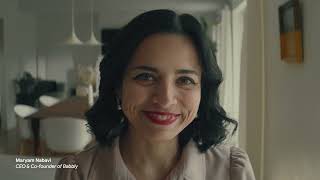
Yes, for sure. I'm Maryam Nababi. I'm one of the co founders and CEO of Babily. Babbly, we're building the world's largest data platform to track and support baby development in the first thousand days of life, which is roughly the first three years. We do this because we know that 80% of the brain is developed in the first three years, and yet we have no idea how to track it. And here I have my co founder. Carla, would you like to introduce yourself?
Yeah. So I'm the cto, unlike Mariam said, we're like, I'm in charge of the technical and the AI part of the company.
And you two worked together in the past? I guess. What, what made you decide to strike out on your own, do a startup and specifically focus in this area?
Yeah, well, we actually didn't work together in the past. Like, we met through a common contact with my previous job, and I was deciding what to do next. I knew it wanted to be an impact type of project, and he told me, you should meet Mariam. And Mariam told me the story how this started as a personal need that she realized that could be solved by AI. She made a cto. So, yeah, we started this.
So I got two questions for you. Okay. So I'm going to present them at the same time. I love what you're doing. It's really interesting. So my wife and I have a child. We have one child. And, you know, love the baby phase. And, you know, I think we're. Think we're done. But, you know, when you. My first question is about how you present information to parents. You know, there's a lot of analogs to what you're doing in other verticals that we work with. I just sat in on a presentation yesterday with a company that can use, you know, audio information essentially to determine the deception of executives on an earnings call. And the way that they presented that information was kind of. Kind of rough. You know, how are you presenting this information to parents? I'd love to hear about that. And then the second thing just sort of tied to that is what's the biggest pushback that you've received since starting the company?
Yes. Great questions. So let's just start by explaining what we do. So I talked about the problem. We have no idea how to track development, but essentially what we do is we use the baby's voice as a proxy for their brain development. We take the baby's voice, we analyze the utterances in it, and we look at the benchmarks that we know from literature and then we tell the parents if the baby is following a typical or atypical trajectory. At the core, every parent, especially new parents, want to make sure that their baby's okay. It's a universal thing. It doesn't matter where you live, where you come from. So the question is, you know, how do we use data in real time to give them that peace of mind? And it's a very subtle difference between how much data you give them and how much, especially if they're already paranoid and if they are type A parents, you don't want to constantly raise anxiety and push on their competitive parenting button. So instead of giving data for the sake of data or having too many points along that journey that could tease these anxieties, we try to reframe the problem and really focus on what are the key touch points along that first three years of life that we need to interact with parents and really help them understand their baby's development and their baby's unique development. Because every child is also different. There are no two children that are the same. So by reframing the problem on, focusing on milestones and celebrating those milestones on whatever trajectory that baby is, I think we were able to get them to excited about the journey and of course, you know, gamification of the experience. We have an app on Android and iOS where parents can record their baby, upload the recording to the app and get the data by gamifying that experience and telling them, here is another fun idea this week that you can do with your child to help them achieve this next milestone. So I think that's how we looked at the problem.
I think it's great.
I love how unique it is because it's so different from what you know, maybe sort of the trap perhaps that we get stuck in thinking about voice, that your, your solution, your approach to the problem is, you know, not specific to a particular language. It's not, it's not specific to, you know, a particular cultural way of raising a child. It is sort of, sort of universal across, across childhood and beyond just the sort of AI driven nature of your platform, you also have some interplay with speech language pathologists and sort of human driven coaching of parents as well. Can you tell us more about that?
Yeah, I can take that. So, yeah, we have a program where a therapist in our team gives parents like a coaching program just to help them interact better with their child so they encourage development. Right. So it was never the idea to replace therapists. Right. Like the AI is there to help gather all that information that today therapists don't really don't necessarily have, or they have it later on. Right. So today when they come to the coaching program, if they've been using the app for a while, the therapist can see what the skills the baby had maybe a month ago, which is a very hard question for parents. Right. Like parents don't really know exactly what were the milestones of a baby a month ago. So they start with a lot more information. And since all the activities we provide there are like science based, those are the type of activities that the coaches, the therapists recommend. Then they can focus on how, what specific advice those parents need, like do they need to pause more? Do they need to talk? Higher pitch. This parent is voice that we call, do they need to encourage repetition? So it's a way of improving the therapist toolkit, basically.
Isn't it interesting to think about the information that we're going to learn as a result of companies like yours? You know, I think all the time about a story I read a couple of years ago. I had no idea. I didn't grow up with pets, never had pets. My wife is a big pet person. But the idea that dogs can smell if you have cancer. So I find that fascinating. And so throughout the whole history of planet Earth, dogs have been able to smell if human beings have cancer. But only in the last 10 years, really, or so have we surmised that information. It's going to be fascinating to see what the correlation, what information that babies are giving us about themselves and their environments and their genetics and so on that they've always been giving to us, but that we just now have become, you know, awakened about. I think it's really fascinating. I commend you for the work.
No, go ahead, Mario.
Sorry. No, I was gonna say it's absolutely right. There are things that, you know, for instance, the biggest one is if the baby is not saying repetition of consonant, vowel sounds or ma, ma or da, da, let's say by nine months. We now know that that's correlated to a lot of neurodevelopmental disorders. So imagine right now, let's say the age of diagnosis for conditions like autism or apraxia is around Four to five years. Imagine what it looks like if you put that parent or the family on the right track to get advice and get the coaching. As young as a 6 month old baby or 9 months old baby and the impact of neuroplasticity of the brain on how quickly these babies can learn and achieve those developmental milestones. Yeah.
And we're actually starting a two year study with University of Toronto to start tracking babies from a very early age. And then after two years or a few years, if they do get a diagnosis, we can see what our AI learned from them. And if it was right, or if we can learn something else that we don't know, like the duplicated bubbling at nine months, there might be other markers even earlier. Right.
I suspect you're going to learn some surprising things and I also suspect you're going to be challenged with the use of data in ways you don't expect because I, when I see you, I see Canary Speech three years ago. Canary Speech has gone through some of those sorts of things on their way to a lot of success. So, yeah, I think you're on to something. I'm, we're grateful for your time on the show. I think it's, it's going to be fun to watch what you do.
Thank you.
Thanks.
You guys ready to play a little game?
I'm ready to.
All right, Bradley, I put in the private chat there. I put the code. If you want to log in, then I'll share the code with everybody else, everybody out in the audience. If you want to head to Jackbox tv, you can type in your name. I'll give you a secret code here in a second and you can help judge. And if you are going to be judging, you'll want to pay attention to what's on your phone or in your browser because there is about a 15, 20 second delay from what you'll see on the screen. Bradley, I see you're in. So I'll show the official code there.
Okay.
And we will get this rolling.
All right.
For anybody out there, the code is T, X, Z, W TXZW or just
want to get to know them better as friends. You people are playing favorites.
Yeah. Miriam and Carl, I know you guys hadn't, hadn't played Dictionarium before. This is a, a very silly game. These games are great for, great for family zooms as well.
Enter the room code and play along.
We played this with Nolan Bushnell and Zay Ortiz a couple weeks ago and came up with some great and very silly words and definitions.
Write a Definition for this word on your. This word moved to Hollywood to make it big, but only appears in the background of ncis.
So we see our word.
I would.
You may want to refresh your page. And then. All right, time's running out.
A lot of pressure.
Yeah, this is going to be in. In the Oxford dictionary for all time. All right, so the word is uchia, a usually trivial injury to an adult which results in baby, like whining for a period of up to 72 hours to cut your finger. You cut your finger? Oh, I missed it. A priest. All right, let's see. It'll show all. It'll show all of them up here. There we go. So we have usually trivial injury to an adult, which results in baby, like whining for a period of up to 72 hours to cut your finger with your tax papers. A priest. And the expression you make when you do something you know is bad for you but feels so good. So everybody out in the audience can. Can vote. We get to vote as well.
Someone still has not voted. That person should vote.
And let's see what we get.
Oh.
Oh, Carla, you and I tied. Nice. All right, off to an early lead. So, ucha, the expression you make when you do something that you know is bad for you, but it feels so good. So now round two. We have to come up with a synonym, a new word that means the same thing.
Think of a new word that matches the definition on your device. Then write it down on your device. Quickly, quickly. Write, write, write.
New synonyms for ucha, the expression you make when you do something that you know is bad for you but feels so good. Synonyms for uchia.
Let's check out these new words.
We have procrastinatis. Oh, well, Shish. Yeah. And owie. Wowie. I wonder what. What the Babbly app would think of our. Our gibberish right now.
Ooh.
When there's a tie, I pick my favorite.
That was not Carla.
That's a good one. Oh, man. Carla in a commanding lead now.
Wow.
All right, and last round. Now we have to use a Welsh ish in a sentence.
Oh, wow.
Fun tip. Imagine how you would use the new words in a job interview or when threatening someone.
It.
Got a comment from John Harper in the chat. These games are great. What inspired you guys to create this portion of the show? I think having a little casual fun on a Friday morning is a good way to start the day. Good way to kick off the weekend. So eat the ice cream and a Welsh ish later when guests once Again, didn't choose my word. I mumbled to myself a Welsh ish for which badly immediately told me to shut up. I know I need to mow the lawn, but I decided to play video games instead. Oh, well, shish. And slapping him was like, oh, well,
these are quality entrances.
These are great. Oh, Bradley coming back. We'll see. Is it. Is it gonna be enough?
I think it is.
Oh, well, it's just the expression you make when you do something you know is bad for you but feels so good. Drive from ucha. When guest once again didn't choose my word, I mumbled to myself, oh, Welsh ish for which b immediately told me to shut up.
Now we get to see who won.
Need a drum roll.
That was close. That was close.
Bradley. Back on. Back on a roll again. Good job.
This was a stiff competition from our co founders here.
I was scared that not being native would make it difficult, but I think it played my advantage because I don't have
it. Just should have stopped and given whoever came up with Carl, I think it was you. Oh, well. The automatic Victor.
Well, Carla, Mariam, thanks so much for joining today. If people want to learn more, get in contact with you. How can you they do that?
Yeah, they can do that by reaching out to us at helloavelly Co. Our handle is getbabbily across Twitter, Instagram, Facebook. And they can also, if they have a baby or know someone who does, we would love them to test the app and send their feedback.
It's been a pleasure having you on the show and, you know, just like real babies, as you're finding out, startup babies also make noise and can determine their future. And the noise y' all are making is really, really great. So thanks for being part of the show.
Thank you.
Thanks for having us. It was really interesting and fun.
Everybody out in the audience, thanks. Thanks for watching. Have a great weekend and we will see you next week.
More from Maryam
January 2023 HITLAB Symposium: JP Morgan Review | Alexia Priest & Maryam Nabavi