Startup Talk Podcast with Maryam Nabavi of Babbly
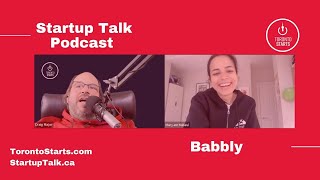
In this episode of Startup Talk Toronto, host Craig interviews Maryam Nabavi, the CEO and co‑founder of Babbly, a mobile platform that uses AI to analyze babies' vocalizations and track early language development. Maryam explains how Babbly’s technology classifies babbling stages, provides parents with data‑driven insights, and offers personalized, play‑based activities to accelerate communication skills. She discusses the scientific basis linking early babbling to later vocabulary and academic success, emphasizing the critical brain development that occurs in the first three years. The conversation covers Maryam’s personal journey from aerospace engineering to product design, the inspiration behind founding Babbly, and how she found her technical co‑founder. They detail the impact of COVID‑19, which prompted a pivot to include virtual speech‑language pathologist consultations. Marketing and traction strategies focus on partnerships with childcare centers, influencer pediatricians, and data‑driven parent segments. Product development involved outsourcing the MVP front‑end while building the AI and backend in‑house, with future resources shifting toward AI defensibility. Maryam reflects on the Techstars accelerator experience, its mentorship, and financial modeling workshops. She shares lessons on fundraising, pitching, founder pitfalls such as over‑managing burn rate, and the importance of seeking diverse feedback. Finally, she outlines upcoming plans: hardware/OEM integrations to become the "brain of the nursery," expanded coaching programs, and how listeners can access the app and services.
Chapters
Good morning, everyone, and welcome to Startup Talk Toronto Startup Podcast. And with me today is Maryam Nabavi, CEO and co founder of Babbli. Welcome.
Thank you. Thanks for having me.
How are you doing this morning? Everything great?
Yeah. I'm very excited for this month. We have awesome promotions going on, new signups, new parents, a few plans to host seminars. It's going to be a busy one.
Sounds like you got a lot going on. And I quickly took a look at your bio, and so instead of me reading a little bit about it, why don't we start with you telling us a little bit about what Babbly is? What do you do?
Yeah. Babbly is a mobile platform that helps parents track and support their baby's language development. We have a technology that's able to essentially analyze baby sounds and give parents data for the first time to really understand what is their baby able to do and to promote them to get from point A to point B.
And what is point B?
So for most parents who have a child, let's say that are around six months of age, they're waiting for that first word. It's, you know, moms usually want the baby to start saying mama, and the dad wants to hear dada. So really, you know, it depends on the child's age. It depends on their unique skills, but essentially it's being able to communicate their basic wants and needs, to reduce tantrums and frustrations, and to really help and support them to build social skills. It sounds crazy, but babies start to develop social skills from very early on, even like month two. So point A and point B is different for every parent. But our goal is to help parents with their unique needs and support their child's unique skills as well.
So I see, you know, you're originally trained as an aerospace engineer. Is that, you know, another fancy word for a rocket scientist?
Yeah, I guess
just is curious. Like, does it take a rocket scientist and an expert in AI to. To figure out what kind of emotions and sounds and are you analyzing the different syllables and the range and the pitch? Like, what's happening in the app? And as a parent, what kind of information am I getting?
Yeah. So our AI has essentially been able to classify the different utterances in babies. That's just a fancy way of, I guess, saying the different acoustic qualities and features in a baby sound. Fun fact. All babies, regardless of their mother tongue or their culture, go through the exact same stages of speech development from birth to about age 12 months. So they start making vowel sounds like oo or ah, which we Call cooing. Then the consonant starts to emerge and they combine consonants with vowels. Scientists look at the combination of those constant vowel sounds and call them three different stages of babbling. So our AI is essentially able to classify the baby sounds and tell the parents what stage of babbling the baby's at. These skills have a very high degree of significance in terms of brain development. So by 10 months of age, we want to see that a baby is able to have reduplicated babbling or repeated consonant vowel sounds. We don't necessarily get too deep into the science with the app, but as a parent, what you can see is after uploading a video of your baby right away, you can see, okay, my baby is at, let's say single syllable babbling. And based on her age, this is an age appropriate skill. How do I get her from single to reduplicated babbling? And then we give you weekly activities that are all play based. And by doing them for five to 10 minutes a day, you can start, start to see more sophisticated ways for your baby to communicate.
So I know how important communication is later on in life. You know, communication is probably our weakest skill as a whole as humans, and it impacts the most part of our life. You know, we communicate for relationship with friends, for job, for money, for everything that we do. And yet, you know, we seem to get the least amount of training in it and you know, mentally it connecting with other humans, talking, smiling is so important to your overall health and well being. Like the science is overwhelming, but I've only focused on adults. What, what is that? What is the science around that and what's the impact of that in children?
That's such a great question. You know, what's really fascinating is that 80% of the brain is developed in the first three years of life. Most people don't know that. So if you think about the amount of growth and the amount of neurons that are developed in those first three years, there is a huge opportunity to wire the brain in a particular way that's more prone to communicate with people that are in the surrounding. The other really interesting study that has been done is that babbling is directly correlated to vocabulary size by age 3. And the number of vocabularies that a baby has or a child has by age 3 is directly correlated to their academic success in university. It's mind blowing, but essentially what this means is communication skills at a young age, and by that I mean from 6 to 18 months can actually be a significant predictor of how well that baby does academically later on in life, it's not shocking because when you look at, again, the correlation of babbling to first word, first word to vocabulary size and vocabulary size to literacy, it becomes very evident that the more time we spend with babies in those early years and really to respond to their utterances or their vocalizations, the more we're reinforcing those, you know, neural pathways or highways for the baby to get incentivized by interacting with the adults or other babies around them.
Now, I have to admit, the first time I read this, I thought of the movie Baby Geniuses where all the babies are running around talking to each other. And I take a step back and I think, well, doesn't every parent want their child to be more advanced, to have a leg up ahead of the competition, to be smarter? So I use the app, I've uploaded the video of my child and I know my point A is here, whatever that is in line. A little ahead, a little behind, doesn't really matter at this point. Now what, how does that help me? What's the next step?
Yeah, so once you have, let's say, a baseline for your baby's speech skills, like I said, we provide you with personalized activities that are all play based. So it could be playing, you know, a pretend play, let's say tea party, in a particular way that, and when I say particular way, it's not really rocket science. It's just, you know, being able to sit at the eye level with the baby, making sure that you're maintaining eye contact, whatever comes out of their mouth or whatever gesture and body language they're showing the parent will actually encourage and respond to. And studies have shown, I mean, early intervention, we know is, is impactful and we know it works. But our own studies also showed that parents who follow these activities for at least five minutes a day will start to see noticeable improvement in their baby's communication skills within two weeks. And that's really exciting. Again, the improvement depends on where the child's baseline is. If your baby doesn't, let's say, have a great eye contact, that means they're not looking at your face and how you're making vowel sounds or whatever words that are coming out of your mouth. So first, we want to make sure that we establish those critical skills, such as eye contact. If your baby's baseline is, for instance, babbling all the time and responding to you, well, we want to diversify the repertoire of their consonant vowel sound so they're not just saying mama dada for everything from airplane to cat to dog. We want to make sure that they are expanding on it and they're able to have turn taking we're back and forth conversations with adults.
So let's. I like to take a step back and talk about who the entrepreneur was growing up. So who were you? Were you a handful for your parents? Were you studious into music, sports? You weren't always a rocket scientist. So what were you when you were a kid?
No, honestly, I think I was a bit of a troublemaker. Not because I was, you know, I just always was wired, I guess to take risks and not calculated risk. Like I've done a lot of stupid things jumping from second floor thinking that I will grow wings. So I think in that way I'm kind of an adrenaline junk. And growing up I did all kinds of stuff to just, you know, get that rush. I did want to be an astronaut and that kind of led me to, to do aerospace engineering. But engineering itself at least you know, when I studied it. And this makes me sound really old, but private space wasn't really around and it wasn't very entrepreneurial industry. You ended up working for one of the big aerospace companies, which wasn't really aligned with my character, who I was, you know, all over the place. I wanted to do have the freedom to really work on something and see the impact. So that kind of made me pivot from engineering and I did my master's in product design, which was kind of a combination of using your left and right brain to apply, you know, design thinking into everyday problems. And I really enjoyed that. And I think actually a lot of those skills are. I'm using them now at babbily.
So at what point, you know, you've gone to aeronautical studies and science and whatnot. And again, I don't know where you would go and how that whole system. But at what point did you decide, you know, I want to run my own business?
To be honest, I was always. My dad is an entrepreneur and I grew up just, you know, seeing how, how, you know, amazing it is when you have a vision and when you actually make that vision into something tangible that directly impacts people's lives. He's in the medical equipment business. So I was very familiar with the health tech or medtech industry. So it wasn't really something alien to me. But I think what really gave me the reason, the strong reason and the appetite to leave my comfortable consulting job and really jump into this was the conviction that I had in the mission and feeling that this problem is worth pursuing no matter how long it's going to take or what I have to give up or the opportunity cost. I think that is true for people who don't even think about entrepreneurship along their career. You hear them finding a problem that really resonates with them and they just make that big leap initially.
So speaking of the problem, what came first? The co founder or your idea that this is what you wanted to do?
Well, the pain came first. It wasn't even an idea. The pain of dealing with a child who had speech delays, speech and language delays, seeing him struggle to communicate, to tell me what he wants and realizing that I'm not the only one that I, you know, initially you think you're the bad parent, that you didn't, you know, notice it initially. And then figuring out that this is a problem that millions of people deal with just made me realize that, okay, somebody has to do something about it and why shouldn't that person be me? And of course I knew that I had to put a team together to, you know, pursue this. So the co founder, I was, I am very lucky to work with my co founder who came through introductions from friends and it took us about six to about nine months to really solidify how her skills in machine learning and voice can be applied to solve this problem.
So you know, finding the right co founder, you know, you mentioned it but you know, it can be really crucial. Like I know a lot of startups are early stage that end up breaking up or failing because they have the wrong relationships with co founders. Can you tell me how you met your co founder was introduction and how you finally decided that yes, you wanted to work together?
Yeah, it's actually a long story, but when I first realized the problem that I was having with my son, I started to look for. I knew that I had to find someone who has background in technical background in machine learning and voice. I knew that through voice analysis we can use a baby's voice as a proxy for their brain development. So those were kind of the technical criteria that I had in mind. But the one thing that was really, really important to me was this person. I couldn't expect them to have the same level of relevance or I guess relate to the problem as much as I do as the mom of a child with speech delay. But at least I wanted them to have a strong reason to do this. You know, people who are potentially good candidates to become a technical co founder or people who can easily make, you know, I mean, six figure salaries like 200k plus in one of the big tech firms. So what was the reason for that person to join me and my small startup and to take the risk. And when I met Carla, she was at the time she just left the Alexa team in Toronto and we had a mutual friend who was still working at Amazon. And when he heard that I'm looking for someone, he said, let me put you in touch with someone that I know wants to do something meaningful. And I thought, okay, that's a good starting point. But of course we had to meet several times. It took us about six to nine months to really for her to understand, okay, is this a solvable problem technically and is she the person to help me with that? And then can we actually make a meaningful difference? Because that was the thing that we were both. We knew that we wanted to make an impact and we knew that it's going to be a very challenging way because no one has done this before. We sometimes joke with ourselves that this is the moonshot of baby development. And that's kind of, I think why we came along and we've been so successful as co founders in our relationship is because we are fully aligned on the things that matter the most. Of course we have disagreements when it comes to where to use resources. We're always fighting for more time from devs and things like that. But I would say if you agree on value system, which sounds like sometimes they say it's like a marriage, it's true. You have to really be aligned on your values.
So how's the situation changed during COVID or your value prop? I imagine I'm just thinking now more people are not getting out a lot of development. You take your, your kid out somewhere, you show them all the different things, maybe their school, maybe there's play dates, maybe there's all sorts of different things where they're interacting. How has Covid changed your marketing, changed your value prop at all? Has it changed?
Yeah. So before COVID what we were razor focused on was just the application and being able to get as many parents to download the babbily uploaded data of their baby and get the results at home. We weren't really thinking of getting into the intervention and the support part. We were just trying to stay as a data platform and do the analysis. Our hypothesis always pre Covid was we are going to at one point hand it off to let the parent know that they need to take this data to their doctor or to the speech therapist. After the pandemic hit what we realized, I was actually one of those families that all the therapies were canceled that were previously in who were already in therapy had to now switch to zoom and virtual, which a lot of them opted out of, especially in the beginning when we thought, this is kind of a short term thing. A lot of families thought, okay, I'm going to wait until we can get back to in person. And then a lot of people who unfortunately were struggling to figure out, okay, does my child need therapy? Do I need to talk to, who should I talk to? They were googling things. They were in a very tough place because your doctor initially wasn't seeing you unless your child had a fever or cough or whatever. So speech development oftentimes doesn't come as the top priority when you're talking with medical professionals, unfortunately. And for those parents, what we did for the first month, we were offering them 15 minute free consultation with our speech language pathologist, who's our advisor as well. And what we found was these parents came into these consultations with an extreme amount of anxiety about what am I going to do? What is the future of my, is my child ever going to talk? And they left literally within 15 minutes. They left with a concrete answer. Whether the concrete answer is, okay, we think your child, you can benefit from weekly consultations or whether you're being paranoid, your child is fine. Let's look into the six months from now. And I guess the pivot was we started to add consultations as a complementary service to the babylies app. And now for anyone that goes into the app, they can directly connect with a speech language pathologist and who can review their data in the app and really optimizes their time with a professional.
So is anyone your ideal client or is there a specific type of parent or child that is better suited?
No, definitely. I would say there are two types of core type of parents that we think are. We've seen them coming back to the app or using the coaching. One is the data driven type, a millenn that wants to really stay on top of their baby development. They probably have used a smart baby monitor to track their baby's sleep and heart rate and everything. And as the baby grows, they want to make sure that their baby's development is on track and they appreciate the data driven approach that we take to that. The second audience is the parents who have a child between 12 to 18 months. By the first birthday, the baby hasn't started to say mama and dada. And the parents are getting worried and they want to do something about it. And they find it really helpful to have expert advice and not just a bunch of opinions on random Reddit threads or Facebook groups.
So how do you build and find your audience? I often talk to startups about traction. So you have a fairly, you know, well defined audience. How are you going about getting their attention and letting them know you exist?
Yeah, a couple of ways. But I would say the main channel that we've been focusing on is through communities that interact with parents. Childcare centers are one of them. We have had great partnerships with companies like Kids Co who have more than 100 locations across North America, each one about a few hundred families. As the best in class provider of child care, they want to make sure that their community has access to all the resources to raise a healthy, happy child. Other types of channel partnerships that we've explored are through social media influencers, especially key opinion leaders such as pediatricians or speech language pathologists themselves. One of our advisors is a very well known pediatrician here in Canada and we see every time she shares something about us on her social media platforms we see a search. So we know by partnering with those influencers we can really maximize our traction and our reduce the need to burn money. On marketing.
I guess you have an app in the App Store, Google play and Apple iOS. Can you tell me a little bit about the process And a couple of quick things. Did your co founder build a team? Did you in house build it? Did you outsource the app or did you just work on the back end? And the AI, how did that work? And then were there any advice you have for other entrepreneurs who are thinking about launching an app?
Yeah, so we did outsource parts of the app, especially the mvp because we wanted to be focused on the AI side and really the cleaning, the labeling, the dataset. We work with a company especially on the front end. Although we did a lot of the backend ourselves, I would say it was a worthwhile experience back then. But moving forward, like you know, Hindsight is always 2020. When I look back I think we, we could have reduced that MVP even more to get the feedback that we got three months earlier than that and do the rest in house. But right now we are a team of five and most of the team we have developers in the team who are working on improvements in the app. But moving forward I would say the majority of the company's resources and the team composition in the future is going to be on the AI side because that's really our core skill and the defensibility behind the company.
So how many years have you been working on Babbly now?
This week it hasn't been Two years yet. This January will be two years.
That's fantastic. And you recently graduated techstars, I think this year or you. Okay. And can you tell us how the program helped you? Yeah, I been in the community a long time. I know Sunil and a buddy of mine, Will Greenblatt, he does a lot of pitch coaching. You may or may not know him. He helps a lot of the techstars people out. But techstars is a big name, right. And Brad Feld is one of the reasons why Toronto Starts exists. So tell us a little bit about how the program helped you and what types of startups you think should be thinking about techstars.
Yeah, so I think techstars is a really great program program for anyone who wants to really accelerate their path to product market fit. You know, typically it's if you just have an idea on a piece of napkin, there are other accelerators that you can apply to. Founders Institute is a great one. But once you have that initial MVP and you want to, you know, work towards your product market fit, I would say techstars is the fuel that you need. In that rocket, they will connect you with hundreds of mentors, investors from across the world. This year was a unique one because it was the first virtual techstars. And initially I think everybody was unsure of how it's going to go. But the upside of it was we were not necessarily limited to people who were in the ecosystem in the city and we could, could jump on a call with someone from the west coast or even Europe. So in that sense, it was really phenomenal. And I would say there were a couple of workshops, one in particular that I've been talking about, but it was about building your financial model. It's something that pre techstars, I always thought, okay, I'm going to get someone to help me and just maybe do it. As long as I understand what's going on, it should be good enough. Post techstars, I did the whole financial model myself. I've been hearing from investors over and over that this is one of the best ones that they've seen. And I give the full credit to the workshop leaders. So they actually give you very targeted material that if you have the time to maximize that, it's really great.
I've heard nothing but good things. And again, like I said, the cohorts seem to be great. Everyone seems to be getting funded. Did you get funding from any after demo day?
It's in the works.
Okay, fair enough. I didn't ask you about this ahead of time. Usually I ask whether it's okay to talk about funding or not.
Hopefully we'll close it soon.
Good. So how important is being able to pitch for an entrepreneur? Speaking of funding.
Oh God. For the CEO, it's probably the most important thing that you can do for your company. I have to say I had an unfair advantage from my consulting days that I was very used to pitching 247 to the extent that sometimes I think, you know, I'm really good at PowerPoint, but I have to really get away from PowerPoint sometimes. But it's really important. And it's really important to not just have good, you know, material. You know, sometimes I see decks that are perfect. Like they follow the structure perfectly, they have a lot of data. But being able to adjust your story every time you speak to an investor and knowing where they're coming from, that has been one of the most biggest learnings that I've had that ideally no pitch should be exactly like the previous one.
Yeah, usually you change it all the time based on all sorts of different feedback from your audience, eye contact, shrugs. This that you don't like the way a thousand different things. I tried to share both successes and failures in the hopes that others won't make the same mistakes. Can you tell us a little bit, tell us of a time where maybe you screwed up and made the wrong decision?
Yeah. Very early on I was very, very careful with our. Not that I'm not now, but I was over paranoid about our burn rate and I wanted to keep it to the absolute bare minimum. And I ended up doing a lot of the things myself that I shouldn't have, like bookkeeping, like accounting, or even preparing like you know, legal documents. And I ended up spending double the amount of time and money by hiring the right people. So I would say from the very beginning, make sure that you calculate all of those expenses. They're just there. There's nothing that you can do about it. Calculate that as part of your initial cost and just do it right from the beginning because down the road you'll save so much time.
And that's a great tip. Do you have any other tips for founders?
I mean one that I see for myself, although honestly I don't know what I could have done about it is as a founder who has experienced the pain themselves, it's really easy to think that you're the subject matter expert and you very quickly become blind spotted to others viewpoint of the same problem. So as a mother of a child with language delay, I thought I understand what every mother with A child with language delay thinks and how the app should work, whereas that's obviously not the reality. So being able to be very realistic about, you know, how much of your opinion matters and being able to find room and leave others to provide feedback and the team to hear others feedback is really important.
Do you have any advice for startups seeking advisors? You went through the techstars program program, you got introduced to a bunch of people, but if someone wasn't in a program like that, how would they go about getting advisors?
I actually got most of my advisors team before techstars. Most of them came from previous relationships that I had. Like, you know, my ex CEO at the company that I used to work at was the first advisor. Naturally, it was a relationship that we had, so he was always a mentor and advisor. And that second, and, you know, once it got to a point where I had to actually write a cold email or pick up the phone and call someone, it became again, a very human story from someone who has experienced this. And they, you know, I genuinely was asking for help. I would recommend not asking them to become an advisor in the first call. Just, you know, try to understand if they care enough about your problem. If they spend that first, you know, half an hour, then do they want to spend the next hour, Then naturally the conversation about, you know, advisors comes, but it takes time. So as with most things, having patience is important. Yeah, I don't know if that was helpful.
No, I think so. And I think I get approached a lot of times and people jump immediately, hey, to that advisor role or partner. And like, I'm always very hesitant. This is a. I got my own stuff going on. So why don't we start with a half hour and then, you know. Exactly. Next meeting, Next meeting. We'll meet again in a couple of weeks, see how you're going. And if there's a natural fit here, it'll progress, but it's just kind of getting that next meeting and making sure that the relationship works for both of you.
Totally. And that's important because I remember there were people that I was like, oh, God, if I could get this person as an advisor, like, you know, I would be so happy. I would give them this amount of equity. And then after the third meeting, I was like, actually, I don't think this is going to work. So I'm happy that we took that time to really get to know each other. And there was nothing wrong with them. It was just not the right chemistry. So you're absolutely right. It has to both work, both ways.
So what is next for you and for Babbli?
Well, we have a really intense and exciting couple months ahead of us because we are in discussion with a few hardware and OEM providers of nursery devices. I'll just leave it as categories like baby monitors and, you know, and devices that are in the nursery. And we want to essentially, the vision for the company has always been to be the brain of the nursery and we think by combining data from different parts of the nursery, we can give parents a full view, a full picture of their child's development. So we have a few potential pilots with these providers on the way. And pushing our coaching program to help as many parents as possible is also something that is really the highlight of my day. Every time I get an email from a parent saying my child said this for the first time, it's really rewarding.
If people want to find out more, where would they go? Not just for the people who are here, but the people who are only listening.
Yeah, for the app and the coaching program both, they can go to Babbily Co. They can download the app, both iOS and Android from the website for free for a limited time. And the coaching, we have something in the website says parent coaching. I'll post the link for that as well. And they can sign up for either four week coaching program or a 90 minute consultation with a registered speech language pathologist. And we are offering that to anyone in North America.
So thank you very much for taking the time today. It's a really interesting product. It sounds like it's going to change a lot of the way we look at early childhood education and development and I'm really looking forward to hearing what happens. So make sure you stay in touch with us in our audience.
Thank you, Craig. Thanks for having me.
Thank you for being here and thank you for everyone who showed up to take part in today for being part of the Startup Talk podcast.
More from Maryam
January 2023 HITLAB Symposium: JP Morgan Review | Alexia Priest & Maryam Nabavi
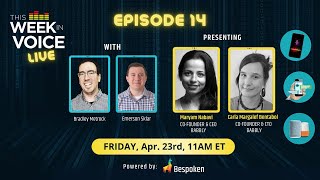
This Week in Voice LIVE - Episode 14 - Maryam Nabavi and Carla Margalef Bentabol of Babbly