Reflecting on limiting beliefs, the founder mindset paradigm and entrepreneurial worldview - Ep 104
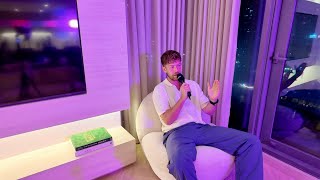
Matthew Kelly delivers an informal, one-take podcast-style monologue (Ep. 104) reflecting on the stark difference between entrepreneurial and conventional worldviews. He argues entrepreneurs tend to "see opportunity" and create freedom (financial, creative, location/time) while conventional people more often see limits; he frames entrepreneurship as both a powerful mindset and a burdensome, sometimes pathological choice, links it to past failures and mental-health cycles, and urges training the mind to break limiting beliefs.
Chapters
Yo, fellas. Back with episode 104, insanely of the Midnight Pod. I've got a very fancy looking interview style mic. This is on sale on Amazon and I thought, fuck it, I would cop. Don't know what's going on with the lighting or the setup here. It might look terrible. I'm just trying something new. I'm probably gonna do it in like one take. So if this does look terrible, then I guess I will change it. But wow, that's quite a cool angle. Definitely too close to me. What's that saying? Maybe move that down slightly. Yeah, I kind of want to bring the actual pod back and yeah, get very cozy chairs and do it properly and like make nice production value, which this certainly is not. And my pod has really never been. But yeah, fuck. I'm just going to talk about something that's been on my mind recently separately. And lots of things have been on my mind. And I'm one of the few people probably that decides to talk about on the Internet. And that is just the absolutely huge gap between the mindset way of seeing the world and ultimately like paradigm of life between I guess, people that go and achieve mega success in all areas, however you define that. But I'll define that in this context in a second. And those that don't al those that live a more normal life. Right. And I'm not saying that's worse or you're a worse person or whatever because like my own fucking brother is one of those people in comparison to me. I don't mean he's less successful necessarily. I mean he has chosen to live a more conventional life and pursue more conventional things, which actually probably makes him happier than me, and that's fine. So I think, I actually think entrepreneurship is like basically another word for mental illness and being a founder and certainly being a founder for your entire life and choosing to still be a founder even after you've fucked up stuff in the past and lost loads of money and been through lots of stress and trauma and all that, which I have and I've been very public about. Right. So that's the angle I'm coming at this from. But I just, I'm so fortunate to know so many insanely successful people. And I guess success in this case, I'm talking about business success and I'm ultimately talking about freedom. They've created financial creative and location and time freedom through the vehicle of entrepreneurship and building a business that has ultimately, you know, enabled them to make enough money to have that freedom. Right. But also do it doing it ethically and doing it in a way that's creatively cool. I think those things are very, very important as well. I think how you make your money is as important as how much you make, if not more important. And there's a lot of people that don't think that, and a lot of them are in the online space, you know, naming their names. So yeah, I've been, I've built great network of people and very successful people who also fucking happy and just have cool lives, right? And they're definitely in like the top 0.01%, if not the top 0.001%. Like statistically, since it's important to remember in the bubbles that we're often in, even people that watch this stuff and like, are on Twitter and so on. Even just by like being on Twitter, like, and following founders and so on, you're probably in like the top 5% already without even at least like mindset wise and setting yourself up to be in like the top 1% just by being there. Because most people just don't think this way. Right? And I think the fundamental difference between, Let me define a few things. I think entrepreneurship and entrepreneurial people, you don't necessarily have to be a founder, but I guess more typically you are a founder of some sort of, whether that's a fucking YouTube channel or an econ brand or an agency, whatever it ends up being. Entrepreneurial people see opportunities and figure stuff out. Whereas I guess normal people, whatever you want to call them, you know, more conventional people, typically see limits and problems and are stuck in their ways with how they view the world and the limits they put on themselves and so on and so on. And the easiest way to define it is like create versus consume. I think that's on my midnight website. And it's something that has always been evident to me in these people. So yeah, the crazy difference I've observed, I think about it a lot because is it nature versus nurture? But like, how does one guy from the same background, like, broadly speaking, I know there's nuance and whatever, but assuming, you know, you both grow up, you know, without much opportunity, without much money, at least, you know, normal background, like, like most people, how does one person say that? School, you know, build multiple businesses, make loads of money, travel the world, live a life of abundance, like physically, mentally, emotionally, financially, spiritually, even. And another, or even probably most works a job they don't necessarily like, is very limited financially for their entire lives, their entire lives, probably imposes that mindset on their friends. And their family and vice versa, and then their kids and their next generation. Because, yeah, I find that difference so fascinating. I'm not even talking about me or anything, by the way. I'm just, like, observing it in my most successful friends. I'm definitely not one of those. I'm still figuring out. But there's obviously levels to it. And I think it's so interesting because even I've had issues probably in the past few years more than ever off the back of, like, my 20, 21 major failure, which everyone knows about, watches this with, like, limiting beliefs and not thinking things could be enjoyable or you couldn't possibly enjoy stuff if I was actually making money and scaling. And this is going to end because it ended before. And a lot of that for me is like, trauma and like, toxic thinking that I need to work on. And I am working on that, and I'm aware of that. But I'm literally just riffing here. One take, by the way. I'm just like a new genre of video. Matt Kelly, Ultimate Ramble. One take even worse than my old videos now with the fucking interview mic. So I look like an absolute twat. But anyway, bear with me. Yeah, I just find that difference so crazy. And I think it's such a fucking cliche, but it just fundamentally starts with your belief system and the paradigm through which you view the world. You know, one person sees the same world and thinks, there's all this tech advancement, there's all this opportunity, there's access to the Internet, even without money. Like, I just need to get on Twitter and make connections and make something happen, happen, and recognizes that I can create my own luck through effort and time and sacrifices. The other person sees the same world, and through their lens, their paradigm, they see, you know, problems, too much risk, a lack of opportunity. They think if you haven't got money, you're never going to make it. And I think this is a very, like, UK mindset, and I'm very much generalizing, so do not, you know, take it with a pinch of salt. But you have to generalize when I'm speaking about this sort of stuff. It's a very UK mindset to, you know, tall poppy syndrome, thinking that people that are successful must have been handed it on a plate or must have inherited it. And there is a lot of that, don't get me wrong, and that fucking annoys me as well. But in most cases, like, successful people and wealthy people don't come from that background. Maybe not in most cases, but in the cases that I'm you know, referring to and looking up to and yeah, everything has to start with that mindset, right? Because like, like for me, like even when I was 14, I kind of just knew I wouldn't finish uni. I like knew that I'd do something else. I don't know, like there was this seed of possibility of like not following the traditional path. And I guess most people, like I've got a twin brother, right? Great guy, very different to me, non identical twin. Like I said, he's probably more happy than me, but it's just like we're really interesting case because we literally have the same parents and the same upbringing, the same friends at school, yet pretty much 18 to like 21. We went very different paths. You know, he got the 2 degrees, got the grad job, then a better job than a better job, bought the house with a mortgage, etc. And that's fine, but that is a very traditional normal path. Whereas I just felt a real opposition to that because I guess, yeah, I guess I'd always felt in opposition to that because the way I viewed the world was I don't want to follow that convention. So I wonder where that comes from. And then through that and as a result of that I ended up ultimately starting businesses, right? And going down this path. And then, you know, one thing leads to another, you build a network, you make some money, you lose some money, you learn a lot of stuff and that becomes your career. But it primarily and initially started with I guess, a different way of viewing the world. And even now that's very evident in, you know, maybe our political views, our views on certain world world news. I'm going to say to be generalist and non political on this video, but it's just funny because we have the same exact upbringing, like quite literally. So we're like great example of like there's got to be something there that. Sorry, my girlfriend who told me she was meditating just came in and ruined my entire flow of thought in this one tape video. I might even post this. But I'm just thinking about it so much because basically to like round off my ramble, the difference is so stark in how people view the world. And it starts as a seed, usually. And I don't know what that seed is. Is it nature, nurture, something? Because in my case it was neither like pre 18, because we were the same nature and nurture really. Like at least, you know, the same parents might go a different slice of that genetics. Same parents, same upbringing. So same nurture. And then something changed. So where does that seed come from? But when. When you see how, like, you can live and what's possible and the fact that you can, you know, break outside the matrix and all this and whatever that means to you, but, like, you know, I. E. The possibility of doing stuff that isn't conventional, when you see that's possible, like, there's no going back. For me, that happened pretty young. For a lot of founders, that happens quite young, and they get exposed to people that it has happened to, and then they change their mind. And, yeah, I just find it crazy. And then that compounds so much over time, and then it tends to show up in other areas outside of just business and money and stuff. It shows up in politics. It shows up in questioning the narrative of whatever is fed to you, whether that's the news, whether that's on social media, whether that's, you know, this guy's the bad guy because they say he is, and then, you know, unable to give an answer as to why that guy's the bad guy or that woman's the bad woman, whatever it is. Yeah, I just think it's really interesting because I think if you can see opportunity in the world, even when there is none right in front of you at the time, it just opens up a whole new way of being. And I just think it's a more fun life when you realize that you can create stuff. And, like, the fucking slogan of my brand or one of the slogans is, nothing exists until you create it. Right. I used to have the neon sign that was created your own reality. And the irony with me is I've always been a massive proponent of this stuff and, like, made all these dramatic slogans and neon signs and so on. But even myself, I fall into those limiting belief patterns sometimes, probably partly because of mental health up and downs and partly because of, you know, like, actual life up and downs. I like my last business crashing and burning and going from this, like, super high to this super low, but then also building back up because I just knew that even in that dark point, there was still. You can still create. Right. It's very hard, especially starting from, like, a certain point wherever you are. Like, Like a low point. But it's definitely possible. So, yeah, I don't know. I want to wrap this video up, but don't underestimate the power of, like. Yeah, I guess the final point is don't underestimate the power of training your mind and subconscious mind and yourself to not see everything by default in the way that most people see it, whether that's opportunity, whether that's a challenge, whether that's, you know, your own prospects, whether that's anything like train your mind to see that in the most useful way for you. And that's very, very, very, very, very hard. If you are surrounded by people that, you know, only choose to see certain things a certain way, that isn't necessarily the most productive view for them. And I think the world would be a better place if everyone at least tried to have a more productive and, to be honest, optimistic view on everything. It's kind of ironic coming from me, but even I'm trying to work on this a lot. Right. And you can shape that in whatever way is relevant. Relevant for you. Like, for example, I'm trying to snap out of the negative, like, comparison spiral to thinking like someone else's category is better and, you know, going on social media and scrolling too much. And I'm really trying to train myself to like, take my confidence to the next level about myself and my abilities rather than focusing on, you know, people that are ahead of me, for example, and choosing to see that as a good thing. Right. Rather than like a, oh, I'm behind. For example, you know, someone else might need to train themselves to believe that actually they can quit their job and, you know, create a freelancing income that's better than what they made before. And that would give them the time and location freedom that they've never fucking experienced before. And then when that happens, there's no going back, which might then lead to them starting an agency and starting a brand and one day selling it for millions of pounds. Right. So, like, if you can train your mind to break a limiting belief, which is often and probably usually unconscious for you, and it's probably been ingrained in you from your family, your friends, school, whatever it is, if you can break that limiting belief and train yourself to identify those limiting beliefs, break them and then crack on. I think it just unlocks exponential personal growth that I don't think people realize, like, the extent to which you can get better once you. Yeah. Break those initial limiting beliefs. Right. Because. And I feel like I'm only like 20 there on this stuff, honestly. Like, I've shared a lot of this on the pod before. I probably used to be. I probably used to appear like, more optimistic and more super, like, creationary and then kind of started to retreat. Maybe like my slightly later 20s when it was like 26, 27, I thought, oh, me, like, I'm not where I want to be. But then I realized that even that was just me slipping into, like, limiting and unuseful beliefs. So I've made a real effort in the past, like six months and even past few months to not necessarily just be more positive, but that is like a net output of it, but, like, to be more. To maintain a healthier perspective on, like, where I am relative to where I was and trying to enjoy the process a bit more because I'm also doing that. So, anyway, I'm gonna wrap this up here with the final note of control your mind, control your life, basically. And that's something I'm working on. And I probably need to work on it even more than most people. And yeah, I don't know, I hope that this is relatable. If not, hopefully this was. Hopefully this was relatable. This is probably one of my most rambly videos of all time. I literally just sat here, was testing out this new mic, and I thought, fuck it, I'll start talking. Which probably why I need to bring the guest podcast back with Red Wine, which I'm going to do very soon, by the way. More on that later. So, yeah, anyway, subscribe to the pod. I promise next video will be more cohesive and hopefully valuable. But fuck it, try new stuff. Appreciate you all. Catch you soon. Subscribe to the pod. See you next week, Sam.









