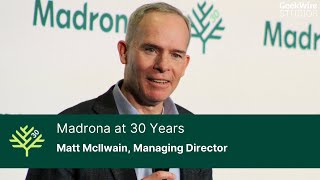
In this GeekWire interview, John Cook talks with Matt McIlwain, managing director of Madrona Venture Group, about the firm’s three‑decade journey. McIlwain reflects on early landmark investments such as Isilon Systems, AppDio, and Smartsheet, highlighting how the founders’ conviction helped those companies survive a tough macro environment and become successful. He outlines the traits Madrona looks for in founders—curiosity, the ability to synthesize information, a bias toward action, and a learning loop—and cites examples like Sonny Gupta, Brent Frye, and Sujal Patel. The conversation then shifts to Madrona’s deep community involvement in the Pacific Northwest, described through the “bigger pie theory” and partnerships with the University of Washington, the Allen Institutes, Fred Hutch Cancer Center, and Tech Alliance. Looking ahead, McIlwain sees the next 30 years dominated by the applied AI era, stressing the need for supportive policy in Washington state and the strategic advantage of having both Seattle and Silicon Valley offices. He explains the mantra “day one for the long run,” emphasizing early‑stage trust, long‑term partnership, and the venture‑building journey. The interview closes with congratulations on Madrona’s 30‑year milestone.
Chapters
Hello, I'm John Cook, co-founder of GeekWire. On behalf of GeekWire Studios, I'm really excited to be joined here by Matt McIlwain, managing director of Madrona Venture Group.
Well, thanks, John. It's so great to be with you. And, you know, it's been many years of partnering and collaborating together in this ecosystem. Absolutely.
I mean, 30 years at Madrona, really, when you think about it. And tell me a little bit of the magic moments that have happened for you over those 30 years. And I know that's probably hard to think about, but What stands out to you in the past 30 years?
If you go way, way back, a couple of things I would think about, you know, Isilon Systems, an incredible company, two incredible 26-year-old engineers, Paul Mikesell and Sujal Patel, that left Real Networks right when the market was crashing at the end of 2000, early into 2001. And they were such high conviction about solving problems that they left to start a company that became Isilon. We had a chance to partner with them. And we're still great friends with both of them, still working with Sujal in particular on a couple of things. And maybe one other example, you know, I just think about, you know, a company that we backed in 2007, actually two companies we backed in 2007, AppDio and Smartsheet. And these are both people that we knew in the ecosystem. We'd actually backed Sonny Gupta's prior company. And on the Smartsheet front, I'd known Brent and Mark and Eric and the founding team. But the opportunity in the fall of 2007, just before we had a really tough macro environment, to back those companies and then help navigate them through their near-death experiences and ultimate success, pretty awesome.
Over the years, of all the founders you've backed, is there something that stands out as a Madrona entrepreneur and characteristics that you think really resonate?
Well, that's a great question. I kind of think about this as founder market fit, and it's somebody who has got curiosity to keep asking questions, but the humility to really listen and figure out how am I going to make sense of the different answers I get to asking the questions. And then they're good at synthesizing that. And then they're willing to act because the worst thing you can do is not act. Even if you're going to be wrong on a decision, you've got to be able to make a decision and try something and then learn from that again. And that loops you right back around to curiosity. And people like Sonny and Mark Mater and Brent Frye and Sujal Patel, and you can go down the list. There's a definite pattern of people that have the curiosity, synthesis, act, learn kind of loop.
And Madrona has been so engaged in the community over those 30 years. Maybe talk a little bit about that engagement in the Pacific Northwest tech community and why that's such an important core value for what you do at Madrona.
Well, I love your use of the term core value because the founding team at Madrona, you know, Tom, Paul, and Jerry and Bill, that was what they were. They were very engaged in the community. There were things that they were involved with that most people didn't even know. And so This idea of having community impact has always been a part of who we are. We deeply believe in the bigger pie theory, which is there's a much bigger pie to be built, not just the economic pie, but the community pie. And so that involvement with the University of Washington, that involvement with both of the Allen Institutes, the Fred Hutch Cancer Center, you know, you know, Tech Alliance, you can go just down the list of amazing organizations that are serving the bigger pie theory in our, in our community. And I think we really have this expectation and belief that we can serve the broader community by being actively involved, engaged citizens.
When you think about Madrona in its next 30 years, what's ahead?
Oh my gosh. I mean, we are in a time that's similar, but I think maybe more impactful to that internet era 30 years ago when we were founded. We're just in the early days of the applied AI era. Now that's funny to say 'cause we've been investing in AI for over a decade and There's just some great institutions here. But the next 10 years in particular, and how not just with the technologies, but the business models and consumer and business and up and down the stack, that's going to be transformative. I also think that we're at a key time in Seattle, in the state of Washington, that we've got to think long and hard about what are the policies that are actually going to drive and support that innovation ecosystem. So that's something I think we all care about. We talk about a lot. And we also have a great office in Silicon Valley that complements our office up here. And so we really can help build companies from day one for the long run either place. There's always going to be disruption. There's always going to be technology innovation. And we want to be one of those players that's going to be helping to partner with great founders to build lasting companies.
Day one for the long run is something I'm hearing a lot from your founders that I've been talking to. Why is that a mantra that's so important to you?
Well, it's, it's really an honor when you have a chance to work with founders who have made the leap into building a company and you show a belief in them and a conviction to them early on. I think it builds an extra special relationship, a deeper level of trust. You know, I mean, you know, when, when Sonny and, and, and, and Jeff Gerber, who had been at the very first company I ever invested in outta the University of Washington, decided to start, you know, at the end of 2004, a company called I Can Clue, which preceded Aptio. You know, the fact that we took a risk and put a couple hundred thousand dollars into backing those two and then helping them build that company, you know, they never forgot it. We never forgot it. And it's just extra special to be there really early on. We love being there early on. The hard thing is, is that, you know, we're only gonna have the capacity to serve a small number of entrepreneurs at that early stage, which is why sometimes we invest at later stages. But You know, but we really love that privilege of being there for the whole journey because we know there's going to be ups and downs. We talked today at our annual meeting about this idea that venture literally by definition is a daring and risky journey. It is daring to do it. It's risky by definition, and it's certainly a journey. And so we want to be alongside that journey with these entrepreneurs.
Well, Matt McIlwain, managing director of Madrona Venture Group, congrats on 30 years.
Thank you, John Cook. And thanks for all that you at GeekWire do as well.