
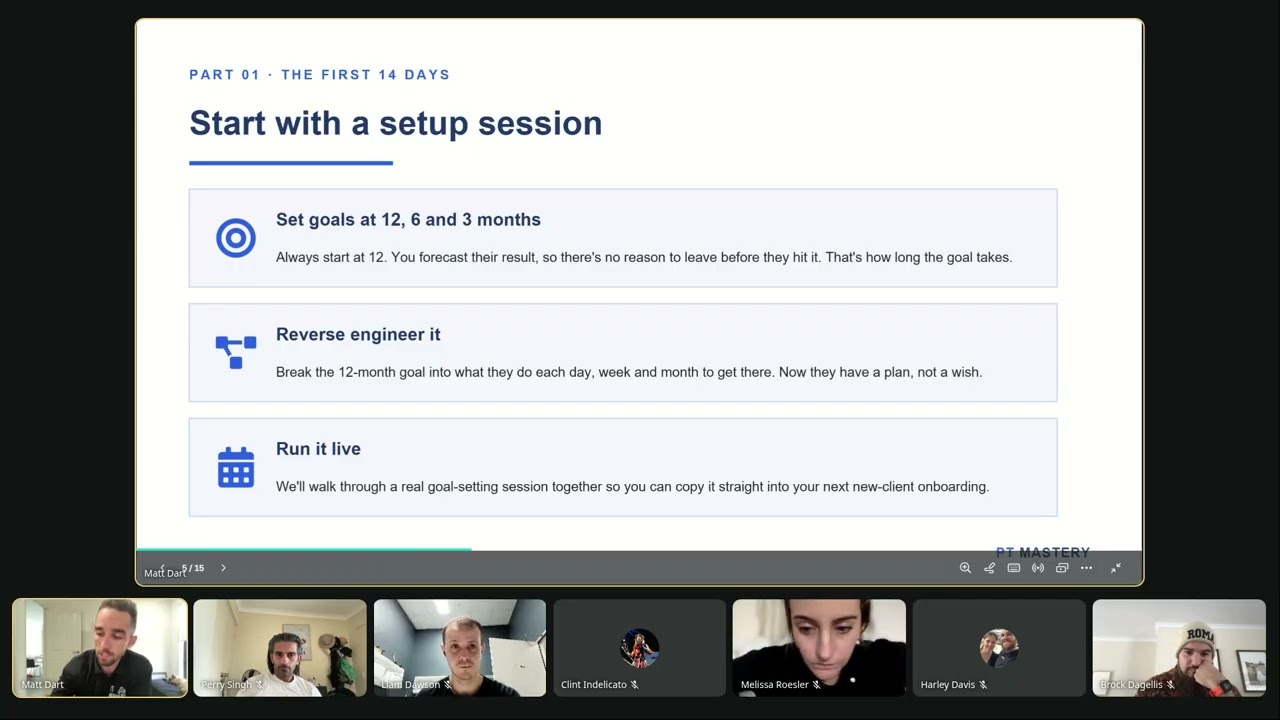
In this 90‑minute live webinar Matt Dart walks fitness business owners through a complete client‑retention system that turns first‑time customers into year‑long members and a continuous source of social proof. He starts by emphasizing why keeping clients longer saves marketing spend and time, then outlines a four‑step framework: (1) a structured onboarding process focused on a 14‑day setup session and 12‑month goal setting; (2) ongoing client nurturing via regular check‑ins, community events, milestone rewards and a clear reassessment cadence (3‑, 6‑, 12‑month checkpoints); (3) a proactive “spot‑and‑save” system that flags at‑risk clients using a manual traffic‑light review or automated CRM/AI tagging; and (4) harvesting results into testimonials, Instagram posts, Google reviews and other social proof. Throughout he demonstrates live role‑plays, shares checklists, discusses software integrations (Trainerize, EverFit, Claude AI), and provides practical tips for scheduling recurring goal‑setting sessions, rewarding milestones, and turning data (measurements, body scans, compliance metrics) into marketing content. The session ends with Q&A on implementation details and a call to embed these processes into daily operations.
Chapters
get stuck into it. Okay, so client retention. Every single person, realistically every single person should be on this call, but that's okay. Some people are obviously going to watch the replay, but every single person should be able to get something out of today in terms of keeping your clients for longer. So I'm going to start sharing my screen in a second. And Liam, just so you know, Claude actually made this presentation for me, so we'll see, we'll see what you think. Um, so let me start sharing this bad boy and we'll get stuck into it. Morning, Mel, great to have you here as always. Okay, you guys can see that? Someone give us a thumbs up. Yep, beautiful. All right, so the title of this one was Clients for Life: The Retention and Testimonial Engine. Um, So there's two parts to this, is how to actually get your clients to stay with you for 12 months or more. And the second part is how you can, uh, or how you can easily get social proof. And I actually might scroll back through my Instagram and literally show you live examples of what that looks like. So I've done like bits and pieces of this training before, um, but I'm just going to put it all into one so it's all in the one spot for you guys. So put a 1 in the chat if you guys want to have your clients stay with you for longer. Give me a 1 in the chat if that's what you guys want. Want a Harley? Awesome. All right, I'm going to show you guys what works for me, um, when I was, uh, you know, doing my face-to-face PT stuff, plus also online. Funny story— well, not funny story, a little bit of insight for you guys. Since I've moved my clients online, I have actually only lost 3 clients. For online coaching in 2, 2 and a bit years. Yeah, maybe that was because they were doing face-to-face with me a lot of the time, um, but I basically give them no reason to leave. Like, we're still always focusing on something. There's no reason why they should leave. And it's the same with you guys. As long as people still have something that they're working towards— yes, you know, some people will have some financial difficulties, which is fine, but if they're financially fine, then there's not a whole lot of reasons why they should leave you. So let's get into it. So why does this matter? Uh, I'm sure everyone on this call would all agree we don't necessarily like doing marketing, sales, doing free consults all the time. So wouldn't it be better if you just kept your clients for longer so you didn't have to do as much sales and marketing? So Here's the thing. So if you were to keep your clients for 3 months, which is for most of you guys the bare minimum that people would stay with you for, if you were to keep them for 4 months, that's 4 times as long, uh, with— if you guys are doing ads, zero extra ad spend if it costs you money to get clients, but also saving you guys time if you guys aren't doing ads and you're doing, uh, stuff in the gym for free. You gotta think about it as well, like, if your conversion is I don't know, let's just say 40%, it would save you an extra 6 hours of time just by keeping that client for longer. So it's definitely worth your time to figure out how you can get your clients to stay with you for, you know, 12 months plus. Um, a lot of the time in my experience, and you guys might have this as well, when people generally get to around that 6-month mark of training with you they very rarely leave after that 6-month mark. I'm not sure if you guys have the data on this, but most of the clients that used to leave my PT business were either 3, 3 or 4 months is usually when they would usually, um, finish up for whatever reason. So, and a little exercise that I encourage you guys to do, and I think, Mel, we've done this before, um, when we're working on retention for you, is is if you go back to, and I think Perry would've done this for you as well, if you go back and look at, and you look at all the clients that you've had and literally go into your payment provider and see how long they actually were with you for, and you'll be able to see a trend of when people generally leave. So prime example, let's say you had 10 clients and you had 5 of them just do the bare minimum, which is the 12 weeks, you had 3 that did 9 months, you had 1 that has, or you had 2 that's never left. So quite clearly there you can see the trend is half of the people are leaving after the minimum term. So what you do there is you reverse engineer what generally happens at that 12-week mark that is causing people to leave. And it can be a number of things in terms of how you set up the sale, which some people say, hey, it's a 12-week program, which means you're basically signing them up for 12 weeks. And the, the, the solution to that is, hey, we work with people for at least 12 weeks, is that okay? So if you say language like, hey, it's a 12-week program, it's a 90-day program that we do, then subconsciously they're like, okay, cool, I'm only committing for 90 days. Okay, subconscious thoughts here, no fault of anyone, it's just subconscious. It's That's how the brain works. But there might be other things that you guys are not doing that is causing people to leave during that time. Maybe they don't see, maybe they start to plateau with their progress. And this is something for you guys just to do a bit of an evaluation or a bit of reflection for you guys as well, because there'll be trends. And this is, welcome to the real life of business, right? You need to analyze the data make decisions on the logic, not how you feel. Okay, so that was a bit of extra insights there. Okay, so we're gonna go through 4 different things today. So 4 different things that you can, you can do to get clients for life. So first thing is the onboarding, then it's the client nurturing, then it's saving them, and then it's kind of harvesting, and then also kind of getting client testimonials. So we're going to go through one by one. Okay, so the first one is by far the most important part, which is the first 14 days of when they start with you. Okay, so if you guys don't have a very specific process for the first 14 days, this is something that you probably need to put on your action items to complete. If you don't set them up for success in the first 14 days, then you've lost them. There's no well, not no chance, but unlikely that they're going to stay with you long term. So this is what you got to do. You should start with a setup session. Now for me, I actually used to do a setup session for free, uh, initially. I did eventually change to just have that as part of their normal paid sessions, um, but I used to do this as like a bonus when they sign up. We do like a 30-minute setup session. Now the setup session is to set them up for success, which is exactly what it says there. So what you're going to do, the first thing you're going to do is— this is all about goal setting, by the way, and I'm going to go through like a live example in a second. So you're going to set 12-month goals. So it doesn't matter what you've discussed in the consult, I want you to set a 12-month goal. So 12-month goal, um, you know, whether it's weight loss, strength, whatever it is. If they can't figure out what they want to achieve ask questions like, cool, if you had your dream body in 12 months, what would that look like and feel like? Okay, you need to have a 12-month goal. If you guys are only setting goals for like 3 months or short-term goals, it is your fault for them leaving. Okay, say that again. It is your fault that they are leaving if you're only setting short-term goals. You need to set long-term goals, and it's okay for them to change their goal if they want, but you need to have a long-term goal. So prime example, let me just do— let me do like a live walkthrough here. Who wants to volunteer? I'm going to be the trainer and I need someone to be the client. Anyone? Terry, unmute. So working for you. Hey Brock, great to see you as well, my friend. Oh, let me allow audio. Does that work, Curry? Can't hear you. Okay, you can be the next example. Anyone else want to volunteer?
Yeah, I'll do it.
Brock, awesome. Okay, so you're going to be the client, uh, I'm going to be the PT. I'm just going to give you guys a bit of an idea how you would start a setup session, and we're going to set some goals. So just, Brock, just make up whatever you want. And we'll, um, we'll do it together. So Brock, um, so I'm super pumped to be working with you. Uh, in this session we're going to do what we call a setup session. So we're going to set some goals, some long-term goals, and we're going to reverse engineer them so you know exactly what you need to do each week, each month to be able to achieve these goals. Does that sound good to you?
Yep, sounds good.
Awesome. So let's start by saying, uh, 12-month goal, what would you like to achieve um, together in the next 12 months?
Uh, I'd like to, um, lose about 10 kilos and bench 100.
Awesome. So lose 10 kilos and bench 100 kilos. Now you guys should have already talked about this in the consult, but you can also go into detail in terms of why they want to achieve these goals. For this example, I'm not going to do that. I'm just going to go through the goal setting part of it. So So 10 kilos and you want to bench 100 kilos right now. Okay, cool. Can I just ask Brock, when you say you want to lose 10 kilos, how long do you think that's going to take us to lose 10 kilos?
Well, I had a mate that lost it in about 5 months, so I thought that was pretty, pretty good time to aim for.
Yep. Okay, awesome. So everyone listen to what I'm going to say here. So that's awesome. We can definitely do that in 5 months. What are we going to work on after we achieve that goal?
Uh, maybe I'll look at, uh, if I lose that 10 kilos, uh, just trying to gain a bit more muscle, like staying the same body weight but gaining more muscle.
Yeah. And what does it— what does that mean? Where do you want the more— what do you want more muscle? You want it in your chest and your arms?
What do you think?
Yeah, probably like bigger arms, bigger chest, big shoulders.
Yeah, awesome. So that's obviously going to come down to the bench press as well. So 100 kilo bench press goal, what are you lifting at the moment?
At the moment I'm doing 60 for reps. Beautiful.
Okay, so that's obviously going to take a fair bit of time. I think that'll be a really good 12-month goal. Uh, for the 10 kilos, I think we could, as you said, achieve that in 5 or 6 months. Do you think, like, if we lost 10 kilos, do you think you'd want to lose more weight after that, or do you think we should just focus on the building muscle and strength after that?
Um, I think it'd be based on sort of how I'm feeling about how my body looks, um, at that point.
Awesome. Yeah, love it.
Awesome.
This is sounding really good. So we got the 10 kilo weight loss, 100 kilo bench. Um, what else would you want to achieve?
Uh, probably just, I guess, feeling a bit more, uh, strong and energetic.
Yeah, so energy levels. Yeah, love it. Apart from the bench press, is there any other exercises that you really want to focus on, like deadlifts or squats or anything like that?
Uh, nah, deadlifts and squats scare me.
Okay, cool. Let's talk about that. Why do they scare you? Do you feel like you've got the wrong technique, or have you seen something?
Um, yeah, I just like know too many guys that hurt their back, and, um, every time I try them, my back just feels a bit sore the next day.
Okay, cool. We can probably put that on our short-term, um, goal to improve your technique there to avoid any like back injuries, um, which is awesome. So it sounds like, um, obviously a bit of chest and bit of shoulders is the, is the main concern with bench press, and then the 10 kilo weight loss. Does that sound about right?
Yeah, they're the main things I want to do.
Awesome, sweet. So Um, thanks, Brock, for volunteering. Appreciate that. In the chat, what did you notice I was doing? In the chat, what did you notice I was doing? I kept bringing it back to long term, 100%. Yeah, I made the goals longer on purpose. Yeah, that's the key here. So cool. When we hit that goal, what are we going to focus on? So same thing, if you guys, if you guys do have a client that maybe, maybe they only want to lose that 10 kilos, right, which is only going to take maybe 5 months. Most people will just leave it at that. Oh cool, nice, perfect, sounds good. Okay, well let's, let's look at what's— what your body's going to be like when you hit that goal. Then what are you going to do? You're not just going to do nothing. Fitness is a lifetime, lifetime sport, right? You don't just sit there and do nothing after that and put the weight back on. So what else are we going to do? This is what— this is the conversation you guys need to have when they first start. And I'll talk about how you kind of have ongoing conversations. Now the next thing you wanna do from there, once you have a 12-month goal, you break that down into 6 months and 3 months. So what that looks like is, let's just say for example there was a 20-kilo weight loss goal, and let's just say for example we said, cool, that's gonna take us 12 months. Then you're gonna say, okay, cool, we're gonna set a goal so in 6 months' time, and you literally put in the date, the date that it's gonna happen. 'By Christmas, we're going to lose 10 kilos. Does that sound good to you?' 'Yeah, perfect.' 'And then we're going to set a goal for the next 3 months. We're going to work towards losing 5 kilos.' So they know exactly what's happening. First 3 months, 6 months, 12 months. And then what happens is when you do your goal setting and reassessment sessions, which I'll talk through in a second, you're going to re-forecast with these goals. So let's say, for example, that they're at 3 months or that they're at 6 weeks as an example, and they've lost, uh, 1 kilo, which is fine. Happy days, you lost a kilo, high five. And then you re-forecast again. So you, so you go, cool, in our first session we said we wanted to lose 20 kilos, so we lost 1 kilo, well done. So all it means from now is it's going to take us another 20 months if we keep going how we're going. To be able to lose the 20 kilos. Okay, what we can do to fast-track that is do XYZ.
Cool.
Do you want to do that? Or do you want to keep doing what we're doing? Okay, so they always know where they're at with their long-term goal. Is that making sense? Just let us know if this is making sense. Okay, so you guys should always be bringing up their long-term goals. And it's okay to change their goals. Prime example, once you start training them on strength training, maybe they're like, I want to be able to deadlift properly, after you learn how to do it properly, and then you change the goal. Okay, cool. So in 12 months' time, what would be a good goal for us to hit for a deadlift? Cool. So you're at 50 kilos now and you want to get to 100. It's going to take us at least 12 months. Guess what? You're only thinking about 12-month goals now. I think I did this example the other week where I think you guys know I signed up to a jiu-jitsu gym nearby and to get to the next belt, the guy's like, it's going to take you 2 or 3 years to get to the next belt. And I was like, what? 2 or 3 years? And I was like, oh, fuck, all right. So he pretty much just subconsciously told me that I'm going to keep doing this for 2 or 3 years. He's pretty much locked me in 2 or 3 years. I'm not going to leave. I'll just have to start again. So like, that's what— this is the conversation you guys need to have with your clients when you first start. Okay, um, okay, I've gone through that. Let's go to— I kind of went through this a little bit before, but every, every single time you do like a reassessment of their goals, you collect data from like measurements, fitness testing, body scan, or any of that type of stuff. You re-forecast again. So there's always something to work on. A lot of people will leave not so much because they have money issues, it's because they run out of, uh, inspiration to keep moving towards a goal. So they either have achieved their goal and they don't know what they're paying you for anymore, um, which, you know, is good, you've helped them achieve the goal, but there's other stuff to work on. Okay, so I put a little visual here, but every 3, 6, 9, 12 months, the goal moves forward. So at all times, they should have a 12-month goal that they're working towards. Okay, part 2: check-ins, touchpoints, and community. So a little tip down the bottom here: they sign up for the results, but they stay for the community. Um, prime example, some of my online clients that I work with at the moment, we sometimes go to the footy together. I'm a massive Broncos fan. So kind of having like, uh, you know, Mel does this really well with her community events. Um, yeah, I think, I think you guys do like breakfast once a month or something. You bring the kids all down and you'll hang out. Um, which is like, you got to find a lot of people are not that they won't want to leave that type of environment because it's also good for the kids as well, right? So, um, yeah, let's go into some details here. So of course you, you guys all do like check-ins and stuff, so you can do the check-ins either in, in the gym, in the, in, in person, uh, or you can do them obviously in the online capacity each week or each fortnight depending on how often you guys want to do them. Um, I actually— let me give you some insights here. Everyone does like check-in forms now, right? For the first like 3 years of me being a PT, I didn't do a single check-in form. I did it all in person in the gym. So I was still checking in on people, but I was like, I was not doing any work outside of the gym, like nothing. Only when I wanted to obviously do a bit more, uh, online coaching where I started to actually do check-in forms. Um, so I wanted to put this in here as an option because you don't necessarily need to do check-in forms, but you need to be checking in on people during their sessions. The other thing you can do is milestones and rewards. So something that was really good for us, for my business, was, you know, 5K Weight Loss Club. When they get 50 sessions, they might get like a t-shirt that says, you know, completed 50 sessions or 100 sessions as an example. And then obviously gives them some public shoutouts. They wear the shirt around the gym with your logo and stuff on it, and people want to— they want that status. People want status. But if anyone says they don't want status, they're lying. It's human nature to be like a wanted, like a status person. Okay, so this can be whatever you guys want to do, but a lot of things that worked quite well for me is session milestones and result milestones. So if you guys are focusing on weight loss as a result, maybe you guys could do 5 kilo weight loss, 10 kilo, etc., etc. If you guys focusing on lifts, maybe, uh, I don't know, maybe 100 kilo lift as an example, whatever that looks like for your individual clients. Or you can keep it super simple with just number of sessions that they've done— 50 sessions, 100 sessions— and they might get access to certain certain merchandise that you guys can give them, or, you know, maybe they get like a reduced rate when they hit 100 sessions, as an example. And then of course recognize it publicly as well. So maybe if you guys are doing like community events, now this could be a good option for you. Maybe when, when you guys catch up, maybe when someone hits a certain milestone, you do a little presentation for them with everyone else around. Public acknowledgement. That's a massive thing for retention as well. Does anyone do that, by the way? Any like milestones or rewards?
Just, um, one client, she's been— I've got two clients that have been with me for a year and they've been so loyal, so I got them like a little beauty hamper for like a year. Um, when they got to like— I have like a client of the month thing, so every month whoever's been working hard, I get them a little voucher. But I've had like 2, 3 clients that have been with me for like a year So yeah, I just got them like a little, um, just like a little soap thing kit that's like a girly thing.
Yeah, nice, awesome. Yeah, you can do like anniversary stuff, and once they've been training with you for a year, you can give them a present. Birthdays is also a good one. Uh, of course, this is the stuff that you, you know, you go extra mile for that is going to keep people around. Uh, as I said before, with like the monthly social events, uh, at a bare minimum, I think you guys should be doing them every quarter, so every 3 months. Um, definitely at Christmas time, that's a nice easy one. Everyone kind of does that. Um, but, uh, yeah, as I said, like, if you can get your clients to become like friends, uh, not only will they, um, probably end up training together in the gym, but they will look forward to catching up for those monthly events as well. Yes, I highly, highly suggest doing that. Okay, part 3: spot and save at-risk clients. So this is about catching people that are starting to show signs that they might leave and being proactive rather than having to wait until they're at the point where they want to cancel. So let's go through this. So you can either do it manually or you can automate it through a CRM. So most of you guys, you can just do it manually. You don't need a CRM or a software for this type of stuff, but I'm just going to show you guys what's possible as well. So whether or not you guys know this or not, me and Scott catch up every single week, and we talk about every single one of you guys every single week. And we just want to identify people that need extra support. You know, maybe, maybe they need an extra coaching call, for example, or maybe everything's fine, I just need to leave you alone, as an example. So we go through that every single week. And I think you guys should do the same thing with your clients. Now it's hard if you guys don't have a team to be able to do this because it's all relying on, on you, right? Which is fine. But for example, if you took half an hour every single Monday, for example, and you went through all your clients and you just had a quick like traffic light system, which is like green, yellow, green, yellow, red. Green people are, you know, crushing it. They're logging all their workouts, they're doing their nutrition, they're crushing it. Just leave them alone, you don't need to do anything. Yellow, which means they're, they're doing okay, they might need a little bit of a check-in. So maybe you can put that on your list to check in with those people. Or red is maybe they haven't trained this week, maybe they're not doing any nutrition, and they're on the verge of canceling. So they're the ones you've got to be more proactive with. Okay, you can automate this process if you're using softwares like Yeah, any software really, like EverFit, Trainerize, you can actually, um, integrate. If you want to use Claude, Claude Code, for example, you can integrate that and get it to look at the data in terms of compliance. And if— and I think, I think you can actually do this directly through Trainerize as well. If people have, like, if they're under a certain compliance each week, it puts them under a tag, and then each week you can see people that are under a certain compliance. So I use Trainerize, so I know that can happen. But, you know, I'm sure every single software will have that type of option as well. Otherwise, if you want to use something like an AI software like Claude, you can, you can integrate it into that software and it can basically pull all the data and tell you which clients are green, yellow, and red. I did this for Scott for Everfit. I logged into his account and did it for him. Um, so it's definitely possible. And basically you just give it access to be able to read the data and it'll read the data for you. It'll say, hey, Jenny has done 8 out of her 9 sessions over the last 2 weeks. She's logged all her nutrition and she's done her check-in form every single week for the last 4 weeks. She's green, keep her. I mean, don't keep her, but like there's no, no action required type of thing. And then you'd be like, hey, these are the, the 5 clients that are on the verge of canceling because they haven't trained this week. They haven't done their check-ins for the last 4 weeks in a row, and you need to make sure you're on top of it because otherwise you're going to lose them. Okay, uh, and then actually, before I go into part 4, um, this stuff makes sense. Part 3, spot and save at-risk clients. Has anyone had like a client cancel and be like, oh yeah, I was, I was waiting for this message. They never had that before. Like, yeah, yeah, they've been, they've been slacking off, or they're just taking the piss now, uh, or yeah, maybe they've canceled a few sessions and you're like, oh fuck, they're gonna cancel now. Anyone had that before? I can always tell with a lot of people. Just me? That's okay, it'll happen if it's not happened yet. You're laughing. Um, but the whole point of this, like, this one is you need to kind of— there's a timeline where you have the opportunity to save people before they throw in the towel. There's an opportunity where you've got a week, maybe 2 weeks, where they're on the fence about canceling. And if you were to kind of reach out or have a conversation or to sit down with them for their next session rather than training them and just going through the motions, if you were to sit down and get to the bottom of what's actually happening, then you'd actually save them. Prime example, I had a client who, um, just refused to train on their own apart from their PT sessions. Just refused. And we're just doing one session a week, and, um, she got super frustrated that she was not losing weight. Or I got super frustrated, and I was like, hey, we're not gonna train today. I just need to understand what's happening so we can make sure you actually get the results that you want. So we didn't do any physical training. We sat her down, uh, said, hey, we're 3 months in, you said you wanted to lose, you know, 20 kilos and you haven't lost anything. The training that we're doing is fine, so it's either one of two things. Either your nutrition's trash uh, we're eating like, eating like crap throughout the week, uh, or you're not training, uh, at all on your own. Which one is it? And it was both. Um, but I said, okay, cool, well, what's the easiest thing to fix so we can make some progress straight away? And she said, okay, I can come in and train twice a week on my own. So I said, okay, perfect, I'm gonna do Um, yeah, like for example, I'm gonna give you 2 sessions to do on your own. I don't care if it does the same thing every week, but I need you to exercise outside of our sessions. And then once we figured that out, like, cool, we've got the routine, then we fix the nutrition. Okay, so sometimes you just need to— don't just train them for the hell of it. Sometimes you need to sit them down and figure out what is going on. A lot of the time it's nutrition. Um, which you can literally just pull up and say, hey, look, you said you're only consuming— according to your MyFitnessPal, you're only consuming 2,000 calories per day, but you're gaining weight every week. So tell me, is everything accurate that you're putting in here, or are you not putting everything in here? Which one is it? I need you to tell me.. And they'll tell you, um, but you need to sit them down and just be direct and be like, hey, this— the stats are telling me that you should be losing weight, so there's a reason why you're not losing weight. So you need to tell me what's happening, otherwise it's pointless. It's pointless for us to exercise if your nutrition's crap, you know what I mean? So you guys need to have the hard conversation as soon as you start to get that vibe. Otherwise they're just going to cancel, okay? And they'll tell you every type of excuse— oh, you can't afford it, mortgage has gone up, or moving house, blah blah blah blah blah. But in reality, it's probably not that. It's probably because they're not getting the result. Maybe it's their fault, maybe it's your fault, but it's your responsibility as the business owner. So let's get moving on. Okay, part 4. This is, uh, turning results into marketing. Who feels like they do this well? Who gets regular client testimonials? Anyone? But most people, they think about it last minute and they forget to do it, or they don't do it at all. So I'm gonna give you guys a really simple way And I'll literally get up my Instagram in a second and show you guys, um, what it would look like. So you guys are going to build this into your goal setting and reassessment sessions as part of your process that happens every single time. So I used to— actually, let me see if I can find it. I literally used to have a Let me see if I can find it here. Um, sorry, teams, give us 2 seconds while I find this. Believe it'll be in the delivery system. Okay. Have a look at this bad boy. So remember how I talked about the setup session? Well, this setup session checklist, boom, boom, boom, boom, boom, boom, boom. Nothing gets missed. Just an idea, maybe you guys should have a checklist as well. And then over here, look at this goal setting and reassessment checklist. Your weight measurements, body scan, progress photos, fitness testing, analyze progress, adjust goals, update nutrition, update program, social proof, Boom, right there. Never gets missed. Social proof every single time. So if you guys want this, it's in the delivery system. So when you're in the classroom under delivery, then delivery system, and then example system. Actually, can you guys even see that? You can't even see it. 2 seconds. So when you go into Classroom, uh, then you go Delivery here, and then Delivery System, and then Example System. That's where you'll see the checklist. Okay, let me go back to my presentation. Okay, so you're going to capture the proof every 6 weeks. Um, now Remember when we do the goal setting and reassessment sessions, you guys can collect whatever data you guys need to be able to get them the best results. Uh, hold on, let's check the chat here. Piece of text ones. Yeah, cool. I'll show you how to do it, Holly, in a second. Um, so you don't have to do stuff outside of the sessions, you can just do it during the sessions. Uh, any type of data that you get, you can use as social proof. With of course their permission, as in body scan before and afters, measurements. If you do photos, which I highly suggest you guys do, some people won't want to do it, which is fine, but majority of people are open and willing to do it. But in the goal setting and reassessment session, remember you're re-forecasting, or you're getting all the data first, then you're re-forecasting where they're at. So literally all you're going to do after you do that is you're literally just going to take a selfie. Before you find out, hey, do you mind if I give you a shout out on social media? Is that okay with you? Hey, let's do a quick selfie. Boom, done. 5 seconds. Um, you can even say, do you mind if I give you a shout out on your, on your progress on social media? As long as they say yes, of course. Some people might want to do it, might not want to do it, but majority of people, they're happy to, um, get a shout out. And then what happens is you get a never-ending supply of social proof. Every 6 weeks, a client's got new results, whether it's small or big. If you're consistently getting social proof, you will never run out of content to post. Now I'm going to show you guys shortly literally what that looks like, because I'll literally get on my Instagram and I'll show you some live examples of what that looks like. So a couple of things that you can do for social proof, uh, Google reviews. If you're getting like, like Harley for example, if you're getting like text, you're better off getting them to do a text Google review and you just screenshotting it and using other social proof because then you kind of get to it, to it, to it once. Um, then you screenshot it and post it, as I said, on Facebook and Instagram. Um, now what I would suggest is when people get to certain milestones like 5 kilo, 10 kilo, 20 kilo club, you know, 100 kilo deadlift, 100 kilo bench, whatever it is. Uh, do like a 30-second client interview or just get them to do like a selfie-style video. Um, which, you know, I'm sure you guys all know what I'm talking about. Like, they can just have the phone here and go, hey, it's, um, it's Mel. I just want to give a shout out to Brocky's helped me lose 5 kilos in the last 6 weeks. Um, love training with her. I highly recommend this service. You should go check her out, etc., etc. 2 seconds, someone's calling me. Let's hang up from them. Boom. Okay, so that's essentially, um, oh, we got one more thing here, um, So the— if you think about it, like, the, the goal setting and reassessment session is probably one of the most important parts of the business, to be honest. It's not so much the sessions that get the results, it's what they do outside of the sessions and the data that you can collect that helps you make the right decision on which direction to go, which program to do, what nutrition to to give them. So it comes down to 3 things here. So obviously retention, so you can reforecast the connection, which is reconnect, which is obviously checking in, making sure they've got all the right support, etc. And then the marketing side of things, which is collecting the social proof. That's it. So I'm literally going to go onto my Instagram right now and find some examples for you guys. I want to know What's the biggest takeaway that you've had from today? And then we can also go through some questions. We got a little bit of spare time as well. So firstly, in the chat, what's your biggest takeaway? And I'm going to try and scroll through my Instagram to find what it's like. Actually, I go on Facebook as well because I can search. Yeah, Google Reviews will be super helpful for you, Brock. Yeah, yeah, because obviously you don't have the walk-by traffic, so that's going to be huge for you. Um, all right, let me go in here and I'm going to search. I'll share my screen in a second. I'm just going to try and find the posts All right, Clint setting up the next goal after achieving the first goal. Yeah, 100%. There's always something else to work on. There's always levels. Levels to the game, as I always say, which is true. All right, uh, retention is about— can you just— I mean, Brock, just ask me that question. Do you not mind?
What questions are—
is that a question you put in the chat? What happens after you talk to us, saying biggest takeaway from the session? Oh cool, sorry.
Yep, not a question.
Cool, cool, cool. Sorry, not forget about goal setting sessions. Yeah, Perry, do you guys, um You guys need to have some type of process where you guys can't forget about those things. I'll show you what I do in a second. Try to scroll through. So the annoying thing about when you post a lot of stuff, you gotta scroll through all the way. It's good to also look back and see what you posted about too.
Did anyone do that?
Like, oh geez, what was I posting about? Couple years ago. Yeah, that's why I was confused, Brock. I was like, what's the question here? Okay, um, while I'm scrolling through Instagram, Terry, I'm just going to show you something. Um, so this is if you're doing everything manually. If you're using like a software like Trainerize, you can literally— you can just literally every 6 weeks you put it as a recurring event every 6 weeks to do their goal setting and reassessment session. It's super, super easy. But if you guys doing stuff manually, uh, let's say for example today is the, the signup session or the setup session, sorry. Literally after today, or literally in 6 weeks. So 1, 2, 3, 4, 5. This is— you remember how I used to, when I did the training on the session upgrade, this is the session upgrade. So I remind myself every 6 weeks to upgrade their sessions or to offer an upgrade. But you might put in here goal setting reassessment in here on the notes, just so you kind of remember when to do it, and you would do that every 6 weeks. And if you have like a, like Trainerize, uh, whatever, or whatever, you would just make a recurring event. Like if, for example, um, you know, every, every 6 weeks on the Monday to— for the client even to book in their goal setting and reassessment session, uh, or as a reminder for you if you check their file every week So cool, the session that week is going to be the goal setting session and there's no training. All right, um, was there any further questions, team? I'm just gonna scroll through and show you guys some.
I have a question, Matt.
Yeah, go for it.
I know this is not ideal, but could you do your goal and forecasting sessions like face to face on Zoom, um, on Zoom online?
You could.
Okay.
Um, the key there is the goal setting and reassessment session is part of their weekly subscription, so it's not, it's not an extra session.
Okay.
Yeah, so as long as I understand they're not getting that face-to-face session as well.
Okay.
Um, so it's like every 6 weeks, one of their sessions is, okay, um, dull thing in a reassessment session.
I usually, um, I was going to say, I usually tell them before they're going to have it so that if they want to come in and train, because sometimes they obviously want to train, I say, look, we're going to do our 6-week session this week, so if you want to train, just come in earlier. So they don't feel like they're missing out on their training, you know what I mean? I think Matt did say, oh yeah, you're ready to train, and they're like, oh, I don't want to sit down and do this. So I'm like, okay, I'll just tell you No, that's true.
I think Matt did say if they don't want to do that, you can do half an hour of training and then the rest you can do your goal setting session if they're not up for doing the session. But that's a great idea, Mel, to just bring them in the gym because otherwise they're not accountable.
Yeah, mine is just so pumped up to train, and then, then if I don't— once I— they got there and they're like, oh, okay, they had like all these caffeine, and then I'm like, Yeah, I used to, uh, I used to tell them, um, the week before.
So I used to say, hey, remember, I used to do it on the— I used to do mine every 4 weeks. So I used to say, cool, the first week of every month we're doing the body scan measurements, blah blah blah. Uh, I actually say, look, if you can stay back afterwards, um, because in that case when I did body scans, you don't want to train before a body scan. Yeah, it'll change the data. So I used to say, cool, we'll do your body scan and then you can train after. Yeah, okay. So, uh, yeah, good question though, Perry. You can obviously do it online, um, but you, you obviously, you still want to be able to get the data as well. You still probably want to do measurements, um, and all that type of stuff if you, if you need to.
Yeah, 100%.
Yeah. So here's, uh, here's a little throwback for you. Look at this, when my little daughter was born. Jesus Christ, 4 years ago. Um, Funny story, this client here, he's still an online client to this day. He's one of the clients that I was talking about, um, going to the footy with. So he's been with me for 4 years. This is literally all he did. I literally took a selfie. I was— when I was at Jets. How good is this? Robert has dropped 3 kilos in 1 week. How good do you think that's— that client feels when I shout him out after 1 week of training with me? He's lost 3 kilos in 1 week. He's on top of the world. He's not leaving. He's been with me 4 years. He's never leaving. You know what I mean? Here's another one. Kian. This is actually not meant to happen this way, but he's also still with me to this day as an online client now. Kian's latest achievements. This is the body scan. Social proof. I did this every single month with the body scanner. There's another one. What's this one? Ah, this is social proof. All of our clients combined lost 123 kilos of fat and gained 72 kilos of muscle. How's that for some social proof? Another one. I know that's when we expanded. There's another client result. Boom. Took a picture of him. He didn't want his face in there, so I just took a picture like this. I'm doing this during the session, team. Doesn't have to be outside of the session. Boom! More social proof. Literally almost every second post, social proof. Um, social proof.
This is awesome, Matt, but we can't see your screen.
Oh no, you told me 5 minutes ago. Okay, hold on. Can you guys see the screen now? Okay, let me start again. This is the client I was talking about. Selfie, lost 3 kilos in one week, and he's still with me to this day. Kian, doesn't always have to be a selfie. Take a picture with the body scan, blah blah blah. Um, this is actually when I become a sports nutritionist. Back in the day. There you go. Another one here. If you— if the client doesn't want his face in there, take a picture like this of him doing that, doing an exercise, doing a bench press, doing a deadlift. Social proof right there. See, all this is all social proof. And you wonder why I got so many clients coming from my social media. Literally every second post is social proof. So you can imagine how much social proof I had. Like, we had like 180, 180, 180 clients. You can imagine how much social proof I had. I know you guys don't have that many clients right now, but even if you have 10 clients, every 6 weeks you should have some type of social proofs that you guys should be posting. Again, this one, this one didn't want her face in there. It's just social proof. So proving that you can get people results. Okay, again, this one just for strength. Bench press from 65 kilos to 90, squat from 70 to 110, deadlift from 80 to 120. Okay, don't overcomplicate this stuff. This is during the session, right after the fitness test. Hey Dale, do you mind if I give you a shout out on social media about your progress? Yeah, 100%. Cool. Let me just take a quick picture. Okay, let's bring back memory lane. My first ever client event, a Christmas party. See, all the stuff I'm teaching you guys, I've done it all. I'm just telling you guys what works for me. Okay, any questions, team? Literally all I used to post about is social proof. Just going by this, it's all social proof.
What was that event where you were wearing purple? Was that like a promotion or competition or something?
This one? Yeah, I'm sorry, this is a partnership with ASN, Australian Sports Nutrition, uh, where we set up a little stall in the shopping center nearby, and we ran like a competition. As you can see here, I had competition prizes, samples, uh, we gave away some free PT sessions, and we had a bunch of fun. So it was a good way to get the name out there because we were literally— my gym was inside the shopping center. So we usually just, um, you know, obviously all the locals came down to that shopping center so they could obviously find out where we, where we were located and stuff. Um, so yeah, this was the gym here. That's the team back in the day. Um, that's it. Did anyone have any other questions you guys want to go through? Oh, memory lane! This is how it started. Oh my goodness, this is my boot camp I used to do in the park. With my friends that refused to pay me. Funny story. So this guy here, Josh, he's my high school mate. Um, this is funny, guys. I used to do a weekly boot camp in the park just to get some experience, and, um, I did it for free for 4 weeks just to get some experience. And I was like, I'm going to start, uh, I need to obviously make some income from this. I'm probably going to start charging for it. How much would you reckon you would, um, pay for it for like a weekly bootcamp session? And he's like, oh, I don't know. I was like, oh, I would just want to do like a coin, like $2 or something. He's like, oh no, it's probably a bit much. Good mates, hey? Um, so not mates anymore. But anyway, that's where it all started. Uh, I literally did, um, boot camps in a park. So everyone's got to start somewhere, right? Anyway, that's enough about me. Go back memory lane. Um, all right team, so that is how you can keep your clients for life. Uh, hope that was, uh, very insightful. I had fun doing that training. That was cool looking back on that stuff. Um, so just make sure there's no other things in the chat. Yeah, cool. All right, team, um, I'll leave you guys to it. Uh, have an epic weekend. Uh, see you guys Monday. Next week's Friday coaching call is going to be more about marketing, so back to lead generation stuff next week. Uh, apart from that, enjoy the weekend. I'll talk to you Monday. Bye-bye.
More from Matt




Your staff aren’t lazy. Your systems, standards and leadership might be. Check out Episode 138!





Your team can’t take ownership of work you refuse to hand over. Stop being the bottleneck! #shorts
