Agentic GTM with Tariq from Cargo - GTM Engineer School (Preview)
Tariq from Cargo and hosts Jared and Max preview GTM Engineer School, a four-week course starting Apr 29 with 16 projects and 28 hours of live instruction. Week 3 covers agentic GTM workflows: using vector databases for qualification, custom triggers, and hybrid human-AI routing to find competitive advantages. The course teaches building custom tools and plays, with case studies from Descript and Weights & Biases.
Questions this video answers
Kicks off Tuesday, April 29 (year implied 2025 from upload date).
Up to 28 hours of live class over four weeks with replays.
Three months of Octave Core (valued $450) and two months of Clay Pro (noted as worth $1,600; $800/month) plus bonuses from Cargo, Lemlist, Air Ops; total tooling value cited as over $3,000.
Chapters
All right, good. So maybe we should get going. I'll, I'll give my intro here. Welcome everybody. Today we'll introduce GTM Engineer School briefly and then Tariq and Max will share a bit about the workflows you're going to be learning in GTM Engineer School, which kicks off Tuesday, April 29th.
See?
Pretty easy agenda. We'll talk about the kinds of hands on exercise you're going to be doing and then we'll do a little Q and A about your hosts here. I'm Jared, live in Silicon Valley. My background includes product growth and demand generation. I led growth at Auth0 and then campaigns at Okta. I've always invested in ongoing learning for myself and for my team and for me, structured learning, like live classes with experts you can actually interact with when you're stuck, that's been the most valuable. So I've personally benefited from Reforge, from Sales Impact Academy, from Pavilion, courses, from Winning by Design. So that's my inspiration for this course. Tariq, you want to introduce yourself and then, and then Max.
Sure, sure. So yeah, Tariq here, first member of the Cargo team of the two people you'll be interacting with here. And I just want to say before I introduce myself, so Max and I both have very, you know, particular personalities and ways of approaching GTM engineering. I think that's something you should leverage during the course as well. So my background before joining Cargo, I was not really in this GTM engineering growth related revenue ops kind of world. So I'm pretty much a noob. So I'm usually the dumbest person in the room when we build workflows with our clients. And then I, I try to ask smart people dumb questions and get smarter. So that's my GTM engineering journey. And that's also why I really enjoy building this community that we're building because, you know, we're all on a journey to become more of what we're not. So most of what I've been doing at Cargo is building workflows, getting clients into the door activated and then building this community, trying to build more education around what we do. So that's me, Tarik, and I give the microphone to Max.
Yes, very modest. Don't believe him. He's very good. Yeah. So for me, I've been, my background is I've been working all my life in growth from B2C and B2B. So I've been able to see a bit of everything inbound and outbound. Pretty much like Jared, I'm a big fan of MOOC and class I've been doing everything like Reforge, CXL and Daemon Curve at the beginning. So I'm very excited to work with this GTM Engineer School. I think of course learning is one way and the second is acting on this knowledge. Of course this is the beauty of GTM Engineering school is like it's really practical. It's not like yeah, you should use AI in 2025 and that's it. But we are going to be really in depth on these topics and yeah, so very excited to be here, guys.
Okay, let me nuance this Jared, if I may, if I could. If you give me 30 seconds. So Max is one of the few people in the industry who reads books about growth revenue architecture before going to bed, right? I almost know no one who does that. So and this is, I'm not saying this just to tease Max, this is the kind of duo that you have in the course that you can leverage. So Max is the person, if you want to understand where something comes from, who was the first person to do account scoring? What was the entire history of this concept of 50 years? You go to Max, right? If you want to sit next to a fireplace and listen to a story, he's really good at that. What I'm more inclined towards is building quickly, getting shit done and moving to the next problem. And so you have two different approaches and so use us wisely during this course to get the most out of it. Did I do justice to you, Max? Was that good?
Very good. Thank you. We appreciate the support here.
Any book that you'd recommend for the group?
I mean you mentioned it. It's not the pocketbook guys. It's as you can see the size is not a pocketbook but architecture from Jaku from a winning by design for me has been very interesting because we still operate a lot with this aar. So acquisition, activation, revenue recur, you know it and I think it's interesting but at the specific steps when you reach this 10 million milestone for a company a big party of your revenue will come from the post closing things like upsell, cross, sell, retention and this is something we tend to forget but if we are working in the B2B SaaS industry this is a big part of your of new generation and this is a book that I really appreciated on that and otherwise I will say Take forward says by Justin Mikhail has been when I read it four, four years ago I was like wow. Oh there is someone that talks about modan tactics and not the not the crappy Thing that you hear everywhere. So this would be the two books I would recommend.
That was a trigger question. You see what happened there? Guys, this is exactly what I was saying. Max, you're not alone. By the way, you have a friend in the chat. Max, Will is also reading these books before they go to bed. I've heard. So rumor has it that if you put this book right below your pillow before you go to sleep, you wake up with a better architecture.
Yes. Yeah, I heard that thing that went.
Just a little note. Can everyone who's not speaking go on mute just so we don't have background noise? I've done a lot of these zooms and it often comes up. There's some interesting stories.
Good, thanks.
Well, back to you, Jared. Sorry. Okay.
All right, Sounds good. Okay, so what I hear a lot is the tech is moving faster than I can keep up. And that's never happened before. That's what a lot of people tell me. And I felt the same way. I don't know if that's a familiar refrain or something that resonates with you. AI is reshaping how we go to market and it's happening super fast. So the teams who figure out how to turn that power into pipeline are going to win. But let's be real, the landscape here can feel overwhelming and the learning curve can be steep. So that's why we built this course. What we're doing is we're bringing together 30 pioneers, founders like we have on the call, educators, GTM consultants, and they're going to guide you through. It's a project based learning experience. You're going to Learn by doing 16 mini projects using 5 leading tools across the GTM stack. You'll get theory, you'll get frameworks, and you'll get case studies, but mostly hands on work. There's no prereqs. It's a 101 level course built for rev ops managers, AES, SDRs, growth content managers, PMMs and MOPS. You'll attend up to 28 hours of live class over four weeks with replays. If you miss one or two, that's fine. And you'll go from stuck to shipping. And yes, also you're going to get premium access to all the tools. So for example, three months of Octave Core, which is worth $450. Two months of Clay Pro, which is worth $1600, it's $800 a month. And then plus similar packages, bonuses from cargo, from Lemlist, from Air Ops, so over $3,000 in tools four weeks of the course Let me go through them real quick. Week one, you'll define your ideal customer profile and turn that into a compelling message you can operationalize and activate across channels. You'll walk away from week one with a solid list of high quality leads and a process to score and prioritize them. Week two, called Outbound and Personalization. This week we'll build and automate highly personalized outreach, then optimize deliverability so you can scale your outbound efficiently and effectively. And then week three, which is we're going to be talking about today, is all about building smart GTM agents, automating research, qualification and outreach based on product usage or deal lookalikes so you can spend less time guessing and more time closing. And finally, week four, we'll switch up a little bit. In week four, we're going to wrap up by teaching you how to turn any topic into optimized SEO content and repurpose it into short form search and messaging assets. We're going to give you repeatable systems for high leverage content creation. And the exercises you're going to do in the Zoom breakouts are guided by TAs like Kellen, Patrick, Eric, Bill. Jorge is on the call. So with that, today we're going to focus on week three and I'll let Tariq and Max take it from here down in the bottom right, we've got another webinar tomorrow featuring Yash from Clay. You can go to this link here and register it now I'm done and turn it over to you guys.
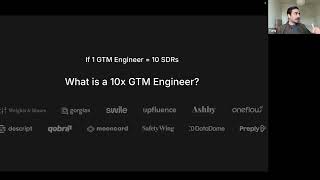
Sure. Awesome. So let me take a stab at it, Max, and I'll bring you in. Basically, so far what you've done is you've started to accumulate some mental models of what GTM looks like and you've accumulated some tools which you can use in isolation to sort of get work done. So as Jared said, from being stuck to getting stuff shipped. Now, the framework that we want to introduce to you is to switch gears from thinking about tools and outcomes and more about how to become a 10x GTM engineer. And this is not trivial. GTM is a Pareto market, which means that if everyone is doing the same thing, in the end, we're all losing. So it has always been the case that there's a small fraction of the population doing GTM who's doing it better than everyone else. And the people who continue to sort of thrive in GTM are the ones who continue to find new ways to remain in this top five, 1%. So beat the rest of the market. And so the message is, yes, you have tools, you have frameworks, etc. Etc. But you need to be thinking more in the sense of hey, what gives me a unique sort of unfair competitive advantage to get to land in a prospect's inbox, to call a prospect on the phone, to get a real life conversation and make sure I close the deal and not a competitor or a substitute. That's what we're going to be introducing to you. So yes, we have these modules built around building tools and workflows but the idea is we're trying to replicate for you the thinking that we have seen from all of these logos where really cool GTM engineers work. And we've seen them work, we've seen them build stuff live, we try to distill all of that and we bring those back to you as learning outcomes in this module. Max, what's your take on this?
Yeah, I mean I think there is a global paradigm shift in the way to operate. Before it was really about headcount with the predictable revenue from Aaron it was always like this that we were supposed to generate more pipeline. It was yeah, let's hire more sales. I think today everyone see that the cost of acquisition is drastically increasing and the result of outbound, the traditional outbound I would say is getting worse and worse. And this GTM engineer for me is people that are tech enabled. So of course you all have experience with using anthropic, using OpenAI, using perplexity, when to source specific data. You are already familiar with this new AI model and you should of course and for me the GTM engineer is someone that has this technical quotient that understands the API, basic understanding of coding language. You don't need to learn to code because prompting is a new coding in fact. But you need to be really familiar with the tech because the most advanced company like Gorgias, that is a very good example here that were sending 1 million email every month but they were doing this four years ago. This is because they've been able to shape new way of building an engine that is not. Yeah, I use Luminfo. Yeah, that's good but I mean all your competitors use Luminfo. So for me there is a, a blend of technical quotient, creativity as you say. Because if you do the best practice, you just do what everyone else is doing. So you are not the signal in the noise, you're just more noise. So this is for me what is very GTM engineer about. It's technical question, creativity and having a holistic view. So revenue architecture from Jaco again Very cool book for this of how we generate revenue, understand inbound, outbound, activation, product led growth versus sales, all that thing. So having this, this T shape mindset, and this is for me, yeah, what I would say defined as a GTM engineer and from what I saw on the, on the very famous company like ramp and rippling, etc.
And I think this is very key to why we insist on. This is part of our ethos. Right. So when Cargo was built, it was essentially working backwards from people at these companies, these kinds of 10x team engineers, bringing those back to features and playbooks that are accessible to the rest of the world, you know, without having the same resources as people like Gorgeous or Ramp or whatever. But the point is that the bar is always moving. So if you learn something with the module in four or five weeks and you're doing the same thing in a year from now, then you've missed the message. That's what he wanted you to go away with. Right. So this is just a fundamental basis. Use this to become the 10xG team engineer who's looking for that alpha all the time. So if you go to the next slide, Jared. So we're not just talking in the air. Everything that we've built for you as a module is essentially coming from a 10x GTM engineer somewhere who has been able to find Alpha by building a particular, you know, particular tool, agent, playbook, workflow, etc. So we distill that back to you, we put that into a learning sort of outcome module and we try to have you walk away with it and then make your own. And so we can maybe deep dive into a couple of the examples. Max, maybe tell us about descript. This is the most recent example. Right. So how did they find Alpha through uncovering these personal signups on their website.
Yeah, I mean I do my best to not share my screen because I have the warframe on my eye right now.
Yeah.
Octave is not something that is still very well known but is super efficient if you're able to feed it with first party data. Octave, it is a way to define who is your icp, who is your product, what is your product, what is the current status quo, what is the capacities of your product, et cetera. From this it shape a messaging. So unique message for everyone. Just a quick note here. Outbound, you know it probably, but today the button is not even. Yeah, I craft the best message. Yes. Do I arrive in the inbox first? And that's the biggest problem today. I mean if you say hello first name as a personalization. I mean you do 100, 200, 300 email and then you will be your reputation, your domain will be like, okay, this guy is just flooding everyone, so you need to do personalization. So then we thought about, okay, there is this liquid syntax stuff where we can shape a bit differently the value prop for everyone, but was still a bit like not amazing. And now there is this AI, an AI that is able with the good data to really send unique information for Tariq, for Lared, et cetera. And what they are doing discrete. So Descript is a product led growth company so they don't have the same issue of Outbound. It's like just they have like 500,000 sign up per month. So the first thing they do is to do enrichment to surface who are the product qualified lead, the ones that are very icp, very interesting people for them. And then they populate all the information they have from the product from the onboarding to feed Octave. And so Octave is generated a four email sequence, purely unique. I mean no one can receive the exact same email. And this is what they've been building with Cargo. So for Dell space, if I want to be a bit more tactical, we sit on top of their salesforce. What is the trigger is as soon as one lead is marked as Pegul, it goes in the workflow. We then generate with Octave the specific sequence and then we create this unique sequence instantly in that case. And this is very advanced. I mean the results are way better than what the sales reps were doing. And in fact what has been the trigger for yeah, let's use Octave. It was that sales reps have been trying to do outreach on their own as they just burned the domain in three weeks. Their domain were like okay, it's bad. There have been blocked by Google and Microsoft. Unfortunately it was not their primary domain. But this is where technology again can be an edge because you have this unique value prop that is tailored for each individual. And this is for instance what the very cool use case that Descript is doing.
And so I can give an example on weights and bytes as well, which is someone we've been working very closely with. So Weights and Bytes is a machine learning operations platform used by people at, let's say machine learning engineers at like OpenAI, at Waymo, at your top AI companies. Now they're not the only MLOps platform, right? And they know that. And where they found alpha was they get a lot of people who sign up with their personal emails, right? Some of them are actually part of bigger organizations like OpenAI, Anthropic, Weibo, etc. And they should be converted, right? But they should be converted when they display the right behavior, when there's enough critical mass of people on the platform, and a few hundred other factors. Now, everyone does scoring in the market. So if you have the same score outcome as everyone in your competition, then basically you're missing the timing to get to the right person at the right time, right? And so what they figured out was because they have all these data points of what the consumers are doing over time, you have that in your sales data, so your salesforce data, which tracks opportunities and deals, you have that in your product users data, you have that in, let's see, your payment data, and so on, so forth. You pass all of this context as a vector and you use that to score continuously. So not a framework that is static, but is continuous. You can just beat your competition on timing. And so what they were doing was as they were setting up the scoring, as soon as they reached the right threshold, they get that to a rep, they ping the reps manager, so they make sure it's quick. The rep gets on the phone, they already have the synthesis of the information they need to close that deal. And they're making a lot of money just from this simple workflow. Right? So that's a very good example. So both descript weights and biases of finding alpha by having that component that is customized for you, that you've built yourself. And so again, coming back to this course, we've taken that knowledge, we've taken that experience, we've distilled that into a module, we'll show you the feature that they've used to build that, and then you can go away and try to replicate that, maybe do even better. And as a spoiler, there's some parts of features we're going to talk about here that we haven't released publicly. So these are only being used by some of our users. You will be some of the first people to see these features. So that's your sort of alpha to start with. Maybe we can go to the next slide. Jared. Right, so the Playbook works very simply, and this is sort of the framework that we're going to give you for this module. The simplest way to find alpha is, number one, to find unique data points that give you more information, more intelligence about the right segment of your customers and the right timing to talk to them. So not your classic tables from Apollo and zoom info, etc. Etc. But columns that matter to you and you Uniquely. Secondly, you qualify using all of your data so that you have better timing versus your competition given the density of information that you have. Number two and number three, when you have a workforce where you're splitting leads between giving to a human or giving to an automated sequence or giving to some AI agent that's crafting messaging for you, whom do you send to? Which one? So you should have your own recipe to decide. Hey, if it's a lead which is very high tier, I'm going to give it to my best rep who's going to give them a phone call versus if it's tier three, I might put them in a nurturing sequence written by AI and then maybe if they change their behavior, we'll do something else. That's your recipe. That's what we call the best allocation action. So with these three points, this is the beginning of your of you finding your alpha using this tool. Max, anything I've missed there? No.
I think of course I can talk a lot about this but as a summary it's very good for the custom data points. Again, as I said, if you're using just the same industry annual revenue and company size as a way to do segmentation, you don't have any edge. Everyone is doing the same thing. But with LLM today with Perplexity, for instance, that is basically a model that has this ability to crawl Internet, you can have unique information. For instance, we work with a carbon company and sometimes it's very hard to know. Okay, but how do we assess and we just ask AI okay, give us a score from 1 to 10. How much do you think this company would be interested in buying carbon? And that's just a score from 0 to 10. And of course we asked the AI to provide a concrete source so we make sure to have this detail. So we did this and then just having these new attributes on the account level has been drastically changing the outcome. And the conversion rate, the outbound conversion rate. So the number of meeting book rate just because we knew that when we talked to someone they were. Yeah in fact actually looking for this kind of initiative. So this is one way. Of course there are multiple ways. Like you are venta. Yeah, you need to know if a company is already SoC2 or not. It's super important and you can have a lot of different way of thinking. The beauty of this is that unique for your business and of course we have a prompt to help you so you can just use it and find unique data point and unique sales trigger that you can use for your own Company.
Excellent. So if you go to the next slide, this is just following up on the module structure. So with this framework in mind, you basically do two things in both of the parts of the cargo module, which is you build your tools, which allows you to build that agent. So an agent, roughly speaking, is a semantic ability. So the LLM that has access to some tools and that can get some stuff done. So we build those tools together and then secondly we use those tools inside plays that you know of. So it can be your classic PLG play, it can be your lookalike play, etc. Etc. There will always be this combination. Build the tool, use it. Build the tool, use it. And then so if you go to the next slide, this is the first part of what we're going to be focusing on. So we said, hey, unique data is important. So to get unique data, you need to do account research. Right? So how do you build a custom account research which is better or more customized to you than for all of the rest of your competition? Max, anything to say there quickly?
No, I mean here the account research, most of the time we see how many tools are releasing this, but to be very practical, it's just a matter of doing chaining multiple prompts and why you need to chain multiple prompts because you want to leverage specific tools. For instance, if you need tools technographic data, you may want to use tool like ZRStack or like EdgeInsight or whatever to get this tech stack if it's something very important. On the other hand, if you're like, yeah, but I need to have the employee count the number of HQ location because I'm a remote company and I want to know if they have multiple HQ or whatever. This is data that you can extract from LinkedIn. And the beauty of account research in fact is just that chaining multiple tools that are best in class, best of breed to find unique information and then you aggregate and summarize the key insights so you can provide kind of account plan for your reps. And this is of course a use case that makes a lot of sense for enterprise deals or for tier one. You don't want to do a black box outreach that is fully automated, but you may want to provide the reps with full context, the buying committee, everything he needs to know with just an account research that you can map as a note in your CRM or in Slack or whatever.
Excellent. So let's go then to the next part. So once you have your research, then you need to be qualifying your account your lead better than Everyone else, using all of your data, they've introduced this concept of a Vector db. Vector DB is very simple. It's like any other database, except that can take a lot of information. It packages that into what you call space in the vector. Then you use that to send to an LLM and to say, hey, use this information to give me a good answer in a very simplified way. You can take a lot of information and use that to qualify your leads better. And that's something we're going to be building together as well. Then if you go to the next part. So smarter triggers. So triggers are basically saying, hey, you have the right person to talk to, you have the right reason to talk to them, but you have the right timing to talk to them today versus yesterday versus tomorrow. Right. So smarter trigger basically means, hey, can we create a rule set that can decide when is the right time given the right indication to talk to someone? And can we make sure that we're sort of polling for these, the accumulation of these signals at the right frequency? Can we make sure that we're not duplicating, reaching out to the same person again and again and so on, so forth. So we're going to be setting that up together as well. Max, anything to say about triggers?
Yeah, I mean, what is interesting with triggers is it's like systematic. You don't do ad hoc list building. You're not saying, oh yeah, I have this guy, I want to outreach all the AI company posterity and I do this extract from Crunchbase. But you do have a specific trigger. And the beauty of this is like as soon as any company fit this specific criteria, then will be automatically enrolled. And that's why also I like this, the semantic that we hear from Time sometimes, that is about engine for me, this is really what is gross growth is building systematic system that generates revenue at scale as your company grow. And this is all about trigger. Everything is trigger, in fact. So it just, even if you do a customer success or whatever you want to trigger on specific nps, you want to on a renewal date is in three months. Okay, let's summarize everything. Let's send it to the customer success. But it's all about trigger at the end. You just want to have like a stock exchange terminal where you see that there is signals, there is trigger everywhere, populating and triggering specific process and treatment for all the account and leads. So this is for me very important because we are not doing things that are static, we are not working on spreadsheets.
So yeah, I love the metaphors the stock exchange terminal. And I mean this is a bit of a tangent but sales and marketing is, the line between them is getting blurry. And we talked about this on our webinar yesterday. A lot of what you do is outbound starts to look like what you used to do principally from abm. Right. And that's again just targeting the right person because you have better information, better qualification for them and a better trigger to get to them. So. Perfect. Yeah, so this is the last part and this we've referred to very quickly before. When you have a hybrid force of high touch engagement with your prospects, then much more low touch sequences that are running on their own without much personalization, then you throw in your AI and so on and so forth. So you have all these means of creating relationships with your prospects. Which one should you use for which prospect? And that's what we call just better treatment. So that's, you know, that's, that's your customized rule set to say hey, when this happens, we know that we're going, they're going to get better treatment than everyone else, hence we should route them to the right, right location. I don't want to spend too much time on this because we want to, we want to have some questions at the end as well. We'll just go to the next slide very quickly. I mean here we want to, you to walk away with the dream, right. So why care about finding this alpha? Why? You know, what is the outcome of learning all of these parts of the module is that as you scale in sophistication in your stack, you will be opening up new capabilities. So these are the tools that you will keep on using at every stage of your stack. So whether you're a pre product fit or post or growth or scale, the components will remain the same, the mental model will remain the same. It's just that you will have new capabilities to add to your arsenal to beat your competition on timing, messaging and selection of Persona Max. Any, any last words there before we open up for Q and A.
About this? About.
Yeah, just, yeah, let's, let's say last words to, to the audience to give them a feel of what they walk away with. And then I think we should take some questions because there must be some. If that's fine with you Jared? Yeah, sounds good.
So yeah, no, I mean I don't have anything to add here. Again for me it's really important to have these stairs vision because you need to as a growth mindset you need always to achieve small shift fast and go Very quickly and isolate things before aggregating because you don't know what is basically effective or not at the end. And yeah, I think I'm excited to go from foundation level to very, very advanced. This is what for. Personally, I'm the most excited about is.
Going very, very far.
And yeah, I excited to work with everyone here.
Excellent. So let's take questions maybe Jared, if you permit me.
Yeah, yeah, go for it.
So we have a curious exchange on what is an SDR versus XDR again, new term coin. In this call, question from Isaac, what do your best fit students look like? I mean, honestly, we've built the course in a way that is accessible to everyone. So once you get in the platform, you'll see there's a lot of moving parts because there's a lot of possibilities. Right. But we've tried to minimize that space where you have a static input and you can write back to that same source as an output. Right. Which means that you don't need to be very technical to get going to start building with this fun stuff right now. That's the baseline. I think once you get comfortable with that baseline, then if you're able to take those ideas, change the data sources, change the outputs, change the parts of the, of the workflow in between, that's when you're getting the most benefit out of it. So in conclusion, in my view, and I'll have Max's opinion on this as well, if you're, if you have a concrete problem to work with in your head, GTM wise, and if you're not afraid to get your hands dirty and taking the sort of like the templates, the modules that we give you and make them more sophisticated, more customized for your use case, you're the best fit student for this kind of course, Max.
Yeah, no, definitely. I think if you have your own use case, it's even better. So of course we can shape it and make sure that we can solve a specific pain that you have. I would say that the prerequisite though is to have product market fit in your company. Because if you're still really figuring out who's your Persona, what's your value, prop, etc, of course it's hard to scale and you don't want to scale in fact, when you are at this level. But otherwise. Now I put your line with what you said.
Excellent. We have a question from Harkin. So what are the best use cases to use? Cargo instead of clay. Very good question. So if you look at how cargo is built versus let's say a Benchmark like Clay, they serve two different Personas, two different sort of users, right? They're part of the same generation of tools. So but there's fine details that make the difference. For instance, when we were talking about smarter triggers, that's a play of using of building your right segment and then scheduling in the right way so that you can find net additions or updates in that data segment and then enrolling them in the workflow if they're not duplicates, and so on, so forth. That's a complicated trigger logic which is much more sophisticated than the simple scheduling that you'll find in clay. Similarly, whereas you start off with an interface which is more like a sheet in clay, here you start off with a canvas, which means that you can handle objects and not just strings inside your workflows, which seems trivial, but when you think about sophistication, it becomes very important. In a very simple use case like when you have, let's say, look alikes, when you find look alikes, you find many companies that look alike your best customers. And then for every company you find many people who belong to that company. That's two sets of arrays. So objects that you need to handle within the same workflow, because it's built to handle this, you'd handle all of that in one space. Whereas in a sheet like interface you will have to have maybe three sheets to do that same use case. So the way that cargo is built is attacking the same generation or let's say same family of, of use cases. But the approach to handle the use case is way different because it's built for someone who goes up that ladder of sophistication. Max, anything to add there?
No, I mean to add clay is very good tool of course. So I think, I mean the difference with clay is when it comes to being set up on top of a system of record. So I mean for all the product LED company, we are on top of the data warehouse and for other we are on top of the CRM. And when it comes to do specific things like okay, automated enrichment of all your CRM every two, three months or every at a specific set of conditions, doing deduplication of your CRM because we all know that, we all know that we have four times the same company for no reason, this is kind of use case that you would be able to do with Cargo and which you just can't do at all with, with Clay. And for us we manage the entire end to end lead operation. You can't do allocation, you can't do territory management. You can't do capacity management. We for us as I when when we built cargo we were thinking about like kind of middleware before your CRM when we push something in your CRM is fully enriched, fully contextualized, already allocated business ready to be engaged. So this is for me the interoperability and the end to end lead orchestration would be the primary differentiator and the recent one we have today from an external revops agency that work is like in fact we have a way better enrichment rate for contact data than them. But again it's a good tool and I don't want to criticize. It's very cool. In fact the good things about GTM engineering school is that you will be using both.
We have a question from. From Alison. Alison, maybe if you're still there, if you could unmute and maybe explain your question. So talking to metrics and time to value.
Yeah.
What is the expectation?
Yeah, just I'm sure you have some just you know, metrics when you're talking I'm just curious like what metrics you're using. I mean because it's really you're thinking about to me it changes the whole the aspect of marketing and how you are not only the roles but in terms of how you're getting that seat at the table to get this type of spend. Because to me this allows you to constantly revamp your strategy according to what your sales goals are. So I'm just wondering if you can speak to like what types of benefit business benefits lead on the lead side or sales or cutting you know, the long 18 months process. Just like you know, can you speak 20 at those things? In a way if by industry you're finding I'm just curious of like some trends.
Yeah. Max time to value. So this is a conversation we have our prospects quite often. Right. Basically how do you how what she's asking is how do you frame the time to value for using a tool like cargo? So what is the ROI on going with a tool like cargo?
Yeah so it depends a lot about the use case. For sales LED company the metrics under the hood is a pipeline generated and meeting book rate. If you have better only verified email, better phone number, you automate everything. Everything is signal based or trigger based. Then you are just removing the groundwork for sales reps and they are just in outreach or in the salesloft or lemnist or whatever following the leads and the actions they need to do. So for me for the sales dead company would be mainly about meeting book rate and pipeline Generated so you can just have an attribute, for instance account source and you know that the origin of this account has been populated through cargo, for instance from a new hire or whatever. So pipeline generating says efficiency. Efficiency, you know that's the hard things about. Even with the revops job title efficiency is like okay, but how do you quantify efficiency? That's always the hard question for us. It's just basically to push each lead and each account on the right process. So again as we said very briefly at the beginning today, you have limitations. You can't do multi channel outreach for everyone. You have 150 connection requests on LinkedIn so only good account deserve that. You go to them on LinkedIn and also the tier three for instance, you will shoot them on behalf of your sales reps but they don't do anything. You just grab the email of your sales reps and send on one too many, etc. So for me the sales efficiency is a question about resource allocation. It's like how much effort should we want to do for any lead that we want to engage and at the same time you are maximizing also the engagement coverage. So efficiency is just, we are able now to engage with way more people than before cargo because it was, I mean the reps needs to do it by themselves. So it will be the number of account engaged and the time that you give back to high value. Like as every website like only one third of their time selling, we see it on every salesforce report every year like they spend only 30% of their time selling. Basically we give them more time to focus on the high value, the money time basically task and then this would be a, this would be the main, the main reason.
Excellent. So I think we're slightly over time just very quickly to address Kevin's question. So if you're a PM and anytime, if your job involves activating data from what you see in product usage or product feedback and using that to drive towards revenue, then this module is relevant to you. And so we do have people from more like the product marketing background and they find a lot of value in like the content we create or the tool that we've created. If you have an activation scope then it's probably interesting for you if you have a pure sort of feature development scope and that's a different conversation and I think that's that. Jared, should I give you back the microphone so you can wrap up?
Yeah, I think so.
This is fantastic. Thanks Tariq. Thanks Max. Thanks everybody for your questions. Let everybody get on with their day. Hope to see some of you in class hope to see some of you tomorrow at our webinar and shoot me any questions you have. Very accessible. Just find me on LinkedIn and that's about it. Thanks, everybody.
Thank you.
Take care.
Thank you, Sam.
More from Matteo

Roll Claude out from one laptop to the whole GTM org | Sam Gong & Zach Vidibor









