AI Search module Preview
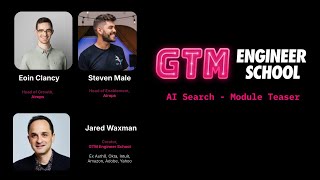
Steven Owen walks through a five-week course on AI-driven content workflows for go-to-market teams. He demos Air Ops for building automated content creation and social-post pipelines, showing how to chain models, add human review steps, and use brand kits. The course includes case studies from Deepgram and Webflow, tool credits, and templates you can reuse.
Chapters
So I'm going to give a little background, I'll go to Market Engineer School, five minutes or so, kind of what this is all about. And then, and then we're going to kick into Owen and Stevens presentation about AI search. So you know, just for the framing here, I'm one of the co founders of Go to Market Engineer School. And the thing is that what we've seen over the last two years is we hear over and over again is people saying that they know that they're feeling behind. Basically people in go to market roles in growth and rev ops content, they're feeling behind. They know that whether it's, they know that AI can help out and automation can help out in CRM hygiene, in scaling, personalized outreach. They know they're seeing everything on LinkedIn. They know that there's all these buyer signals out there that are new. They know that they can make their own buyer signals. I'm going to just make sure everybody is muted here. I'm getting a little bit of backup noise. There we go. And they know the mindset is shifting from SEO to AEO answer engine optimization and they know the tools are out there. But take having finding the time to learn what learn the correct structures, methodologies, building systems around these tools. A lot of people are telling us that they just haven't found the time to make that happen. And so we're kind of this is a forcing function for you to find that time. And I would really argue that yeah, there's a new term here but this isn't really just hype. There is a movement here around how revenue and growth functions are operating. People are combining tools, data, better data than we've ever had before and they're combining them into messaging and content and workflows. That's a, that's a coherent engine. I mean everybody's system is going to look different. But what we're offering with go to Market Engineer school is it's a hands on learning experience. There's live builds, you get tool credits so you can use these tools for a couple of months with, without having to, you know, worry about what's going to happen on your credit card. You're going to get peer feedback, you're going to get experts, experts at these companies, experts who are coming from or run outbound agencies that are going to be giving you feedback. You're going to share your screen and show them where you're getting stuck and they're going to help you work through it. So you're not alone in this. And more than just frameworks. You're going to leave the course with workflows you can deploy right away. So who's this for? It's for growth and revenue operations folks, marketers, sales operators. We have agency folks in here picking up new skills. So let me, let me talk about today's agenda. I'm giving my little spiel here. We're gonna do whiteboarding session and then there's going to be QA from, from the audience here. And you know, I talked a little bit about what makes go to market engineer school different but we've got this cross tool expertise. You're going to learn five tools at least and, and see how they connect together. Like I said, it's going to be hands on learning. Each week there's going to be a lecture and then there's going to be homework exercises you got to do. And then you're going to come back in these small groups with TAs and they're going to help you debug it and they're going to help you apply it to your situations best you can in a, you know, a group of five or 10 or 15 people and then obviously led by experts and you're going to get access to the tools and then beyond all that you're going to get a slack community alumni network, access to our job boards, weekly newsletters or podcasts and stay connected to other people who are learning alongside with you. So our graduates, nine out of 10 of them have said that they recommend this to friends and about 30% of our students from Cohort 1 actually got landed new roles within two months of the ending of the course. Course is five weeks. We're going to kick it off with a little primer and then we're going to get going talking about research, enrichment and scoring with with Yash from Clay. And then from there we're going to show you how to build a brain like a PMM brain that knows everything about your company, your products, your ICPs, your segments, your use cases and use that to power messaging and integrate that in with Clay or whatever your tool of choice is. And then we're going to get into agentic enablement. And especially this is useful if you have internal data that you want to include in your scoring or your other workflows, Snowflake, other kinds of data that you want to include Tariq and Max from, from Cargo. We're going to run that module and then we're going to get into, and then we're going to get into workflow automation with Lorenz and He's going to show us n it n and we're going to do content, answer engine optimization and everything that you're going to learn today with Stephen and Andrea and that's going to be great. But you're going to get a preview of that lesson today. We might change these dates or we might flip these dates around for this last two, but this is the five week course and after the five week course there's going to be some optional sessions to go even a little bit deeper. The schedule looks like this. On a weekly basis there's going to be a two hour live lecture that's going to be instructor led. It's going to be 8 to 10am Pacific. There's going to be a recording available. If you miss one or this time it doesn't work for you, you get access to the recording. Then you're going to get a couple of homework exercises, one more kind of a beginner level, one more kind of an intermediate level. And we're going to have various different sessions on Thursday, Friday or Monday, Tuesday where you can jump into these zooms with TAs and they're going to help you figure out what you missed and work through it and make sure that the concepts sink in and you're able to actually execute on your own. You'll have that weekend to abandon your family and work on Go to Market Engineering. Before I hand it off, I just wanted to mention too, we have this substack, we have a weekly newsletter that comes out, gives you an update on the industry and we are also dropping episodes every week of a podcast where we interview top Go To Market engineers and outbound agencies and other experts. So definitely check this out. I think you're going to really enjoy the podcast. And then we have people contact us for, for hiring because they're looking for Go to Market engineers. We actually also have a Go to Market engineer job board you can access. And then just to wrap it up here, the course if you're interested, really officially the last day to register is this Monday and then the course starts a week later. We've got Great instructors and TAs. The list price here is 1850. Like I said, it's five weeks. It's project based. There's going to be, you're going to get about $7,000 in worth of tools and access and credits that last you two months to to learn and get going. And then all the other things here that you, that you see and a certificate to put on on LinkedIn if that's, if that's Valuable to you, but, but really the skills that you're going to walk away with are going to be, you know, the main thing. There are, there are some other places you can, you, you can start to learn these things. And my recommendation is to, you know, take as many courses as you can as, as you can afford both time and money. I know myself, I'm a lifelong learner and in this space I try to take as many courses as I can offered by vendors, offered by other folks. You're going to learn a little bit, something different each time. So do hope you join us. And with that, I'm going to hand it off. Yeah, this is the schedule, this is where you can go. And I'm going to hand it off to Steven Owen.
Thank you. Thank you so much. Amazing. So I'll dive into this first. We'll start with a bit of story and then we'll kind of show you some things you can learn how to build while being with us. But I want to just to set the scene a little bit and just like, why are we even here in the first place? So for us specifically, we've now talked to what We've now trained 200 plus content engineers at companies like Notion, Vanta, Cisco, Webbook, any kind of company you can imagine. And everyone is coming to us at the moment with the fact that it feels like the AI revolution is here. And the playbook we've all used as like marketers, content growth people for the last decade is like no longer working as well as it used to. And on the like, that's the best news ever. Like, there's never been a more valuable and exciting time to be in this industry as well. And there's never been more funding, there's never been more money, there's never been more companies hiring for people like you learning about AI in this kind of content. I also want to set the scene that AI doesn't replace the marketer, it empowers them. So Ross Simmons did this quote here, which is just really, really good. But the more you try to push AI, the more you realize it's still not that smart. And you need the human expertise to really kind of build the workflow, build the bridge, build the logic to actually make sure the AI outputs are really, really good. So this is again really good news because it means the human is actually more secured now than ever before. But you need to know how to work with AI to make sure that that's the case. It's also like the best career move you can make is like how might you learn these tools now? So Dharmesh, who's the CTO at HubSpot, very, very successful now. But he is making this joke about, today it's bring your own device to work, tomorrow it's bring your own agents. So the agents or the workflows that you're building today in your career are actually the best assets for you personally and professionally to bring along in your career journey. Like this is how you double your output, double productivity, but it's also how you secure your next job or secure your promotion or anything you kind of want to do at work. So the shift that we're seeing at Air Ops, being more on the content in the SEO space is like winning the battle for attention is now harder than ever. So it's never been easier to produce content, but to produce quality content is where a lot of companies are struggling. And we're also seeing huge changes in, like, how people are buying. So before a lot of people used to Google things. Now with the rise of ChatGPT, the shift is starting to go towards LLM search. So Webflow had 2% of signups, joined Webflow last year. This year it's now 8. I think it's actually now 10% of signups to Webflow come from LLMs or AI search. So this is like ChatGPT for example. The other cool thing that we're also experiencing ourselves is used to on Google search things like keywords. On average, people search for four terms or four words. On Google, like coffee shop near me. On LLMs, people searching up to 30 words in a string. So it's very hyper focused, very specific, and it's also very tailored to the user's journey and what the user is after. So if you're looking for like travel insurance, for example, you're like, hey, I'm this kind of person. This is where I'm traveling. Here are the requirements. You can now get very tailored. And because of that, this rise is only going to increase. So what we are trying to teach people is like how to actually build an advantage in this new age of showing up. And the kind of three ways that we help people do it is through content strategy, creative production or content production and in search optimization. So we help you kind of solidify these three pillars to really get the biggest impact from your work. These are just examples of each one. So for content strategy, we can actually use AI in all the context of your brand, your strategy, as well as deep research to actually build a really cool content roadmap to do editorial briefs which we can then turn into articles and your place, sorry Jared, if you could just mute people in chat, that'd be amazing. And then also we can then help with like search monetization. So we can then incorporate SEMrush or other technical tools to make sure that the content you're producing will help you rank in Google going forward. And so this is one example from Deepgram. So they saw a 24x increase in traffic by building this workflow, generating a bunch of high quality articles that are more long tail. And again, Deepgram is already a very successful company, so to get a further 20x increase in traffic is just wild. They also look into content refresh. As we know with AI search, if your content is refreshed within the last three months, it's four times more likely to appear on citations than if it's been touched 12 months or longer. So a lot of companies are shifting towards how might we also not only create new content but but then refresh the content we already have that is already working to appear more in LLMs. And this is just an example of how complicated you can build one of these workflows. The cool part as you kind of learn is you could start just by starting with a keyword, doing some like live Google search research, fetching some competitive things, and then doing one more step. So this workflow can start quite simple. And then as you get better at the platform and as you get better at learning how to talk to AI, you can add more and more steps to make sure that every time you hit the play button an even higher quality page is created or you've got even more work automated for you. So maybe to begin with, you just create the title in the body, the blog post itself, and maybe later on you actually increase and create a whole featured image. And maybe you do meta description, meta title, internal links and all that kind of stuff as well. But this is just a kind of example of how elaborate these workloads can build over time. Which is why one person at Deep Cram can push 3,000 programmatic pages, which wouldn't be possible two years ago. So we're seeing the rise of the content engineer. I personally run a bunch of cohorts at Air Ops and these are just some examples of what people do using Air Ops and just learning about AI over a three to five week period. So Eric from Wiz, again, very big company, he slashes review time, so he used to review articles every time they went live to make sure the quality is there and make sure they rank this Used to take two hours per article. After three weeks learning about Air apps and learning about our platform, he slashed it down to five minutes through automation. Clarissa from BigCommerce automated 70% of her job in three weeks. Rachel from Notion saves hours per piece where literally the Notion market template is. Template Marketplace is huge. Her kind of AI goes through the whole marketplace, identifies which template is most likely to rank on Google and automatically optimize it for SEO. And then Terry from Sunday saves 12 hours a week again, taking what she does on a daily basis, building some workflows behind it and creating some automations behind it as well. I also want to say like throughout, what you'll learn throughout this whole course is people more and more are hiring content engineers. These are just some in the last couple of weeks, but like HubSpot, banter, firecraw, anthropic themselves, Wise chime like, these are companies that are hiring actively for this like new role which bridges content and AI engineering together, which is literally what you'll learn by going through this course. And these are some of the things that we provide at Air Ops as well. So if you go through the Air Ops platform, we also give you our team, our method and our community on top of that. So what are you actually going to learn through our section at Air Ops in the GTM engineering school? The main thing I want to teach you is like agnostic of the AI of the Air Ops platform is they just want to teach you the fundamentals of AI. So the four levels we talk about often is like its inputs and knowledge bases. So what context do you need to create really high quality content? This could be the sitemap of your website, it could be a brand kit, it could be Persona information. But like what do you actually need to make sure the quality of the content is really good? We then teach you how to actually prompt and we show you what models to use for different tasks. This is a very interesting thing because we all are prompting, but not many of us are thinking about how we're prompting. So we actually teach you different ways to prompt. We're going to bring in Andrea, who's been doing this for the last year, building AI workflows and AI marketing workflows nonstop for big companies like webflow. So she is the expert on how to prompt and what the limitations of LLMs are at the moment and how to get around those limitations as well. We then teach you how to orchestrate a workflow. So going back many slides, you saw that they kind of the big graph of the Many steps you need to put things in the right order to get the right outcomes. So we show you what order is optimal to actually get the quality content you're after. And then finally we teach you how to then create and optimize over time. So once you have the content, how do you continually optimize that to improve it even further? And you've probably all tried to use ChatGPT or Claude to create some sort of content before, whether it's a social media post, a blog post, an email maybe. And oftentimes you then need to either tweak it or it's just garbage. And so essentially these are the four foundations of how to make sure that every time you do a prompt and every time you request a certain bit of content, in whatever category that is, the quality is not only as good as what you do, but even better. Like you stack on research you wouldn't have time for to do mentally, as one example. So during our kind of section, we're going to help you build essentially a 10x workflow. So how do we take one component of your day to day life and weekly task and then automate the process? So essentially you'll finish our section with the ability to create and tailor high quality content at scale. And so you'll do content creation. This could either be a blog post, again, a social media post. We can help you do content refresh, we can help you actually outreach to prospects and clients that are higher quality and tailor every single response to them as well. So we'll help you build something that creates content and then you can tailor and tweak that to whatever use case you're after. So enough of me just talking into the abyss. I first want to start with one workflow that Vivian from webflow did during her bit in the cohort. So I'm going to take you behind the scenes of the Air Ops platform, give a little bit of a taster before I pass it to Owen, who's my better half, to kind of show a few more demos and then to also do a little whiteboard session as well. So this is the kind of back end of Air Ops, but I want to show you is the actual workflow itself. So this is the workflow and before I dive into this a little bit, this is the output. So what happens is Vivian, they do a whole bunch of webinars, they do a whole bunch of podcasts, and what they wanted to do is every time they did one of these web flow webinars is they wanted to automatically create five different Blog posts and that take in the transcript of the webinar and create content at scale for them. So not only a blog post, but then also how do we turn that into social media content as well? And so this is an example where the input in this is a call transcript, the actual signup URL as well. So they can get the context and the brand kit for webflow. And then what it does, it processes the transcript, it grabs the webinar, details, identifies the topic it formats. There's a human review step which is really important. It then scrapes semrush to make sure that the topic it identifies is actually getting search volume to then make sure it ranks on Google for a very important topic. To then get more leads. It then generates the blog post itself. It does a quality check. It actually checks to make sure that we're not kind of doing content cannibalization, and then generates the meta description and then outputs it directly onto a grid which you can then publish directly into webflow. So all Vivian needs to do is literally click one button with the transcripts and it creates this high quality piece of content. It actually creates four more pieces of content and then some social media posts to go along with it. So this is just one example of how in three weeks or during our section of the course, we can teach you how to build a workflow like this to create content that would normally take you hours to do manually, that can do it at scale at a quality that even webflow are proud of to go from there. So, armor Shops, stop sharing my screen now and I'll pass it on to Owen to potentially do another demo and then also some whiteboarding.
Thanks, Stephen. Before we do that, any questions from anyone? Yes. No, Maybe. Okay. The other thing I'll add just as I'm getting my screen ready was Stephen walked through a lot there under the umbrella of content engineering, but all of those same skills are like super transferable. So the name I put in the chat there was Joe Rue, who is someone I look up to. Hopefully I'm sharing the right screen. But Joe was, when I joined Air Ops, one of the first users I went to go and interview because he was going super deep. And like Joe runs his own GTM agency right now. I think he actually was in the first cohort as well. But if you don't follow him on LinkedIn, please do. He is an amazing person to follow. But when I gave Steven's pitch last time to this group, I highlighted Joe Matteo and some other amazing GTM engineers in cohort. One just to call out some of the people we've interacted with since Kai from Repath. Amazing. Some of the stuff he shares out here of how he's using N8N clay, Octave and Air Ops all together from end to end GTM orchestration. Just incredible. He's able to marry VO3 with a bunch of other stuff. So just to see kind of the a group of people that have come out from the last cohort and like what they're producing, like his velocity of publishing stuff at minimum to LinkedIn is quite high. So I would say like check some of those guys out and then keegan if my LinkedIn will want to load. He's super as well, big 76ers fan, but hit him up. I think maybe within the GTM Slack channel you'll get access to like the previous cohort, but a guy doing like amazing stuff around Orchestration. So sorry, that all just goes back to this key point here which I'll dive a little bit more into. But the while Stephen like put it all in the frame of like content, it's the same sorts of like skill sets that are going to be transferable as you work with different tools and you work on product marketing context or pure like outbound messaging as well. So you need to figure out like what are your inputs. You need to be able to like map out your model which we'll do on a whiteboard in a second. Be able to figure out orchestrating workflows in a tool but also between tools. Like Clay is going to be way better than anything else as part of the cohort for enrichment and like discovery. But something like Air Ops is going to be better for content creation. Something like Octave is going to be amazing for product marketing level Personas too. And then we don't have it here. But one thing I'm really bullish on is as a GTM engineer learning how to cooperate and work with a copilot. Like great to be able to use a tool, but these tools like Air Ops or Octave, they have copilots to help you do your job better. So kind of like we hear about prompt engineering. Like to be able to use a copilot is going to give you far more power. So within our week or so of exercises, those are kind of the three to four principles upon which we train under Steven Content Engineers. But I think you would come away with as GTM engineers as well. I see my chat bubble popping up. Let me give a second here to see what people are asking. Okay, that's good. Faheed anup I'll get to your questions in just a moment. We can go into whiteboard, but I have one workflow up here in my tab which is around social posts. So Stephen mentioned webflow and Vivian have their own version. I personally, for my stuff have this workflow built. And again I think we showed like Deepgram as an example. They care about like volume. Most of our customers care about like maximizing like volume to a certain degree, but then super high quality. And the high quality comes with the amount of context you can give your workflow or give your model to make sure that quality input gives you quality output. So what I have here is the ability within like an airtable view to state like input attributes. So I can say my post type, I give it directions. Imagine you're telling your external social post generator or editor like exactly what like way to go on a topic. You can give it source context as a URL or a full description. Description could be sentence, it could be a full essay as I have in some of these ones. And then you can ask it to do web research or not. In the end I run a workflow, but under the hood. What happens is when I say I want different post types and again, this is all kind of like the orchestration and setup piece that we'll get into, but I have it fed and I can send this to anyone afterwards with a series of like templates. So across each of these types that I go to care about, I have it fed with some of the best social posts that have been on LinkedIn the last like year based on engagement. So it has like full context of like what this actually describes. Then we get into what the hook is because the first line on LinkedIn is really going to make or break your post and then it has like a full example to continue engagement, bring people down. But the start of my workflow is about like feeding in this template to the whole process that I then need to build upon. So if I jump into the underlying workflow, which is this guy, and if I zoom out, if you haven't seen airops, Stephen just showed it to you. But it's essentially a workflow builder. We have access to a lot of attributes that are primarily content in nature, but also kind of like clay, we have some enrichment or other, other tools like Semrush as well. So under the hood here, what I'm doing is I give it a series of inputs and I say, okay, I want a different. I want to be able to choose between different post types. So we can look at those in a minute, but really where the value comes in and it's a little bit behind the scenes, we won't get into it today, but it's in your brand kit. So this is where in another part of the system you establish all of the rules and guidance and context that your brand cares about. So probably internally at your companies, there's words you want to use as words you don't use. There's like a style, there's a tone, there's like Personas you go after. So very, very similar to Octave. We have our own version of those Personas and verticals baked into Air Ops that you just bring in essentially as like a single attribute into your workflow. And then here I have two paths to go down. If I can click out of there, my bad. I can either let the workflow do external research for me when I'm not knowledgeable on a topic, or I give it my own context. So this is just a path we'll see in a second. So based on the post type I set, it will fetch all of those examples from my knowledge base. And then here's where we make the decision. If I've given it context. If I want to write a recap post about an amazing webinar with Jared and the team, I'll feed in maybe the transcript and then it'll go down the left hand path. Or the example I'll show you in a second is more about like, I don't know much about VO3, but I'd like to learn more and at least communicate externally that I know a ton about it. So we'll give you that example where instead of me giving loads of information and context, I'm going to get perplexity to do the job for me. But independent of kind of like the parts we can take, I think what's really important if you haven't heard about it before, our system prompt versus your user prompt and then user assistant pairs. I don't know if people know too much about it, but you kind of need all three to four components to have an amazing input be turned into an amazing output. So system versus user message. Your system is like you're training up or giving context to the model on what role you want it to perform. So in my case here, it's a world class LinkedIn poster. I'm giving it the context of my brand and then a lot of context about Air Ops as well, so that it kind of like stays on tone and then really within the user message is where I'M giving it a lot more information as to, okay, you can be this person, but here's the exact task I want you to go and complete. So here I have it kind of primed with a sample request from my side. And then how you use the pairing of these user assistant pairs is you almost like start to give it training wheels. You're saying, like, write a post about this for me, and then I've hard coded what I think is a very good output. And then by doing this kind of on repeat, all within the same session, when I actually go to use this block and I say, okay, here's my net new request. I want to write about VO3. It's going to retrace this, it's going to store it within its context. It's going to be like, oh, I know who I am, I know what to do, I know what really good example outputs look like. And then when I actually make my request, the post I get out the far side is going to be far higher quality than if I just went to ChatGPT and said, Write a post on X. So all of it is really feeding into being the base and core foundation for higher quality output. So that's kind of under the hood. I think one key principle you can leave with today and then maybe not in all cases, but especially for some of these LinkedIn posts, I wanted. I found that the. Each model had its own take and own tone of voice, which I wanted to direct kind of in my favor. So what I ended up doing was I'd get Claude Opus 4, which is amazing at like writing content, to give me the first draft and then I would pass that into 01 and be like, hey, this is like pretty good, but I think you can do better. And that'll give me another draft. And then I repeat it again with another like really good anthropic model 3.7. So each time I'm kind of using different tools available to me to increase the quality of it, but each on their own should still be quite good. And then basically I can go off and I can do a stock image search. You could push this to play, you could automatically feed it to your LinkedIn endpoint, but at the end it's an output. So this is all codified in a workflow. It comes to fruition just under this column here. And essentially I'm feeding in inputs on the left, I have a workflow that runs on the right, and then the output comes over further on the right. So if I actually just change this one to Be yes, an example I'll run live is this. Let me just kick it off so that it runs. But I'm saying I want to develop a cheat sheet that I'm giving it directions, make it very clear and actionable for a cohort of people learning GTM engineering who work at B2B SaaS companies. And then my topic is using VO3 for generating videos for demand gen channels. So what it should do under the hood, given that I've turned on web research, is take this topic, go off and explore perplexity, explore cited resources, come back, start to aggregate it, start to listen to the direction I gave it here and everything you saw under the hood and then write the actual on brand message for me. So the images I have linked up here are not the best, so we'll gloss over those. But the previous example I ran because it takes a minute or so to run it is driven towards driving social engagement. So if I click into this it's going to be a little bit more like FOMO Y so it's like you're not doing AI powered demand gen, right? If you're paying a ton, you can't react to trends. So like Matteo isn't here. But I feel like Matteo has a good workflow under the hood as well for driving like fomo. But like I didn't give it any of this context, it went off and it looked at other LinkedIn posts, it looked at other great content people had and I'm not going to say that this is exactly copy and paste, but it's going to drastically shorten the amount of time I need to put in to develop a very, very good post. And generally what I do for anything you see on my LinkedIn is run it through this grid. I'll take one of the three examples for example outputs, maybe make one or two tweaks to it and then just like copy, paste, send. So under the hood Stephen went through a ton of content and SEO and AI search focused examples, but it's an LLM builder at the end of the day where you can use it to construct anything that you want. So like once it gets to this point of review needed, I get to choose between some images I should really update. We have a better endpoint for a lot of this, but if I hit this I can accept output and it will start to finish it off. But I think as you design different workflows just like what you saw there, where review is needed, being able to insert a critical junctions, the ability to influence the model or influence the Rest of the workflow is going to be like key to maintaining quality. Sure. Some things you run can just run end to end and they're not going to make a big difference whether you tweak it or not. But if you're trying to develop maybe lead magnets you send to prospective customers or something else where the quality just needs to be checked, baking in like a human review step is going to be super critical to just making sure that the output, even of a high quality workflow is as high quality as you want. So I'll pause there. There was a long demo. Do people have questions or. I think what we did last time was like a bit of a whiteboard session of like maybe how you can combine different tools together or how you might think about a given problem that you have right now. Otherwise I'll go through the chat. So bottom up, can you share these workflows as JSON templates? Absolutely. Where might be best, Jared, for me to share stuff with people afterwards?
You can send it to me and I will shoot it out to the folks that have attended.
Cool.
Yeah.
Okay, perfect.
But definitely if there's something that you want, send me a note on LinkedIn and remind me.
Sounds good. Anu put a question. Just wondering, is the workflow something that can be done in Clay as well? Sure. I'll say that like Clay is not set up for as much around like content generation model diversity, like really nailing down into the content and context you can provide. So you can connect your product data to airops via like Snowflake. You can scrape your website and just like embed it. You can. Clay just doesn't have that out of the box. But what we don't have out of the box as well as clay is the ability to like run a ton of enrichment. So that's where I think as part of this course you get a nice feel for what tools are going to be like T shaped in the direction where you can start to marry them the best together. What else are there? Are the LLM API calls priced into Air Ops or bring your own key as of right. For for you joining as part of the GTM Engineering school, you will have access to bring your own key, but we'll give you enough tasks as part of it or you don't need to do that. But at our like free or $200 tier we don't offer bring your own key. That's kind of like an enterprise feature as of right now. But even on those tiers you have loads of headroom in terms of tasks, kind of like credits and clay, where the task usage on an LLM model probably won't be your limiting factor. What else? How easy is it to pick up the Air Ops platform? Well, if you'd like to go super deep just on Air Ops, Steven's your guy. We have not to run self promotion, but if you do want to go deep, we run our own cohort. The next one will be on October 13th and everything Stephen showed off from the likes of Notion or Sunday or HubSpot you can get a feel for on our website. Fahifahad Sorry, had a question. You mentioned product marketing. What specific use cases have you seen product marketers use Air Ops for? Great question. If you actually go to some of Kai's stuff. Kai is not a product marketer, but he doesn't have a product marketer at his company. So what he has built as just one example is he'll feed in a ton of call transcripts from like a gong or attention or Chorus. He's able to then like tag them based on like vertical and then Persona and then just again store them in a knowledge base and then he can develop like a playbook around each of those different groups. So that's helping him develop PMM style playbooks per Persona, which he can then use as input to content generation workflows or other enrichment criteria you can pass on to other tools. That's one. Otherwise we see people do loads of funky stuff with they can put in their competitors, they can go out, do like a web crawl and I think there's one amazing customer. I won't say their name because they're a big company, but they do a weekly crawl of their competitors to see what do they update, what do they launch, were there any changes in messaging? And it dumps a weekly newsletter into their growth team channel on what were kind of the biggest trends in their competitive space that week. So that's just helping them stay on top of like product shifts without needing to do the manual research. So that's pretty cool as well. Oh wow. There's a lot of other stuff. What is the quantifiable difference between building a Gemini gem to this to do this versus using Air Ops? I'm interested in Steven's answer. Pre integrated tools. Oh yeah, I'm not familiar with Gemini Gems, but assuming it's like a workflow you can construct, probably not a ton different. Just like will be easier out of the box. As Steven mentioned, given that we have a number of integrations already baked in here so we have Lots of stuff. Access to essentially any model Amar or how to product is like SLA is. If a new model comes out, it's live in Air Ops within an hour. There's lots of other stuff across like web scrape, the ability to run any part of like Python code conditionals that you need read from different databases and then tons of extra internal research. And our, our co pilot then which we didn't get into here is super good. Like I been a while since I got super deep in Python, but I needed to create a GONG integration recently and I was like, I just told it, hit this endpoint for me, handle all the credentials, handle all of the authentication for me. It created just like a bit of Python code that did everything for me in about like 20 seconds. So if we don't have an integration out of the box, the likes of Copilot can just build it for you and abstract that complexity away from you as well. What else does Air Ops make sense for startups of two to three people? I couldn't figure out pricing. Pricing is something we'll, we'll have better communicated on our website for end of next week. But like independent of company size, it depends on what you're focusing on internally. And if content is a big part of your like go to market motion, Air Ops can definitely help you like add velocity to it in terms of net new creation. If you already maybe you're inheriting like a massive bank of previously published content, you need to do some like cleanup or maybe SEO is a focus for the quarter and I think we're a good fit there. If you want to use us as like a core workflow builder, I would just take one step back and try and figure out what workflows you're looking to build. If they're deeply integrated in needing enrichment or other discovery or a link back to your CRM, maybe then a clay or something else would be a better fit. But if you want any help with tool selection, don't hesitate to reach out.
Yeah and then I think that is one of the things that we, we are trying to do in this course and I think we, we did successfully last time, which is you're gonna get a feel. Yes, there's overlap between the tools, but you're gonna get a feel in by doing. You know, you're gonna learn by doing. And then you're gonna get a feel for like, oh, what I'm trying to do at this moment in time, I'm gonna use this tool or these tools combined and then this other workflow yeah, maybe I could use. It's not. It's going to be a lot more work. I'm going to. This is going to be a huge shortcut. If I use some power steps and Air Ops, you're going to know which one to use. You're going to get it done in an hour instead of, you know, trying to build something that Clay wasn't really built for.
Right.
So, I mean, if you're getting deep into scraping other content, you know, going through the Dom there, you know, some of the Sam Roche and some of the other, you know, SEO inputs, you know, this is one of the top tools you should, you should learn. This is why we're, we're including it. And, oh, and so great that you highlighted some of the students from, from last time, from last year and everything up to.
They've all remained in touch, which is great to see.
Yeah, yeah, yeah. It's fantastic. I know they've been very, you know, the folks that do that you highlighted, been very engaged in our, in our Slack community and sharing all the innovations, all the new workflows they've been building and blowing us away.
Cool.
Any other questions before we wrap up? Any questions about the course or, or Air Ops? Going once, going twice. Okay, well, shoot me a note if you need anything. And we hope to see some of you in class starting in, you know, about two weeks. So I will let you get on with your evening or your day. Have a wonderful weekend. Thank you, Steve. And thank you, Owen. This is fantastic.
More from Matteo

Roll Claude out from one laptop to the whole GTM org | Sam Gong & Zach Vidibor









