GTM Engineer School webinar - Agentic Enablement w Cargo
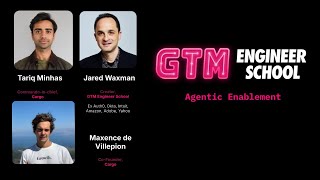
Jared Waxman leads a GTM Engineer School webinar with Cargo founders Tarek and Maxence on agentic AI for sales. The 5-week course costs $1,850 and includes $7,000 in tool access. Cargo positions itself as an AI workforce that stacks signals through agents and distributes execution to reps via Slack, CRM buttons, and a Chrome extension.
Questions this video answers
$1,850
$7,000 worth of access to tools
Wednesdays, two-hour instructor-led sessions at 8:00 AM Pacific time
Five weeks of core learning
Chapters
Foreign. We're good here. Thank you everyone for joining. I'm Jared Waxman and I'm one of the two folks that is behind Go to Market Engineer School. Matteo is probably on the line somewhere. Mateo, are you there? Well, he may not have joined yet, but the two of us are really pleased to get to work with some of the best entrepreneurs, some of the top entrepreneurs in this space today. And today you're going to get to meet Tariq and Maxence from Cargo. We had the pleasure of working with them. Go to Market Engineer School Cohort 1 and they're back to teach in Cohort 2 on GTM workflow Automation. So today's agenda we are going to, I'm going to talk for a few minutes and then I'm going to kick it off or hand it off to Cargo. They're going to do a little whiteboarding session, talk about DTM 2.0 and probably give you a little bit of a taster of what you might learn, what you might do hands on. When we have more time in a week long module and go to Market Engineer School and then we'll take some, we'll do some Q and A. You know, the thing is that I, that I hear over and over from people in Go to Market and in Growth and in Rev Ops is that AI incorporating AI and automation, this modern tooling, everybody knows that this could help us be more efficient and gain more leverage. But many feel quite behind. And whether that relates to CRM hygiene or scaling, personalized outreach or scoring or being responsive to new buyer signals that are available to us, or creating your own custom intelligence columns to insert into your communications, your outreach, even messaging and content and assets, gated assets, social assets, these things are all being revolutionized with the new tools out there. But people are feeling behind. The gap between what's possible and what teams are able to do right now is large because the tools are moving so fast. So GTM Engineer School, we talk a little bit about theory, but a lot is really just building hands on. So that's what you're going to get to do. And what makes Go to Market in your school a little bit different is we teach a bunch of tools. It's like a whiskey tasting experience. You get a little bit across the board and it's all about hands on learning. You're going to have access to the tools, you're going to have access to the premium features of the tools, you're going to have access for a couple of months so you're not going to have to Worry about, you know, burning through your credit card, using credits and things like that as you're learning. And that is really helpful and really freeing. And it's led by the folks leading in the space, the, the entrepreneurs, the head trainers, the, the top outbound agencies showing you the top workflows that are, that are actually out there in the world. And then you get a free, you get a slack community to share your, your, your work in progress and your learnings and everything with. Our graduates had a pretty good experience last time. 90% of them said that they would recommend the program. 30% of them actually found new job opportunities within two, two months after the course ended. A little bit about the course, there is five core weeks of the course and then there's some optional material and involvement after for the next five weeks. But we're going to do a GTM primer. Matteo and I, I'm going to give you a little background. And then Yash from Clay is going to go through research, enrichment and scoring.
And then shared lab replacement, exclusion, placement, occlusion.
If, if, if you could put yourself on me, it would be great. And then Zach from Octave is going to go through how companies at the bleeding edge now are doing messaging based on a deep knowledge of your ICPs, your product, your segments that you're going after, use cases and personalizing all kinds of messaging out from there. And Tariq and Max are going to talk about workflow automation in a way that you are not going to see this or not going to be able to do this anywhere else. So we really keen to keep them part of this course because the top players end up with needs that really only cargo can fill. And then we're going to dive a little bit into N8N and Lawrence is going to show some cool workflows on nn. And I'm sure you're all hearing about NN and probably playing around a little bit. Then finally, airops is going to help us learn about content answer engine optimization using airops. And even if your company is not using these tools specifically, that's fine. We are not trying to force you into one tool, but you're going to see across these tools. There's a lot of overlap, but then there's also things that you could do uniquely, but the patterns of how you build every other tool in the space is going to be patterned on one of the motifs that are used in the tools that we go through in this course. So you'll have a really good foundation no matter what tools you end up using. Or building a little bit about the weekly schedule. The lectures kick off on Wednesday, two hours instructor led. It's 8am Pacific time. If that time doesn't work for you, we'll have a recording available available and then you get some async exercises to do. But we don't leave you on your own. We want you to struggle. We know you're going to run into challenges and then we're going to have a bunch of different live debugging sessions at multiple time slots led by wonderful TAs. Many of these TAs run their own outbound agencies or they, or they work for one of the vendors and they're going to help you in small breakout, small, small debugging sessions. And we'll tag some of them beginner if you're just getting started with the tool and we're going to tag some of them intermediate if you've already been say working with clay for a little while and you know you want to be debugging with people at your level. So that's going to happen Thursday, Friday you'll have the weekend to spend some time not only with your family but also working on some of these workflows. And then Monday, Tuesday we'll throw a couple other debugging sessions in there. So that's how this is going to work, each module. The other thing I want to let you know about is Matteo in particular and I'm helping out a little bit. Matteo in particular is putting a lot of time and effort into this wonderful substack. He puts out a good newsletter every week with lots of great information about what's going on in the industry. And we also, Mateo and I recorded podcasts episodes with some of the top players in the space. So we invite you to check that out. And if you are interested in what the job market is around, go to Market Engineering. We've got this other website, GTM Engineer Jobs up to date with with jobs in the space. Lastly, last slide here. Do you get what do you get in the course and cohort two? It is $1850. It is five weeks of core learning, live lessons, as I talked about exercises. You get $7,000 worth of access to these tools and you get pre built workflows, you get loom videos, you get access to a wonderful community and a certificate you can display on LinkedIn. And we hope to see you. There's one week from today left to register and we have a few seats left but most of them have been taken. We hope to see you and with that I'm going to kick it off or hand it off to Tariq and Max. And if you want to join our sessions next week, we have one with Steven and Owen maybe will join from Air Ops, and then Lorenz will talk about NN on the 23rd. And that's it. Thank you. Over to you. Thank you, Jared.
I'm audible, right?
Yes.
And so is Max. Yes, Max, if. Excellent. So let me try and share my screen and we'll take you to a quick presentation that we've built by quick show of hands. How many people have heard of Cargo know what we do? Okay, so that's, that's a few. You can show my hand.
Yeah.
Or if your video is not on, go. Feel free to use the chat.
Perfect.
So freight forwarding now.
So, yeah, there's a, let's say there's a minority of people who know what we do. And for the rest, maybe what I'll do is I'll quickly share some tabs, quickly to walk you through what is, what is Cargo? But how we describe ourselves is the AI workforce for gtm. And each of those words has been selected carefully. And over the course of this talk, hopefully it makes sense why we call ourselves that. And if I don't do a good job at that, then you ping us in the Q and A and we take a try again. By this point in the GTM Engineering school, you've, you've learned the basics of what you need to get your hands and feet moving in the GTM engineering space, which is you can do some workflow, orchestration and clay tables. You can build the right messages tailored to your ICP with Octave, et cetera. And later on you will touch SEO and some other workflow automation. How we see our part not only in the GTM landscape, but also in, in the school is because GTM engineering is a new movement. It's very opinionated. So is it a hyper? Not is always a question. What does it serve? What does it mean? How can organizations start implementing GTM engineering? Hire them, evaluate them, reward them. All of these are open questions. And so we have a community of people who have been sort of debating these things for the last year. And this goes on while we build Cargo. So Max and I, Aurelian and Zoe, are the team that have been busy building cargo since 2023. We've developed a strong opinion on where this space is going and we've tried to emulate the best tools and environments that the best GTM engineering teams have back to all of our users so that they can have that capability as a competitive advantage. So that, in short, is why we exist. We're going to tell you a little bit more about this thesis and about what the tool can do and what you're going to learn in this course. First, Max, maybe let's do a quick personal introduction. So I let you go first. Tell the audience who is Maxence.
So, hello everyone. So, yeah, Max, I've been working for the last 10 years in growth and go to market both in B2C and B2B. And then I started to build cargo two years ago to basically help people build the next, the future of the revenue engine. So we are going to see a bit more about this. But that's me in two minutes.
Excellent. And so my name is Tarek. I'm going to be the other person that you're going to be seeing a lot of in this course module. I was new to this GTM engineering space two and a half, three years ago, and it's only by virtue of joining the Cargo project back in summer 23 when we were doing Y Combinator, that I started to do to delve into this space. And so most of my experience is coming from building workflows for our clients, particularly in the sub enterprise space. And so through osmosis, I've seen what the best people do and I try to emulate this, translate this to everyone else so that everyone can have those capabilities. So between Max and I, we're going to be sharing all those sort of insights and experiences to you, hopefully as much as possible during the module. And then obviously we're part of the GTM Engineering school community, so we're always available to help you out as you go further in this GTM engineering journey, in your future roles, etc. With that said, let's go forward and anchor the rest of this conversation around one metric. So because we have a strong view on what GTM engineering is, we want you to leave this module obsessed with this one metric, which we think encompasses a lot of what you're going to be hired for or rewarded for in your roles as GTM engineers. So that is sales velocity. We can obviously spend a lot more time on this formula and there's good stuff written about it. What it essentially means is how fast can you add and close opportunities in your pipeline given the resources that you have. Resources meaning both human as well as computing. And so what we hope is by the end of this course, you have the right tools to be able to attack this metric and crack it. And GTM teams have been trying to crack sales velocity for a very long time. And as is always the case, some do a much better job than most of the rest of the market because the market moves very quickly. The tools and paradigms and challenges that you face move. And so every few months, every few years, this challenge is reinvented.
But.
But the North Star remains sales velocity always. So that's what we're going to be anchoring. The rest of this conversation about why sales velocity has evolved recently and become even more important than it was we think than five years ago is simply because we live in a hyper efficiency world and we're becoming more and more of that. So I stole a quote from Sam Altman. The idea is as GTM teams, we live in a more challenging world, so we have higher objectives, more aggressive objectives, because there's more competition. At the same time, the cost of doing business, the cost of acquiring people, the cost of converting them, et cetera, has risen because there's a lot more competition. The barriers to entry are much lower, especially in the software space. And so with many fewer people, we need to do a lot more work and a lot more wins than we used to. So this is what we call hyper efficiency and this is how we tie back the state of the world we see today to sales velocity. The contributing factor to this is AI. So not only is AI leading to the need for hyper efficiency, it is also our weapon in keeping up with this market and doing better. Cargo is part of that narrative. This is why we call ourselves the AI workforce for gtm, because GTM essentially needs a revolution based on what capabilities agentic AI can provide us. And we want to be able to give you those capabilities, given what we have built for you. How we see the GTM engineer is, I mean, I'll use a metaphor, maybe you like it or not, and Max will tell me if he agrees is imagine you have a football team which has all the best players, but no coach to tell them how to synergize between all of them, how to bring out the best capabilities from each of the players when they play information during a critical game. So when a G team engineer arrives onto the scene, they are essentially the CEO of the efficiency and output of each of the members of their sales team. And a sales team is only as good as the tools and the knowledge that is being provided to them. And so it's a GTM engineer's job to make sure those tools and knowledge are of the best quality and are of the best fit so these people can do the best job at hand. And so if you're a good gtm engineer, you're 10xing the output and efficiency of your sales team. And we have examples of these people that we work with or that we have seen in the ecosystem who are able to do this continuously. The only difference is today you're using the AI agentic paradigm to achieve that objective. So let's elaborate on this theory. Max has a very interesting piece that he's going to release soon about the two different paradigms of sales enablement that teams have employed so far and why now that's outdated and we need to have a new paradigm. Enter the conversation. Max, I give you this, I give you the mic.
Let's go. So, yep, so for the first model, and by the way, I saw that there is some guy here from Pigment, so we can all say hello to him because it's an amazing illustration about the first model. So basically today you have two main organization on okay, how we can generate more pipeline more efficiently. The first one is what you can see at Gorgias Pigment rippling where Basically you have one gross GTM engineer RevOps team that centralized all the pipeline generation. So it means their mission is to seed reps with qualified pipeline automatically. So that's amazing because of course, as you can imagine, it's super efficient. So it means that the rep doesn't do anything and they have automatically assigned some account with a reason to engage with the right stakeholder, already enriched, verified, et cetera and eventually push to the right sequence. So amazing. But the problem of this is like if this team is not here or if the reps wants to do something by itself, he's totally lost. He's back to medieval age with Chrome extension, browser extension and Apollo seat or Zoom info seat. So basically totally inefficient. So this problem and Tariq at the beginning mentioned the safe velocity. So the drawback of this kind of motion is the dependency and in fact what we call the revenue latency. So the time between an insight and information and the action and the revenue latency, you're going to hear more and more about these metrics. But that's a very issue in the model that we can see today. So first thing we have amazing growth team, they do all the work. But if as a rep I want to do something by myself, I'm like, yeah, I'm clicking everywhere. Second part, and this part is the autonomous reps. So basically you can see this model in Ercole for instance, or at Monte Carlo where you have the Zoom info seat, you have some chrome extension, you don't have a gross ops team. So the amazing thing is like you are totally autonomous so you can do whatever you want. You go on LinkedIn, sales navigator, you find this lead, you can click on your extension one time to find email, another one to find the phone. Try to see after if you have some context already on this lead in your cm, et cetera, full autonomous, zero efficiency. So that's, that's the problem today is like the two models exist, but the two model create revenue latency. That is one of the biggest issue of all the. The revenue engine that we can see in the B2B SaaS. So I will stop here for now. So yeah, maybe you can tell us because it makes me smile this slide because two years ago when I was starting in this space, a lot of people were talking about the semantic layer, like having a unified data layer. Instead of random API call, you have have one center of gravity that is most of the time the data warehouse with all the data unified, clean shape, et cetera. So you can make the data available and provide a 360 view for any company of contact record. And now when I see this I'm like, yeah, the wording changed a bit, but we are still in the same logic. So I think Tyke, you can expand a bit on this part.
Yeah, I mean essentially you see the conflict, right? So either you have a very upstream heavy team which build a great set of processes and maybe they translate well downstream, or you completely leave your downstream reps autonomous and they do as they please and hopefully things work out. But we see that in these two paradigms we didn't have the perfect solution. And we knew that the promised paradise was a world where all of the data that is spread across different databases and tools, et cetera, all of that intelligence that we know about our prospects so both first party and third party can live in one place. And so we can leverage all of that to give the best sort of context and enablement to our sales reps so they can do a good job. Some teams were able to do this back in those days, which Max mentioned when we started building cargo, which was through arduously pulling together all this data, making sure all the records talk to each other, building the joins and relationships between those tables so that reps can have what we call the golden record, so they can have all that contact associated to their prospect account, their prospect contact, et cetera, et cetera. But this is very hard to do and very hard to maintain for most People, not only because it requires a lot of talent infrastructure, but also you have to have the input data structure in a very nice way so that you can leverage it later. Right from that point. So from those two and a half years ago, that debate has shifted now because we have a new capability which is agents, which can do more heavy lifting with less qualitative data to get us to the point that we needed before with a lot more work. And so before, the teams that were able to do the best orchestration were the ones that were winning. And Max mentioned some of them. Right. So the gorgeous is the pigments and so on, so forth. Now the reason why teams win in GTM is more that they're able to assemble that context in one place and leverage it using agents. So it's no longer the barrier to entry, is no longer how well you can build workflows on top of these data. That's become more of a commodity. Now the barrier is how well can you assemble the best context to let agents do their job well so that they can enable your reps to do their job better. And so this is also where we position ourselves as cargo. And what we want to teach you in this module is how to use cargo to build and leverage that context layer for your agents to enable your reps. And so we're going to throw out a term that we've, you know, recently been coining internally. Let's see if it sticks. You want to end up in a situation where you have some sort of GTM brain that has the, has subconsciously subsumed all of your intelligence, first and third party about your prospects and is available on demand to your reps as and when they need it. And the interesting part is upstream. So that brain is being assembled and maintained by your GTM engineer. Your revenue ops function downstream. The agents that are feeding your sales rep have a memory attached both at the company level and also at the person level, so they can adapt to the habits and requirements of that person downstream. And so this is the solution to that problem we always had between upstream and downstream rigidity. You have your architecture upstream, but you have a flexible downstream which adapts to the context at hand for your rep. And that's how we solve this dilemma. Max, tell us about distributed execution because you came up with this term.
Yeah, sure. So just as a step back, today we see, I don't know, thousands and hundreds of tools every day. We know that the go to market stack exploded year over year, etc. But still you have this issue where sales Reps are doing like you heard it in gartner everywhere like 70% of the time of reps is spending on done selling activity. And it's always the same issue even when we have new tools. Same issue and the best of both world. When we can combine the quality of a process at pigment rippling gorgeous and you can make this available as a standalone application shape to the business specific role like a reps for instance. This is where you have the best of both world. And for me this is the most important thing because when you talk with people you still see that yeah, the context is not shared. You have data in silo, you need to fill a RFP and you don't have any data etc. That's the main issue. So for this the goal is again to have one source of trust. This logical and this idea of source of trust remains totally relevant today. But you need what is super important is the ability to manufacture this intelligence and make it available very simply for go to market teams. It can be for instance a CRM button. I mean how many people today in the call if they're using Salesforce or HubSpot, how much of you have custom button in your CRM? Probably I mean a minority. Whereas it's super convenient. I mean if you help me as a click of a button get the most relevant contact for any given company as simple as clicking a button. I buy it of course, because I know that otherwise my sales reps is on sales navigator trying to get the email, checking if it's not already located to another one, another reps, etc. Big issue about distributing is like content. Jared was talking about content with erops. That's the same thing. First you need to build to write the content, then you need to distribute. That's the exact same logic in go to market. The first part is of course building the engine. But building the engine is good for. If you talk with me, yeah, I can talk for hours about the plumbing of go to market. But the big market is with the car body. It's like you're not talking about the revenue engine itself, you're talking about the car or how it looks like the car body, what you can see and it can be again chrome extension. It can be a CRM button, it can be a slack agent. Can be an agent that you talk just a chat. But keep in mind this idea is pretty much like content. Yes, 50% is building the engine, but the other 50% that is the most important to have an impact company wide is how you can Enable and distribute what you built into smaller pieces that all the teams can use very seamlessly.
Excellent. So actually, timing wise, this cohort comes at the perfect time because so far most of Cargo's focus has been on building that platform where the best GTM engineering teams can do that upstream work. So allow them a space where they can get the sophistication they want to build workflows, get data together, et cetera. Now we're coming to a point where we have capability of distributing this execution across wherever the sales reps are. So that can be, as Max said, a Slack agent, that can be a CRM button, that can be an extension that we're going to launch very soon. And so you're coming at a point where we're enabling this sort of GTM 2.0 across sales teams to attack that revenue efficiency metric. As we said, this is what we want to tease you with in terms of the outcomes for this course. You've seen why revenue efficiency is important. Now we will show you the tools that your sales reps, if you're working in a RevOps or GTM engineering role now, are probably itching to get their hands on today. So by the end of this course, you'll be able to pick up and build this architecture where your sales reps can go in and ask an agent, as one of the ones on your screen, to help them do their work. I, without diving into too much more details, I'll leave it at that. And because I promised that I'll give you a quick overview of the platform, I'll share my screen now and walk you through a little bit of what to expect when going into Cargo. And then of course, we have a few minutes now. I think we are for 10 minutes for Q& A. Correct, correct, correct. So, yep, when you will join the course and attend our module, you'll basically be given access and a bunch of credits to use your Cargo workspace. What it is, is composed of four different modules. So this is our sort of landing page where you're going to see a bunch of templates pop up in the next few days. What's powering the platform is our data module. So our data module is able to connect to most of your gtm, the tools that you can think of, pull in the data from there, build relationships between all that data and give that data, make the data accessible to your agents and your workflows. So what are agents? And workflows are, as we just described, agents are a bunch of use cases. So there's a bunch of them here that your reps can access on demand to help them do their job where they are on a one off basis, ad hoc basis. Plays are workflows that you can use, that you can set up to be triggered programmatically given changes in your data without anyone having to trigger them to work. So plays are your upstream work, your architecture, and agents are your downstream execution. Both plays and agents rely on tools which are small, let's say helper functions that allow agents and plays to do their jobs. So if I was to show you some Cargo tools, we have, let's say a tool that does very a lot of heavy lifting with a lot of email, waterfall enrichment, et cetera, to find you the best emails, the best phone numbers, et cetera. These are used by both agents and plays to get their job done. So these are the three basic modules of Cargo. And when you attend the class, what we're going to start with is how to build your first agent and deploy it where your reps are in a slack agent and in a chrome extension. And that will look a bit like this. Where you will build an agent, you will give it the right set of instructions. You'll be able to give it access to all of Cargo's tools available in our catalog to do its jobs. You can give it access to your CRM resources, any of the databases that you might be wanting to leverage. You can give it access to your MCP servers, et cetera. And then you enable an agent to respond to a user's request. So here I've set up a simple example for you. I wanted the five best stakeholders to sell Cargo to Ashby and it basically went through the entire organization, understood what Cargo is trying to sell to them and found me these five people who have the best sort of relevance to our ICP to be able to sell to them. And so all of this, you're going to learn how to build and then deploy to your sales team by the end of this course. So I will leave things there and I'm very happy to take questions to build upon what we just said. Max, all good?
Yeah. Nothing to add on this. Most recommended contact. Just for people thinking like why it's better to have a non deterministic way of approaching contact is because you will see anytime you talk with people, sometimes you say, okay, who is your buyer Persona? Who, who are you selling to? They say, oh yeah, but it depends on the size of the company. If it's small company, it's CEO, cto. If it's larger company, yes, in that Case it would be more X, Y, Z, et cetera. There is a lot of variability that can be company size, can be industry based, where in fact from one company to another, you don't have at all the same Persona or the same title, even if they operate the same function. So that's where in fact having something a bit more broad that can understand what's the job to be done by your target person is way more relevant and will also avoid a lot of headache because it will always find the best contact for any given company, the best contact possible. So yeah, just wanted to add this quick in the trenches plus compliment and.
Guys in the module in the school, do people bring their own use cases from work or are you going to give them some sort of examples to chug through?
Yeah, so basically when building this agentic feature, we spoke to the GTM teams that we work with and we made a list of templates for agents that are the most useful. So we're going to expose some of these templates to you guys and then what you can do is you go back with those templates and you fork them to your own use case and then you can make it work in your own teams.
Of course we can work also, if it's really, it's something that makes a lot of sense for us, like you're saying, okay, we want to work on an agent to do the next best action. That is one of my favorite stuff. Then of course we'll be happy to help you in an individualization to make it happen.
And this time with the ges, we have a flexible format, as Jared explained. So we have a theory session to begin with and then you have three or four days to build async with our help, whatever you need. So there's a lot of flexibility in what outcome you want to achieve, but the principles will remain the same. We will teach you to build agents of any sort using the examples at hand.
If you've got questions, just shout it out or you can put it in the chat and I'll read it. I'll read it in a funny accent. No, no I won't. On how do cargo's agents differ from that of other tools?
Like.
Like N is a question.
Very good question, Fahad. So I won't speak for N because you have a, an event with them. So I let them Let Lawrence answer that. If you think of what drives an agent's performance, it's just number one, the data that it has access to and number two, the tools it has access to to use that data to do the job. If you're building agents for your GTM context, meaning GTM specific challenges, then you need very good quality GTM data and all of it. And you need very good quality tools to do those GTM jobs. Because Cargo is built as a platform specifically for GTM, unlike N10, you have access to all of your GTM stack. So this can be your CRM, your product usage signals, this can be your third party databases, etc. All of that is already packaged into the tool and available for the agent as a context. Then on the tool side, simple GTM problems like getting real time data from LinkedIn, having the best enrichment for your telephone numbers in the US etc. Etc. Are already built as tools in Cargo that are being used by the best GTM teams. And so you're giving your agents the best resources and tools to do their job. Whereas in a more generalist tool like N10, we think you're going to spend a lot more time dealing with customizing whatever resources are available to your GTM outputs. And that's how we differentiate versus an agentic builder in Nat N. Max, anything to add on top there?
No, I mean it's, it's. For me it's, it's good.
Okay. Another question came in from David. You've talked about messaging and identifying the right people icp. What about signals in terms of the right timing? Is that integrated into Cargo or how do you see go to market 2.0 teams managing integrating timing signals. Timing signals Max.
Yeah, I mean it's a very interesting question. So yeah, we. Long story short, we are integrating with all the provider so you can do all the job change. You hire champions, tracking employee growth, fundraising and so on. The question I'm asking myself currently because I think Chad and the capacity to crawl the entire Internet with the API is making this signal base way more actionable and easy to do. Last time I was building like last week I was building a use case with a customer. So classical lookalike, you generate a company from your existing customer and they say yeah, how we can get signals for this game and basically what we did is to create an agent that is going to not check one data like the new hire, but the goal of the agent is to give us a buyer or sales readiness score. That is not one signal. Yeah, there is new hire. Oh, look at that. They did a fundraising. Yeah, I mean cool stuff, but maybe it doesn't change at all anything. But instead we stack all the information into a sales readiness score that give you. Okay Should I? There is a buying window, there is. This is a good momentum or not. And that's the thing I'm exploring more and more because I feel like doing like we were doing five years ago, signal by signals. Each signal is equal, one trigger, equal, one sequence is out of day to day. It doesn't make that much sense anymore. We have the capacity to digest multiple people kind of signals, to stack them together to create a more holistic sales readiness score that will help us activate the data. And when you assign and activate, of course you can take all the signals as short snippets to personalize the copy or do specific things, but this is more how I see things. So to summarize, yes, we can do all the signals based that exist, but for me, the right way to think about this is to think holistically and having a global sales readiness score that indicates the momentum for any given company that will not rely on one single signal. So that would be my answer and.
I'll jump on that point to reinforce something we said earlier in the slides. Doing signal stacking, which is what Max has described two, three years ago, is quite tough to pull off and we've seen very few people do it properly. Why? Because for each kind of signal you need an events table, right? And then for each of those events table, you need to build relationships with the entity at hand. So maybe an account or a contact, et cetera. And then you need to make sure you have the right triggers for when a certain threshold or score is achieved. You send the right sort of output. Now, today this is easier because if you just give all of these tables as context to your agent and you give some sort of guardrails on what qualifies as a good signal stack, and then you let the agent build the right sort of message on top, you're much more likely to beat your competition on timing and messaging than someone who's not doing that. So building this has become much easier than before. As GTM engineers, this is an opportunity, but also a warning sign. Every time you'll have tools that will make it easier to do this stuff. Eventually everyone will catch on. So you have to stay ahead of the market by keeping on innovating. And so the best GTM teams are in fact always innovating six months in advance because everyone else is catching up. So make sure you get into this agentic piece now and take advantage of it, milk it until the next paradigm comes along and you're ready. Waiting for that to happen. Nice.
Okay, maybe just take one more question. You could ask any question about cargo. Go to Market, Engineering, the school, anything. Okay, maybe there's no more questions. Last chance. Going once, going twice. All right, we will. We will call it a wrap. Thank you, Max. Thank you, Terry. This is insightful. And we hope to see you in school in go to Morgan Engineer School. Thank you all for your time. Have a wonderful day. Take care.
Thank you, everyone.
Thank you, guys. Have a good one. Bye.
More from Matteo

Roll Claude out from one laptop to the whole GTM org | Sam Gong & Zach Vidibor









