DON’T Try to Get Views on YouTube! Do THIS Instead
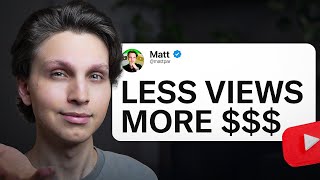
Matt shows how educational YouTube channels make 5-6 figures monthly on far fewer views than viral entertainment channels, using RPM rates of $100-$500 versus $3-$5. He breaks down the "Authority Without Identity" framework, AI tools that cost $220 monthly instead of $2,500-$5,000, and how diversified income streams from ads, affiliates, courses, and SaaS subscriptions compound earnings.
Chapters
So everybody thinks that you need millions of views and viral videos in order to make serious money on YouTube. Well, I'm about to completely destroy that belief, and I'll be doing it using real numbers from my community of over 11,000 YouTubers. Now, I personally run over 12 different YouTube channels, and I've seen people running thousands of different YouTube channels, and here's what I've discovered that most people completely miss. What if I told you that there were faceless YouTube channels making 5 to 6 figures per month while viral channels with 10 times the amount of views are barely breaking even. You might be saying, "Matt, that sounds impossible. How can a channel with less views make more money?" Well, I'm gonna show you the exact data that proves this. And by the end of this video, you're gonna understand why the most profitable YouTube channels are often the ones that you've never even heard of. But first, let me tell you a quick story that changed everything that I thought I knew about YouTube. When I first started YouTube at 14 years old, I was obsessed obsessed with just getting millions of views. I thought that was the only way to make real money on YouTube. And I was running these entertainment channels, they were getting decent views, but I was barely making anything from them at the time. Eventually, I figured out how you can put ads on your videos by joining the YouTube Partner Program, and I built these channels up myself up until the point that they were making around $30,000 per month. But then the adpocalypse happened, which is where YouTube ad rates decreased significantly overnight due to some advertisers not wanting to put some ads on some controversial videos. This was years ago, but things went from 100 to zero very quick. But shortly after that, I discovered something that completely changed everything that I thought I knew about YouTube. I found this faceless channel in the business niche that was getting maybe 50,000 views per month, which is very low in the grand scheme of YouTube. But the owner of that channel was making more than all of my viral channels combined. At first I thought, there's no way this is possible. How could someone with that tiny amount of views be making more than all of my channels with —of views combined. And then I started looking into the data, and what I found completely transformed how I approach YouTube. But more on that in a second. Before we get into the specific numbers, you need to understand something that 99% of YouTube channels don't. The highest earning YouTube channels are not the ones that you watch for entertainment. Let me share some numbers that might shock you. I recently analyzed hundreds of different channels within my community, channels using only stock footage, AI avatars, professional voiceovers, and educational problem-solving content. And here's what I found. The faceless channels that were implementing the monetization secrets that I teach correctly were making anywhere from $100 to $1,000 per 1,000 views, while viral entertainment channels were making only $3 to $10 per 1,000 views. Now you might be saying, Matt, I don't believe you. How is that even possible? And I wouldn't blame you. This doesn't sound real, but I'm gonna prove it. And the first step is recognizing the fundamental difference between educational and entertainment YouTube channels. Now when you think of educational YouTube channels, you might think of YouTubers like Ali Abdaal who makes $5 million a year from his channel or Marques Brownlee who makes $13 to $17 million per year from tech reviews. And these are incredible success stories that proves that educational content can make a lot more than entertainment content. But here's the secret that not many people know. You do not have to be in front of a camera to have potentially huge success monetarily on YouTube. And you also don't even need to be getting millions of views. Let me give you 5 real examples from channels that I've analyzed, starting with the channel Practical Wisdom. Their video about the 10 legit ways to make money online has over 10 million views and still probably generates income 6 years later. But what's really interesting is that this isn't just ad revenue. They also have affiliate partnerships, sponsorships, and even course promotions. Now let's say you're running a finance channel, for example. Imagine you're getting 100,000 views per month, which is really the minimum that I recommend shooting for, for most of the channels that I consult. Your goal should be 100K views per month minimum. I would love to see you get to 500K, even a million views plus per month. But your first goal should always be 100K views per month, which is very possible in tons of different niches. That would probably be around $1,000 per month from ad revenue due to the fact that finance is a very high CPM niche. And then let's say you were promoting financial tools as an affiliate that could bring in another $8K to $12K a month. That's judging based off of $50 to $200 per conversion with 2% to 5% conversion rates. And then let's say you had your own investing course. Priced at $497. At just 12 to 20 sales at 100K monthly views, which is very low and very conservative in my opinion, that would be $6,000 to $10,000 a month alone just from that. And the total potential is between $14,500 and $22,800 per month. Now, whenever I talk about revenue numbers or anything else like that, obviously I can't guarantee you're gonna make a single cent out there online. Most people don't do anything with the information that I give, but just looking at the production side of that channel, let's say they're just slideshow videos with a simple voiceover, the total production cost would maybe be $20 to $50 per video if you outsourced and got somebody else to make those videos. Now the next case study I wanna go over is a channel called Brett in Tech. This is a completely faceless tech channel that just does screen recording videos that you could use a free screen recorder like OBS to do, just teaching how to use different software programs on your PC. But more importantly, he's promoting a lot of these softwares as an affiliate, and some of these affiliates pay $100 to $200 per signup. Even with just a 1% conversion rate, just do the math on that, it could be crazy. Now the beautiful thing about this is you could run multiple different channels. Let's say you ran 3 channels across 3 different niches. Let's say channel 1 was in the business niche. It got 80K views a month, made $12K a month. Channel 2 was in the finance niche, getting 60K views a month and making $15K a month. And channel 3 was in the productivity niche, getting 40K views a month, making $8K a month. The combined total from all these channels would be $35K a month just from 180 total views across all of the channels. And they could outsource those channels, hiring people to do all the work for them for a fraction of the cost. Now obviously it's not a guarantee if you make 3 channels you're not going to instantly make $30K a month. There's a lot more that goes into this. But I'm showing this to show that there are channels out there that are succeeding like crazy on YouTube. And the crazy part is you don't even know some of the people behind a lot of those huge faceless channels out there because they're completely anonymous. You never have to show your face or get in front of a camera or even be an influencer at all. And right now you might be saying, "But Matt, how do I actually start something like this?" Well, that depends on several factors. Let me break down the exact numbers so you know why this works so well. First, you need to understand how we measure YouTube earnings. We typically do it with a phrase known as RPM, which is revenue per million, or how much money you make per 1,000 views. Traditional entertainment channels will make anywhere between $3 and $5 per 1,000 views. And this is based off my own experience over the past 10 years. And this revenue is just from ads alone because there's not really affiliate products or courses or digital products or anything else that you can sell with these entertainment channels. So you're limited to really just ad revenue and sometimes sponsorships, but even sponsorships are less frequent until you have a ginormous channel. So to make $10,000 a month, you would need between 2 and 3 million views per month. That's over 66,000 views per day. And here's the problem. You're completely dependent on ad revenue, which can fluctuate wildly or just disappear out of nowhere if your channel gets demonetized. But what about faceless education channels? They can make $100 to $500 per 1,000 views. I know that sounds crazy, but it's true when you factor in all the different revenue streams that can go along with those channels, which means you only need 20,000 to 100,000 views every single month in order to hit that $10K goal. But it gets even better. Let's say you made a faceless business channel and promoted a $500 course, and it was about how to start an online business or even just use some of the tools that go along with doing an online business. If just 0.1% of viewers, which is extremely conservative, bought your course, that's 1 sale for every 1,000 views, which would be $500 per 1,000 views instead of the typical $5 that 90% of channels get. But here's where it gets really interesting. What if you added on recurring revenue? If you promoted, say, a $100 business software, one of the softwares that you talk about and promote in your videos, and get just 2% of viewers to sign up for that, since it's cheaper, more people will sign up for it. That's $2,000 per month in recurring revenue just $5 from 1,000 views, and that money keeps coming in month after month as long as people stay subscribed. An entertainment channel would just make $5 from those 1,000 views and call it a day. They're leaving so much money on the table. And now that brings me to something that most people never consider: the ultimate scalable advantage of faceless channels. You can run unlimited channels without anybody knowing it's you. Imagine running 10 different channels across educational niches. Business, finance, productivity, health, relationships, and technology. Each channel targets different expensive problems. And here's why this works so well. First of all, there's no personal brand limitations. You can test any niche without it damaging your reputation. If a channel fails, nobody knew it was you. Secondly, you have location and time freedom. You can hire teams to run everything for you while you just focus on the overall strategy. For all my faceless channels, I just come up with video ideas and then upload and optimize the finished videos. And people are running these operations from all over the world. You can be in Bali, Costa Rica, doing whatever you want for your time while your channels run for you. And thirdly, if one of your channels fail, it doesn't affect any of your other channels because you're not putting all of your eggs into one basket. But let me address the elephant in the room that I know you're thinking about. You're probably saying, Matt, this all sounds expensive to set up. Let me break down the real cost for you though. So for traditional production costs in the past 10 years, this is what most people had to deal with. You typically would have to get a stock footage subscription, which is gonna cost you like $30 a month. Typically you have to hire a scriptwriter for $50, $60 a video for a good script. And then you need a professional voiceover, which will cost $25 to $50 a video. And then you'll need a video editor for $100 to $300 per video. And then a thumbnail designer, let's call it $15 a video. And that's $200 to $400 per video. And if you're posting 3 times a week, that's $2,500 to $5,000 per month. But here's where everything changes. Now you can use AI tools that are just as good as humans to do a lot of the work for you. Now, you never just wanna rely 100% on AI tools. You wanna look over everything AI does and make sure that your content is giving value, cuz YouTube is cracking down if you're just posting spammy videos on the platform, mass generated by AI. You wanna make sure that you're using the right AI tools, and let me tell you what those are. The first of which is a tool that I built myself for YouTube, which is TubeMagic. And I built this internally for myself so I could write insane insanely good YouTube scripts, not just using something like ChatGPT, which is gonna pull information from everywhere. Instead, you want it using the right script frameworks that rehook people throughout videos, helping keep people's attention. Now, TubeMagic right now is $50 a month. Then let's say you use another tool, which is another tool that I made called vid.ai that will generate your videos, and then you can go ahead and edit them after the fact, put in your own videos and so forth. And that's $137 per month. You can always use a free editor like CapCut as well if you want to. Vid.ai will just save you untold amounts of time. Then let's say you use ElevenLabs for voiceovers. We'll call that $22 per month. And then Canva for thumbnails, which is $15 per month. Your total monthly cost there is only $221. That's less than a lot of people spend on just one video doing it the traditionally produced way. And if you compare that to viral creators who are spending thousands of dollars per video for much lower revenue per view, and you'll understand why faceless channels doing it the educational route is the way to go and why using AI to help you with it can really boost those things, but you want to use AI the right way. You want to make sure your videos are still giving value and don't rely on the tools 100%. And here's something that most people don't realize. AI tools are getting so good that a lot of people can't even recognize what is or isn't AI anymore. I used to be the most anti-AI person on the planet up until last year when it got so good that I couldn't ignore it anymore. And instead I had to adapt and change with the times. Now, I recently did a video on my channel where I talk about why AI is ruining YouTube. but probably not in the way that you think. So I would recommend watching that video so you have a better understanding of how AI can and can't help. So why do these faceless educational channels make so much money? It all comes down to understanding problem-solution economics. When somebody has an expensive problem, they're willing to pay for a solution. Think about it this way. If somebody is struggling to start a business and let's say that business could make them $10K a month, how much would they pay for a proven system that would help them get to where they're going or invest in education or consulting that would help them. I do this all the time. I've spent over $300,000 on education, and I would attribute that partially to why I'm able to make millions of dollars per year right now. Well, somebody in that situation would have no problem paying $500, $1,000, even $5,000, $10,000 to help them get to where they want to get. The math makes sense from their perspective. And yes, there's a lot of scams out there when it comes to online education and everything else, but the sum total that you'll get from information if you invest in education and in yourself in my opinion, is well worth it as long as you thoroughly research and vet that the people that you're paying for consulting from. But here is where most people go wrong. They think that they need to be an expert in order to create educational content. That is completely false. You just need to be what I call an information DJ. Now, I've talked about this so many times, but basically it's where you take information that's already out there and you put it in a structured way that YouTube will actually promote. And you take info from multiple sources so your videos are then by definition the best. and that's how you blow up on YouTube. For example, you could watch the top 5 best videos about how to do dropshipping on YouTube, read 3 to 4 blog posts on the topic, find 2 to 3 case studies, and then combine all of these into one comprehensive video that will make your video better than all of the rest. And the beauty of this approach is that you can do this in literally any niche that has expensive problems. And if you want to make this even easier, you can use TubeMagic to help you write your scripts for you, and it'll do that whole process where you just put in the context videos and it'll watch through them and read through them and then put it all together into the best video using all the proven frameworks to keep people's attention. So educational channels are where it's at in my opinion. You can literally run a global operation from anywhere in the world and the data clearly shows where the money is flowing. Goldman Sachs forecasts that the creator economy is growing from $250 billion today to $480 billion by 2027 with educational content leading that growth in my opinion. 75% of brand targeting budgets last year targeted specifically educational content creators. Why? Because educational audiences have problems and a higher purchase intent and lifetime value for those brands. And brands would rather sponsor a channel about business tips that has only 100,000 engaged viewers than an entertainment channel with a million passive viewers. Those viewers are worth not even close to the amount to a brand than those active, engaged educational viewers. So faceless educational channels are where it's at if you want to build wealth over fame. But here's the most powerful advantage: their content compounds year over year, while entertainment channels typically die within weeks. A faceless video about how to start an online business could generate revenue for 3 to 5 years because people always need that information. Now, obviously the landscape changes, you might have to talk about different tools and so forth and make updates of those videos. However, if you're just talking about general principles and evergreen subjects, they can last for a long time. But an entertainment video about celebrity drama will die next week. And the psychological truth that most people miss is that people have expensive problems and they want solutions, not personalities. People care about results. But there is a specific system for building trust with faceless educational channels, and I call it the Authority Without Identity framework. And step number 1 of that framework is a problem-first content structure. Start every single video by identifying the exact problem that a viewer is wanting to solve by watching your video, and then provide the specific solution step by step. No fluff, no filler. Step 2 then is results and data over stories. Use case studies, statistics, screenshots, and real examples. And they don't just have to be from yourself. You can use them from people online as well to prove your points. People trust data. Step 3 then is consistent value delivery. Every single video must solve a genuine problem. No clickbait without a payoff. Your audience needs to know that when they click on your videos, they get real value. You want to train people in that. Step 4 then is strategic social proof. Now again, If you don't have social proof yourself, you can show other examples of channels. You can show other examples of what you're talking about. For example, if I talk about YouTube channels, for example, if you're doing a channel about how to grow on YouTube, you can show other channels that have grown on YouTube to prove your points. And then step 5 is to have multiple revenue touchpoints. Don't just sell once. You want to build a system for doing this. So you're making ad revenue and then you funnel people from all of your videos into a flywheel pillar video. And then on that video, you sell a more expensive solution. and you funnel people by way of end screens and pinned comments and links in description from all your other videos, so then you're building revenue in multiple ways and it's like a flywheel that improves based on itself. And now you might be thinking, don't people want to connect with a real person? And you are kinda right. Creators like Ali Abdaal or Marques Brownlee have built incredible personal brands. But based on my experience running both type of channels, here's what I've learned. When someone has a problem, they need a solution. It doesn't matter if that solution comes from a talking head or edited clips with a nice voiceover. They want to fix their issue. I started this channel, Make Money Matt, as a completely faceless channel and I got up to making $30K a month from it. But if you do want the best of both worlds, which is personal connection without showing your face, then there's a solution that works incredibly well. AI avatars. I've seen channels with AI avatars do incredibly well and pull in 5 to 6 figures per month. Obviously it's not guaranteed you'll make that much if you use an AI avatar, but the method clearly works. Now, if at this point you're thinking, Matt, this all sounds amazing, but how do I actually implement all of this? This. I get it, there's a lot of information and it can feel overwhelming to know where to start. That's why I've put together Tube Accelerator, where I literally walk you through all of this step by step. This is not just another cookie cutter course which gives you information that you can find for free online. You're gonna get the exact script that I use on my Flywheel Pillar videos in order to sell things like crazy from my channels. You're gonna get access to my team that actually helps me run my channels that you can ask questions to at any time. You'll get access to a community and much more. And what makes this program different than so many other programs out there is that you get real support 24/7. We're there to help you. But here's the thing, Tube Accelerator is not for everyone. If you're looking for a push-button solution to just push a button and make money, this is not it. And anybody claiming that does exist is lying to you. This does require work, it requires consistency, and it does require following a proven system. But if you want to see if Tube Accelerator is right for you, then feel free to click that link down in the description and book a call with my team, and we'll be honest about whether our approach aligns with you or not. We're not going to try to sell you something that's not a good fit. We only want to work with serious people. Makes it a lot more fun for me me and you. But before you go, you're probably wondering one more thing. What are the biggest mistakes that end faceless channels before they even get started? Well, I'm gonna cover that in this video right here where I break down the mistakes that cost creators their channels in a lot of instances. And it's a really good idea that you watch this video so you know what is completely avoidable and what to look out for. I'll also show you all the best niches for doing this, and this video right here is basically like a free course, so check it out. It could save you months of time. I'll see you there. Peace out.
More from Matt

I Let GPT-6 Astra Run My Faceless YouTube Channel For 60 Minutes and THIS Happened

Stop Waiting for 1,000 Subscribers to Make Money on YouTube (Do THIS Tonight)




I Tested Letting Claude Fable 5 Create a YouTube Channel for 1 Hour and THIS Happened

