Here's What You Can And Can't Copyright With AI
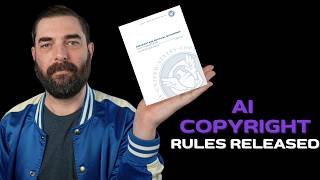
Matt Wolfe breaks down a new U.S. Copyright Office report on AI-generated images. The Office says AI content alone isn't copyrightable, but using AI as a tool within human-created work can protect the human parts. A Randy Travis AI vocal model got registered because humans controlled it; a Midjourney remix might too, depending on how much you directed it.
Questions this video answers
January 29, 2025.
Officially 52 pages, but the speaker says substantive content is closer to ~38 pages.
No — the report specifically does not get into training-data issues.
The Office registered the sound recording because AI was used as a tool to realize vocal sounds and the work involved human creative input.
The officer registered the work but annotated the registration: limited to "unaltered human pictorial authorship" clearly perceptible in the deposit and separable from non-human expression excluded from the claim.
Chapters
On January 29, 2025, the United States Copyright Office released a very detailed report on how they view copyright on AI images. In this video, I'm going to do my best to break down what it says, what it means for artists that use AI, and try my best to answer some questions about it that have popped up around it. So on the screen you can see the report itself. It's actually 52 pages, but if you ignore like the COVID pages and the about this report and all of these various table of contents and things like that, it's really closer to about a 38 page report. This is also part two in a series of reports that the Copyright Office is putting out about artificial intelligence. This report specifically does not get into anything really regarding the training data of AI. So I know that'll probably be a big question people will have. What is the Copyright Office's take on the data that these models were trained on? This report doesn't seem to get into that. This report specifically gets into. If you use AI to create images, is that copyrightable? I did post the quick TLDR version over on my X account and if you don't really care about getting into the weeds at all, here's what it essentially says. AI generated content alone cannot be copyrighted. There must be meaningful human creative input. Simply writing prompts is usually not enough to claim copyright. So they're saying you can't just go to Mid Journey or Leonardo or Ideogram or Flux or one of these tools, give it a prompt, get an image back and say, this is my image, I want copyright on it. They're going to say no to that every single time. However, using AI as a tool as part of a larger process does not prevent copyright protection. So for example, if you make a film and in the film you used AI to change the voice on a character or create some sort of AI generated background for a scene that you're filming. The whole film is still going to be able to be protected under copyright. But maybe the specific video that was AI generated, that was playing in the background, that video itself won't be copyrighted, but the film as a whole will. You can copyright the human created parts of a work that use some AI elements. The report essentially concludes that no new laws are necessary right now to handle AI copyright issues. They seem to believe that the way copyright laws are currently written is enough to handle these AI cases. Now, when I posted this on X, a lot of great questions and a lot of great sort of what about this scenario? Type things came up and so I want to address those in a minute. But first let's dig in a little bit on this actual report here so you don't have to just take my word from it from this X post. So this is directly from the report here. The use of AI tools to assist rather than stand in for human creativity does not affect the the availability of copyright protection for that output. So again, you could use AI as an assistive tool in a greater work. You just can't prompt an image into existence and expect to get copyright on it. Copyright protects the original expression in a work created by a human author, even if the work also includes AI generated material. Here's where there's a super gray area in my opinion though. Whether human contributions to AI generated outputs are sufficient to constitute authorship must be analyzed on a case by case basis. So they're not making any sort of blanket statement statement like if 25% of it was human created and 75% was AI, or if 75% was human created, 25% was AI, they're not making any sort of like specific sort of ruling about that. Plus I feel like it would be really hard to determine those percentages. So they're saying we have to decide this on a case by case basis. Whenever a new piece of art comes across to be copyrighted based on the functioning of current generally available technology, prompts do not alone provide sufficient control. So they are leaving this a little bit open for the future technology because it does say current generally available technology. This to me sounds like they're leaving the door open to change these in the near future. They actually do have a few examples inside of this paper to help clarify some things. So there's an example around the country artist Randy Travis here, the Office recently considered an application to register a sound recording by Grammy winning country artist Randy Travis, who has limited speech function following a stroke. The track was created based on the recording of a human voice using a special purpose AI vocal model as a tool to help realize the sounds that Mr. Travis and the other members of the human creative team desired. The result, which would have been infeasible without this technology, was a new track appearing to be sung by Travis's legendary voice. Because the sound recording used AI as a tool not to generate expression, the Office registered the work. So AI in this case was used as a tool. They trained a model on Randy Travis's voice. Assuming the rest of the track was created with traditional models with the band in the studio, and the only thing that was using AI was using his Trained voice for the vocals over the top of it. The copyright office sees this as a copyrightable creative work by the artist that just leveraged AI as one of the tools in the larger arsenal of this creation. Another example that feels a little less clear cut to me actually comes from a friend of mine, Chris Castanova. She created a work of art where she actually, actually drew this original image. This is a pen drawing that she drew with a half face and some flowers coming out of it. And then she ran it through stable diffusion with the prompt a young cyborg woman, roses, flowers coming out of her head, photorealism, cinematic lighting, hyper realism, 8k hyper detailed. So again, human drawn art fed into an AI image generator to create an image with more lifelike flowers, more lifelike facial features, etc. So based on this, you would think, okay, this output is likely copyrightable because a large portion of this was created with human input, with AI being used as an assistive tool. But it's a little more gray than that. The drawing itself is a copyrightable work and its expressive elements are clearly perceptible in the output, including the outline of the mask, the position of the nose, mouth and cheekbones relative to the shape of the mask, the arrangement of the stems and rose buds, and the shape and placements of the four leaves. Basically, everything that's present in this original drawing that's in this output is copyrightable. However, after reviewing the information provided in the application, the officer registered the work with an annotation stating that registration is limited to unaltered human pictorial authorship that is clearly perceptible in the deposit and separable from the non human expression that is excluded from the claim. So to me, this is super confusing. They're saying that the elements from the original image that are in this new image are covered under copyright, but the realistic nose, mouth, flowers, and all of this stuff that AI generated on top of it, it is not, to me, being this ambiguous, I think just confuses the case even more. It's almost like saying, yes, it's protected under copyright, but with an asterisk. If somebody tries to use that image and you try to go after them for copyright, we'll have to determine whether they used the portions that were copyrightable or the portions that weren't. Like they're just making it so much more confusing with something like this. And I think in the long term, all of this copyright law is going to need to be sort of rethought and rewritten. They also have another example down here of how midjourney lets you do inpainting Essentially, many popular AI platforms offer tools that encourage users to select, edit and adapt AI generated content in an iterative fashion. Mid Journey, for instance, offers what it calls very Region and remix prompting, which allows users to select and regenerate regions of an image with a modified prompt. This is an example from Midjourney's website. Generate candidate image with prompt meadow trail lithograph select and upscale the image. Use freehand editing tool to select a region. Generate candidate images with prompt meadow Stream lithograph Select an upscale image and then the image was further modified by repeating the editing process. They selected an area, put a balloon there, put a castle there. So would we think this is copyrightable or not? Basically generate an image with AI, highlight an area, tell it to generate different things in the area. Here's what the paper says about that. Unlike prompts alone, these tools can enable the user to control the selection and placement of individual creative elements. Whether such modifications rise to the minimum standards of originality will depend on a case by case determination. In those cases where they do doubt should be copyrightable. So if you generate an image with AI and then select a whole bunch of areas and do a whole bunch of inpainting over and over and over again, theoretically they may accept it as a copyrightable work. However, if you draw your own image and then have AI sort of polish the image up for you, it's only partially copyrightable. I think this specific case here, where they claim that where you can see the original drawing in the output is copyrightable, but everything AI generated is not, really, really sort of muddies the waters of this entire paper. They it felt fairly clear cut until they shared this. In my opinion, I could be interpreting this wrong and I'm sure the comments will let me know if I am. But at the end of the day, the main point they're trying to make with this paper is that they don't want to discourage people from using AI in bigger works. If you're creating a film and you need to use some AI elements to get your vision to life, or you're creating an image and you created most of the image, but maybe you inpaint one little section of the image to add like a bird or something and Photoshop generative fill, they don't want you to avoid doing that for worries that you can't copyright it. Or if you're creating a song and you know the majority of the song is generated with real instrumentals, but maybe you use a little bit of AI to add some sort of additional musical element in the background. Well, the majority of these things were human creativity that leveraged AI as like a little extra tool to support or improve the creative thing that you made. One thing they are very, very clear on though, is if you just go to an AI tool, type a prompt, and then copy and paste that output and try to copyright it under the current rules, those are never going to get copyrighted. You're not going to get an image straight out of Midjourney or Leonardo copyrighted. You're not going to get an essay that you pulled straight from ChatGPT copyrighted. You're not going to get a song that you prompted from Suno that just came straight out of their machine copyrighted. But if you're using these tools as part of a much larger process, you'll probably get protection under copyright. But it's still all a case by case basis. There were a few questions that popped up when I post this X post here, and I want to address some of them because there are some interesting things that people brought up. Jacques here said ironically, pressing a button on a camera can take less effort than a curated and authored prompt. And that's something that I really, really agree with. It's a lot more difficult for me to think of a really, really creative prompt with a lot of elements in it and do it over and over and over again until I have an image that this is the one I'm most proud of than it is for me to hold up my camera, take a picture of my backyard and create go and get it copyrighted. There's also the fact that most cameras these days have AI built into it. My Sony camera that I'm shooting into right now has AI functionality in it. I don't have it turned on, but it does have it. My insta360 cameras I have, that's one of their big selling points. They talk about how there's AI in their cameras. Is there going to be a gray area in the future where if I take a picture with a camera that has AI built into it, now all of a sudden it can't be copyrighted because AI was used to create that image? I mean, I feel like under the current laws it still can be copyrighted because AI is just a little tiny piece of the process. But again, Jock's point still stands. It's actually a lot more difficult to type a prompt that produces a good result than it is to snap a photo that produces a good result. But the amount of effort takes, I guess, isn't necessarily a factor in whether or not something should be copyrighted or not. But I think the even bigger issue here is this one that Tom brought up. Doesn't that mean that all content creators need a way to prove that it wasn't generated AI to have content protection? Like. Like, won't we get to a point now where if we submit something to be copyrighted, they're going to need us to prove that we didn't generate it with AI? Is that going to be what happens with all artwork, with all photography, with all like images and books and songs that are submitted for copyright? Is the burden to prove that it wasn't AI on the creator? I don't know. That creates another whole gray area and in my opinion, a fairly massive issue to overcome. Here's a random edge case that M brought up from scenario. He worked with this person, Araminta, who essentially trained their own art into an AI model so that they could then prompt images using their style of art. So they actually uploaded the original images that they trained into the model. So here's some of the images like these mushrooms and this sword and this person with like a funky hat and this poison bottle and a cat. And so these are the images that this person trained into the model hoping that they can create a sort of fine tuned model on their style of art and then ask the image generator to prompt it in their style. Well, these are the types images that were coming back when they gave it prompts that were supposed to be in their style. So should these be considered copyright? Because the training data inside of the AI models, yes, it had the larger data set still in it, but they fine tuned it to specifically try to generate images on their own style. Now whether these actually match their style that closely, I guess is, you know, up for debate. But the bigger question here is let's say they did look very, very, very close to the styles of the images that were trained in there. If the underlying images were trained on your work and then you prompted more work to look like your existing work into existence, could that be copyrighted under the current rules? The answer is no. But at the end of the day, this is all very evolving. They did actually write into this paper wording that suggests that this will evolve and change over time. For instance, the line based on the functioning of current generally available technology and the fact that they said the office will continue to monitor technological and legal developments to determine whether any of these conclusions should be revisited. So they don't seem to be set in stone and locked in on these specific guidelines. But the overarching theme of this paper is don't worry about using AI as part of a larger process, but if AI did most of the work for you, there's a pretty good chance it won't get copywritten. So you can't prompt stuff into existence and get it copywritten. You can't let AI do like 90% of the work for you and still get it copywritten. But if you're using it as a tool in a much, much larger process, then they still will likely allow copyright. But there might also be an asterisk where some of the elements are copywritten, but some of them aren't. And at the end of the day, this is all my interpretation. I did read this report and I'm trying to share my interpretation. Other people may have different interpretations on this. I don't know if the way they're going about this is the right or wrong way. I'm still forming my own opinions, and my opinions on this topic specifically change very, very, very often as new information is presented to me. However, I feel this is an overall net positive for people using AI in their creative workflows as a tool. I was never really somebody that was a big proponent of being able to just prompt an image and say, this is now my copyrighted work. So I don't necessarily disagree with the decision on you just can't prompt it into existence. But I also feel like my opinion on that could change over time too. As these tools evolve, as the economy ev evolves, as the world evolves, as more and more people adopt AI, I think everything's going to continue to evolve. And with it, the way I feel about this stuff will evolve as well. I just wanted to present what was in front of us and do my best to break it down and explain it. And I probably did it in a very long, rambly way. But hopefully you have a better picture of what the copyright office thinks of AI generated works now. But that's what I got for you today. Hopefully you found this helpful, informative, useful if you want to stay looped in with the latest AI news and tutorials, and useful if you want to stay looped in with the latest AI news and tutorials and cool tools that come out in the AI world. Make sure you like this video and subscribe to this channel and I'll make sure more stuff like this shows up in your YouTube feed. And again, if you haven't already, check out FutureTools IE where I curate all of the coolest AI tools. Keep the AI news page up to date on a daily basis. And I have a 100 free newsletter where twice a week I'll send you just the most important news and coolest tools that I come across directly to your email inbox box. And as a thank you for signing up, you'll get free access to the AI Income Database, a database of ways to make extra money using these various AI tools that are available to you. It's all for free. You can find it over at FutureTools IO. And thank you once again for tuning in. I really, really appreciate you. Hopefully I'll see you in the next one. Bye. Bye.
More from Matt




AI News: Dots, GPT-6.1 Sol, Sonnet 5.5, Gemini 4, and everything you need to know




