The Biggest AI News Updates Were NOT at CES
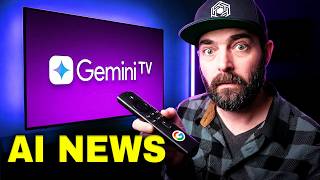
Matt Wolfe rounds up AI news from CES 2026. OpenAI launched ChatGPT Health with medical records integration, NVIDIA announced the Ruben platform, and Google pushed Gemini into Gmail and Google TV. Meta paused Display glasses production while Yann LeCun clashed with leadership.
Questions this video answers
January 10, 2026.
NVIDIA's first 'extreme co-designed' 6-chip AI platform (announced at Jensen Huang's CES keynote).
50 petaflops of NVFP4 inference.
It is in beta and requires joining a waitlist to access.
Referred to as 'Kira' (spelled Q I R A / QIRA in the narration).
Chapters
All right, so I'm out here on location at CES in Las Vegas. Tons of cool tech, tons of cool announcements. Four of us wolves running around the desert together in Las Vegas. I'm actually going to make a separate video about all the cool tech that we explored and saw inside of ces. But there was some cool news that happened outside of CES as well, including Lenovo, Kira, including ChatGPT Health, and some fresh drama out of Meta. We're going to get into all of that right now. Meeting in the middle of the desert always made me nervous. It's a scary place. So first up, let's Talk about how ChatGPT is going to be your new doctor. I mean, if it isn't already, because, I mean, it's mine, so. So ChatGPT introduced ChatGPT Health this week. So the article here says today health information is often scattered across portals, apps, wearables, PDFs and medical notes, so it's hard to see the full picture. You can now securely connect medical records and wellness apps like Apple health function and MyFitnessPal. So ChatGPT can help you understand recent test results, prepare for appointments with your doctor, get advice on how to approach your diet, workout routine, or understand the trade offs of different insurance options based on your healthcare patterns. That sounds fun. Sounds dystopian. Wait, does that mean they're gonna send your health data to insurance companies that are gonna use it to decide whether or not to give you coverage? Anyway, so right now this ChatGPT Health feature is in like a beta. You actually have to get on a wait list to use it. They're not making it available for everybody. But if you go to the link in the description, you'll be able to get on the waitlist. And apparently this is like a whole new section of ChatGPT, so your normal ChatGPT chats will be in one sect. The health data where you're talking about all the health stuff is in a completely different section of ChatGPT. And next up for our first story from CES, there is a ton of news from Nvidia. Like Jensen Huang did one of his famous like two hour long keynotes where he just dropped announcement after announcement after announcement. But the stuff that I think you're interested in is this stuff here. So during his keynote, Jensen unveiled Ruben, which is Nvidia's first extreme co designed 6 chip AI platform now in full production. They also introduced Alpamio. Alpameo. Alpameo, Alpamio. And this is actually an open reasoning model for vehicles. This is like an open model that companies that are building cars that want AI in them can go and use this model freely. Hey, look, Homer's got one of those robot cars, one of those American robot cars. So there's the Rubin GPUs and there's these Vera CPUs, and these are all designed to go into what Jensen is calling these AI factories. It seems like he's trying to rebrand data centers into calling them AI factories. So the Ruben GPUs have 50 petaflops of NVF poor NVF4P fucking inference. 50 petaflops of NVFP4 inference. The VARA CPUs are engineered for data movement and agentic processing. Then there's the NVLink C scale up networking, the Spectrum X Ethernet Phototonics Scale out NETworking, the Connect X9 Super Nics and Bluefield 4 DPUs. And if you have no idea what any of that means, then we're in the same boat. So the big picture takeaway of all this from Nvidia and Jensen's keynote is that they're putting an emphasis on trying to catch up to the amount of adoption. Like they can't make GPUs fast enough for the amount of AI adoption. And. And so they're really ramping things up to make sure there's enough capacity so everybody has access to this AI and the compute necessary to run this AI. Moving right along, there was an insane keynote at the Sphere here in Las Vegas, where Lenovo announced all sorts of new stuff. Did you know that Motorola phones are still a thing? I learned that at the Sphere when they were making all of their announcements about all of the stuff they're working on. There's the Motorola phones, there's Motorola little wearable pins, there's new Lenovo computers. Like pretty much every type of device, Lenovo has new versions of this coming out with AI at the center of them. They also announced what they're calling Kira. That's Q I R A. I think it's pronounced Kira. But this is like an AI platform that's supposed to work across devices. So if you have a Motorola phone, the AI will work on the phone. If you have a Lenovo laptop, it works on the laptop. But they're actually synced and communicate with each other. So. So if you start speaking on your phone and talking to the AI on your phone, well, that conversation is remembered over on your Lenovo laptop. And it's using both local compute and cloud compute, so it's actually doing A lot of this stuff on device and syncing between the two of them. And this Kira Assistant isn't based on any single model. It says here Kira is not built around a single flagship AI model. Instead it's modular under the hood. It mixes local on device models or with cloud based models anchored by Microsoft and OpenAI infrastructure accessed through Azure. So basically it sounds to me like they're not just picking one model from OpenAI or Anthropic or Google. They're gonna kind of pick the best model at the time. And that's what this CURA is going to use. One downside is, well, you've gotta be using Lenovo Devices and Motorola Devices. So in my opinion this sounds like Lenovo's attempt to kind of create a locked in ecosystem similar to Apple. Cause once you're using Cura Assistant on a Motorola and a Lenovo laptop, well, you're not going to want to leave their ecosystem. This might look like just another AI video, but there's something completely different happening here. This is LTX2, it generates video and audio, it's out of this world and it's running 100% locally on my GPU. That means zero cloud processing was used to make these videos. Lightrics just open sourced the entire model family. And I don't just mean open API, I mean open weights for full training code and the evaluation benchmarks. That includes the training recipes so you can fully fine tune the model to your exact use cases and preferences. This is going to save you so much time in the long run because the model is going to generate exactly what you're looking for without having to go back and forth 10 times and like waste all your credits. So now you can get the speed of local iteration. And because it's on your own device, your IP never leaves your machine. That's huge for for businesses, studios and creators. And it's optimized for Nvidia RTX GPUs which makes high quality local generation actually practical. On a home workstation you could do text to video, image to video, depth, conditioning and audio alignment all on the same platform. So if you're interested, the weights are live. Now all you have to do is clone the repo, check the benchmarks and run it yourself. The link is in the description below. And thank you so much to Lightrics for sponsoring this portion of today's video. Now this isn't from ces, but there was a couple announcements out of Google this week as well, starting with the fact that apparently Gmail is entering the Gemini era. Now, I personally thought they were already in the Gemini era. Basically what this is is that they're rolling out a bunch of new AI features in Gmail. Now if you were a paying Google customer for a while, you might have already had some of these AI features, but they're rolling them out to everybody. So here's some of the features that are rolling out. You can ask your inbox anything with AI overviews. So just like you can do a Google search, AI overviews turns information into answers without needing to dig. And when you an email with dozens of replies, Gmail synthesizes the entire conversation into a concise summary of key points. This is obviously using Gemini under the hood to generate the overviews. And starting this week, everyone can now use the Help me write feature to polish up emails or draft emails completely from scratch. There's also new suggested replies. So when an email comes in, it will give you suggested replies. So you don't even need to think anymore. You can just press a button and it'll email them back for you. Who needs thinking anyway? There's also a feature where it'll help you pinpoint what matters the most from within your inbox. So it says here your inbox is filled with updates. Some are critical, others are just noise. The new AI inbox filters out the clutter so you can focus on what's important. Basically, it looks like it's going to give you this personalized briefing, it's going to highlight to do's and it's going to catch you up on what matters based on what's in your inbox. Now I've actually been hearing a lot of excitement about this feature. A lot of people are saying this is going to be a lot of people's sort of gateway drug like entry into actually adopting and using AI. Come on Dewey, join the party. No Dewey, you don't want this. Get out of here. Because who doesn't use Gmail these days? And well, with this feature in Gmail, everybody's going to start using AI. You're going to use AI and you're going to like it. Moving right along in other Google news, they introduced new Gemini features for Google TVs. This was an announcement at CES. I somehow missed this announcement during CES and only found out about it from reading this article right here. They were previewing how Gemini is making Google TV even more helpful and bringing more ways to interact with your tv. So one of the features is it's going to give you AI overviews of various shows so you can decide if you want to watch it based on the AI overview, you'll be able to use Gemini to actually search your Google Photos library from your Google Smart tv. You're going to be able to use Nano, Banana and Veo to reimagine personal photos on your tv. And probably the coolest, coolest feature, and the one that most people are actually going to use, is the feature where you can actually change settings using Google's AI. So you can say things like, my TV's too bright, make it dimmer and it will actually go into the TV settings and change those settings for you. So I just spent the last several days exploring the CES floor and these new AI glasses are everywhere. Like, I swear we probably saw 30 to 40 AI glasses company. They're everywhere. So that brings me to this story here about Meta's glasses in particular. So during CES there was several announcements about the Meta glasses. Specifically, one is something I wish I had right now, which is a new teleprompter feature inside of the Meta Display glasses. So you can actually see what you're about to say streaming right in front of you as you're talking. And you don't need to look up at your producer and ask him what to say next every three minutes. You're doing great, kid. Thanks. There's also a new handwriting feature which is designed to make it so you can pretend you're listening to the person across the table from you while actually secretly texting somebody else. So what it is is a feature where you can sort of put your hand on your lap and draw letters and it will actually respond to text messages using your Meta Display glasses by just drawing the letters with your hand. So while you're pretending to be interested in your date across the table, you can actually be texting your buddy about where you're going to go watch the football game tonight. Also very disturbing. They're rolling out pedestrian navigation in four new cities, bringing the total up to 32 total cities. There's a few other announcements that they made about the Meta Display glasses, but I'll make sure the link to this article is in the description so you could read about everything that they just rolled out. But while we're on the topic of these Meta Display glasses, apparently the demand has been really high. Meta's been struggling to meet them, so they're actually not going to roll them out as quickly as they planned. So apparently the Meta Display glasses are no longer going to be available internationally in early 2026 as planned, Meta announced that it's pausing plans to launch the glasses in France, Italy, Canada and the UK by early 2026 due to unprecedented demand and limited inventory. Sorry, Dave. No Canada. And finally, in the last bit of Meta related news, we have some drama. Roll the animation. So we have some drama from Yann Lecun, who is the ex chief AI scientist from Meta. Now, if you're not Familiar with Yann LeCun, he's literally considered one of the godfathers of AI. He won the Turing Award back with Geoffrey Hinton, and the Turing Award is pretty much considered like the Nobel Prize of Computing. So this guy is a really, really big deal. Somehow Meta managed to get Yann LeCun on their team as the chief AI scientist. And then recently Meta acquired like 49% of scale AI and they brought in scale AI CE Alexander Wang as their head of superintelligence, essentially making Alexander Yann LeCun's boss. Well, it didn't take long, and Jan eventually left Meta to go start his own AI company. And, well, he's been doing the rounds of some podcasts and talking to some people and sharing what his thoughts are on Meta and Alexander Wang, and, well, I don't really think he's a fan. Yann Lecun calls Alexander Wang inexperienced and predicts more meta AI employee departures. In an interview with the Financial Times, LeCun, who was met as chief AI scientist, said Wang was inexperienced and didn't fully understand AI researchers. He learns fast. He knows what he doesn't know. There's no experience with research or how you practice research, how you do it, or what would be attractive or repulsive to a researcher. So apparently Zuck was frustrated with LeCun because he was a little disappointed in the progress of their LLAMA models. In the interview, Lecun said that the AI team fudged some of the results of llama 4. He went on to say, Mark was really upset and basically lost confidence in everyone who was involved in this. So just really, really fascinating. I love the AI drama. To me, that's some of the most fun content to talk about. Is all of this, like, beefing within the AI world? But yeah, Likud left Meta and started, I wouldn't really say talking crap, but not really talking great about the experience at Meta. She doesn't even go here. And that's what I got. This is actually a shorter news video than normal because, well, there's going to be a lot of stuff that I'm going to talk about in my upcoming CES videos. But before I end this one, I'll give you a sneak peek of some of the interesting stuff we saw at CES this year. Let's roll it. All right, so that's what I got for you today. Don't forget, I do have a couple really cool videos coming up about all of the cool tech we saw here at ces. Those will be coming out in the next few days, so stick around for those. Make sure you like and subscribe if you aren't already. Thank you so much for nerding out with me today and hopefully I'll see you in the next one. Thank you so much for nerding out with me today. If you like videos like this, make sure to give it a thumbs up and subscribe to this channel. I'll make sure more videos like this show up in your YouTube feed. And if you haven't already, check out Future Tools IO, where I share all the coolest AI tools and all the latest AI news. And there's an awesome free newsletter. Thanks again. Really appreciate you. See you in the next one.
More from Matt




AI News: Dots, GPT-6.1 Sol, Sonnet 5.5, Gemini 4, and everything you need to know




