The Clawdbot Story Just Took a WILD Turn
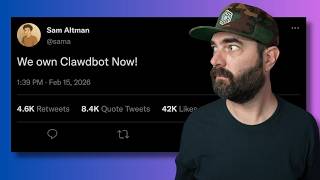
Matt Wolfe covers how Claudebot, a WhatsApp-to-Claude tool that hit 200,000 GitHub stars, got rebranded twice after trademark and security disasters, then its creator Peter Steinberger was hired by OpenAI to lead personal agents. Over 30,000 instances were exposed with 93% vulnerable to attack.
Chapters
A few weeks ago, I made a video about claudebot, the AI agent that was completely taking over the Internet. And, well, a lot of you guys watched it and I think a lot of you have been trying to follow along to this story. Well, that story just took a massive turn because over the weekend, Sam Altman announced that the guy who built Cloudbot, now called OpenClaw, is joining OpenAI. Peter Steinberger is joining OpenAI to drive the next generation of personal agents. He's a genius with a lot of amazing ideas about the future of very smart agents interacting with each other to do very useful things for people. We expect this will quickly become core to our product offerings. Open Claw will live in a foundation as an open source project that OpenAI will continue to support. The future is going to be extremely multi agent and it's important to us to support open source as part of that. And the way this all happened, the chain of events that led to this moment, is honestly one of the wildest stories in the world of AI right now. It involves a trademark threat from anthropic crypto scammers that almost destroyed the entire project, a social media platform for AI agents, and a cybersecurity design that had like every cybersecurity firm on the planet freaking out about this. So in this video, I'm gonna walk you through it all. So here's the quick tldr. If you didn't see my last video Back in November 2025, this guy here, Peter Steinberger, built a little side project. It was basically glue code that connected WhatsApp to Claude code so he can like text message his AI agent and have it do things for him on his behalf. You know, little things like manage his inbox or book reservations for him, check into flights or, you know, control his smart home, little things like that. Instead, just chatting like you would with chat, GPT or Claude, it would actually go and complete real tasks for you. He open sourced it under the name claudebot, like a claw C L, A W D bot. And for a little bit it kind of flew under the radar. Had, you know, a few thousand stars on GitHub. It was doing good, but it wasn't like the massive thing we know it as right now. But then in January, it absolutely exploded. Right now it's sitting at 201,000 stars on GitHub and it got over 2 million visitors in a single week. It was the fastest growing open source project in GitHub history. It was absolutely everywhere. And it spawned this whole ecosystem, including this mult book, which was like a social network for AI agents. It also spawned things like the Silk Road for AI agents and Tinder for AI agents and only fans for AI agents. And literally everything you can imagine that humans do, but for AI agents, they all came out of this Clod Bot, Mo Bot, Open Claw sort of ecosystem that was being built. Andre Karpathy, one of the original founders over at OpenAI, said, what's currently going on at Multbook is genuinely the most incredible sci fi takeoff adjacent thing I've seen recently. And, well, that's pretty much where my last video on Clodbot left off. I went on to show you how to install it, if you were interested. But that was before more of this story unfolded. On January 27, right as Cloudbot was starting to go viral, Anthropic's legal team sent Peter a notice that Clodbot was a little bit too close to their Claude branding. So they rebranded Clodbot to Moltbot. That's where that Molt Book name got its name from. I assume Peter kind of agreed. Yeah, it's pretty close. And rebranded with no big issue whatever, since Lobster's Molt. Molt Book was still a play on the lobster theme. But here's where things went kind of sideways. Within seconds, literally 10 seconds after he released that old username and grabbed the new username, crypto scammers picked up the old username. Within minutes, they've released fake tokens on Solana, they started serving malware from his GitHub, they hijacked his NPM packages, and every one of his Twitter mentions just turned into a wall of spam.
Honestly, I was that close of just deleting it. I was like, I determine the future, you build it. That was a big part of me. I got a lot of joy out of that idea. And then I thought about all the people that already contributed to it, and I couldn't do it.
So he did a second rebrand, this time to Open Claw, and he described it as like a covert operation that he had to do.
Nobody could know. Like, I literally was monitoring Twitter. If, like, if there's any mention of openclaw, like, with reloading, it's like, okay, they don't expect anything yet. And I created a few decoy names. All that I shouldn't have to do, you know, like, not helping the project. Like, I lost, like 10 hours just by having to plan this in full secrecy. Like a war game. Yeah, this is the Manhattan project of the 21st century. Is renaming so stupid.
Now, here's part of the story that I think is really important, the whole trademark claim from Anthropic was actually legally defensible. Now, I'm not saying Anthropic was wrong to do it. They got to do what they got to do to protect their ip. I totally get that. But the unintended consequences of that letter was that it kind of set off this chain of events that sort of pushed Peter right into the arms of Anthropic's biggest competitor. Now, while all this naming drama was happening, there was also another storyline unfolding about the security of OpenCloth. In fact, Gartner here actually called it an unacceptable cybersecurity risk. They actually told enterprises to block downloads and traffic Emergency immediately. From claudebot. Researchers actually found over 30,000 open clot instances just publicly available on the Internet. No authentication, no protection, just data exposed for anybody to go find. These instances had access to people's email accounts, their calendars, their Slack credentials, their API credentials, anything they fed to their cloud bot people were able to access. One security Firm found that 93% of verified instances had security vulnerabilities. CrowdStrike literally removed an open claw removal tool for companies to remove it completely from their systems. And then there was multiple the AI social media platform I mentioned earlier, it exposed 1.5 million API keys and 35,000 user emails, basically because of a database misconfiguration. So you've basically got the most exciting AI agent anybody has ever seen, but it's also got some of the biggest security holes anyone has ever seen. Both things were true at the same time. So by now you might be thinking, well, who is this Peter guy? Is he just some like random vibe coder who slapped this up on the Internet and got lucky? Well, not even close. Peter actually built a company called PSPDF Kit. It's a PDF toolkit that's used by Apple and Dropbox and SAP. He bootstrapped it for 13 years. Nearly a billion people currently use apps powered by software he developed. He's a self made multi multi millionaire and actually a pretty serious developer. But after his exit, he kind of burned out. Didn't touch a computer for months. Kind of stayed away from the tech side of the world for like three years. Finally coming back in April 2025. At this point I had gotten good enough for it to help him write code. He kind of got into the whole vibe coding thing and got back into developing projects and he developed a lot of projects. Like just check out this GitHub activity here. All of these green do bots are Basically days he was working on code. He put tons of open source projects into the world. Most that didn't gain much traction at all until of course, Claude Bot Bot Open Claw, which then of course led to the viral explosion and eventually to what happened over this past weekend with OpenAI. With the viral success and all of the attention and all of the people using this, he realized he couldn't do it himself anymore. He said he wanted to build an agent that even his mom can use, but the problem was it was costing him between 10 and $20,000 a month operate OpenClaw on his own and he was paying all of that out of pocket. So fast forward to now with Peter Steinberger joining OpenAI. A lot of people are wondering why OpenAI apparently meta wanted him. He said Mark Zuckerberg was interested. Satya Nadella from Microsoft called him personally. They were interested as well. But he chose OpenAI. And the main reason he chose OpenAI he wrote about in a blog post here over the weekend. It's always been important to me that OpenClass stays open source and given the freedom to flourish, ultimately I felt OpenAI was the best place to continue pushing on my vision, expand its reach. The more I talked with the people there, the clearer it became that we both share the same vision. So that leads me to believe that some of the other companies he talked to were less interested in keeping Open Claw open source. But there is a much bigger strategic play in place here. OpenAI's kind of in trouble right now. Like not they're going out of business next month sort of trouble, but they're sort of losing the enterprise market and that's a problem. So take a look at this chart here. According to Menlo Ventures, OpenAI held 50% of the enterprise market share back in 2023. Fast forward to mid-2025. That dropped to 25% with Anthropic taking the lead at 32%. Again, this is Enterprise LLMs, not necessarily like your chatbots, like Claude or Chat GPT. In fact, here's an even more recent chart that I just found from Even later in 2025 that shows that Anthropic now actually has 40% of the enterprise LLM API market share. Claude code actually hit a billion in revenue within six months of launching. So OpenAI is kind of watching Anthropic eat their lunch in enterprise share. And that's mostly because of the success of Claude code and the whole developer ecosystem that's been built around it. That's also why OpenAI has been pushing Codex so much lately. But here's the thing that's really, really wild to me. Open Claw caused a ton of people to go sign up for Anthropic's higher tier plans and spend money on Anthropic's APIs. Most people that were running Openclaw were using Anthropics APIs to do it. So OpenAI just recruited one of the main people that was sending a ton of customers to their competitor. So this isn't about like model benchmarks or which model is the smartest anymore. That's kind of like table stakes now. They're all kind of caught up to each other for the most part. The real battle now is who controls the agent layer, the software that sits between the AI model and you using the model, and that can actually go do things on your behalf as opposed to just give you responses. The first company that really nails this agent layer where security is totally figured out, it can go and use all of your tools on your behalf, it can search the Internet, it can basically be that personal assistant that just goes off and does things for you, while you also have peace of mind that it is not a security nightmare and going to give all your data away. Whoever figures that out the best is going to be the next big winner in this AI race. And, well, OpenAI just made a giant move to compete in that space. All right, so what does this all actually mean for you? Number one, AI agents aren't some, like, theoretical future thing that we're gonna get. They're actually here and they're working. Yes, they've got some security flaws right now and some major issues, but 201,000 stars here on GitHub shows that this is something people actually really, really, really want. Number two, expect OpenAI to start shipping agent features into ChatGPT. Peter Steinberger's fingerprints are going to be all over whatever comes next when he says he wants an agent that even his mom could figure out how to use. That should tell you exactly where all of this is heading. They want agents for normal people, not just developers, and no Mac Mini needed. And third, this story is a masterclass in unintended consequences, specifically for Anthropic. Anthropic sends a trademark letter, which triggers a rebrand, which triggers a crypto scam, which triggers a second rebrand, which attracts attention from every major tech company on the planet, which ends with Anthropic's biggest competitor hiring the guy and absorbing the ecosystem that literally everybody's showing that they want right now. And this story is far from over. Open Claw is moving to a foundation. Peter is building an OpenAI now, and these agent wars are just getting started. Heck, Meta just acquired Manus, which is seemingly their big play at kind of the same idea. But I'll keep you updated as all of this develops. If you watch that original Clodbot video, let me know in the comments if you saw it playing out the way that it's played out, because I definitely did not. And if you want to stay looped in on what's going on in the world of AI, the latest news, the latest drama, tech tutorials on how to actually use this stuff, and, you know, breakdowns of the coolest tools and stuff like that, that's what I'm here to do. I want to keep you looped in and help you have your finger on the pulse of what's going on in the AI world. Whether you hate AI or you love AI, I will keep you looped in. You like that kind of thing, like this video and subscribe to this channel. It really, really helps me grow, but it also ensures that more videos like this will show up in your YouTube feed. So thank you so much for tuning in and nerding out with me today. I really, really appreciate you spending the time with me and hopefully I'll see you in the next one.
Bye. Bye.
More from Matt




AI News: Dots, GPT-6.1 Sol, Sonnet 5.5, Gemini 4, and everything you need to know




