This $42/mo Tool Will Help You Live to 120+ with AI
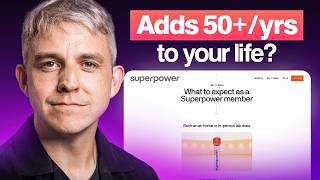
Max describes Superpower, a $42/month service that combines AI with human doctors to run 100+ lab tests twice yearly and deliver personalized health recommendations using wearable data. He takes 30 to 50 supplements daily but says most are overrated or poorly dosed, and argues that positive mental attitude matters as much as biotech for living past 120.
Chapters
Out your phone, you can message your health AI or send a text message to your concierge team. Oh, that's awesome.
So this is like, basically like your own, like AI doctor for this. Like, so you get, you give it all the data about yourself and then now it knows all it's about you and then versus having to go into the AI. Okay, yeah.
And then this one here is a medical team. There's this three humans on it, assisted with, with technology and AI. So you have both. So basically that's what we do today. Test the whole body twice a year with 100 plus labs, connect the dots, tell you what to do, and make it really, really easy to take action with a lot of things in one place. So we're growing quite quickly and having a lot of people wanting to sign up.
How long have you guys been doing this? Like, what was the inspiration for starting it?
I, as I mentioned, went through a challenging personal health experience. Yeah, Chronic migraines, chronic sinusitis. I had surgery, was told to medicate for life, didn't really know what was going on until I found a genius doctor who connected the dots. And it made me realize there's a big gap between the best of healthcare and what most people have access to. And I've believed for the past decade or so that for as long as that gap exists, someone or some company has to come along and close it. And I didn't think that was possible until November 2020 22, when ChatGPT was launched and started to show a path towards what was possible with these AI tools. And we started the company with the belief that we could take the very best of medicine that today costs hundreds of thousands of dollars and make that accessible for a few hundred dollars. So that was the initial impetus.
So I guess, I mean, how can people listening to this, how can they actually live a longer life using AI? Is it just use superpower or is there any other practical advice you can give people that they could just get started with?
Today, if you want to live a longer life, we're going to need biotech. And biotech might be expensive. So if people are using AI to start companies and make money, they're probably going to live a longer life. That's the first thing. It's the unfortunate reality of where the future is going. But biotech will define the future more than healthy eating. And access to biotech might be unevenly distributed. And insofar as AI can make us more productive. That's interesting. I think today these foundational models, if it has full Context. They're very good at connecting the dots, they're very good at working out what's going on. There are ways to prompt it, to make it more effective. I find the Reasoning models like O3 are the best. I'll prompt it with something like, you're an elite integrative medicine doctor, you're the best in the world. Everything about medicine, everything about me, you know, everything at the frontier. You also understand traditional Chinese medicine and Ayurvedic medicine. You've seen everything. You think deeply about the root cause. And my doctor, here's what's going on for me. I'll explain everything, I'll give you everything. My, my upbringing, my life, what I eat, what I do. And if you give it all of that, it's really damn good. So that's just chatgpt. Now, there's a lot of other things you can do with prompting that make it far better. We try to do a lot of that with the superpower AI, but. But you can do a lot now with ChatGPT. They're pretty impressive.
Yeah, I've been surprised. I had a hand injury and it was lingering for like three or four months. And I started chatting with ChatGPT about it and it told me exactly what was going on. I went to a doctor and they told me basically the same thing. And so I'm like, oh, in theory I could have just used ChatGPT. I didn't necessarily have to go to a doctor.
Oh yeah, yeah. And look, these AIs are better than the doctors often. Now there was this paper that came out that showed Dr. Accuracy, Dr. Plus AI accuracy, and then just AI accuracy. The just AI was better than the Dr. Plus the AI. It was more accurate. Right. That's the model today with limited context without being specialized or set up for medicine specific use cases. Where we're going is models that are more specialized with more context.
We are still holding on to humans as the practitioners of the art of medicine. And I think anyone who does that is still reasoning from the past and reasoning from the current point in time we're at. Whereas I think what we need to consider is the rate of change and the directionality of change. If we think models today are impressive, well, in two years time we're going to be blown away.
Right?
Yeah.
I mean, if you think about it, doctors, they get paid so much because they go to school for a really long time and they remember lots of stuff and they read so many different books and they probably retain like, I don't know, 5% of the knowledge or something like that that's actually out there with AI Obviously they could know every single paper that's out there. And then like you said, even other stuff, Chinese medicine, whatever, it can look at the collective knowledge of humanity with health and actually apply that.
Yeah, I think that's such a good point, which is that a large part of medical school is remembering knowledge. Right. And one of the magical things about technology is we don't have to remember knowledge anymore. So yeah, I, look, I tend to agree and we already implicitly know this is true. There are people who will hear this and be like, what do you mean he's talking? I'm like, we already implicitly know this is true. Like when, when you have a health question, what do you do? You go to Google or ChatGPT before the doctor. Typically what people do then you go to the doctor and they might say some things and then you go back to Google and chat GPT after the doctor. And you know what, during the consult, the doctor's using Google and ChatGPT as well. So we already implicitly know that people go to the algorithm a lot of the time before they go to the doctor.
Right. It is feel like people are still going to want to see a doctor in a lot of cases. Right. They want to talk to a person and you know, and it's a probably change over time, but I think as of right now people want to talk to a doctor and be reassured and things like this, I guess also if you get like a bad diagnosis or something too, right? Like that's probably where you would want a human telling you, I guess, versus an AI.
Yeah, like today, 100% people trust humans. The opinion of a doctor validates or invalidates an AI. It makes you more likely to follow a recommendation. That's all going to, that's all going to change. It's inevitable. I'll give you maybe a hypothetical. Let's say you're, you're boarding an airplane, you're going to do a 15 hour trip and over the loudspeaker you hear the autopilot and the technology is not working. This flight, the pilot's just going to fly it. You're going to be like, where's the parachute?
See you guys later.
Yeah, well imagine, imagine you're midair and it's like, we're sorry to tell you, but the AI and the technology has broken. The pilot is going to be flying the rest. You're like, no, no, this is like, are you fearing for your life? That's where we're going to get to. Right?
Yeah.
And if you said to someone in 19, whatever, 40 that the AI is going to fly the plane, they would have been, no way. That's so unsafe. I need the human there. Well, now it's the opposite. Yeah, I think we're going to see that now. We need the AI there. Going to see the same in healthcare.
Yeah. It feels like younger people embrace it, you know, faster. Because, you know, I talked to people in my family recently who didn't even know that AI helps fly. Fly the planes.
Yeah, like, totally. There's a reason why there's still a pilot in the cockpit. The pilot maybe does a couple of things, but if you chat with a commercial airline pilot, ask them about how much they actually do, it's not much. Right?
Right. Yeah.
Yeah.
I live here in Japan. It's. Even with the trains. You notice that, too. I'm pretty sure most of it's automated. And you see the guy up there and he's like, you're just really casual. He's like sipping a coffee, not really paying much attention to anything. He kind of makes sure there's nothing on the track or like, you know, make sure people are okay and stuff. But it seems like it's all just kind of ran by computer systems.
Yep, 100%.
Hey, if you take a look at my web presence online, it's safe to say that I'm a bit AI obsessed. I even have a podcast all about AI that you're watching right now. I've gone down multiple rabbit holes with AI and done countless hours of research on the newest AI tools, every thing, single week. Well, I've done it again and I just dropped my list of my favorite AI tools. I've done all the research on what's been working for me, my favorite use cases and more. So if you want to steal my favorite tools and use them for yourself now, you can. You can get it at the link in the description below. Now back to the show.
Cool. So I heard you had some controversial takes on supplements. So, like, should I be taking supplements? Do they matter? Or are they like, you know, are they BS or whatever?
I think supplements are overrated and many are likely BS. And at the same time, I take 30 to 50 a day in case.
Okay, okay, in case.
No, kind of in case. I don't know. I think I'm like updating my views on it. So there's a few things. One is that no amount of supplementation is going to solve for foundational problems that should be addressed by Attacking the root cause. And no amount of supplementation is going to reliably guarantee you live past 100. Right. So right away we know that even if supplements are marginally useful, they're not that game changing. So we can already say if they're not that game changing then I shouldn't obsess about them too much.
The next thing I'd say is that a lot of supplements are fake or dosed incorrectly or have other sorts of additives or use the wrong part of the, the compound. I was in the the UAE last week and I was in, I was trying to buy some vitamin D. There are all these things in the pharmacy with. And you see this in the US as well, you know all of these vitamin D in the pharmacy with like fancy branding. I'm like, okay, but let's actually look into it. I look into, it's like 300 I use where I'm like, well no, I need like at least probably 5,000 for what I'm going for. So 305,000. That dosing doesn't seem right. The actual supplement itself has preservatives and colors. And then it didn't have vitamin K which is necessary for the absorption of vitamin D. So it's like great, the marketing is good, but the vitamin D is a negligible amount. I'm adding all this other shit to my body and there's no vitamin K which is a co factor necessary for the absorption of vitamin D. Now take a correctly dosed vitamin D. Really good source, purely encapsulated, no additives. 3,000 I use, maybe 5,000 I use. They add vitamin K2 ideally they add vitamin K2 as both forms, MK4 and MK7. And maybe they add vitamin K1 as well. Like, like all those things. Now make a form of, that's just vitamin D. You can look across every other supplement and you have a similar thing. So the second thing I'd say is like not all supplements are created equal and there's a lot of junk out there. And then the third thing I'd say, which is more speculative and I don't believe this enough yet to stop taking supplements, but there might be something here is that supplements actually drain energy. Our bodies are not used to processing the dry powder. A lot of negative charge goes into actually creating the supplements in a big manufacturing lab. And as a result, through mechanisms we don't quite understand, supplements drain your body of energy. And again, I don't believe that enough to have stopped taking them. I took 30 last night.
Yeah, I've never Heard this. I'm like, interesting. It's interesting.
Yeah, I think it is interesting. And there could be something there. And some people hear this stuff and they're like, no, that's bullshit. Typically when I hear someone say that's bullshit, my response is, this is interesting. We don't have evidence yet, but it might be worth pursuing and studying because before there's evidence, there's always no evidence.
Yeah, totally, yeah.
It's just the hypothesis, right?
What do you think about people, you know, probably for the last two years, in terms of longevity? Everyone thinks of Brian Johnson now. Like what, what do you think of, what do you think of, of Brian and what he's doing and trying to live forever.
And look, I, I have a lot of respect for Brian. I think that he's a very good thinker. I think that he's creating a religion which is non trivial. I think he cares about what he's creating as a religion. There are a set of very strong fundamental beliefs underlying it, which is that we need to follow the algorithm because there will come a point in time where the algorithm knows more than us, where the only thing we know is that at this very moment I don't want to die and therefore don't die is the most played game in a moniker or the religion. Right. So I really like that. I think at the same time he's popularizing several health interventions. I don't think he's at the frontier. Like I, I see things he does. And they'll have doctor friends say, this is dumb, he's going to change this. And then like three months later he like changes it. That's fine. Like he's learning. You got to remember he's been playing this game for five years. There are doctors out there who have been playing this game of human optimization for like 30 years, 40 years, 50 years. So I still think there's a lot he doesn't know. He's discovering it and sharing everything he's learning on the way.
So I'm pretty sure, I think that's part that's interesting. And you know what I found fascinating? In a few interviews with him, he talked about one of the reasons for him doing it was that it's kind of like the whole thing I was saying earlier, we're heading into the age of AI. Some of this technology may unlock us to live an extra hundred years in the future. And so, hey, try to make sure you can make it to that point so you can actually extend your life. And one thing I was thinking about, people always Talk about their sleep, like monitoring their sleep. And I think you mentioned you used to do that. Do you recommend monitoring your sleep? Because that's something I've always thought I probably should be doing that. But I'm worried that I'm going to get super obsessed with it, and maybe that'll make me sleep less, actually, because I'm worried about it.
I think most people should try and see whether they like it. I think most people should do it for at least a couple of months because they'll learn to be able to develop a better interoception such that when they remove the ring or the band, they still have a sense of what's going on with their sleep. I do think that it can end up making you more anxious about sleep, and that will make your sleep worse. And that's part of why I don't open my Oura Ring app every morning now. But I also think that even if you don't want to look at the data, it could be worth collecting the data, because we're into a world where we never have to look at the data. The AI would just tell us what to do. And in that world, I want to have a lot of data on myself to support the AI. So that's kind of how I think about the sleep question with Superpower.
Do you have something like that now? Do you, like, submit sleep data, or is that something you guys have thought of doing?
Yeah, we integrate with Aura several other wearables, and that allows us to collect sleep data.
So you mentioned, you know, you already kind of shared, like, one controversial health belief about the thing with supplements. They might drain energy. Is that the most controversial health belief that you have? Is there? Or is there anything else that's even. Even more controversial?
There are a lot of things that I think have a 5% probability, which most people call, like, bullshit. And there are some that I think are higher probability. Now, my problem with all the 5% probability ones is I'll say them. And people say, this is what he believes. I'm like, no, no, no. I believe the opposite. But I think there's a chance of this thing.
People have a hard time. They're like, have really binary mindsets, like, no, it's got to be 100% true, or he's saying it's 100% false, and people have a hard time in between. Yeah, totally.
I guess, like a classic example of this. This idea of. So one of our advisors and doctors, she runs one of the leading cancer clinics around the world, and I asked her what is the number one thing you can do to prevent cancer. And she says PMA positive mental attitude. It's the number one thing. And I actually agree with that. I genuinely believe that how we think, the beliefs we have, the self talk, the way we relate to ourselves, the amount of gratitude we have, impacts all health outcomes, impacts cancer, neurodegeneration, autoimmunity, pain and other things in our body. And I think that the relationship between the brain and thoughts and biology are not where it's not well understood and will increasingly get to a world where it is well understood.
Do you have any theories on like if that's true, like why it's true? Like why would positive thinking and things like that have a, you know, positive impact on your health?
Like look, a lot of our biology is modified by our brain and we know that like we can through our brain choose to increase or decrease our heart rate. Right? We can choose to do a lot of things via our brain and we understand how thinking certain things changes biology and changing your biology changes. We understand that mapping. Now what we don't understand is the mapping when it gets to things like cancer. But I think if the mapping exists for like very simple things, I think that it's likely and completely possible that it exists for more complex things as well. The exact mechanism I don't understand, I don't know if anyone understands, which is why people still call this woo woo and pseudoscience. But throughout history, many of the things we now call science we used to call pseudoscience. So again, I think the right approach is curiosity. And that's the first step in the scientific method. Curiosity and hypothesis rather than just being closed minded.
Yeah, I agree. That's something I've always been like, drives me crazy when I see in some ways, you know, science has become almost like a cult of like, you know, having to agree with, you know, everyone has to agree. There's, you know, what's the paper and if it's not a paper that their peers have reviewed, you can't even discuss it. And it's like, no, you can still discuss it. Like it doesn't mean it's 100 true, but it doesn't mean you should just like completely shut the door and say it's impossible. Okay, so maybe like a fun question, you know, imagine you have a time machine, you know, and you know, you step out, it's 2050. What's, what's, what's different? What's changed?
I think that it's going to be.
Way different to what people think I suspect that we.
Likely won't think about what we do in our actions. I think the AI would just tell us, and we will blindly follow the AI. I think that just about everything we today call work will no longer exist as jobs.
Yeah. I'm just really curious. So you're mostly like. I mean, we almost become the robots. Like the AI is powering us?
Well, potentially, yeah. I think that in a world where the AI knows far, far, far more than us, we don't have a choice but to follow the algorithm. So there's totally a world where the AI determines our behaviors. There's also a world where the AI has merged with us and the AI is part of our thoughts, and we are cyborgs. And I think that cyborgs will be here far closer than we think, particularly because if someone who's a cyborg has a survival advantage, then other humans will have to become cyborgs. Because we're reasonably Darwinistic creatures, we care about survival advantages, and as a result, I think cyborgs are here sooner than people think.
You think by 2050. Are we merging with AI by then?
I think so, yeah. If I was doing it overrun. Yeah, I think so. Cool. Oh, yeah.
One last question. I always like to ask people. My son is 11, and now with AI, I'm always trying to think, like, what should I be teaching him to make sure he's successful in the future?
I would be teaching them people and relationships and how the world works and leverage and company building. Maybe I'd get them to play around with AI and understanding it. But the AI is going to do the coding. The AI is going to do the prompting. I would focus very much on people. I think that scarce resources will not be, can you code? It'll be, can you unlock a door that is gated by a person? So I'd focus more on everything that's innately human rather than everything that is some sort of skill that is constructed by the current nature of our world.
That makes a lot of sense. Yeah. So, like, teaching them more about culture, comedy, just all kind of different things that would be useful in personal relations.
Probably psychology, biology, getting them to meet people, host dinners, sales, persuasion, like. I think the importance of networks likely become far greater. This whole idea of, like, it's not what you know, it's who you know. I think that that is more true, likely in the next five years than it has been for the past couple of decades.
Yeah, I agree. I've had this conversation with my friend Greg Eisenberg. It's part of the reason we both have been doing more content. We totally agree with this. In the future, your networks and who you know is going to matter a whole lot. Especially when anyone can press a button and copy a product.
I think so. But I also wonder at the same time whether we're going to just see AIs chatting with AIs. For example, right now, if someone messages me on LinkedIn, my AI is responding most of the time rather than me now. In a couple of. In a year, it's probably going to be my AI responding.
Is this the first time we've actually talked.
And.
No.
That'D be hilarious.
To Twitter. I'm still. I still got Twitter. Twitter's less noisy. LinkedIn. I get like several hundred messages, like hundreds of messages a week. Twitter's still quite high signal. Yeah. That I'm on Twitter. I'm using WhatsApp. Emails are a mix. Half, half. And again, though, we'll get to a world where the AI drafts our emails, where the AI liaises with the other AI. It's just like AI is all the way down.
Yeah. Cool. Well, give me on Superpower. Give me. I want to live to, you know, 120 or whatever. You're promising 100.
When you sign up, we ask your aging go. The maximum you're allowed is 170. We should. We should extend it.
200. Yeah. Come on, man.
200. Yes. What are we doing? Come on.
Okay, cool. This, this been great. Thanks, Max.
Great. Thanks, Nathan.
It.
More from Matt




AI News: Dots, GPT-6.1 Sol, Sonnet 5.5, Gemini 4, and everything you need to know




