What's Actually Coming in AI (From Someone Building It)
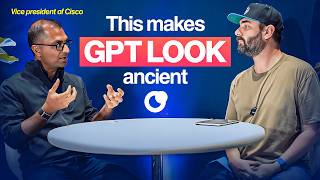
DJ Sampath from Cisco discusses what's actually happening in enterprise AI. Cisco built AI Canvas, a workspace where humans and AI agents collaborate in real time. They're also shipping AI Defense to protect models from prompt injection attacks, and training specialized models on networking data that can do deep research.
Chapters
Hey, welcome to the Next Wave podcast. I'm Matt Wolf and in today's episode, we're talking to the senior Vice president of AI product over at Cisco. Now, if you're not familiar with Cisco, we're going to break down exactly what Cisco does and their role in the sort of AI infrastructure in today's episode. But that's not really the exciting part of what we're going to get into. We're going to talk about things like how AI is leading to this army of AI agents that are coming, how we can prevent attacks like prompt injection attacks. And our guest on today's episode, DJ Sampath, is going to tell us about the new AI canvas that Cisco is working on. It's this combination of like AI chat, generative user interface and real time problem solving all in one tool. And in my opinion, it is the future of what AI is going to look like.
It's a completely reimagined user interface.
In fact, it is a generative ui. That means that it generates dashboards on the fly in a multimodal way.
It was one of the first times in a long time where I saw an example or a demo of something that felt really, really game changing.
What you're seeing here on the left hand side is the AI assistant, and on the right is where the agents and humans are going to work together to be able to solve problems. I'm just going to type in here, troubleshoot this ticket, and it's going to generate the UI for you. So you just saw that it, it created a widget.
That, that widget was not something you built.
It actually generated the widget. AI generates that widget.
Now, Cisco is really, really focused on the enterprise side, but almost everything we do on the computer, on the Internet with AI, Cisco actually has a hand in it, which is why I couldn't have been more excited to sit down with their head of AI in this episode. So I'm not going to waste any.
More of your time.
Let's go ahead and dive right in with DJ Sampath from Cisco.
Let's start with your role at Cisco. So what's your role at Cisco? And like, what does your day to day look like?
Yeah, I'm SVP of which stands as senior Vice President of products for AI software and platform. I came into Cisco about a couple years ago through an acquisition. I was a CEO, founder of a company called Armor Blocks.
Okay.
And we got acquired into Cisco. And since then my charter has been to make Cisco a lot more AI native. And about four months ago we spun out of the security organization and formed a brand new organization for AI software and platform. I reported the Chief Product Officer GT Patel, and our goal is to build AI software products. We're building a product called AI Defense, which helps secure the use of AI. Security and privacy is super important. As you think about how customers are starting to adopt AI, the second thing we're working on is building AI assistants that go seamlessly into different parts of the product. That's like, think of it as having a chatgpt baked into every single one of your Cisco products. Right. And then the third one that we're doing we launched today at Cisco Live is called the AI Canvas. Yes. And it's one of the coolest projects that I worked on and I'm tremendously excited about the potential of what it can do.
Very cool. I do want to talk about AI Canvas a bit more in just a minute, but before we do so, my audience is really more consumer. I wouldn't really say they're super enterprise focused and I want to help them better understand, like, what Cisco does. So can you just in your own words, sort of explain, like, what does Cisco do? Like when somebody asks, like, what is Cisco as a company? What is their role and the bigger picture of everything.
Now if you think about it today, when we fire up our iPads, we see like, watch a video on Netflix. There's a lot of mechanics that's going behind this to make that happen. So think about it this way, right? It's your Netflix on your iPad is coming from a WI fi access point that's sitting inside of your home or your office. And those access points are connected to a router. And that router is connected to a service provider, like a Comcast. Or pick your favorite service provider as a backhaul. And then from that service provider, it's connected to the broader autonomous systems of the Internet. Practically all of the servers that are hosting those files. If you're watching Mission Impossible on your iPad, somebody has to actually host that Mission Impossible file somewhere and stream it over the Internet. Right. The servers that Netflix have are the data centers that are essentially hosting that file. Cisco builds every single part of that infrastructure. That WI FI router, we build that the router that the WI FI router connects to and the backhaul, we build that. The Xfinity connection or the Comcast connection that you have. Comcast uses Cisco products to be able to connect all of those things. And then the data center that Netflix hosts those movies inside of, Cisco helps build that. Whether it's the hyperscaler or your own private data center. So think about it this way. We build the infrastructure for the Internet and now we're building that infrastructure for the modern AI era.
Gotcha.
Cool.
Well, that sort of leads perfectly to my next question, because I want to know a little bit more about, like, when it comes to the network and all those pieces you just mentioned, how does, how does AI fit into the mix?
You know, our firm belief is, you know, as you start to think about what's happening inside of the enterprises and now even when you think about the consumers that you talk about, every single consumer is consuming from an enterprise. If the consumer goes to an Airbnb, you know, the Airbnb company is an enterprise that actually needs to buy all of these equipment and so on and so forth. If they go to Starbucks, they go to, you know, every single thing that they like that's an enterprise. And Cisco's powering all of those enterprises. But here's what's about to happen, right? Every single one of those enterprises are starting to adopt AI to be able to make their capabilities a whole lot different, right? You have your Starbucks rewards app. They want to build an AI app that'll make that Starbucks rewards even more interesting and enticing. They want to think about Airbnb. Airbnb actually has a chat concierge that is powered by AI. So you're going to start to see every application becoming an AI powered application. And when that happens, Cisco suddenly becomes tremendously relevant from a safety and security perspective because everything is moving from these chat apps to agentic applications. And that was the whole topic of conversation today. As you start to see that transition happen, you're going to have to reimagine what your infrastructure is going to look like all the way from the network switches and routers to the security that you're using, to the ability to monitor all of these applications that are running inside of the environment. You're going to need observability that tells you what these agents are doing. You're going to have not just tens, hundreds, you're going to have billions of agents, right? And when you start to see that happen, you better be ready with an infrastructure that makes sense.
Very cool, Very cool. So you did demo, you demoed the AI canvas. And I do want to talk about it. I was telling you before we hit record that out of the whole keynote. That was probably the highlight for me of when you demoed that on stage. It was just really, really cool.
You made my day.
Can you Quickly just explain what the AI canvas is and break it down for us.
Yeah. So if you think about a lot of the experiences that we've seen so far, you've had it as a conversational interface and a chatbot that you go out and you start communicating with and it responds back. Right. But we also recognized that when you're doing a more complex set of tasks, you're going to need something more than just this FML conversation that just keeps going back and forth. So we thought about this long and hard and we have a phenomenal design team. By the way, some of these designers are the world's best designers and they've sat down and they thought about, how do we solve this problem? And they came up with this notion of, hey, what if we think about this as a, there are tools like mirror boards or figma boards that you used to be able to design software. What if you thought about this whole management plane as a board or a canvas?
Right.
And so we explored that idea a little bit further and we said we needed a place where agents and humans can work together. And that really was the kernel of the idea for us to be able to say, let's go build a canvas where you have a conversational interface. But along with that, we're going to give generative UIs.
Yeah.
As opposed to generative AI. We're saying, listen, you can have UIs that are completely generated. And so generative UI is going to be the way that people interact with AI and agents going forward. And we combine those concepts into the product that we launched called AI Canvas.
Right. So how would you know? How would a, let's say one of the Cisco customers. How would a Cisco customer actually leverage that? Is it like a. Because what it looked like on stage was it was almost like one of their customers could call in with maybe a network issue. They could get into this sort of canvas dashboard and help them problem solve within moments. Because of AI.
That's exactly right. Now you're spot on. Right. So essentially think about it this way. A lot of these enterprises that we're talking to have more than one Cisco product. So, so what ends up happening is, you know, we're starting on by saying, listen, we're going to connect the dots across all of these products that you have, because we're going to help troubleshoot some of these things, but we're also going to allow third party tools to sort of interface with this. Like if you remember the demo, we started out by saying, hey, we're going to start with a ServiceNow ticket. Right. Because people have gone into ServiceNow, another product, and they've gone ahead, raised the ticket. We take that information from that third party, we start breaking it down, and then we look at what are the products that. The model that we have built right now, it's called the Deep Network model. It's a new model that we launched, which has been trained on all the 40 years of networking knowled that Cisco has. And that model now figures out based on the ticket, saying, hey, what, what other data do I need to go out and get? And then calls that respective product, pulls that data and makes it incredibly easy for you to start correlating all of that stuff as opposed to going to one dashboard, going into another one, another one, and then copy pasting a bunch of stuff, creating sticky notes and then putting it on and then, and then putting it together like, you know, like an old school detector would do it. You know, we're, we're simplifying that, creating a brand new experience for it.
Yeah, I mean, again, it was my favorite demo of the whole keynote. It was really, really cool. Thank you. Congratulations on the Internet actually holding up while you were deploying it.
Here's something that I haven't talked to a lot of people about. For that demo to work perfectly, you needed a lot of the Cisco products to work. The networking had to work. The VPN from a security perspective had to work. We had to segment the network so that, you know, the WI fi that you all had when you were sitting in the audience, There were about 9,000 people in the audience inside of that room. And the WI fi had to be segmented in such a way that the demo worked on a different network than the network that everybody else was browsing on. All of that powered by Cisco. Yeah, right. So guess what? We're really good at this stuff.
Yeah, yeah. I mean, the proof of concept right there, you used it in the old and the demo itself.
Hey, if you take a look at my web presence online, it's safe to say that I'm a bit AI obsessed. I even have a podcast all about AI that you're watching right now. I've gone down multiple rabbit holes with AI and done countless hours of research.
On the newest AI tools. And every single week, well, I've done.
It again and I just dropped my.
List of my favorite AI tools.
I've done all the research on what's been working for me, my favorite use cases and more.
So if you want to steal my.
Favorite tools and use them for yourself.
Now, you can you can get it at the link in the description below. Now back to the show. Earlier today, G2 was talking to Kevin Wheel and he asked a question that I really, really liked. So I'm going to steal it and ask you the same question. So he asked Kevin, what is something about AI that's really surprised you that maybe you didn't see coming?
It's a great question. One of the things to me is I always imagined AI would take away some of the most mundane tasks, be like things that I'm not tremendously interested in. And while that's happening, I never thought that AI would start to do creative stuff.
Right.
To me that was genuinely surprising, especially if you start to see what the sora model from OpenAI is doing to like what Google announced. With VL models, you're starting to see high quality video along with audio be created where I can now sit down and write a storyboard and then pass it to a model and the model generates a full stitched out thing together which used to take several months, as you probably know better than most people, just to be able to create photorealistic video realistic things. It was just so hard. And it's been extremely surprising to see AI take a really honest shot at being creative.
Yeah, yeah, we got like AI art, AI images almost before we got AI filling out our spreadsheets for us. Exactly.
That's exactly right. You know, isn't that, isn't that mind boggling?
Yeah, it's kind of crazy.
Yeah.
So I want to shift gears a little bit and talk about some of the like, risks of AI a little bit. Yep. So, you know, as AI becomes more commonplace and it becomes more accessible to anybody, that also means that, you know, the people with malicious intent have easier access to be able to code things up and things like that. How do you see us sort of like solving that problem or. I mean it feels like it's going to be a constant cat and mouse game of we figure out ways to stop the malicious people, but then they figure out new ways. So I'm curious, like how, how are you guys approaching the sort of security issues with malicious code and things like that?
Matt, that's a, it's a real problem.
Yeah.
And I'll be straight up. Right. You know, we, we sort of saw this coming in some ways because we've been doing security for, for a long time.
Right.
And I've been a security guy myself. Like, you know, I've been on both sides. I've been a developer that complained about the security guy and I've been the security guy that complained about the developers, so I know a thing or two about this. Now here's, here's what's happening, right? With, with AI, safety and security is absolutely paramount, right? A lot of folks are hesitant to adopt AI because safety and security is still not fully, you know, fully figured out. We sort of saw this coming earlier, and in January we launched a product called AI Defense. What AI Defense does is it helps organizations understand which applications inside of their organization is using AI. It helps validate the models to make sure that these models don't have vulnerabilities. Because guess what? If the models have vulnerabilities, you could have attackers use techniques like prompt injection attacks or context window overloads or meta prompt extraction and then cause the model to do some unnatural things, right? That can be really challenging, especially if you start putting these models inside of production environments. And last but not the least, you need to have runtime guardrails. Like, when users are using AI applications, you want to make sure that it's safe and it's secure. Now, safety and security are two different things, though. Safety is all about making sure that the model is not poisoned in any way or doesn't inherently have biases and so on and so forth. And a lot of model providers are working hard to make sure that their models are aligned. But again, the problem is it's not all the same. Every model behaves slightly differently, right? And then from a security perspective, attackers are attacking these models nonstop with newer techniques. It's back in the day when the Internet came up, everybody was using these techniques like denial of service attacks or distributed DDoS attacks, all of that stuff. We're starting to see similar things happen, but in a completely new dimension from an AI point of view. So you need a solution that actually secures this in a safe and solve for the security problem as well in a unified manner. And that's really what we're doing with AI Defense. But as somebody that's thinking about safety and security, you got to make sure that you have something in place that checks off a box.
Gotcha.
Cool.
Well, I want to ask you the jobs question, right? What are your thoughts on. Obviously there's this narrative of AI is taking jobs. Is it something people should be worried about? And what advice would you give people who that are either entering the workforce or maybe looking to go on a new career path?
I think here's what I'd say, right?
I don't believe people are losing their jobs to AI, right. I think people that are using AI, are going to be farther ahead than people that don't use AI. So if you really think about how this job equation is going to go, you know, every single time somebody that knows how to use AI is going to move forward faster and is going to get those jobs.
Right?
So the only advice would be to say, hey, get really, really comfortable using AI. And I'll give you a quick analogy for this, right? Historically, we've always had. I'll use the analogy of using computers. When you thought about the world before computers existed, people came in and said, oh, are the computers going to take away our jobs? If I were to tell you that right now, we would all laugh. There's no way a laptop, my MacBook Pro, is not going to take my job. You still need a human operator sitting down and typing on this keyboard to be able to make that happen. So we're in a very similar sort of stage right now where you better learn how to use that laptop and your spreadsheets and your Microsoft Word and so on and so forth. And that was true for the era before and now it's true right now that you better know how to use AI, understand how you can improve your productivity with the help of AI. So I think that is the path to success.
Yeah, I couldn't agree more. I think Kevin wheel his analogy of the hidden figures and how they used to use the slide rules and write all the math down by hand and now we look back at that and think, well, that's crazy, that's crazy. In the future we'll be looking at. We actually used to write all of that monotonous code by hand.
Why? And that's happening already. Yeah, I think we're going to see some big step function change in that asymptote in the exponent that we talk about. I think we're at the beginning part of that exponent. There's so much more to go. And AI is one of those really, really steep exponents that we're going to see a lot of interesting things happen.
Yeah, absolutely. So this is my last question. It's kind of a two parter question. What excites you most about what you can do with AI today? And what excites you most about what you'll be able to do with AI in say a year or so?
For the first one, I think it's the deep research models. The models that actually, you know, when you go out and say, hey, go do this particular task for me, starts to go out and browse like you know, 50 different websites, collects all the data, sits down, synthesizes the whole thing.
I got a PhD almost about 15 years ago. One of the hardest things as a PhD student was doing the literature survey, putting all that stuff together and then sitting down, reading them, summarizing them, and then forming a point of view on a matter of. And I may not choose to use that point of view or that perspective at all, but it's helpful to get to that point of view. Now, that whole thing, what used to take, I don't know, maybe about like months, you know, can be now completed in like a matter of minutes. Right? You know, 15 minutes later, I've got a very well thought out response of, like, I've looked at all of these research literature. Here's what, here's what the answer is. I think that's mind boggling, truly, you know, and it's available here and now. That's so cool.
I feel like that's the first little, like, taste of agents we all got too.
100%. That is one of the best use of agents, you know. And, and to your second question, what am I really excited about, man? I'm stoked about the progress that we're making in embodied AI, physical AI, right? You're starting to see robots sort of start to understand the world in a way that we've never seen before. Right? Because you have these world models that are starting to make correlations between images that they're consuming. Being able to understand depth, being able to understand, like, hey, no, this is an object that will break. And then having a semantic understanding of the world, I think the leaps and bounds that are happening over there is mind boggling. And I think we're going to see really, really interesting innovations come away very soon.
Yeah, I even saw a booth here in the Cisco Expo where it was like tuning guitars. I don't know if you saw that booth.
Oh, you haven't seen it.
There's a robot that takes a pick and it plucks the guitar string, it listens and then it actually, the robot goes up and twists it and tunes the guitar for you. So cool.
Now I gotta check this out right now. I gotta go find out where it is.
One of the coolest booths I've seen, so amen.
I agree.
Well, dj, this has been amazing. Thank you so much. I really appreciate the time.
Thanks so much for having me, man. I appreciate it.
Yeah, thanks for the chat.
See you.
More from Matt




AI News: Dots, GPT-6.1 Sol, Sonnet 5.5, Gemini 4, and everything you need to know




