With AI, Are Coding Jobs at Risk? ft. Python Simplified
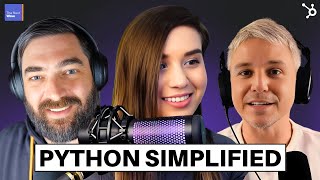
Maria Shah from Python Simplified discusses how AI is reshaping coding work. Copilots still struggle with accuracy and security, but long-term, engineers might manage swarms of AI instead of writing code themselves. The conversation also covers whether training AI on public code and images without permission is ethical or legal.
Chapters
Do you still think it's important that people learn to code?
Right now, basically, it's all about a symbiotic relationship.
I think that's going to be like, a really interesting world where you have, like, a new class of, like, uber engineers who are manning an army of AI bots.
The first route is a utopia. The second one is a dystopia. The third one is something that I kind of envisioned.
Hey, welcome to the Next Wave podcast. My name is Matt Wolf and I'm here with my co host, Nathan Lands. And today we've got an amazing guest. She has an amazing YouTube channel all about Python and how to code. Her tutorials are amazing. So many people learn Python from her and we're excited to have her on the show to talk about the future of coding and how it overlaps with AI. So welcome to the show. Maria Shah, thank you for being on.
Yeah, absolutely. Thank you for inviting me.
Good to meet you.
So let's talk a little bit about the AI world because I know, you know, when. When we were out at gtc, the talk of the whole event was AI, right? Like, everything is AI and obviously coding is one of those areas where AI has completely taken over. I know Nathan was one of the sort of early adopters of, of GitHub co pilot and. Yeah, I guess I just want to know what are your sort of, like, overall thoughts? Let's just kind of start from like the 30,000 foot, like, general overview. Like, what are your thoughts of, like, that overlap of AI encoding? Are you excited that AI is making coding easier? Are you worried about coders losing jobs? Like, where do you kind of stand on the whole thing?
Right now I'm slightly confused because I've tried a few of the AI models to kind of see what they're all about, and I don't see a lot of difference between just kind of copying the prompt and pasting it in a search engine. Like, I think the biggest difference I see is the fact that when you do so with a search engine, you can see a whole bunch of sources, and then you decide which one of these is your favorite and. And you kind of go from there. But I find these copilots as a middleman between the developer and the documentation. And for me being so nerdy, I really like documentation. I really appreciate it. It's my favorite place to be and that's how I write most of my tutorials. So getting it from the source is more important to me than kind of saving a minute or so or even less. So that's where I'm a bit confused because I hear a lot of my viewers really exciting, really excited about ChatGPT, about Copilot and Devin, probably, even though I don't even know if it's open to the wide public yet. But maybe Nathan can share his opinion about it.
And that's kind of something I was thinking about too, like, for, like your, like, YouTube channel. Like, it's. It's gotta be. You know, I've seen other, other YouTubers as well who are like, their, their channel's primarily about coding that they're very skeptical of. And I'm like, it feels like there's a slight conflict there too, though. Cause, like, if. If, you know, if AI does get so good that you don't need to learn coding anymore, you know, it's like a lot of those channels, I have to kind of pivot to some kind of other kind of content, which I'm sure you're coming from a genuine place. And like, yeah, there's definitely major limitations right now. But yeah, I just have a. You know, like, you guys were talking about the Nvidia conference. You know, Jensen said that, you know, in the future you won't need coders.
When you, when you think of the future, you need to think of the. All the possible routes that we can go through. And the whole purpose of artificial intelligence is to be competitive or better than us in all the cognitive tasks that humans are engaged in. And this was from the inception of AI. There is nothing new about it. This is a. You know, the people. People's loss of jobs has been a very major ethical concern of AI, and people were reasoning about it since the 1950s. I noticed a very weird trend. I'm kind of. I'm taking you guys off topic because when ChatGPT.
Let's go.
Matt loves rabbit holes.
So when ChatGPT emerged, there was a wave of folks who were saying that it will never replace us. There were a lot of people saying that this will never happen. And I was kind of warning people about it. I was saying that, hey, if you're filming videos and you're saying on record that ChatGPT is better than you encoding, what are the chances that your employer will hear it? Why would you do that? Even if it's true, why would you admit something like that? And I found that a lot of people were telling me, maria, you're crazy. It's not going to happen. You're. You're just paranoid. You're just, you know, speaking doomsday stuff. But now that Folks like Jensen are saying, you know, very similar things. Maybe they take me a bit more seriously. I'm not sure.
Yeah, there was a recent tweet from, I think his name is Ethan Mollick, the professor from Wharton where he was sharing some kind of recent study that showed, I think he showed that like 85% of employees in polls are saying that they're using ChatGPT at work. And then also I think it was like some, something like 70 something percent of them don't tell their employer. So it's like, so like a lot of people are using ChatGPT at work for emails and all kinds of different tasks and they're just not telling their bosses. So.
Yeah, well, it's funny because I look at the whole scenario from somebody who doesn't really know code. Like I don't know anything about Python, I don't know how to write JavaScript, I know a little HTML and CSS and that's about it, right? And so when I look at it from that perspective, I was actually able to get into ChatGPT. This was back when it was 3.5, I think, and I was actually able to develop a game using JavaScript that was playable, it had graphics. I actually used Midjourney to generate some images and it was this little like side scroller game where you jumped and collect coins. And it looked really good because I used Midjourney and all the code worked. So from somebody who doesn't know JavaScript at all, I was able to go from I have an idea for a real simple game I want to build to I actually have a playable game and I never actually touched a line of code myself. So I think, you know, from the perspective of somebody who doesn't code, I think it's really exciting to see, oh, maybe I'll actually be able to code now from people that actually know how to code, it's a different story, right? Like, so I'm at this, I'm at this Cisco conference now out in Vegas. So anybody who's watching the video and sees a different background, that's why. But somebody on stage was talking about how right now if you know how to code, it's still actually faster to just code something than to use ChatGPT. Because if you use ChatGPT, it'll write the code and then you spend just as much time double checking and debugging the code to get it to work. But for somebody who's never been able to code JavaScript, all I did was go, that didn't work. What do I try next. That didn't work. What do I try next? It took me hours to code the game, but I actually eventually got there without ever touching a line of code myself. So it's kind of like, I can see why there's excitement around it from non coders, but I can also see why coders would be like, right now it's more of a nuisance than it is helpful.
For sure. For sure. There are a few reasons why folks who are coding for living, they wouldn't be using it, but I think it's cool that it gave you these superpowers that you weren't able to use JavaScript, you never learned it, and suddenly you have your own JavaScript game, which is amazing. Like, I find it to be an incredible way to take your creativity and kind of manifest it in a way that you never thought you could. So it's pretty cool. So in terms of the coding, the world of coding, there are a few reasons why it's probably not a good idea to use these type of models for that. Because our industry is very dynamic. Things change on a daily basis. Just because something works now, it doesn't mean that it's going to work tomorrow or in a few days. You know, there's. Python has new versions almost every couple of weeks and it's something that keeps changing. So you need to be on top of things and it's an occupational hazard. You can say that you learn something in university and by the time you're done, nobody's using it anymore. So that's number one. If you're using a model like ChatGPT, how often is it being updated? If there's an update happening in one of the libraries, how long before ChatGPT is aware of it? So there's a bit of a problem there. Another issue is vulnerabilities, cybersecurity, computer security. Because these models, they tend to produce very similar code. Whenever you have a similar prompt, it will show you a similar code. Basically, it creates a way for very malicious people to exploit a lot of software all at once. So if you write a prompt of help me make this game, this car game, and everybody gets the same piece of code for their car game, if somebody wants to write a malicious software to target this specific bit of code, it will apply on all the software at once. So whenever you're using this code, make sure you do a bit of variation. That's what I would do at least.
Yeah. It feels like both of those are just current limitations. Right? Like, at least to me, because you're talking about the complexity and things changing fast and I think AI can be way better at dealing with that than humans. Humans are not very good at dealing with fast change and massive amounts of data and processing that data. So yeah, that ChatGPT and GPT4 kind of suck at this, but I think probably GPT5, GPT6, I think these problems are going to be solved, you know, like perplexity also they pull in like more real time data and kind of feed it into the LLM. So I think, you know, in terms of like packages changing and things like that, you, you probably already could get past that. Maybe just no one's done it in a good way yet, but it feels like that's something that's going to be solvable.
No, you're absolutely right. The things that humans find easy, usually that's what AI finds very complex. And the things that humans find complex, such as mathematics, analytics and reading large bodies of text, making conclusions out of them, it's something that models are doing better than us. So basically it's all about a symbiotic relationship. I think in the end of the day we need to use these models to make our lives better. But it's a challenge.
Hey, real quick. You and I both know how quickly AI is evolving. So if you're tired of constantly playing catch up in the AI space, I've got just the solution for you. HubSpot's AI for Business Builders Guide is a four step resource for that covers prompt engineering, API integration, fine tuning and product development. If you want to get a grip on the tech, boost performance and get the most out of your AI investment, this guide will be your saving grace. They figured out a way to make this info easy for non techie folks to understand and they're giving it away for free. Read the guide, get your AI questions sorted and kick off the AI journey in your business today. Click the link in the description below. And now back to the show.
Yeah, I mean engineering is all about problem solving, right? So like I think ultimately coding is just a way that you solve problems. So long term I kind of imagine that we'll have a new class of uber engineers who are probably, they know how to code, but they're also manning an army of AI bots that are helping them do things that they don't want to spend time doing. The menial kind of coding task, right? But then they have the ability to go in, possibly with the help of a copilot as well, to kind of go in and you know, where they need to, to modify things. And I think that's going to be like a really interesting world where you have these, like, brilliant engineers who can, like, go off and have a swarm of AI helping enhance what they, what they do for sure.
Now, this is more of, I guess, like a philosophical question, but I'm definitely curious to hear your answer. If, if Jensen is right and in five years, we don't need coders, do you think. Do you still think it's important that people learn to code?
Right now, I think this is a problem that is not unique to folks who code. I can say that about many industries. I can say it about accountants, I can say it about truck drivers. I can say it about many, many professions.
100%.
Is it worth doing anything? Right? It's definitely a fair question. Given the current state of AI, I think that there's a few routes that we can go through in the future. The first route is a utopia. The second one is a dystopia. The third one is something that I kind of envisioned. So I imagined instead of everyone using the same type of models, instead of millions of people using ChatGPT, let's say that everyone will have their own type of AI that is customized to ourselves. So, for example, if I have Maria GPT, I will train it on the books I read, on the movies I watched, on the values that my parents taught me, on, you know, the, the collection of knowledge that I. That I experienced through the years. I will train it on the countries I visited. I will train it on anything that will make it closer to myself. I will train it on my political affiliations. I will give it my biases, because everyone has biases. My model would love Python. And if somebody else uses this model who loves C, they'll be very upset. Right? But I'm the only one who will be using my model. And needless to say, these models will be not public. Everyone will have it stored. And I can see how this would be an enhancement of yourself and it's going to be proprietary to you and it's going to be used in a way to make you indispensable rather than just part of the herd that is using the exact same model to accomplish the same task.
Yeah, I agree. It's kind of like, for some reason, I'm thinking of like, Star Trek versus Star Wars. I'm thinking like the Borg and Star Trek versus, like the more like space pirate kind of vibe of Star wars, you know, where like, the people are more independent and doing their own thing. Like, so I'm a I'm a big proponent of open source but I'm also, you know, we've talked about this on the podcast several times now. Like I'm a big proponent of open source and I'm also very worried that and excited. I have very mixed feelings about OpenAI. I think they're, they're probably very far ahead of other people based on like rumors I've heard about GPT5 from friends in San Francisco. I think they're very far ahead. And so yeah, that could lead to a Borg type of scenario where yeah, everyone's outsourcing all of their thinking to this genius AI brain and so everyone acts very, very similar. Now Sam Altman has said that like they plan to make it a little bit more personalized over time and everyone, he said the same kind of thing. Everyone has biases and so they wanted to make it, they don't make it left wing or right wing, whatever. It's like, you know, whatever your biases are like it learns that and it kind of adapts to you. So I hope they actually take that seriously long term so we don't end up in a Borg type scenario.
Yeah, I mean I'm on the same page. I think that's where all of this is headed. I think that's kind of like Sam Altman's vision right now. I think that's what you know, Satya Nadella over at Microsoft, they're trying to do that with everything at Microsoft. Sundar over at Google starting to do that with Google. I think that's sort of the vision all of these big companies have is turning this into like this personal AI assistant that is to totally trained on you and what you like and it can see your calendar, it can see your emails, it can, you know, go back through some of the conversations you've had and it just kind of knows everything about you and you know what you need to do next and can direct you through the day. Hey, don't forget you've got this meeting at 2:00 and just sort of like be there with you all the time to assist you. I do think that's sort of where that's where it's all headed. And there was that, that interview with the CEO of Bumble as as well. I don't know if you saw that clip where she talked about like that's going to be the future of dating too where you create like this AI avatar of yourself and your AI avatar that's trained on you goes and dates other people's avatars. And then when the two avatars find a compatibility, it comes back and says, here's a match we found for you.
To me it sounds awful.
Actually, that's a dystopian one. Yeah.
So for me, the future where Sam Altman, you know, controls our personal AIs that knows everything about us, it's also kind of dystopian. You mentioned open source. And for many, many years, the type of researches that were in the field of AI, they all were accompanied by a paper that tells you with full transparency what kind of data the model was trained on, the architecture of the model, even what kind of equipment it used so that you can recreate the same conditions on your end. And so you can provide a, what is called a peer review. Right. Because it's not truly science unless somebody else can recreate it. And for many, many years I've been reading those papers and they were kind of the standard of kind of publishing new architecture. So for example, Alexnet, which I'm sure you guys are familiar with, there is resnet, there's vgg, they all are accompanied by papers that are fully transparent. So when we are entering this realm of proprietary models where people are hiding the type of data that they're using, you know, and it worries me because it hasn't been the case for many, many years. So I wonder what changed.
It did. It did kind of seem to change with OpenAI, obviously. I don't know if you've seen the whole argument on X that Elon Musk and Musk and Yann Lecun have been having where Jan's tried to claim that it's not science. Unless there's a paper and Elon. Yeah, there's a, there's a whole drama going on.
But I think both of them are scientists, both of them, the fact that they are passionately arguing with one another, it's just an example of how scientific both of them are.
Yeah, it is interesting though, like even Anthropic, who seems to be pretty ethical, pretty above board, pretty safety minded, still has a closed model that they don't share what's going on underneath the model, which is interesting to me. But yeah, I wonder why that is. It does seem like it kind of started from OpenAI. Because isn't GPT2 fully documented? Can't you go and isn't that one openly available to run off of?
You can download it, you can use it in your software, you can get it right now if you want. From hugging face.
Yeah. So it must have been GPT3 that started it all.
Yeah, they're saying it's from like the advancement of the capability and what that enables is what they're saying. You know Balaji, I don't know if you know Balaji, but he tweeted yesterday something about, you know, that the people who are against open source AI, they started with like left wing talking points and then now they've migrated to right wing talking points and they're kind of, they're trying to like, you know, get both sides on the same page because it was like, okay, we need this because otherwise it's going to be biased against certain people. And so they started on that angle and then now they went to more of the national security thing of like, you don't want China to get this. And that's starting to get some traction even in Silicon Valley. So, you know, I have a lot of connections to people I used to mentor for Peter Tails 2020, so I have some connections at Founders Fund and they've been tweeting stuff about this recently where they seem to be more supporting closed source AI for this natural national security reason. Whereas obviously A16Z and most other VCs are really supporting open source because, I mean, even if it's for like their own personal reasons, you. You can't really have many AI startups if everything's closed source and you have to rely on OpenAI. Right. But yeah, it is interesting. The, I would say the national security one is the one that most, you know, I have mixed feelings about because I totally get what they're saying. They're like, yeah, if we open all of this up and then China or Russia or whoever can just copy it. That is the one argument that I have like really mixed feelings about.
Yeah, I'm going to say something kind of controversial here, I think, but I think that's kind of underselling China too. I think China's.
I agree.
Pretty far ahead. Like so many of the papers that I've seen lately have been coming out of China, not the US but their.
LLMs are really far behind and my understanding is the reason is because of their censorship. So they actually have a lot of issues there where their censorship is actually hurting, how they can train their models because they don't even want the people who are training the models to be able to talk about sensitive topics. And so it's actually like really? Apparently that's one of the reasons they're behind it. That's what I've heard from friends.
I'm sure they're trying to really bake their Sort of governmental bias into all the AI. Yeah.
Which slows everything down. Right.
So I think that when it comes to China, they're more focused. Focused on facial recognition and kind of preventing you from using certain services. Because the whole idea about China is that they have an app that is like the Everything app. They call it WeChat. They use it to pay for transactions, they use it to communicate to one another, send messages. They get coupons for food through this app. So everything you want to do, they do on this app. And obviously, all this information goes to the source that trains those artificial intelligence models. So even though their LLM capabilities are. It's reasonable that they're not there, obviously, because there's a lot of censorship there. But there are other models that I bet you they're way more advanced than what we have, and we wouldn't know because they haven't been used against us yet. I also wonder if TikTok is directly connected to China, because there's a lot of information that people voluntarily post on TikTok. I don't have a TikTok, so I don't know. But I know that a lot of people are posting three videos a day about all the things they do. I wonder if they already know us really, really well. And they don't really need LLMs because they kind of like, they just use the video input to train a model that is also looking at the facial expressions you have.
I think you're probably right there, because TikTok is known for having the best algorithm in social media. So I think it's a fair point.
The most addictive. I think it's probably the most addictive.
Both. It's the most addictive because they know people the best. Right?
They.
They've. They understand people. And I do believe, like, I'm a proponent of, you know, TikTok being divested and because. Because I do, like. Like when. When Covid went down, I had a lot of friends. Like, I actually studied Mandarin. I lived in Taiwan, so I'm probably slightly biased on the Taiwan side, but because I have a lot of Silicon Valley friends or who are. Who are all, like, Taiwan founders, you know, or Taiwanese Americans. And like, during COVID there was, like, a thing that kind of went down that was not really talked about because everyone was talking about COVID But during the same time period, China just, like, took over the boards of, like, every single major tech company in China. And people don't really talk about that, but it's. It's kind of why. It was like a Wild transition to happen. Because before it was like, yeah, maybe they kind of control it, but it's not like directly controlling it. It's like, yeah, they can threaten them or whatever, maybe the US government even does that kind of stuff. But like, during the COVID time period, they literally inserted board members into all the major tech companies. And so they basically control every single major tech company in China. And so, yeah, I would not be surprised if they also have the same, you know, China's involved in TikTok and using that data to get way ahead in AI. And like you said, probably we don't even know.
Maybe it's an architecture that is way beyond, you know, LLMs. They just don't share it with us. So I don't know if this argument of national security is entirely applicable because, yeah, they can copy it, but you still need to train it. Right? Because even if you show people how you made your model, you still need to have the equipment and the time, you know, the processing power to train it. And we're talking about models like ChatGPT that are being trained actively for years on supercomputers, and it's very hard to catch up to them even if they come up. And that's the reason why, I don't understand why they don't post, you know, the data, because no matter how, but.
But they want Taiwan. And all the computing's happening in Taiwan, of course.
Well, it's an important center. Yeah. I think every, every piece of electronic in the world depends on this, this manufacturing facility, even cars, even cell phones, things like that. So if, if they're being, you know, taken out of the equation, we're facing a very weird future. At least those of us who haven't invested in a very fancy computer. There's not going to be a lot of parts.
Yeah, I know. Like, I know Yann Lecun. He's been a big, he's been very outspoken about his belief that AGI isn't going to come from large language models. Right. It's going to come from some other sort of AI model, like some sort of world simulator model or something like that. Who knows? You know, maybe China's already got something like that and they're like, yeah, let them have fun with their little LLMs. This is what we're working on. You know, you never know. They.
They probably wouldn't make it public and put it on GitHub if they were working on that.
You will know about it when it's too late.
Right? Exactly, exactly. So I'm curious About your thoughts on the sort of ethics of how the code is trained. Because recently we heard about this partnership between stack overflow and OpenAI, allowing OpenAI to basically train on Stack Overflow's data. And then people started going and trying to sabotage the code that was on Stack Overflow to try to, you know, poison the data. How do you feel about coders work just being trained into the data without their permission?
I think if it was a different organization, if it was an OpenAI, if it was like some open source type of model, Ms. Mr. Al, or like something along these lines that were entering this partnership with Stack Overflow, I don't think those moderators will go to the length of like deleting their, you know, their contribution. Right? Because it's been there for years. It's, it is general knowledge. Like it's something that I've been using for many years since this website existed, you know, it was helping many people solve their errors. And I think that people mistrust OpenAI in particular, first of all, because it's not really open. How can you call your company OpenAI if it's not open? That's the number one closed AI, right? It's like the number one warning sign. That's number one. Second of all, I think that there's just a major level of mistrust to something that is not open source. In the field of programming we support open source from the very get go. Even in the computer science program that I'm taking right now, I'm doing a Computer Science BSc, my lecturer was teaching us about Open Source. He was basically explaining why Windows is not as good as Linux. This type of stuff and we have it for years and we've been teaching people for years about these concepts and suddenly there's this big company that everyone is using it is far ahead of everyone else. They got a supercomputer for free from Jensen back in the time because they were open and free and they suddenly decided to kind of close all the doors and take all this transparency and just throw it to the garbage. Why would they do it? Is it because of money? I think they have enough money. I don't think it's because of that. So what are you hiding? And a lot of people are thinking that. So these moderators, I don't think they just have a problem with some AI learning because you can web scrape any piece of information from any website. You can make a bot that copies all the data you want. It's not a problem. Plus all the data in Stack Overflow as far as I'm concerned, it's public. You don't need to log in to be able to access it. So from a legal perspective, you can already use it. You don't need to go into this partnership. So I think.
It'S very weird to me that Stack Overflow agreed because I don't know what they are earning in this equation.
I think they're just worried, I think, because apparently their traffic's way down because of people not using Stack Overflow. They just asked ChatGPT the same question.
I don't think they had a plan b. I think ChatGPT came up and ate a bunch of Stack Overflows lunch. Stack Overflow tried to create their own Stack AI or Overflow AI or whatever they were calling it. They tried to create their own model and nobody cared because they were already indoctrinated into chat and they went, well, okay, if we can't beat them, join them. I think that's kind of what happened, honestly. But I also think, you know, the whole, like, ethos of like, open source is like, I'm putting this code out there, but if you build something with this code, also make it open source, right? Like, that's sort of the whole like open source chord. Whatever you build with this open source stuff, make that available. And so it's weird to me that companies like chat GPT or OpenAI can go train on all of this code and then close it off. When all of this stuff was put publicly available and was designed for whatever you build with this, also make that publicly available, you know.
Yeah, I agree. It's kind of shady, you know, I don't know what's the purpose of it, but it makes me mistrust. And when you mistrust, you had a lot of trust towards Stack Overflow as a developer from the get go. It's the best source to solve your errors and you can find multiple solutions to the same problem and choose what kind of solution you prefer, basically. So it's a very trusted name that has a lot of integrity. So when it goes into partnership with something that folks like ourselves, the majority of the audience that is still using Stack Overflow, we never left, we kept using it, right? It's kind of a slap in the face. And I don't know, I don't think that Stack Overflow should have been chasing them, you know, preventing them from deleting their comments because that's their decisions. You know, they enter this partnership, they should have known there's going to be a backlash, you know, they have marketing experts that, you know, chat with users. They understand what's going on. You know, it was clear to me. And if it was clear to me, I assume it was clear to stack overflow. So don't like antagonizing them further. Basically just kind of. You can't touch your account. It's suspended. We are checking if you really meant to delete your messages or not. Come on, you guys, that's even worse.
You're just burning the creators that create on your platform even more.
They're training on all the GitHub data too, right? I think that's even a bigger deal. That's probably code itself.
GitHub is owned by Microsoft, and Microsoft and OpenAI are. They're like this. So I would imagine all the GitHub stuff is, you know, freely available to OpenAI.
Yeah, why not? You know, it's public data, like the. Maybe the private repositories. You cannot really access them. But as long as something is public data, and I know it because there was a company, there was a company that was scraping data from platforms and they were. They were accused bright data their name. They were accused of, like, stealing content. They were sued, but when they came to the court, when it was time to kind of actually talk about the laws behind it, it's like, hey, we never logged in to whatever platform we were taking information from. Anyone can copy it. So what is the difference if a bot, if an automated entity is copying it or somebody that physically sits with a keyboard does it? And I think they won.
Yeah. Yeah. I mean, we've been seeing a lot of the same sort of arguments over on the art side as well. Right. Like, you know, a lot of these AI art generators have trained on other people's arts, and a lot of that has gone to court and been fought in court. And same with the writing, too. We had a lot of authors take chat GPT to court saying they trained on their writing, and almost all of these cases end up getting thrown out because, well, it's publicly available data. I guess they're allowed to train on it. So, yeah, it's definitely interesting, but I personally have very mixed feelings about it. All right. I was actually for a little while doing photography and uploading it to sites like Shutterstock to earn, you know, the income from selling the stock photography. Well, a couple years go by and now we find out that, okay, Shutterstock trained all of the images that were uploaded into, like, their new AI model. And Adobe did the same thing with Adobe stock. Right. Everything that's Been uploaded to Adobe stock over, you know, however long Adobe stock's been around. Now, all of a sudden, that became training data for our AI Art generator. Well, cool. When I was uploading photos years ago to try to make money, I didn't really say you had permission to use that photo as part of the training data. I don't really care that much because I'm. I'm like in AI and I'm an AI optimist and I. I'm kind of fine with it, but I don't. I definitely see both sides of that token, you know?
Yeah, absolutely.
Yeah. I think it's a. I think it's a gray area. I think. I think it's a gray area where, like, you know, they. This. There's a reason OpenAI doesn't want to talk about it. Right. Like the CTO, there was that famous clip of her stumbling where they were asked if she was training on. If they were training on YouTube data. And she was like, yeah, I don't know exactly, you know, kind of kind of thing. And then obviously she knows the answer. Like, obviously she knows. And I think it's because probably when they even started the company or when they started really thinking about this stuff, they would have talked with lawyers and they would have. It's kind of like when Uber launched, where technically Uber could be argued that it was illegal when it started, but it was a gray area where they knew they had a legal argument because there was no precedent. Exactly. And so there's no exact precedent here because you have public data, but you can't just copy public data. So they're going to argue, well, the AI is learning from it. It's just like if you go to a museum and you see some art or whatever, you're learning from that, you're not copying it. And so I'm pretty sure that's like the legal case they will make long term, But I think they're really trying to delay having that huge legal battle, but I think it'll happen at some point.
So if right now I decide to train my artificial intelligence model on a subset of data, you can only see the final product. You will not see what kind of data I trained on. I don't have to share it, I don't have to say anything about it. Right. It's unethical, but you would never know because all you do is you take a bunch of images, you feed it into a neural network, and then it finds patterns in those images and it basically creates something new out of this data. So you can say it's like a musician. So for example, the Beatles were inspired by Elvis and Pink Floyd were inspired by the Beatles. So who copied from who? It's the chicken and the egg. And you're right when you're saying that it's inspiration because what the model creates is, is not an exact match to the training data. It has to be something else. They pull it out of latent space. When it comes to generative AI models and this latent space, I don't think anybody owns it.
And those type of things. We should have thought of it way before. Right now when we are talking about the legal copyright implications, it's something we could have talked about years ago, before it became a problem, before people's livelihoods were affected from Shutterstock in places like that. By the way, Firefly, Adobe's Firefly is amazing.
Yeah, yeah.
I might actually use it in my final project. I'm doing a final project for university and I think that that's my way to go. I'm going to make a database.
But even Firefly though, they were like pitching that it was like the responsible way to use AI images. And then apparently they trained on Mid Journey images so they basically just like went to another layer down were like, yeah, we didn't do it. They did it.
Uh, yeah, well, I mean they didn't specifically go out of their way to train on Mid Journey, but a lot of they allowed people to upload Mid Journey images to be sold as stock images. So the Mid Journey images that were uploaded to Adobe stock and then when Adobe went to go and train their Firefly model, well, there was a ton of Mid Journey and stable diffusion generated images in it already because they were allowing people to sell those images as stock. So they didn't go and train specifically on midjourney. They but midjourney and stable diffusion and Dall E images were in the data set because people were allowed to sell that stuff on Adobe stock.
That makes more sense.
It's crazy. Like if you start nitpicking what kind of piece, what pieces of data went into the model, it's, it's a never ending story. You know, you can always find somebody who contributed to create this image. So what? They deserve to get paid too. It's, it's a rabbit hole that I.
Don'T and how much.
Right. I'm a very simple person. I like the Internet. How it was when I was 12, which was basically wild wild West. You could copy anything, you could get anything, you can download anything. And as a content Creator. I know that it's a terrible thing to say because people will copy my content. You know what if they want to? Please. It only helps Python being taught. I make enough money from what I do. I don't care if somebody else is basically using some of it to kind of grow.
This Python world and can kind of teach others. If a teacher is using it in his lecture, I'm not gonna chase him asking him for some royalties. It doesn't make any sense. Why would I do it? Same goes for a musician where.
Some 12 year old kid decides to use his piece of art, his music, in his video. Why would this musician chase the kid? He's sharing his music with the world. So yeah, you don't get paid for it, but you'll get paid enough.
It should cover other fan art if you want to call it. So I find it upsetting that people are really nitpicky with those copyrights laws and if we weren't, maybe the Internet would have been a nicer place.
Yeah, yeah. I mean, I really think we're getting to a point where copyright in general just needs to be rethought. I don't know the solution, but I think it just needs to be rethought because, you know, we're going to be able to generate images that look like other people's images but weren't created by that person. We can already create songs that sound like other people's songs that wasn't created by them. When we get into, you know, Sora and Veo and some of these new video generators, we're going to be able to generate videos that look like the style of other people's videos but weren't created by them. Like, it's just going to get so muddy that I don't feel like the way copyright law was originally written is still going to be relevant. It just needs to be rethought.
I agree, absolutely.
But I don't know how to rethink it. I'm not the one to figure that out.
So actually I had meetings in the Library of Congress with people in the copyright office. I don't know if you know, my last startup Binded, we started off not being involved in copyright and then unfortunately our startup, we kind of pivoted towards copyright, but we were not trying to be doing enforcement and stuff like that, with more just like attribution and things like this. And so I spent a lot of time thinking about how can you change this? And I met with people in the government and now I'm convinced that.
They have no interest in, like changing things. So I don't think there's going to be like a fundamental, like, oh, the government's going to decide that copyright should change or something.
Yeah. Who knows? Who knows? I mean, it could be a generational thing, right? Maybe once there's a little bit more turnover from the more elderly people in the, in the governments, maybe some of the younger generations will see that. Okay. Technology has changed a lot since, you know, a couple hundred years ago when so many of these laws were written. Maybe we should update some of this stuff for like the way the world is now instead of the way the world was 100, 200 years ago.
Yeah, maybe GPT6 will help us figure it out, you know?
Absolutely. Well, this has been an absolutely amazing conversation. We've had a blast talking to you, Maria and I want to make sure that people can go check out your stuff. Where should people go and follow you? After tuning into this episode? Where's the best place to learn tutorials from?
Yeah, the best place is always YouTube. That's my main platform. This is where you can find shorts you don't like. TikTok style shorts. You can find tutorials that are quite long. This is where you find me. Explain very complex concepts in a simple language that even a six year old can understand, hopefully.
It's called Python Simplified. Python Simplified.
Python Simplified. You can find me on YouTube. You can find me on X as well, even though I'm not there very often. Maria Simplified. The best place to find me is YouTube. Maria Shah, Python Simplified.
Well, very cool. Thank you so much for hanging out and talking code with us. This, this was a conversation that we wanted to have, but we wanted to bring on somebody that knows a little bit more about the coding world than us. So I'm so thankful that you were able to join us and, and actually have this conversation with us. So really appreciate it.
Awesome, thanks for having me.
More from Matt




AI News: Dots, GPT-6.1 Sol, Sonnet 5.5, Gemini 4, and everything you need to know




