AI Will Not Save Your MSPs Weak Messaging
Megan Killian argues AI cannot fix weak go-to-market messaging. She's generated $550M in B2B tech revenue and warns that AI amplifies bad practices into faster noise. Before automating outreach, clean your CRM, define your ICP, mine your call library, and extract real buying signals.
Chapters
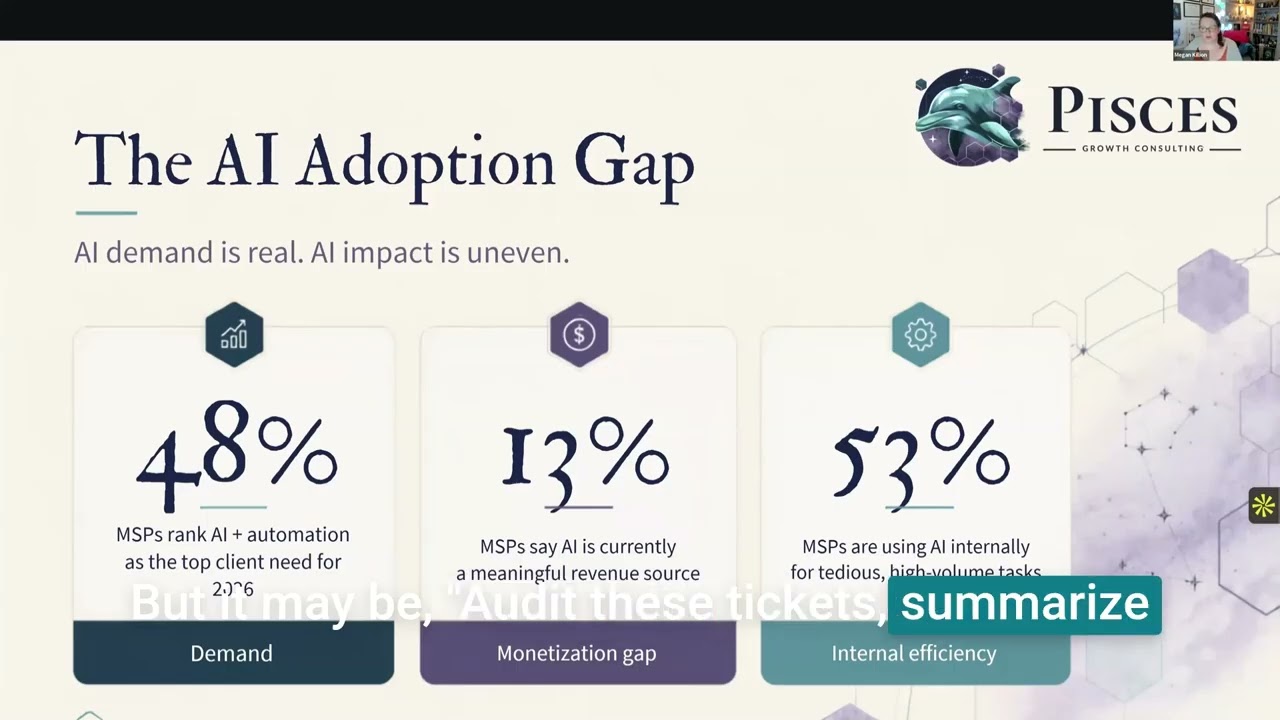
Hey, hey, y'all. I'm Megan Killian, and I'm gonna be doing a dry run of my AI Will Not Save Weak Messaging talk. It's gonna be in the AI in the Channel Summit. I'm recording it because content is king, baby. And if I have to practice, I might as well get better at it and also record it, right? Let's see, share my screen. So hopefully you can see my screen. Fingers crossed. I am still editing this, so if it looks like garbage, oh well. Hi guys, I'm Megan Killian, Chief Consultant at Pisces Growth Consulting, and today we're gonna be talking about AI messaging and channel revenue, but not in the way that most AI sessions are talking about it right now. This is not a session about how to generate more emails, more social posts, more partner copy, more campaign content, or more personalized outreach at scale, because Honestly, we already have enough of that. We do not have enough clarity about who we're targeting, what they actually care about, what proof they need, what problem is urgent enough to act on, and what a human should say next. So the premise of this session is simple. AI will not save weak messaging. If the inputs are vague, the outputs will be vague. If your positioning is generic, AI will help you say generic things faster. If your ICP is unclear, AI will help you scale that confusion. And if your profile is thin, AI will make it sound more polished, but it still will not be persuasive. So this session is about where AI actually helps before the message gets written. It helps with the work around the message, the research, the scoring, the CRM cleanup, the call mining, the pattern recognition, the tedious work humans avoid until the database is a landfill and the messaging sounds like everyone else's. The goal is not more AI-generated content. The goal is fewer bad guesses. Should you listen to me? Before we get into these frameworks, just quick background on me. I have been in B2B tech sales and marketing for 15 years. I started in sales. I don't know at which point people decided I was a marketer, but at some point people did. And since then, that title has been put on me. I went from BDR to business development manager to director of business development to VP of sales and marketing, CRO, CEO, and consultant. In 5 years, I have been the person making the calls. I have been the person building the sequences. I have been the person fixing the CRM, and I've helped add more than $550 million in B2B tech revenue and source more than $50 million of that specifically for MSPs. So basically, if you have done more than $50 million in MSP rev, you probably shouldn't listen to me because you're smarter than I am, know more than me. And I, yeah, I can't be that helpful to you. I still believe in outbound. I still believe in the sales process. I still believe in good messaging. What I don't believe is that more automation is fixing a bad revenue system. All you are doing is pouring gasoline on a fire that's going to eat your entire business when you start using AI and automation to scale junk. It's just noisy. I think we've all been victims of it on the other side. We were getting more calls, more emails, more texts, more LinkedIn messages than ever before. And if you think that's annoying, then don't do it to other people, right? Speaking of, AI gave bad outbound a jetpack. It didn't create it because bad outbound existed way before AI. We already had spray and pay emails. We already had bad fake personalization. We already had, I saw your company's doing exciting things, and the word synergies. We already had sellers pretending that using someone's first name counted as relevance. We already had partner campaigns that sounded like they were written by a committee that had never spoken to a buyer. Did make it much faster and easier and give access to pretty much everyone. It made weak messaging cheaper to produce. It made generic follow-up easier to automate, and it made it possible to create more content with fewer humans stopping to ask, should this exist. The mentality predates AI. Messaging laziness, targeting laziness, positioning laziness, that all existed. But now it is moving at the speed of light and is making lazy people lazier. Do not be the lazy MSP. Do not be the lazy channel provider. Do not use the jetpack. Don't put a bad message into a faster system because what you get isn't actually better marketing. You get faster noise. If the only reason your GTM is not working is because you haven't generated enough assets, it will give you so much money in exchange for that because that's not a real problem. It's not. Salespeople say that's a problem because they want to point at anything possible to not have it be their problem. But at the end of the day, a case study is not the end-all be-all. Your website being better is not the end-all be-all. And I know that sounds crazy coming from marketing, but You can have no assets and still close deals if your messaging is good. And if you create those assets before you have good messaging, it's just a whole bunch of garbage sitting in a folder somewhere that no one ever actually uses. So the question shouldn't be, can we use AI to create more? Absolutely you can. And I have a ton of frameworks around how to create that content using AI once you've done the initial work. But before you start pumping out content, let's figure out who you're talking to, why they buy from you, and how you're getting that message in front of them. Like strategically, conceptually. There's a huge AI adoption gap. The demand's real, but the impact is super uneven. Absolutely not ignoring AI. There's a reason it's a buzzword. There's a reason you're all here. That's absolutely not the issue. Kaseya's State of the MSP coverage shows that AI and automation are now one of the biggest client needs MSPs are seeing. Nearly half of MSPs rank AI and automation as the top client need. So that's a very, very real demand signal. Revenue side is a lot messier. Only a much smaller percentage says that AI is currently a meaningful revenue source. And that gap is super important because it tells us something we should already know. Interest doesn't equal monetization. And someone being curious about something does not mean they're going to pay you to implement that thing in their business, especially when you have never actually successfully implemented it anywhere. It's new enough that it's really tough to say that you are an expert. What does it take to be an expert? Just because your clients are asking about AI, it doesn't mean that you can even figure out how to package it, message it, sell it, deliver it, or attach it to business outcomes. And that same research shows that many providers are using AI internally for tedious, high-volume tasks. That part is super important for this session because the most useful AI applications are often not the flashiest ones. It may not actually be write me a perfect campaign. Especially not without inputs. But it may be audit these tickets, summarize these call notes, find duplicate records, score this list, classify these accounts, find where deals are stale, tell me which follow-ups need a human. It's much less glamorous, but it's often a lot more valuable. The AI demand's real, AI revenue is not automatic, and the gap between those 2 things is where strategy, workflow, and judgment live. Most teams are using AI, but very few are using it well. ScalePad's MSP Trends Report shows something similar. A lot of MSPs have some kind of AI roadmap. Some are executing, some have drafted plans but have not implemented them. Some say their AI adoption's very effective, but more are saying it's only somewhat effective. And that is the messy middle. And honestly, that's where most companies are. They're not anti-AI, and they're not doing nothing. They're experimenting. There's nothing wrong with experimenting, but we also have to differentiate between playing around with a toy and having a sellable product. There are 2 different things. You may have a few tools, may have some AI features in the products that you're already using. They probably have people using things like ChatGPT, Copilot, Gemini, Claude, or some vendor-enabled assistant, like HubSpot has Breeze AI built on AI. Those are just 2 tools that I use every day. Slack has AI. You probably have a few users internally, and they probably have a few people that are absolutely terrified of it, and a few people pasting things in with no guardrails whatsoever. That's the danger zone. Totally normal, but adoption isn't the same as effectiveness. And buying tools doesn't mean the workflow got better. Generating the content does not mean that the message improved. Having an AI roadmap does not mean that the organization knows where judgment belongs. And that's where a lot of teams are getting stuck. They're using AI, but they're using it at the wrong point in the process. They start way down at the end in the output of write me an email, write me a campaign, write me a LinkedIn post, write me a webinar abstract, write me a partner enablement asset. But if the source material is weak, the AI is not solving the problem. It's just organizing the weakness into cleaner sentences. And that's why the question needs to shift from how do we use AI to create more content to how do we use AI to improve the inputs that make content worth creating. Polished does not mean it's useful. One of the things that AI does really well is wave the marketing magic wand and prettify something, right? I worked at a company once where we just called marketing the pretty department. I was in sales at the time. And I do think good marketing is a lot more than that. But realistically, AI has kind of replaced the need for having that person that can turn your thoughts into a one-pager, right? But there's a word that I absolutely love for this problem, and it's called work slough. It's low-quality AI-generated work that looks complete enough to pass at a glance, but it creates more work for the person who has to interpret it, fix it, clean it up, or redo it. I am literally guilty of this. And instead of letting my EA do her job, she's also our social media manager and our graphic designer, have AI put together a proof of concept and send it to her and be like, hey, I want this book finished. And it probably would have been easier if I had just given her the full scope and let her build it from scratch than if I made her reverse engineer the end result back and then do it again. Most people are guilty of this, and many of us are using AI to bridge a communication gap. This is showing up especially consistently in sales and marketing, and the email sounds fine, but it says nothing. The message is polished, but it's generic. The call summary is clean, but it misses the actual buying signal because you didn't train it on what a buying signal is. That enablement asset's nice, but it doesn't help a partner explain why anyone should care. And the campaign has plenty of words, but no point of view. So that's one of the biggest risks with AI and GTM, go-to-market. AI can make bad work look finished. And that is dangerous because unfinished looking work at least tells you it still needs thinking. So if I just dropped something on my EA that was half done, she would obviously finish it, kick it back, whatever. But if I hand her something that looks great and looks polished, she's going to schedule that right out and not fact check it, not make sure that it's a deep thought, whatever. And this becomes especially relevant when you have a lot of junior administrative type people at your job where like literally their job is just to do what you tell them to. And what you're telling them is just push more buttons to generate more garbage. Anyways, when you're thinking about AI and messaging, this is a trap. A lot of people are not actually creating better messaging, they're creating better looking messaging. Better looking messaging has better grammar, better formatting, more confident phrasing, maybe a sharper subject line, maybe a better CTA. And that's a great use for AI, right? It's like you have a thought, it's long-winded, whatever, you give it to AI, you let AI format it. Great. The meat already came from you. It was an original idea. You had points to make. It was a little wandering, but now the AI has tightened it up, neatened it up. But better messaging actually has stronger inputs like a clearer ICP, a sharper UVP— that's unique value proposition— real proof, buyer language, context, timing, specificity, a reason for the person on the other end to care. And AI can help us get there, but only if we stop using it as a shortcut around the strategy work. I also just wanna say that like perfectly written copy is one of the ways people detect AI. I'm not saying good, bad, or indifferent, but like, if you don't want people to know that you're using AI for everything that you do, your absolutely perfect copy is just a glaring red flag because people make mistakes. We do. We spell things wrong. We put the period where it's not supposed to be. Forget capitalization rules. This is not the fucking playbook, okay? You're not gonna give AI the keys to outbound. I, I just wanna be like so clear that I'm not recommending this. Anyone who is recommending this to you is negligent. They're not doing their due diligence. It's unethical. It's messy. It's a bad signal. Just don't, don't, don't even— gross. We're all receiving it, right? I have like the unicorn emoji in my name on LinkedIn, and I get a ton of messages that say like Unicorn Megan. And it's just like, obviously you're using AI and you're not even using it well because you could add an extra step to clean up the first name if you cared. So there's also like, there's almost always gonna be a way to use AI better and to create better workflows. And I would love to be spending this whole session going really, really deep on workflows, and I am gonna give you some high level. If you wanna nerd out with me about workflows, DM me. But anyways, don't upload a giant list to tell AI to personalize emails to everyone, especially without specifying like what personalization looks like. And especially if you haven't like trained it or guided it into being sort of like a second version of you or a copy of you. Because what you end up doing is just like it's sending generic messaging based on what you told it you do. So if you told it like, hey, I'm an MSP, send personalized messaging to people, it's gonna send personalized messaging that's like, oh, I see that you have X amount of employees. Do they all have workstations types stuff. And like, that's— it's not helpful. So you have to train the AI for what to look like when it's researching things. And, and then teach it how to leverage research in personalization before it can personalize. Otherwise, you get those emails, and I'm sure you've all received them, the ones that are like, I saw that you are the title at company. And doesn't that mean you need lead gen? But it's not connected. It doesn't make sense. So like, don't let AI go make up proof, make up case studies, ROI claims, or buyer pain. I'm not suggesting that you automate your already broken follow-up that never gets anybody re-engaged. I'm not suggesting that you turn every event list, every partner list, and every CRM export into a sequence. It's just spray and pray with better grammar. Your partners are already overloaded, your buyers are already skeptical, and executives already know when they're being automated at. So if the message is weak, automation does not make it any stronger. Or if the target's wrong, or the offer is unclear, or if the proof is missing, AI can't manufacture credibility. AI can't fix your bad messaging with a clearer subject line. Like, You need AI to do the work in the garage, right? So you keep driving the car. AI is going to do the work in the garage, cleaning the data, checking the systems, finding the patterns, surfacing what the humans need to know before they decide where to go. That's the difference. Don't use AI to scale weak signal. So what is the playbook then, Megan? Use AI for the work that humans avoid. There's 2 things I kind of want to talk about here. One is if you push the same button more than like 5 times a day, maybe you should be thinking about how AI and automation could be doing that for you. Just like super, super quick. One thing that I had Agentic do was I had it go into my HubSpot, right? And with HubSpot, if you don't have their like data management add-on, you cannot like select all and merge when you have duplicate contacts. 4 duplicate companies. You have to sit there and go, oh yeah, merge those 2, yeah, merge those 2, yeah, merge them. So I opened up ChatGPT's Agentic, gave it my HubSpot login, and was like, hey, just click this button, merge them, and then when you can't merge them, investigate why and return to me why the ones that couldn't be merged couldn't be merged, and then we'll solve that together. So there's just one way Agentic can be used to push a button a bunch of times. Right? And then like separately, I've also had it do the same thing and go through and just like, hey, look at like 3 pages of contacts, collect this information and prioritize who I need to reach out to again next. If you're like me and you have a CRM that's full of data, but you have not like— we have like 50,000 contacts in our CRM. But you don't know who's good and who's bad anymore, and you're not on top of it. You're probably like, you can't call 50,000 people this week. Maybe you can call 10. So like having AI go do the research work to tell you what you should prioritize and to score things, that can be a really good use of it anyways. The other thing is like, if you've ever done Unique Ability or anything like Working Geniuses or anything similar to that, where you've sat down and you've written down everything that you do and decided what work is your best work and what work is just like draining you. Take the stuff in the bottom right quadrant if you've done unique ability and outsource that to AI and automation. The work that you suck at that anyone could do that drains you, that's the work we should be getting it doing. It should be doing auditing. It should be using to score. It should be able to apply your ICP consistently across the list. It should be able to summarize call patterns. It should be able to research buyers before the human writes. It should give the human a better starting point. And you can draft against a framework, not from a blank page, but from your own internal frameworks, from actual inputs, the ideal client profile, the unique value prop, the persona, the pain, the proof, the objections, the offer, the tone, the context. That's where the AI is actually gonna become useful is when it's informed. It knows what a good prospect looks like. It knows what you do. It knows how you do it. It knows what makes that valuable to prospects, and it knows what a good prospect will think about you and how to research and write. And you've given it the framework to write a strong email, and then you just kind of edit it up. You need signal before output, judgment before your automation. And messaging isn't just a writing problem. This is where a lot of AI conversations start to go wrong. Because they treat messaging like the problem's phrasing. But usually phrasing isn't the root issue. It doesn't— like, you don't just need to move the words around in the sentence. The root issue is that your team doesn't know who they're really talking to or why that person should care or what problem is urgent or what the buyer already believes or what proof would make the claim credible or whether this person deserves a manual follow-up or belongs in nurture or what a human should actually do next. So like, if your process does not make it incredibly fucking clear what the next step is, how can you outsource that to AI? How will it know what to do when you don't know what to do and you can't provide it any type of framework for that? Signal is the information that tells you what to say, who to say it to, when to say it, and why it should even matter to them. AI is very good at helping find and structure signal. It can search large sets of messy information. It can summarize patterns. It can compare lists. It can classify accounts. Identify missing fields, extract repeated objections, highlight stale deals, and show you where buyer language is already showing up. But then the human has to decide what that means, and that's the judgment layer. That's the part you really shouldn't be outsourcing to AI unless you have terrible judgment, and then I guess maybe. So the model I want you to hold in your head is messy inputs go in, AI does signal work, humans apply judgment. Then better messaging comes out, and better messaging then supports better enablement, better follow-up, and better revenue conversations. Not because AI magically wrote the perfect message, but because it helped the human stop guessing. Huzzah! A workflow just for you. This is ICP scoring and tiering. It's one of the simplest and most high-impact ways to use AI before you even write a single word. Most teams treat lists like the list itself is the strategy. Your list is not your strategy. It's a list. They go to an event, they get a sponsor, they pull a target account list, they export contacts from the CRM, they buy a list, they get a partner list. And then the default question becomes, what sequence should we put them in? Stop. That's the wrong first question. The first question should be, who on this list deserves human attention? Because not every lead deserves the same follow-up. And what I see happen to sales teams over and over and over again is that, particularly in channel vendors, less so with MSPs, but what happens is you think your sales team is under-resourced and that they don't have enough leads. But in reality, your sales team has too much to work. They just don't know how to prioritize it. So if, like, if you've got a sales guy and he's working 100, 200 deals, that are open. That's impossible. He needs to know, like, which of those deals are actually workable and which ones he should give up on. How does he do that? Some leads may need direct personal messaging. Some might need a lighter semi-personal sequence. Some might need nurturing from marketing, and some should probably be suppressed entirely. AI can help you apply that ICP scorecard across the list, and it shouldn't decide your ICP. That's strategy work. But once you define the criteria, AI can help score consistently, and it can help find some of the patterns that you would put into an ICP if you give it your client list, especially if you score that client list. We can talk about this separately, but like, if you know who your best clients are by profitability and how much your team likes them, you should be able to turn that into an ICP using AI. Anyways. Once you define the criteria, the AI can help you score consistently. So fit, urgency, authority, timing, context, existing relationship, problem severity, strategic value, source quality, how quickly they're even like responding to you. That's the work humans skip a lot because it's tedious, and not everybody even has the brain for it. But if you skip it, you treat everyone the same. And therefore, like, if you get overwhelmed and you can't keep up. So like at one point in my CRM, I had over 5,000 tasks assigned to me. I'm not doing 5,000 tasks. I'm not even a salesperson anymore. Like I'm a consultant. But somewhere in those 5,000 tasks were like 4 follow-ups I really needed to do with prospects that had been hungry that would have made great clients. But I forgot to follow up on them because it was too noisy and there was too much going on. So now we use ChatGPT as a layer between HubSpot and our other tool sets. Including things like Fathom and Slack to take all of those signals, crunch them, and then tell me like, hey, here are 10 things you need to do this week. Here are 50 things that you should assign to Tammy— that's my EA— to do this week. And here are like 10 things that your PM should be doing. Here you go. Right? So like that type of stuff can be really, really helpful from AI. Not that it should be the end-all be-all on where you're supposed to focus your time, but it can help you catch those balls that you otherwise might have So as we talk about tiering, we wanna turn things into tier 1, tier 2, tier 3, and then not a fit. So tier 1 gets human-led follow-up. These are like your key accounts, the people you think are most likely to buy from you. You don't wanna be too hungry here. You want every email to be written by a human being. Everything should be personalized, no garbage outbound. And like, we would rather talk to these guys a year from now and Build a good relationship, then bug them now and get on a do not call list. Tier 2 gets semi-personal outreach. So that's where we start using some automated steps in a sequence. So maybe you've got like 4 or 5 canned emails that have performed well in the past. You don't know enough about these companies to be hyper-personalized. So you're gonna let AI do your personalization. And then maybe you're only gonna call them twice instead of 6 times in a sequence. And tier 3 goes into more of like nurture where the whole thing is automated. And when they start showing signal is when we'll bump them up. It's not less marketing, it's just better prioritization. Like all your systems still need to exist. You still need marketing, you still need sales. You still probably need a BDR. But this means that like we know where the human effort is going to be focused and who should be working which accounts depending on your structure. Like Tier 1 might mean founder-led sales, and Tier 2 might be where your salespeople work, and Tier 3 might be where marketing is. But again, it depends on your structure. So don't take that as like the holy grail of, oh, well, Megan said I have to do it this way. Workflow number 2, this is a knowledge-based reality check. This is one of my favorites because it's deeply unsexy and extremely useful. Your CRM can look full and be lying. I have come into companies that where the salesperson has told me, oh, I have 5 times pipe coverage. I don't need to outbound. But then when I like dug in, he couldn't tell me like who the decision maker was on most of these deals. Like that's not a real deal. That just means you met with someone. So being able to kind of look at that data and ask the GPT or AI of whatever kind, like which deals have no next step, which deals have not been touched in 30, 60, or 90 days, which opportunities are in the wrong stage, I have a whole handout on this that I'm gonna give you after the session. So I'm not gonna go too, too deep into like how to do this, but you get the idea. The next workflow, this is your call library and messaging assets. So your sales calls aren't just calls, right? If you're anything like me, your calls are kind of like a research library. So if you are having calls where you are talking to people about strategy, if you have a VCIO, if you have QBRs, If you have, if you're a consultant and you do consults and you record them, that library is like, that's your brain. That's you as the product. We don't wanna summarize that as like good call in the CRM. And we also, one of the things that happens in most companies is like we end up with this data silo. No one else at the company knows what you're talking about in your calls. They don't know what you promised someone. They don't know like the great idea that came to you in the middle of a consult where you're like, oh my God, we could We could build that. So there's a couple different ways to use call libraries and AI to do things. This particular one is really about like creating messaging assets. So for me, like I use Fathom note taker. I take those notes, automatic agent built in GPT. So it pulls the notes. I had to build through the API. You guys should know how to do this, but if you don't, like I can teach you how MCP works. It's not that complicated. So you wanna pull in the data. From like Fathom. It pulls that in, it takes those call notes, and it crunches them, looks for some keywords, looks for some tonality, and then it builds what questions keep coming up, and it builds like patterns, and then it does a couple of different things with that for us. It sends me a brief of what I should be posting about on LinkedIn or what I should be developing sessions around. It also sends my EA, the social media person, a brief on what she should be building for social media. And internally, it just sends like a blast to everyone around like, hey, what big updates, like what changes have happened inside the company that gets delivered in Slack? So essentially, we are using this against something like a they ask, you answer framework. To generate blog content, to generate LinkedIn posts, to generate a little bit of everything. There are a couple other feedback mechanisms we use, and what yours would be would really depend on what your stack looks like. But ultimately, you just want to give your AI as much data as you can about what's going on in the business and the things that you're saying internally and externally, and then let it look for patterns. Okay, workflow number 4. This is about buyer habitat and message research. Your buyer's language already exists somewhere. Maybe it's LinkedIn comments, podcast conversations, event agendas, community threads, reviews, partner ecosystems, competitor messaging, what have you. AI can help you find and summarize that. Or if you sell into a specific vertical, you could ask it something like, where do these buyers gather? What podcasts they listen to? What communities are they active in? I've said this a lot in other places, but realistically, like, You have to go live in your buyer's ecosystem rather than just inviting them to live in yours. So that means that like if there's a webinar that all of your prospects are gonna be at, you should be at that webinar and you should be using their language, not yours. Stop trying to pull teeth and get people to understand your acronyms and learn to speak in theirs. Speak their language. You show you understand them, not expect them to do the work of understanding you. And AI can be super, super helpful in closing that gap so that you better understand them and their language. This is all framework drafting and human review. So this is like, if you give AI the definitions, then AI can draft like the first pass, and then the human should still own the final bits. Again, all of these are in a packet at the end. So if you scan the QR code, it'll take you there. I don't want to waste your time saying the same things over and over again. If you put crap in, crap's gonna come out. AI can't fix your vague ICP or your lack of messaging or the fact that you don't really know how you help your clients and your prospects. I said earlier, like, you can record your calls, send transcripts to AI, and it can help. That one of the best uses of that is go interview your current clients, ask them what you've done for them and the impact that it's had on the business. Because this is where I see MSPs and even vendors getting lost in the weeds. You know what you did, but you don't know how it helped. In terms of actually solving a real business problem and creating a business outcome because you're not having those conversations. It's more like issue resolved, problem solved, not how did that impact our bottom line and why did it matter to the business. The more industry-focused you get, the more specific this can be. A better response— a better prompt isn't going to fix your bad strategy. So like you have to do the strategy first. Always. You have to do the strategy first. Only then can these things become useful. The better the signal, the better the messaging. So the more you know about your buyer, the more you know about who they talk to, what they talk about, where they hang out, what their objections usually look like, what pain they're in, what their goals are this year, what trends are in their industry, the more you know those things, the better you can create messaging that relates to that. And then when you use better messaging, you have better enablement, that better enablement is gonna create better revenue conversations. And because you're having better revenue conversations, you're gonna get even better feedback, which you can then like loop back into that same system where you're always getting better. You're always iterating messaging because your buyer is changing all the time. And like in the case of MSPs, I know a lot of MSPs that haven't changed their messaging in 10, 20 years since they started as a business. And when they started as a business, the product market fit was obvious. It was like you have a business, your business needs technology, you don't understand how technology works. You can't get your printer up and running. You don't know how to use a router. You can't get yourself online. You don't know how to reset an email password. In the dawn of like search engines, AI itself, YouTube tutorials, all of these things, better documentation online, most people can look up those types of answers themselves. So the fit is no longer just like we handle IT so that you don't have to. You have to figure out like how the work that you do inside of IT solves real business problems. And the business problem can't just be like, oh, IT's a headache, because less and less are people willing to pay thousands of dollars a month to not have to deal with something. It depends on the size of the business, but for the target market most MSPs are shooting for, that's all for me.










