Prepping For Outbound Sales: Understanding Your Offering And Your Buyer
Megan Killion and the team map out outbound sales strategy, defining the agency's core offering: solving revenue growth and productivity problems through unlimited content. They build buyer personas by company size and role, identify pain points like lead generation and time constraints, and outline messaging that emphasizes high-touch, unlimited content as the differentiator.
Chapters
So kicking it off with positive power-up. My personal positive power-up is that I am upright today and I have my color back. So we are headed in the right direction. Passing it to Natalia.
Okay, my positive is that I'm calm.
I'm back home. Awesome.
Is everyone good at my home?
Good, I'm glad.
Hello.
Are you happy to see your grandma?
Yeah, yeah, she's fine and she's grateful that I'm, I'm back. She was lonely and really sad about that.
Uh, Diamond, how about you? What's your positive from the week?
This last week?
Yes. Oh, um, I—
my positive is I've been telling my friend to quit her job for like 2 months now that she absolutely hated, and she finally put her 2 weeks in. So I am so, so happy about that.
Everybody should quit their job.
I, I agree. That's where—
that's my stance too. I'm like, are you unhappy? Yeah, first thing you should do is quit your job.
That's literally— I just have one question and I'm just like, does it make you hate life? Yeah, I don't think you should be there.
Yeah, don't get me wrong, I'm a very pro-work person. Like, I love working. I could never stop working. Yeah, I think everybody should work. I think everybody is capable of, you know, um, contributing to our society at large and they should do that. But also, if your job makes you unhappy, quit.
There's no ifs, ands, or buts.
No, life is way, way, way too short to be miserable doing something that you hate when you could be happy doing something that you love.
You just took the words out of my mouth.
For sure, for sure. All right, so Meredith, you want to share one win from your week? You're muted.
Oh, well, look at this fancy office chair I got.
I love that.
Is it comfy?
It's very comfy. I could sit here, like, I would sit here and watch a movie.
Like, great. Yes. All right. I dig it. Yeah. All right. So the last 2 weeks we focused on prepping for outbound. This is yet another piece of prepping for outbound, but it's called building the list. So here the list is at least in part built for you guys. It's up on Sales Commission and Lead Gen, the tab, the list. We still have some probably adding and subtracting that needs to go into that, but this is the mentality behind the list. So the first step, is always to understand your offering. It's understanding what is the problem that you solve for? What are we solving? Anybody want to take a stab at what the problem is that our product alleviates?
It helps people streamline what they're already doing. It helps people, it makes it easier for them to bring in more clients.
It frees up more of their time.
Yeah.
Yep.
So there are 2 main problems that we solve for. There are at least 1,000 different ways to word it, but it's revenue and productivity. Those are 2 problems, right?
Yes.
Either we are making you more money, or we are giving you more of your time, sometimes both. So what this can look like in like a problem solution is lack of leads coming in, no traffic on the website, no followers on social, Bad engagement metrics on social. No responses to email. Like when they are telling you the problems, they sound a little bit like this. Or like not scaling as fast as we thought we would. Managing marketing is harder than I thought. So this one, I get this one a lot. from founders where they're like, managing marketing is hard. And I'm like, oh yeah, you thought that was just a thing that did itself. Yeah. Uh, and then no clear vision. Now when I was freelancing and consulting, this was the one I solved for personally the most. It's still the one that like I solve for. The Megan solves for no clear vision. The rest we're really solving for like as an agency. with all the products and pieces that come into place. Is there something about your product that has caused you to lose deals in the past? You guys wouldn't have a ton of insight into this, but pricing has been a factor in a couple of deals. Really, when people say that we are losing them based on price though, it's bad targeting. The problem I'm currently trying to solve for is that We get a lot of inbound leads and they often have a problem with pricing. And it's a little hard to tell somebody to go away before you have the qualifying call. But I want to reclaim those 15, 30-minute segments of my time so that I'm not wasting my time on people that are not going to be qualified. That's easy to solve for in outbound because we can fix the targeting. It's a little bit harder to solve for in inbound. Because every qualifying filter I've ever seen be implemented also qualifies out good people too. So we are still trying to solve for that one. But yeah, pricing comes up a lot. I'm trying to think if we've lost a deal to anything else. We churned at Juno, but I tried to churn them. So I was like, please leave, please leave. Uh, so we finally got there.
Um, you can't imagine, guys. You can't imagine.
Oh no.
Yeah.
So yeah, Maísa is left. Megan, I'll let you know after.
Oh, what did you say?
Maísa quit.
Oh yeah, I knew she was going to because she reached out to you. Uh, yeah, yeah, you can tell me later. Um, yeah. Yeah, pricing. Um, at the end of the day, there's ways to overcome the pricing issue, but I actually personally— and it's a little bit different because like I obviously own the whole thing from top to bottom, like I'm doing, I'm hunting, I'm closing the deal, and then I'm managing them— when people complain about price, I say goodbye.
Yes.
Yeah, because prospects that complain about pricing become clients that are headaches because they don't see the value. And if they don't see the value while you're selling, they're not going to magically flip a switch and see the value once they close. They're going to be the clients that are demanding. They're going to be the clients that never— like, it's never enough for. especially if they are complaining about the pricing of the YouPick 2, adios, goodbye. It's one thing when they're complaining about, you know, $7,500 a month starter plan. We have some wiggle room. We can bring that pricing down. We'll work with them. We understand they're a startup, whatever.
Mm-hmm.
If they are complaining about the YouPick 2, $4,500 a month for unlimited 2 services, you don't see the value of marketing, and I'm going to let you go find Some other agency to make miserable. Because they will make us miserable. And once you've nailed your pricing strategy, anywhere you go, that's pretty much going to be true. If they're complaining about the price, they don't see the value. If they don't see the value, there's no point in making them a customer. Now, if you're in a toxic sales work environment, your boss is going to tell you how to overcome the pricing objection instead. I can tell you how to overcome pricing objections. You can reverse it right on them and tell them right to their face they don't see the value in marketing and that, um, you know, they must not want to invest in the future of their company if they don't want to invest in building a brand. But I don't want to explain it to them because if they don't get it, they're not gonna get it anyway. Um, what specifically helps us close difficult leads? What feature, service, or specific to customers say wowed them and got them to sign? It really comes down to people. What makes us different is how we treat our customers and how we treat our people, both internal and external. So none of you guys are actively working to learn the full sales process because you are just doing the prospecting and setting the meetings. But anytime somebody takes a meeting with me and I think they are well qualified, I send them a gift. Not because I am trying to bribe them into buying from us, but because I want to thank them in some small way for giving me their time because I think it is valuable.
What do you send them?
I use Loop and Tie. I will drop that into the chat so you guys can take a look. If you are in the US, you may also get gifts from me through here from time to time. It's just a quick and easy way to send the gift. I usually send like the $25 or $50 package. They get to pick their gift and does direct fulfillment. Everybody, all of our customers got client gifts around the holidays. It's just little stuff in how we treat them.
Mm-hmm.
I always make it a point to learn people's key dates and write those down. You know, like when did they become a business? What's their big— like, or do they have a big kickoff? Do they have a sales kickoff date? Whatever those are, and capture those so we can just even just send a note and say, you know, we hope your sales kickoff goes great or whatever. In terms of features, so on the UPick 2, the fact that it is unlimited is a big deal. And it's the way that the unlimited works is it's not per brand, it's per point of contact. So they pay us $4,500 a month to give us unlimited work. They're the only ones that can assign work and approve work. But they can do it across 2 or 3 brands if they are like an entrepreneur that needs help across multiple companies. And I mean, the unlimited in and of itself tends to wow a lot of people, especially when we say that like, yeah, we mean it. I mean, it's going to be 3 to 5 day business turnaround on most things. Like it takes time. I can't just like, it's not a machine. But yeah, it's unlimited.
Awesome.
So this is a big one that has been hard pretty much everywhere else that I've worked, but I don't have a hard time with it here. Now that's because we don't work in high tech, and that is what I worked in in the past. So could you explain the product to your grandparents or a young child? Like how would you explain what we do to grandma? Natalia, you want to take a crack at it? How do you tell your grandma what you do?
Um, I explained to her about telecom business, I explained to her about internet, and I told her, look, if you are able to talk with someone, if you were able to send a WhatsApp message, is because there is a company that's telecom business. This company needs marketing. What is marketing? We are making some promotions, we are showing the world what we do, what is the company, and this is only a very didactic situation. So now she understands a little bit, she knows I work with marketing, but that's it.
It's very difficult to work with her. I saw people I make complex ideas simple so founders can make more money. That's my, like, that's how I explain it to my grandma. I don't have grandparents anymore. They're all dead. I have kids though. My kids actually get what I do because they're smart. Um, but I just tell— I make complex ideas simple so founders can make more money. That's it. Um, yeah.
Yeah.
There's definitely a big part of it that is like creating content That converts. That's, that's a huge piece. Uh, Diamond, how would you explain what we do to your grandma?
Um, I would say we, we make content that makes, uh, business owners' lives easier. Yeah, we make people's lives easier and we give them time, and we also bring in money. Or actually, one thing I've said to her, actually, because she's like, what do you do? I was like, we make money while making people money.
Yeah, that's, that is exactly what we do. We make money while we make other people money. That's right. That's, that's it on the nail. Um, how about you, Jason? How would you explain to Grandma what you do?
Um, we handle outsourced marketing for people that don't have internal marketing teams.
If I tell it to my grandma, it will be like another language. She won't understand. I'm not critiquing you, but yeah.
No, well, when you said you explained telecom to her, I was like, you explained telecom to your grandma? That's like—
No, no, I never explained it so clear, like outbound or something like that. I always tell a story to her understand. But if I tell other people what I do, okay, I work with marketing and I bring value to brands.
Yeah, bring value to brands.
What Jason told is really good, but my grandma wouldn't understand it.
She's like, what's an internal team? What's outsourced marketing?
Natalia, my grandmother is Chinese, so I wouldn't be able to say it to her like that either, but that's how I would explain it, so it's okay.
Is your Chinese grandma just disappointed that you're not in like a big, big dollar business that she understands?
Like an accountant or a doctor or a dentist? Yeah, of course.
Yeah, big, big shock there. It's okay. My grandma was disappointed that I wasn't fatter. So that's— Meredith, how would you explain what we do to your grandma?
Um, we do, we do marketing for different companies. We help companies advertise, get the word out about themselves. We do it in a way that helps them create profit. Because sometimes those companies don't know what it can— I would say it could be quite complicated. And a lot of companies are very good at what they do as a company, but they might not be very good at, you know, promoting themselves and getting the word out, which gets customers. So that's where we step in.
So you said something that actually hits what we do right, like the nail on the head, right? Which is that these companies, they are good at what they do, whatever that may be, whether that's getting data from point A to point B or it's some type of software, whatever. They're good at their product. We do the marketing because that's not what they're good at.
Right, right.
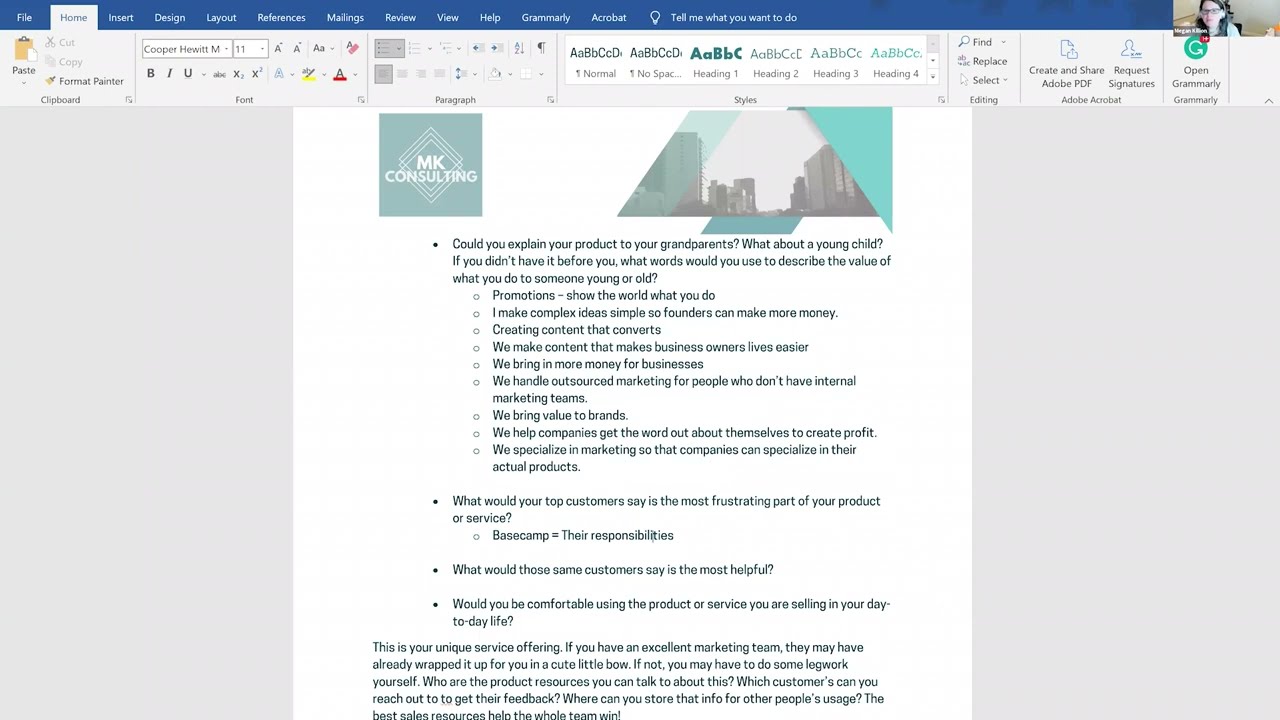
Yeah. So that they can focus on the thing that they actually are good at. And when we get down into the deep nitty-gritty of it, when we're talking to people, most founders don't have the first idea how to make their key marketing hires. And that is actually something we can do for them when we scale to the point where they're really ready to have an internal marketing team, because they have a clear vision, they have a clear mission, they know where they want to go. A lot of these startups, these midsize entrepreneurial orgs, they want to make one marketing hire with no direction and have that person just create it. They are like a founder and they are like, oh, I will hire the marketing person. They will do the strategy. And you are like, no, no, no, we have to do strategy first. You have to have a hand in it, and then you can make that key marketing hire. And that key marketing hire is the person that should build your marketing team. But you cannot just hire like a marketing director and expect it to all be magic. That's not how it works. And that's like the education that we do. And then when it's time to offload, we will help them make that hire that's right for them. What would your top customers say is the most frustrating part of your product or service? Basecamp. That is the thing we hear from people the most. I don't think it matters. what software we're on. They're going to complain about their part of it. So Basecamp translates to their responsibilities.
Mm-hmm.
I'm missing an I. Clients don't like that they have to do work too. We're not quite, especially not for the price that we charge, we are not at the point where I can give everybody a dedicated account manager that just learns their brand and becomes their marketing director. Now in some of our plans, that is what we do. Like if someone came in and they wanted to pay us $18,000 a month to run marketing at their company and be their marketing team, I would go source an account manager for that account that would be their account manager that would be 100% on point in charge of their brand, and that's their only job. So when clients complain about that, it's really like, well, what you really want is $18,000 a month, but we talked about your budget being $5,000 a month. You can't have the $18,000 a month of service for $5,000 a month. This is what we can give you. Ultimately, like the frustrating part for them is that marketing resources is not equal to magic. Sometimes it's not fast enough. Now to be fair, we don't do any of that marketing or calls to action that are like— we are not growth hackers. It's not what we do. We help people find their brand identity, find their voice, and put it out there. We are not telling them that we are going to magically growth hack them from $0 to $100 million a year in revenue. There are marketing companies that make those claims. They charge anywhere from $20,000 to $50,000 a month minimum. And they do it, absolutely, because when you have that many dedicated resources, brainstorming how to make your brand a success. It happens. We are not there. What would those same customers say is the most helpful? Funny enough, it is our people. A lot of customers talk about how well I manage them. I think the number one thing I get back when I ask people what they are happy about is they love how proactive I am. In doing things while they are not paying attention. Little things like when we sell an account, and if you pick too, and let's say they pick like a content package, we are automatically going to do 3 social posts a week and 1 blog post a week. Even if you give us nothing, we will make it happen. It is not going to be as good of content if I can't get you to engage and give me information about your products, and your services, and your brand. But we are still going to do it. And that is the thing people say that they love is like, Megan is really good about following up and making sure that we get things over to her. Both these things are solved for when we scale to the point where we can hire dedicated account managers. We can have people more on top of them and they have less responsibilities. Would I be comfortable using the product or service you are selling in your day-to-day life? Hell yeah, I eat what I cook, baby. We are customers of MKC, both internally for MKC. I also run Coven Cloud and the Blue Hydrangea on MKC. So my real estate business, my social media business, they are both on MKC. So obviously I'm comfortable. Would you be comfortable, Diamond?
More than comfortable.
Yeah.
All right. Meredith, how about you?
Very comfortable. Absolutely.
It would be amazing. Natalia, would you eat what you cook here?
I'm sorry?
If you were like launching a business, would you be comfortable using MKC as your marketing team?
Yes.
How about you, Jason?
Absolutely.
Awesome. That's what I like to hear. So this is your unique service offering, right? So like I do this for other companies, which is like they might actually wrap it up in a bow for you. Most people don't. So this is what is our unique service offering. We do this. Through this, right? And that's what makes us special. I kind of owe you guys wrapping it up and putting it in the playbook. We do have a playbook; it needs some work, but the the U.S. the U.S.P. should be there, or U.S.O. So then understanding your buyer. You guys can kind of do the HubSpot personas on your own. And I recommend that everybody specialize a little bit differently when you are building your personas. We have a wide breadth of things we can go after here. You should go after things that you are comfortable with, where you are comfortable talking to those people. Right. When I say that, I'm a CEO, and before I was a CEO, I was a VP of Sales and Marketing. So I'm really comfortable talking to VP and C-level challenges. And they usually connect pretty well with me because they see me as their equal. We're on equal footing. We're talking to each other. So I don't have any issue when I'm outbounding to those types of people. If you're— less comfortable with that, there's nothing wrong with going after directors of sales, directors of marketing, and finding somebody who you feel like you understand their frustrations better. Or also, like when I was talking to Meredith, she's done a lot of work with consultants in the past and coaches, so she feels really comfortable talking to them one-to-one. They are absolutely a possible client for us, especially like the YouPick2 is really flexible in who could use it. And then like if you want to go after bigger businesses, but you want to target a lower seat, you can do that. A lot of larger companies like Erickson, like StackPath, They have budget owners that aren't C-levels. Like a Director of Marketing may have their own budget that they are free to spend, and maybe we could fit that budget. So building out what industries do you want to go after? And also technology is a huge branch that almost at this point in time, If on top of whatever else you do, your business is not also a technology company, probably not going anywhere. 20 years ago, if you had asked me if Netflix was a technology company, I probably would have said no. They ship me DVDs in the mail that I order. That doesn't really seem like a tech company. That seems like they are in entertainment. Today, Netflix is one of the largest, most innovative technology companies on the planet. Disney is a technology company. Honestly, a lot of your— a lot of your financial companies, Tech companies. Every kind of software is obviously technology, but almost every other industry has software. So you might think to yourself, like, oh, I've never really worked in tech. But okay, you've worked in food service. Do you know how many food service softwares there are? Hundreds? Thousands? Worked in retail. Do you know how many retail services, products, software there is? Those are all technology companies. So I always recommend starting with what you know and then branching out. So like, we are technology obviously. But what can that look like? It can look like fintech. It can look like, I do a ton of CDN and telecom. That's Natalia and I's wheelhouse, right? CBN telecom infrastructure, network security, right? We've done extraordinarily well in managed services/MSPs. That's also— it's just outsourced IT, right? What do you know really well, Jason?
Good question. Um, tech sales stuff like that.
Sales software?
Yeah.
So all those sales tools like Gong and, I mean, Fathom, uh, which we use, they might be a target. Uh, but I would say sales software. And what about real estate software?
Not so familiar with it.
But you are familiar with the pain of being a real estate agent, right?
Not getting enough clients.
Right.
No, but definitely, yes, absolutely. Real estate software for sure.
Because it's reverse engineering it, right? So like maybe you're not familiar with like the product, but honestly you don't need to be. The customer knows their product. What they don't know is their buyer. So I always try to tell myself, if I know the buyer, I know that, I know the marketing, right? So it's like, whose pain points do you get? Oh, uh, parents. Anybody that's targeting parents, like a Care.com type of thing.
Oh, I see.
Yeah, so anybody that's targeting parents, right? Because you know what it's like to be a new parent. I would say maybe like some stuff around fertility would work really well for you too. There's a lot, there's a lot of fertility software now that didn't exist. I used it during my fertility journey. I had no idea, guys, that you could like, you can monitor your temperature all the time and know when you are most likely to drop eggs through soft— like your phone will notify you and be like, it is the 14th day of the month and your temperature is X. Better get to hopping. You're like, whoa, okay, to the bedroom we go. That's like legitimate software that exists. And the reverse also, because you can set that same software to be like, hey, hey, do not touch go, do not pass go, do not collect $100. Now is not the time to party. I've used it for both purposes. Very effective. How about you, Diamond? What do you feel like you just know really, really well?
Um, I know coaches. I know yoga, uh, relaxation, uh, mindfulness apps maybe. Yeah, like, yeah.
Yeah, okay. Um, so mindfulness apps, uh, there's definitely like yoga apps out there. They're usually in the same general application. How about you, Natalia? We talked about CDN and telecom. Is there anything else you feel like you just, you know, incredibly well?
Yeah, I have a knowledge in different things. That is my hobby and my life. I shared with you about diet, so I know a lot of diet applications, and I know a lot of exercising applications. I'm addicted to sports.
Oh yeah, all right. Yeah, sports is huge. Meredith, what about you? What do you know really well?
Um, I know a lot of stuff I know we've covered. I know, um, I know coaching. I know mindfulness, meditation. I know I know, like, personal finance. That's like a big deal to me. I know—
That's a very quickly growing one.
Yeah.
This is like post-2020.
Yeah.
Right alongside this whole like career revolution that's been happening. Also financial revolution. There are so many people who had no money that got rich on the back of Dogecoin or GameStop or AMC, these like kind of viral investment options that happen on Reddit.
There's also a huge like rise in marketing personal finance towards specifically towards women and specifically towards women who Don't, you know, might not know, like, what, you know, like, like, what is the stock market? I don't know. I couldn't explain the stock market to you, but it's where you put your money and your money grows. Okay, just, you know, accept it. And—
Yeah, I actually have an app that actively tries to teach me more about crypto every single time I log in. It like rewards me for taking trainings by giving me free crypto Oh, that's really cool.
What is this?
Uh, hold on, let me find you the name of it. Is it Coinbase? Are they the ones doing this? Yeah, it's Coinbase. Um, they give you free crypto when you take their lessons. Now it's usually like crypto no one's ever heard of, but I actually got Dogecoin by doing a lesson in their module like 2 years ago. And when Doge took off, I made just over $500 on— Oh, that's awesome. So yeah, that's cool. But yes, education. So like education is taking off on its own, but it's also being threaded into kind of like everything else. So for example, Natalia mentioned like nutrition. I have Noom, which is an application that's for like weight loss, but it's all about like teaching you to understand the connection of psychology and your fitness and like your nutrition and how they play together and how like The whole reason that dieting has never worked for you is because dieting hurts your mental health. And if you treat your brain well, you just start losing weight and you find your natural rhythm, like the weight you're supposed to be at, um, just by being kind to yourself. I was like, wait, wait, wait, wait, wait, wait, wait, wait, I've been doing this all wrong. I've been starving myself for no reason. Um, and yeah. It's true, starving yourself is not helpful. But that's one of those things that's like, that education didn't exist before. And part of why I am so passionate about technology is because it reaches education into areas that did not have access to it before. Because the internet penetration rates are on a rise every single year. Even countries that you think of as being sort of disconnected from the world, those are the ones that have the largest growth margins year over year for Internet penetration. So like all of South America is above 60% now. Every South American country is above 60%. It did not used to be, which means that more than half of South America has Internet access. That was not true before. Without technology, Natalia could not be sitting here with us having this conversation. And it pulls people out of situations that they had no path out of before. Because all of the world's knowledge is at your fingertips. All you have to do is have the motivation and consistency to care and follow through on it, which is a separate issue. But that's why technology is so important, because it can get these tools into the hands of people who would not have them otherwise.
And for social change too.
Yeah, well, social change comes with education.
Yeah.
Because as soon as people know that it's out there, the tables flip.
Yeah.
Because the number one, like, kind of stopper of social change, of growth, is that people don't have access to information, so they don't know how things could be. If someone doesn't know how to read, they can't change their local governments. The day that you know that women around the world can own houses, then it's like, well, why can't I?
Yeah.
And all of a sudden you have revolutions in countries that have had hundreds and hundreds and hundreds of years of instability led by women. who are just like, no, I can, because they are doing it everywhere else.
Yeah.
So that is technology on a wide spread. And if you can get companies to buy in, if you can get them to understand that that is the narrative, their brands will take off, because that is what people care about. They don't care about how your product works. They care about the impact that it has. Company size. Our best customers are definitely small, smaller businesses. That said, there is definitely a place for enterprise customers. There is a cell for enterprise that is different than the cell that we use everywhere else though. And we have to really separate the brands in our heads. So like smaller businesses, the sell is everything you said before. We take it over. We give you productivity back. We get marketing so you don't have to. That's like the line with small and medium-sized businesses. With enterprise, we are talking about We can be your failover. We can give you extra bandwidth. $4,500 a month is a sneeze.
What is an enterprise?
Big, big business. So enterprise would be like 500 or more employees, very profitable.
Okay.
Kind of corporation level. These companies have slower buying cycles. They are a little bit harder to navigate. But at the end of the day, they don't expect anywhere near the high level of touch that small businesses do, especially like if they have a marketing department and you say unlimited content, they are going to be like, Oh, perfect. Because they have an internal person whose job it is to come up with marketing ideas, but they might not have the bandwidth to get everything done. They may even have some of these resources internally hired, but they need failover because, all right, let's say we are talking about GlobeNet. GlobeNet has a marketing department, but they pretty much just got one of everything. They have a technical writer. They have a copywriter. But they've experienced some turnover. And every time they have turnover, then they have a gap where it's like, now it takes us 3 months to get somebody in the role, and then it's another 3 months to get them trained up. And then it's really taken us 6 months to get our content flowing again. So every time they have to fire somebody, or somebody quits, or whatever, somebody is sick, they have this gap in their content.
Yep.
That will not happen if they are paying us to do unlimited content for them.
Okay.
So it's more like kind of their failover plan to send the things to that maybe aren't as high level. They've got their copywriter focused on rewriting the entire website, so they want us to make sure that the social media is still running or whatever that is. It gives them extra resources, right?
Okay.
So our job titles are usually We have this one persona that is CEO, founder, owner type, right? Sometimes they are president of small business. Then we've got this VP of marketing/VP of sales of midsize. And then we've got directors at enterprises. That's usually— we've kind of got these 3 tiers. I've had really good luck talking about— talking to the one salesperson at an organization to get them to tell the CEO they need us. That is where most of the pipeline right now came from, is I pivoted and I did this strategy. Because there's a very clear thing that happens that we can target them for. If they have hired their first salesperson this year, that salesperson is in a lot of pain. Because to get hired, that salesperson told the owner that they were going to close a whole bunch of business. And that it was going to be easy. And more often than not, that salesperson came from an organization where they had a lot of support. They had a marketing team. They had a clear ICP, ideal client profile, that was targeted for them. And they had marching orders. They came into the small business. They were hired as the VP of sales or the director of sales or whatever. When you are looking at LinkedIn, a really clear identifier that this is going to be a pain that they are in, If you have a salesperson that previously was working at bigger organizations that carried titles like Director of Sales, who just took a job at one of these small businesses as the VP of Sales. When you're the VP of Sales at a small business, that means you own sales 100%. The CEO no longer cares about sales at all. They think they have outsourced it to you. It's your job, your function. They are often in a lot of pain because they have zero materials to convince people to buy. The website sucks. The social media presence sucks. They don't have a white paper or a case study. They have nothing. They are just selling themselves. That's it. And they are expected to get to these crazy, crazy targets with nothing. Those are usually great targets for us to talk to because they are already actively in that pain every single day. And so you can be like, hey man, for less than your salary, we could come in and we could do all of this content for you that would make your job so much easier. And that tends to be a good sell. Revenue, we just go with profitable. I don't really care. What the number is other than that they are making money, because if they are not making money, they are probably too early for us, and we end up giving away work for free for a long time before we get a contract. And I love startups, but I just don't have the time and energy to do that right now. So these are the big things right here that are going to build your targeting and build your outbound messaging, which is what are their most substantial challenges and pain points? So that's like, what problem are we solving? And do they have multiple pain points, and can we solve for more than one of them? So like, let's take the CEO, right? What do we think their pain points are, Diamond? Time management.
Not having enough time, and they most likely don't know a lot about marketing.
Yep, we solve for both of those, right? We'll help take care of the strategy. We'll give them back their time. They usually also, they're juggling A lot of balls. So like, and they have trouble knowing which ones are most important. So one of the things that CEOs aren't always doing is mapping that revenue to the original action. They don't have the in-depth analytics to know where things are coming from, or where they are going to, or what's happening. They're just overwhelmed. So they're trying to figure out how the hell they're going to pay their taxes this year. They're trying to like especially right now every CEO on the planet is having a heart attack because taxes are going to be due soon and we don't know how to balance the books. Uh oh. So they're they're they're struggling with that and they don't know where their deals came from. So like the pipeline dried up, but they don't know how. They don't have eyes on it. And so then they're like, they're dropping the wrong ball. Because I can tell you almost always content brings you customers. And it's the first thing founders, CEOs, coaches, consultants drop. They drop the content to take care of something else that's happening inside the business. And then their pipeline dries up and they aren't sure why.
I'm like the perfect example of that.
Yeah, like life got stressful, so you stopped making content and now you have no leads. Weird how that works. Where did all my customers go? Oh yeah, I stopped, I stopped posting on Instagram. And there's a pause too, so it's not like it happens Instantaneously. It's, you know, 3 months later, and then you're trying to figure out what happened. So then let's go with like VP of marketing. Natalia, do you know what the top problems for VPs of marketing are?
They don't have a full team to do the activities. And They are overwhelmed too.
No clear guidance is almost always here. Now, sometimes the magic scenario happens where the VP of marketing is actually qualified to be the VP of marketing because they are hired at a startup that like has funding. Like they just raised Series A, and so they have a ton of money, so they go buy an expensive and talented VP of marketing. That does happen. 99.9% of the time though, founders hire cheap VPs of Marketing. They go and find somebody they can afford, and then they are like, build me a marketing strategy. And the VP of Marketing is sitting there like, I have never done that before. And they are Googling. They are like, what is a marketing strategy? And then they download a template, and they are putting things into a template, and they are like, I still don't get it. How is this template supposed to create content? And really, a marketing strategy should take you a long time to build and should involve the founder who knows what they want the business to be. Like, crazy to me that these founders, they want this marketing person to develop their whole vision, mission, and brand. And I'm like, you don't want to be involved in your vision, mission, and brand. You're going to be mad the marketing person did it wrong. So angry founders is one that happens a lot. The VP of marketing has a lot of pressure on them to produce revenue, but they're not getting any clear direction. They don't know what the brand is supposed to be. And then the founder is mad because they're not producing revenue 3 months into their role. So that's, that's VPs of marketing. Jason, what do you think VP of sales, their substantial challenges are?
Having sales team Basically trained up, ready to go. So there's always turnover, especially on the SDR front. Um, on the thing is, it's liaising with product, usually making sure that your, your messaging is the same between marketing, product, and sales. That's what we're having issues with right now. That's why we just hired a product guy. Other than that, like, it's just making sure that you're hitting your numbers, hitting that quota. So yeah, I would just say, obviously, mainly it's revenue goals, right? So—
Yeah, all these pieces underneath it, right? It's like you've got a founder that wants you to hit your revenue goals, but then you've got all these problems that are getting in the way of that, right? You got the untrained salespeople, they're churning, uh, you don't know, you don't understand the product, um, and there's no clear messaging about the brand, right? So that All goes together. Key success metrics. What does success look like for a CEO?
Revenue.
Yeah, revenue. Revenue and profit. That's pretty much it, to be honest. That's all we really care about. What about a VP of marketing?
Analytics?
Yeah, so those analytics are usually like leads, traffic, KPIs around like CTAs clicked, forms filled. Marketing is really dated, guys, and the KPIs are bad most places. But it is what it is. VP of sales. Anybody know what the big metrics are for VPs of sales?
Actually don't.
Profit.
Yeah, usually not profit. Funny enough, despite the fact that the CEO's number one top concern is profit.
I might. That was what I was thinking. I was like, why is profit? Profit and revenue and profit, not all of these people's.
Like, you would think that, Meredith, that is so logical. Um, I don't know anywhere, anywhere, I don't know a single company properly aligning their marketing and sales leads to revenue and profit.
That is dumb.
So VP of Sales usually looks like number of deals Size of deals, MRR, which is like monthly recurring revenue, um, but they're almost never aligned to profit. That's why salespeople cut bad deals.
Hmm.
All the time. All of the time. Because they're paid on top-line revenue, not bottom-line profit. So they're selling deals that take a lot of resources for a small amount of money and hurting the business. But that is how they're paid. All right, guys, we're running low on time and I have another meeting that starts at noon. We will continue this next week. Any quick questions I can answer for you before we wrap up? All right, guys, it's been great. Lovely to see you all. Ping me if you need anything. Okay.
Bye.
Thank you.
Bye.










