Ring to Win: How Picking Up the Phone Transforms MSP Sales and Service Delivery with Megan Killion
Megan Killion covers phone-based sales tactics for MSPs, including why you need to answer inbound calls within 5 minutes, how to structure cold calls with an opener-reason-ask framework, and CBT techniques to manage call anxiety. She argues that AI and automation have limits and that human contact still wins deals.
Chapters
Everybody, so sorry, so sorry. That is 100% my fault. Not technical, not Megan, not anything. That is 100% Eric's fault. 20 of you in here waiting to hear the brilliance of Megan Killian, and since I've already taken 7 minutes of her precious time, I will, uh, let you take it over, Megan. It's all you.
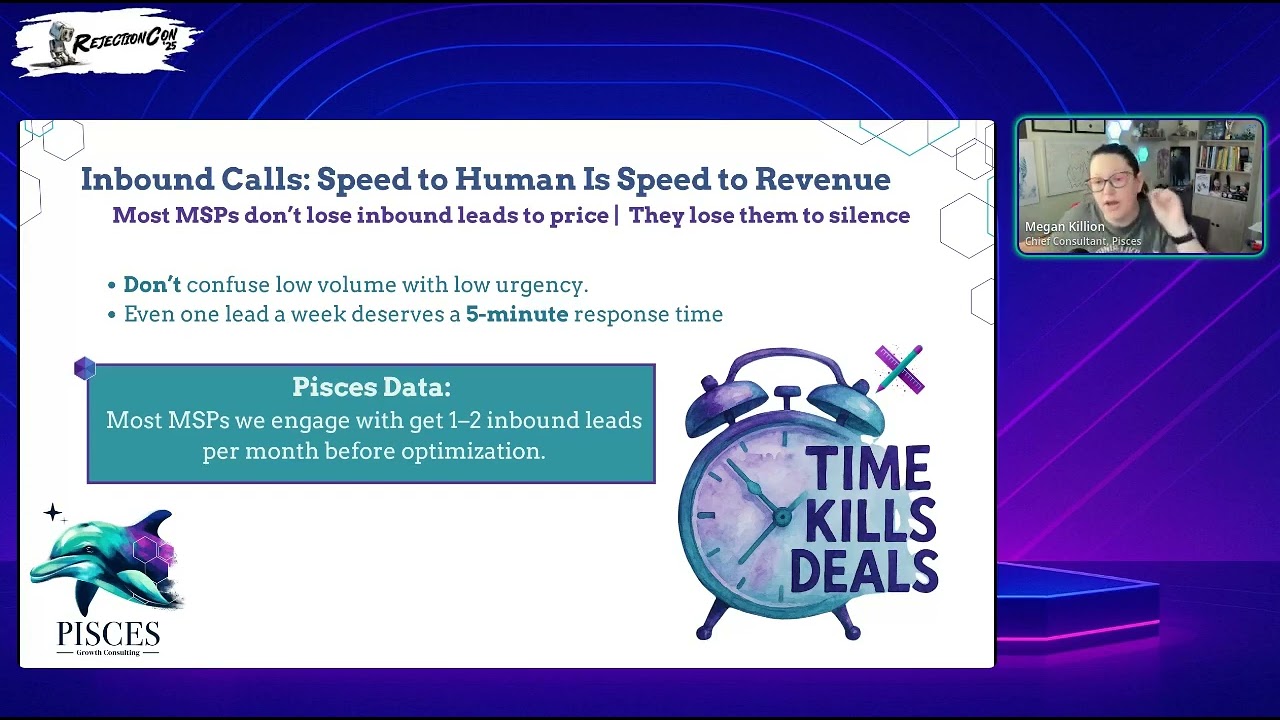
All right, sounds good. Hey guys, sorry for the late start. But we'll catch up real quick. I just want to set the stage by saying that this is not a debate about whether or not calling is dead. We've we're past that. Cold calling is not dead. Calling in general is not dead. The phone is an incredibly valuable channel, both for new business and current business and service delivery. And with that, I will. Start my presentation. Feel free to drop your comments in the chat and any questions that you have. I will absolutely get to them before the end. Alright, so let me first answer the question that I'm sure all of you have, which is why the fuck should you listen to me? My name is Megan Killian. I'm an autistic ADHD bisexual female founder of a consulting firm that helps MSPs scale revenue. I've done $550 million in pipeline. $50 million of that is business closed for MSPs. I've helped 5 MSPs scale past 7 figures personally. And I went from B2B tech sales BDR to a BD manager to a director of BD to the VP of sales and marketing. And I've been a 5-time CEO. Or 5 times CRO and 3 times CEO. I still pick up the phone. So if you think that because you're the CEO now, you don't have to pick up the phone anymore, I don't know, how can you ask other people to do things you're unwilling to do is my question for you. This talk is to help you get past your own anxieties To be able to call. I know that it's hard. I know that a lot of us get in our heads, and it's not even just about business, right? I actually have a tremendous amount of phone anxiety when I am calling like the doctor, when I have to pick the phone and call a family member or a friend, especially if I have to deliver bad news. It's hard. You are not alone in thinking that it's hard. But just because something's hard doesn't mean we stop doing it. Especially when we know that it's what is good for our business. My goal is to help you walk away from this session with actionable frameworks that allow you to do it instead of just thinking about it. Let's talk about the most expensive 5 minutes in your sales process. You are 100 times more likely to convert a lead if you call within the first 5 minutes. Only 7% of businesses respond that fast. You want to be the 7%. You're 21 times more likely to qualify a lead if you respond to it within 5 minutes versus 30 minutes. We've all been sold a lie, not just that cold calling's dead. That's obvious. But I'm talking about the lie that says if you just build the perfect website, if you rank high enough on Google, if your funnel's tight enough, the phone's just going to start ringing. And business will flow. I hear from MSPs all the time that they think good service should sell itself. I deliver a high level of service, I do a good job, people should just be interested. I hate to be the bearer of bad news, but that's not how business works. I know businesses that have spent thousands of dollars on SEO. Some are throwing like real actual money into ads, and then no one's picking up the sales line. They don't call leads back until days later, if at all. And then I hear them say, I guess that lead wasn't serious. Here is the fact: if someone is serious about finding a solution, they want to do it today. They want to do it in the next 5 minutes while it's relevant, while the pain is active. They want a solution in place right now. The lead was serious. They were ready to buy. They were in pain and you weren't there. They're actively looking for a solution. You let it sit. If you are spending money on inbound and you're not set up to respond like it matters, just stop spending. Because until your follow-up reflects the urgency of your lead, you're just wasting your money. If your website says that you're proactive, but your team is ghosting those form fills, the buyer thinks they don't care about me. They're not proactive. The problem is that your buyer assumes that the way the buying process flows, that's how service delivery is going to work. Your prospects know when you're slow to respond. They are remembering that information and they are assuming that's what it's like to do business with you. Get quick on the response, on the uptake. It's important. I love AI. Okay, so first, first thing you have to know, I absolutely love AI. However, your prospect knows when they are chatting with a bot versus a real human being. We can all spot it, right? We all know when we're chatting with AI versus when we're chatting with a real person. Regardless of how real you make it feel, it's not the same thing. 75% of customers want more human interaction in their digital experience, and 60% of customers say that getting routed to a real person is the most frustrating part of support. I am all for automation. I'm all for AI. But when you remove the human touch from your business, You are creating a problem for your future self. That is, your client just doesn't feel like they are important enough to have a human response. There's a place for AI and automation in your business, but it is not when your client has a serious problem. It's not when you have a hot lead. Human work for human people and robot work for robots. Automation should be about efficiency. Not connection. You cannot automate away that connection. And this is a really important touchpoint to stop and kind of talk about 2 very different types of MSPs. I talk to dozens of MSPs every week, and what I have heard is there's really this kind of like differential fork in the road that is happening. And what that is, is the traditional managed service provider versus MSP 3.0. The traditional managed service provider, it's all help desk. You're primarily selling to boomer businesses, owner, older business owners. They probably still have quite a lot of paper in their business. They might be a little bit technophobic. The reason they need you is because they suck at technology. They want you to talk to them. They want to see a person in their office. They want to shake hands. They want to talk on the phone. They do not want to log into a portal and they do not want to self-service. That's why you exist as a business. Your business was built on the premise that somebody can't figure out technology in their business and they need handholding to get through it. If they knew how to do it themselves, they wouldn't be with you. If that's the type of business that you are, embrace it, lean in, be that person, pick up the phone, talk to your clients, go after the people That you know are most likely to buy from you. The second type, that MSP 3.0, typically selling to younger buyers. They might be Gen Z, millennial. They typically want a more self-service process. They're just looking for transparency, quickness. They want fast response times, but they don't care if a robot does it. They probably don't even want you to call them. They're like, can you just send me an email when the ticket is closed out? Thanks. It's important to understand the difference between your buyers when you are thinking about how you're gonna approach the phone and where it belongs in your business. We already talked about this a little bit, but the speed to human is speed to revenue. You're not losing your inbound leads just to price. You are losing them to silence. Someone picks up the phone, they call your business, your service line is staffed 24/7, right? Somebody answers that phone. That's probably right in like your SOW, your SLA is how fast the phone is going to be answered. But when your sales line rings, who answers that? Who owns that? Who has the accountability inside of your organization to own this process? It's important that we don't confuse low volume with low urgency. Usually when I come in and I talk to MSPs, they tell me, ah, I get like 1 actual lead every month to 3 months, right? It's a trickle. There's not much going on. If that is your lead volume, isn't it even more important that you stand out and you be the first one to respond? Even 1 lead a week, 1 lead a week, 1 lead a month, it deserves that 5-minute response time. You need To respond right away. Time is killing your deals. They are going out, they are talking to someone else, and they are deciding to buy from the first MSP they talk to. If nobody's watching out for these leads to come in, if it goes to a shared inbox, and then by the time someone gets around to calling back, it's cold. And then you tell yourself, oh, they weren't that serious. They weren't really in pain. You're just, you're lying to yourself. That lead is a gift. You need to treat it like one. It has to be priority one for someone inside your organization. If you're really, really small, as the owner, you may have to still own this. If you have a larger organization, then sales should own it, or marketing, or account management. But someone inside your org needs to be accountable. And you need to staff it just like you staff help desk. You would probably be incredibly embarrassed if your help desk line just rang and rang and rang and rang and no one answered it and it got sent to voicemail and that voicemail got checked once a week, right? That would be absolutely horrific for you as an MSP. Take your sales line just as seriously. Someone is responsible for answering that phone all of the time. And if you can't answer the questions of, you know, who is responsible for answering this? What is the expected response time? How do we measure that? And who's following up? It's not a marketing problem. It's not a lack of inbound flow. Even one lead every 3 months could be turning into a new deal. If you were giving it the attention that it deserves. The clock starts ticking, right? Here is a graph of where the interest loss starts, right? After 5 minutes, you're starting, you're starting to lose your ability to close this deal. You're 21 times, 21 times. Isn't that a huge number? Right? If we take a 5 and we times it by 20, it's 100. You are massively shooting yourself in the foot with this one if you're not responding right away. If they come in at 9:17 and you call them at 11:42, they've already moved on. They Googled someone else. They clicked a competitor's ad. They already booked another meeting. It's not that the lead wasn't real. It's that their memory is short and your window is shorter. And I know, I know, I know, a lot of you are thinking, I'm slammed, I'm the owner, I have to close deals, my quota is tied to how much new revenue I close, I can't be responding like that, I'm an engineer. I hear you, I hear you. But if that is true, why did you spend $15,000 on your website? Why are you spending $1,000 a month on SEO? Why are you putting money into paid ads? If you cannot treat your leads like they are real and they need a quick response time, it very much is an either or. Either you're taking it serious or you're not. This is a really important thing to know: 50%, 50% of your buyers are choosing the vendor that responds first. So when you hit When you missed that threshold, right, you didn't respond in the first 5 minutes or even the first 30 minutes, your chance of closing that deal was just cut in half. There are very few other places in your sales process where you have this type of table stake. When we talk about like messing up qualification, messing up discovery, messing up other stages of the process, the stakes just frankly aren't as high. You can recover later better than you can in the beginning. And part of that is just psychology, right? Your buyer is assuming that the service they are getting through the buying process is the service they are going to get after the sale. So if you really pride yourself on being a high level of touch company, of being fast, being responsive, being proactive, You need to show that during your sales process as well. Every inbound lead deserves a call plan. That means immediate response. It means you're confirming and qualifying. Ask them right away, like, hey, how did you find me? Ask open-ended questions. If they can answer it with a yes or no, you're kind of digging your own grave. Have a follow-up protocol. At least 5 touches. If you aren't consistently following up, it's, it's really, really common someone's just gonna forget about you. Often when people go out and they're shopping for this type of solution, right, I have an active problem. Let's say I'm really frustrated with my current MSP, their response times suck. I feel like I'm overpaying. We had a cybersecurity incident recently, and I don't, I don't even know if they handled it right, because they won't give me like an RFI. to explain what happened. I'm gonna call around to a couple of different MSPs or fill out a couple different forms. I'm gonna go to Google, I'm gonna look, see what I can find, check some reviews, and then I'm gonna send out probably some requests for information, maybe book some meetings. Sort of depends on the type of buyer that I am. But if while I'm doing that, I'm getting ghosted, those are not vendors I'm gonna buy from. And that problem for me, it's relevant right now, right? You as an owner are busy, so are your prospects, so are your buyers. They move on from things even if it's painful, right? We know that switching your managed service provider is a big ask. You're asking your client to go through pain to be with you instead of with their current provider, right? We're ripping and replacing infrastructure, tech stack. Do you expect someone to continue to want to do that if they aren't seeing consistent forward momentum? Right. So you want to make sure not only are you responding right away, but you're keeping that forward momentum as you move through the deal and that you are consistently touching point across multiple channels. Right. That means following up like you mean it. Not once, not twice, 5 times really is the minimum. And if I can give you just like one tip on how you handle these things once you are on the phone is just to lead with curiosity, dig in, ask questions, be consultative. Someone who's coming inbound to you, they just want their questions answered. They're not ready to be sold to yet. And you shouldn't even have to sell when someone's coming inbound if you can solve their problems. All right, so we've kind of covered what do you do when the lead comes inbound. You know, raise your hand in the comments if, uh, if you're not getting any inbound leads, that's just not a thing that happens for you. And this is a really big challenge for MSPs today, right? It's the number one reason they come to me is like, hey, my, my revenue stagnated, uh, I'm fighting back against a little bit of churn, just natural attrition. And I have nothing new in the pipeline. Well, the search volume for managed services with high intent has gone down substantially. So that means that less people are out shopping to go inbound. What do you do when no one's coming inbound to you? You got to outbound. You got to get on the phone. Phone remains The most effective channel for outreach in 2025. The average cold call success rate is only 1 to 3%, right? But the top reps are consistently exceeding 10%. That means just get good. Like, you got good at Donkey Kong, you can get good at this. Okay. Sales reps that are cold calling daily generate 42% more pipeline than those that don't. This does not say you have to cold call eight hours a day. Means picking up the phone at all on a daily basis will give you 42% more pipeline. And 71% of buyers say that they want to hear from sellers early in the buying process. They want you to call them before they call you. At the end of the day. This type of outbound will not work for every MSP. I'm gonna be transparent with you. There's a lot that goes on in your local market that will impact this: the type of buyer persona that you are selling to, the overall culture of your market, and just whether or not the phone is perceived as rude. Where you are. I can tell you right now, uh, we've seen MSPs really, really struggle in New England with cold calling, for example, particularly in New England cities like New York, Boston, Hartford, where we've seen Midwest MSPs quadruple, 10x their pipeline by adding calling into the mix because that's an incredibly friendly market. The South is a bit more of a mixed bag, and it also, again, it really depends on your buyer persona. You can really tremendously make this a multiplier if you are strategic with where you spend your call hours. That means don't just buy a tool like Apollo or ZoomInfo, create a filter that is basically your entire TAM, total addressable market, and hammer it all. Call when you have something worth saying. Build your list based on triggers. Maybe a trigger is like they downloaded your cyber liability checklist. They opened an email three times but didn't reply. You notice that they posted a job for IT support. Call, call, call. It's not about being slick. It's not being about the most smooth person on the phones. I can tell you that I am still incredibly awkward on the phone. Still, it's been fifteen years, guys. Still a weirdo. Can't break it. What it's about is having a good strategy, being relevant. Show up with a reason. Use your voice to offer something useful. Ask for a conversation, not a close. I coach MSPs every single day on this. I inject SDRs into MSPs every day. And when it's done right, You go from cold to warm when you are timely and helpful. You book meetings, you create pipeline. The structure and your intention is going to impact your win rate. How have you been is the most effective opener out there. Stating your reason early will get you further. So, hey, how have you been? This is Megan from Pisces. I'm calling because I saw that you were listing a sales role for your MSP, but it doesn't look like you've ever had a salesperson before. Are you prepared to onboard them and support them? Open-ended questions, that's kind of a yes or no. But what have you done to prepare to support them? If you're calling for an MSP, hey, how have you been? I saw that you listed a job listing for a new IT director. Just curious if you ever thought about outboarding Outsourcing that. Um, it may be you see that they have a super dated old website. You could call around that. Um, you can use technographic data to call around specific technologies that they're using that might be potentially being sunset. There's been a lot of that going on lately. Um, but you want to be strategic in your outbound. You don't have time to call all day. I get that. You can't call 8 hours a day, especially if you're an owner. So what's the kind of like framework we use? An opener, a reason for the call, and an ask. It's more complicated than that, but I did not want to spend this entire session talking about cold calling. If you want to see my frameworks and talk tracks, just let us know in the comments. One of my people will grab it and send it over to you. There's also going to be a QR code at the end asking you for feedback on the session. And if you Scan that. You can also request any of our services and talk tracks from there. Here's the biggest thing that I see really just kicking the ass of owners, of reps, of everyone. It's not that you don't want to cold call. Fundamentally, you all probably believe me. You all probably believe that, you know, picking up the phone and making some calls a day could change your business. But you're anxious about it. Again, I have been cold calling for 15 years. My SDR manager is in the chat, Josh. He's been cold calling for 6 years, I think. I still get anxious. I still experience that stomach drop every single time. When I book a cold calling session on my calendar and I tell all my SDRs, hey, you can come in, we're gonna live cold call together, I'm gonna do it live in front of you. I feel like I'm gonna throw up because it's a lot. It's a big ask. It's a stranger, man. I can't even go to the grocery store, you know, like, and here I am cold calling strangers all day. 48% of professional salespeople are afraid of making cold calls, meaning that's their whole job and they're still sitting there shaking about it. So what do we do about it? This is the CBT triangle. Some of you may have been familiar. With it if you've ever been through therapy. And the idea is your thoughts, emotions, and behaviors are— they all relate to one another. Your thoughts are getting in the way of you actually doing the thing, right? Your thought might be, I'm bothering them, this is an interruption, they're going to yell at me. Then your emotion is tied to that, right? Like I feel anxious. I feel scared. And then behaviorally, you're going to avoid the dial. You're going to procrastinate. You will find something else to do in your business. How can you break through that? You can do 5 by 5 breathing. You can go splash your face with cold water. And I'm going to be honest with you. I have spent 15 years selling in B2B tech. I've always been in B2B tech. And I have called for SaaS, for CDN, for cybersecurity, for telco, for streaming media. Managed services phone calls are the hardest to make. It is the hardest cold call I've ever had to do in my whole career. It's the hardest thing I've ever had to sell. That's why I stayed in it, because I like being challenged, and I know that y'all need help, truly. Why is it so hard? Most prospects aren't aware that they're in pain. They've got someone already. They think break-fix is fine. They think their current MSP is fine. You know, their uncle's brother's cousin's nephew is, is doing it. Or they think that you're just like everybody else, right? You're just another IT guy who's gonna pitch them backups and monitoring. You're gonna spend a whole bunch of their money, but they're not actually gonna feel it in their business. And that means that if you don't come in precise AF with targeting, messaging, timing, you're toast. You're gonna get your ass handed to you. And that's not just your anxiety speaking. Like, that's real. That's a real thing. You're gonna get told to fuck off. So you have to nail it. The MSPs that are winning with outbound, they've dialed in 3 major things. They know their buyer, not just the company, the role. How does IT impact this person? What are the threats to them? What are the things that make them anxious? What do they want? What would magical fairy tale land look like for them? What are their objectives on a day-to-day? What is the threat to their job if they make a bad decision here? How could a good decision be transformative for them? Well, how does their personal life relate to the problem, right? Are they missing their kids' baseball games? Are they stressing out and having to work more hours than they should have to? They also lead with a hook. Something sharp, specific, tied to ROI. It's not just, we're proactive, our people are better. It is hyper-specific. It is tied to the objective of the buyer. And they nail it every time with a hook to get someone listening. Then third, they're gonna offer something real, a gap analysis, a risk scorecard, a 15-minute automation audit, something that feels valuable before you're asking anything from your buyer. One of the biggest challenges with sales is that we start pitching before we earn the right. It's one of my favorite sayings in sales, earn the right to pitch. You do not deserve to sell to me when we have no relationship and you haven't provided any value to me. Give away something of value first, you know, a checklist, an audit, something that they truly can take action on too. None of this bait and switch. I'm offering you an audit, but this is actually a qualification call garbage. Give it away, expect nothing in return, and then Transition, right? You provide the value. You say, hey, here's a 15-step checklist for what you can do to check and see if your current MSP has you covered. Let them go do it and then follow up and be like, hey, how, how did the checklist go? Do you feel safe? Do you want me to take a look at anything? And then stay on it. Stay relevant. You are not going to In cold outbound, you are probably not going to come across a ton of people who are like, yes, today. How did you know today I want to change my MSP? It's not a decision that's made in a day. This is a difficult choice for people to make. So when you're doing that outbound, you want to provide value that's going to keep you top of mind when someone is ready to buy, and you want to follow up so you stay relevant. When you nail all 3 of these things, you know your buyer, you lead with a hook, you offer something real. Yes, you will get meetings even in this economy, even with risk-averse buyers. It's not just theory. That's what I'm actually seeing with clients who are running 10, 12, sometimes 15 meetings per month with outbound consistently. It's not just smiling and dialing. It's Calling with a purpose. You can't just think your way out of call reluctance. And it's not because your team is lazy. So if you have sellers on your team and you think they're not hitting 100 dials a day, they're lazy, I don't think anything could be less true. I promise you, your sellers want to make commission and they don't want to live on the probably starvation-level salary that you're paying an entry-level seller. They want to generate pipeline. They want to make money. In fact, they need to, to feed their families. They're scared, just like you would be scared. So coming back to this CBT triangle, you can't coach your way out of call reluctance with more scripts. You can't just script it away or framework it away. You have to coach through action. And here's what I tell every single rep or leader I work with. Do a box breathing reset before you start calling to regulate your nervous system. Create a time-blocked rule. Now, for someone who's just doing cold outbound, they already have a list built. So like you have done the RevOps stuff pre-work and you're saying, hey, just call this list. 3-second rule. Don't wait. Pick up the phone before your brain can talk you out of it. If you're expecting an SDR to do the research, build the list, Hand call, then I play a song, right? So the length of the song is how long I have to research, and then I have to dial. When the song's over, time to dial. Stand up when you call. Energy changes confidence. So stand up, walk around, move, and just most of all, reframe what you're doing. You are not bothering someone. You're helping them solve a problem that they already have, and it might be one that they might not even be aware of yet. You are calling with value. You are calling with solutions. You are not here to interrupt their day. Your goal with the call is to find out quickly if you can help and then provide immediate value and have a call to a conversation rather than a call to a meeting, right? Fear isn't going to close deals, but calls do. I know that it's scary to look at a 1 to 3% success rate, and it's also scary when you look at the overall data from the industry. Um, data in our, in our industry is really hard to come by. Small business dialing data is tough, and that's why I really recommend that you pay someone to build your lists for you. Uh, someone who's a professional that can clean them, make sure that those numbers, uh, have connect rates, and then build a warm list for yourself. Especially if you're the owner, you shouldn't be cold calling out of Apollo with no data. You should have a trigger-based, intent-based list that has already had somebody call to warm it to make sure that those numbers get answered by someone relevant. Um, that's going to improve your success rate substantially. And if you, if you've paid much attention over the last couple of years, it's less likely that someone's leaving their MSP because they dropped the ball, and it's at least dropped the ball from like a technical perspective. It's, it's highly likely that they leave their MSP because they just don't feel important. I listen to hundreds of qualifying and discovery calls every single month from MSPs. And one of the most common things I hear is just like, they never called us back. We had to wait forever for a resolution. And it's not a matter of like, we got hacked or we experienced downtime. It's really about how you're making those buyers, those clients feel about you. A ticket gets closed. Then what happens? Is there a call? Is there a check-in? Do you say like, hey, making sure this is resolved on your end, we closed it out, wanna make sure that you're happy. And I get it, the ticket's marked complete, everyone slammed. But for your client, that was the deciding factor, it was an important moment in time. And if no one shows up to close the loop, the moment becomes a mark against you. You don't need to call about every little thing. But when a client logs an issue, especially where it's pervasive, and then you resolve it, that's actually a really great time to reinforce trust. Just a 30-second follow-up call can do more for retention than any CSAT survey is ever going to. Do not wait for your clients to tell you that they are unhappy. Call them and find out if they're happy. I think we have this like disposition to think that if someone's mad at us, they're gonna tell us. They might not. They might just silently go out and look for another MSP. They don't owe you letting you know that they're mad. Actually, they're the one paying for a service. So they might just go out and find somebody else. And that's when you get blindsided and surprised. Oh no, what's happening? Why am I experiencing churn? If you want to retain more of your clients, call them. And while yes, there are specific triggers that you should call around, you know, like a cadence, maybe it's quarterly, maybe it's annually, whatever. And if they did experience an issue, if you get a negative CSAT back, but also you, you can just call them to say, hey, how are you? I appreciate you. What's going on? It's also a great way to get referrals is by actually talking to your clients, particularly when you do it with no agenda, no upsell, just a, hey, how's everything going with the team? Anything we'd be doing better? That is what high touch actually looks like. It's not sending a dashboard once a month. It's not blasting NPS emails that no one reads. Call after onboarding, call after escalation, call before renewals, call after the QBRs. And no, you don't need to do it for every single client. I have clients that I don't care if they cancel. Shh, don't tell them. Right? We all do. We have those clients that we're like, eh, doesn't really matter. Wouldn't impact my bottom line one way or another. I don't see them as a growth opportunity. They're not big social proof. Like, we're never gonna do a testimonial or case study, whatever. Don't call those ones. That's fine. Maybe start with your top 10. Or your riskiest 5, your longest-term clients. 86% of buyers will pay for a better experience. Everyone in the MSP space is talking about how can we charge more, how can we avoid being a commodity. Make them feel good about what you deliver. Make it a positive experience. And caveat, back to what I said at the beginning, This depends on the buyer persona that you are dealing with. Not all of your clients want to be called. As part of our onboarding, we ask our clients what their preferred communication methods are. Highly, highly recommend adding that to your onboarding. Do you wanna call? Do you want a self-service dashboard? Do you want an email? You want me to text you? Let me know. What are your preferences? What matters with clients is that you meet their expectations, not that they follow your process. Your process should be built to meet the client expectation, not the other way around. You can't tell me that you want more clients, you want to retain more of your clients, and then turn around and be like, but only if they do everything exactly the way that we want them to do it. You're kind of a controlling boyfriend, honestly. Like, get past it. It's real hard to build social proof if you aren't willing to have human conversations. It's one of those, the first things that we talk about, because in our process, before you can have an SDR on the phone for you, you have to have social proof. And when I talk to MSPs, they're like, oh, we have, we have hundreds of happy clients. Yeah, show me the receipts. How do you know that they're happy? And like maybe 5% of the MSPs I'm working with have like a good CSAT system and they're pulling from that. They're not having the deeper conversations. Picking up the phone, calling your client, and getting that social proof, recording it, delivering it in multiple types of content. If your clients are happy, they probably are willing to refer you. 83% of satisfied customers are willing to refer, but only 29% actually are. That's a pretty big gap. Where's that? Where's that gap coming from? Oh, they're not being contacted. They're not being asked. There are 2 ways to run referrals really, really well. One is a great automated system that does it fast and easy with no friction, where like your system emails them, they click a link, they give you a name and a phone number and an email address, and then you take it from there. That can work. It can. But it's got to be super, super easy. Like it takes me 3 seconds. If you want like a testimonial recorded for you, You're not a huge SaaS company. Do not send a link asking them to go record it with like a script in front of them. Get on, get on a call with them. Call them, be like, hey, could we meet on Teams next week? And I can just ask you some questions about service delivery. I'm going to record it. I'm going to share it with the team and it might end up on our website. And have good questions. Most of these case studies, they start with just like a how's business call, right? Like, hey, who do you know that could benefit from the same level of service that we give you? And would you be willing to say that on record? Could I put that quote on my website? Could we do a formal case study? In order to get the yes, you have to make the ask. Here's a super easy, like, framework. Feel free to screenshot this, or I'll drop my deck for you guys. If it's inbound, you need to respond within 5 minutes, route it to a real person, confirm and qualify immediately, and follow up at least 5 times if there's no answer. You're going to follow a 3-part structure: opener, reason, ask. Personalize based on industry and role and call consistently. It's not just when you have time. You will have time for the things that you make time for. We work in these things called GSD, Get Shit Done sessions. I have a whole template on that that I can share with you guys on how to like block time on your calendar for these things and make the most out of the time that you have. But you could tell me I only have 30 minutes a week for this and We can make that impactful. And then in service, you wanna make post-ticket calls for key accounts, strategic check-ins quarterly, and ask for social proof. It's not about making more calls. It's about making the right ones at the right moments. So who should be calling? Well, if you're really small, probably you. Unfortunately, when you don't have employees, you got to do it yourself, man. I'm sorry, it's not my fault. I didn't build your business for you. You're the only guy. You got to do everything. You got to juggle all the hats. If you're mid-sized, it might be like your AMs. You might not have dedicated sales yet. But if you're over 30 people in your MSP and you don't have someone dedicated to sales, why do you not want To grow. I want you to grow. I think we should all grow together. If the only time you ever call over money is over money, don't be surprised when they start dodging you. Like, if you only call your clients when they owe— they haven't paid their invoice, obviously they're not going to answer your calls. They're going to be like, that's, that's just my MSP. My, my pay must have bounced. I'm not answering that. You also want to make sure that you're tailoring your call to the preference. We talked about asking this question in onboarding. If you don't want to do that, you don't have time to do that, there's a whole bunch of generational data you can call upon and roles. So if you've got, you know, millennials, they don't like the phone very much. They prefer a scheduled call. If you've got older buyers, they probably do prefer calls, or actually what they'd really love is if you just drop by, which is crazy to me. Do not drop by my office. I'll have a panic attack, but your boomer clients want you to drop by.
Megan, we are unfortunately out of time. We are butting up against the next conversation. I know you have a slide you want to share that has a QR code. Is that right?
Let's get to the last one. Here we go. I'll drop the deck too so you guys can see it.
And I know that we did get some questions in the Q&A section.
I will answer these by messaging you guys or in the chat since we're out of time.
Yeah, I will, I will screenshot these and get these to you, Megan, if you don't see them. And, and, uh, and you can always scan the QR code and, um, you know, ask your question directly in a, in a one-to-one conversation with Megan.
But these are all questions I can answer. We just got a little late start today.
I know, that's my fault. I apologize for cutting you short.
I'll beat you up later, Eric.
That's fine. You can't scare me. I've been married twice. Okay, everybody, I apologize for the late start, and we are now— the next session has already started. So go to the next presentation talk. And Megan, thank you so much. Hugely valuable. You held the entire room the entire time. In fact, it grew the entire time you were talking. So people just kept joining.
Bye, guys. Jump to your next session.
Thank you.










