304 Mental Performance & Wellness Protocols | Dr. Alex Auerbach, Toronto Raptors
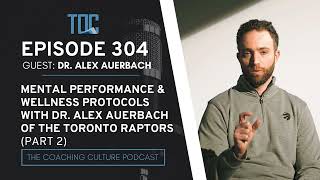
Dr. Alex Auerbach, Senior Director of Wellness & Development for the Toronto Raptors, talks with JP Nurbin and Nate Sanderson about supporting athletes through transitions (allow 90 to 120 days before judging), giving feedback that lands (express care, don't bury the lead), and keeping coaches from burning out by treating their recovery like an athlete's.
Chapters
So in our last episode of the podcast we had Dr. Alex Auerbach on the podcast. He works for the Toronto Raptors as their Senior Director of Wellness and Development, which means he's in charge of off court development for leadership, character and mental wellness as well as he's a part of their executive leadership team. He helps them to focus on the organizational culture of the Raptors. Today we are going to continue our conversation and we're shifting our focus to some protocols or practical steps that you can take as a leader to help yourself and your athletes. Welcome to the Coaching Culture Podcast. I'm your host JP Nurbin and I'm joined by my friend and co host Nate Sanderson. The mission of this podcast is to help you become a better leader and build a better culture. In addition to this podcast, I'm the founder of toc, which provides one on one coaching and consulting for leadership. Learn more about us@tocculture.com this episode is brought to you by the TOC Newsletter every Thursday, our newsletter includes two things you don't want to miss out on. Firstly, the notes to that week's podcast episode. Whether you're listening while driving the car, out for a run or doing the dishes, we don't want you to miss the biggest takeaways from each episode. Secondly, each newsletter is a short article from myself or Nate on leadership and culture. These articles are designed to inspire, encourage and provide practical, practical insights into leadership and culture building. Our content is a perfect fit for anyone who wants to stay up to date with the latest trends and insights and culture building. You can subscribe to the newsletter@tocculture.com or by clicking on the link in the details of each episode.
Well Alex, as we kind of get to the back end here of our interview here today, we wanted to ask you just some kind of some potpourri of questions that a lot of coaches, you know, just run into challenges, whether it's on the performance side or the relational side with their players. And I want to start you off with this one. I listened to an interview recently that Brad Ledbetter did with Landry Fields, who's the GM in Atlanta, and they were talking about a wide range of issues. But one of the things that Fields brought up was there are times, even at the NBA level that we have to encourage our players to have a conversation with their parents about appropriate boundaries that allow them to be professionals at this level. Now, most of our coaches that are listening aren't dealing with professionals that are trying to boundary their parents, but obviously Being a sports parent and interacting with sports parents as a coach is a major, major challenge, you know, these days. And it's not getting any easier, you know, with the advent of social media and parent influence and club sports and all these other factors. My question from your perspective, I guess is if we were going to just record a snippet here and say, all right coaches, this is Alex the expert here from the Toronto Raptors that's going to give you a description that you can play at your parent meeting of what does a healthy sports parent relationship look like with their child? What could you give us? What does that healthy, boundaried yet supportive parent athlete relationship look like?
You're giving me like an impossible question to come up with a small snippet or sound bite, but I'm, I'm going to do, do my best. I think a healthy parent athlete relationship looks like a good balance between investment in your athlete's performance and interest in their engagement in sport and interest and engagement in their life outside of that space. And I think the clearest way to demonstrate this is to counterintuitively not ask about the game right after the game. So if your immediate focus as a parent is diving into everything that just happened in the last 60 minutes for this player, chances are you're probably a little too focused on the sport and not focused enough on the other 23 hours that your kid just lived. That might also be relevant and perhaps more important in the long run for their existence than this one 60 minute thing. I think we also probably as coaches can start earlier in educating parents about realistic outcomes. So I think one of the things I've seen broadly from coaches is a reluctance to tell people that their kid is not special. And this is a really hard conversation to have. And it's the truth, right? Which is that 99.8% of high school athletes will never do anything professional in sports. And so being honest about where someone really is and what their real potential is, while challenging, is probably useful. Right? So that doesn't mean you need to disparage an athlete or tell them, you know, tell the parents that the kid's just never going to make it and they should quit now. Like that's not the point of the conversation. The point is to just frame realistically. This is what I see as possible for your, your athlete. This is where I really think he or she can go and what I think you should be investing in. And by framing the experience properly, you've given parents a new way to think about what their kids performance is and then the last thing I'll say is, I did this. When I was at Arizona, we would onboard, you know, freshmen or first year students, and we would meet with the parents. And I went through. After my first year, I went through my notes of all the student athletes who had come to therapy and looked for major themes. And one of the major questions student athletes had, even at an elite college level, is, will my parents still love me if I stop playing sports? And I think it's really important to let parents know that that's a real concern. And that's probably a concern as coaches, you've actually heard in some way or another, right? Like, I can think of a lot of high school coaches I know who have had the conversation with an athlete who says, you know what, coach? My heart's just like, not really in it and I don't know what to do. Right. Or, you know, I'm just not feeling as connected right now. Or, you know what? Like, it's really hard to come to practice, right? These signs that something here is off. And so I think educating parents about that, that's also an outcome you want to avoid as much as you want to avoid your student not having fun or your kid not having fun. Right. And so I think being honest about those things is where I would point you to all hard conversations. But most reality involves having some difficult conversations.
Well, the great news for me, Alex, is that I can play that clip at my next parent meeting and then hand them your email address. If they have any further questions, then they can contact you. It'll be perfect.
So there you. There you go.
All right, here's my next one for you. I know that you deal with this in the NBA, probably a little bit different skill than we do, maybe at the high school or college level. But anytime an athlete levels up, 8th grader all of a sudden is a freshman that's competing to be on the varsity team. We started a freshman last year. There's huge adjustments going from high school to the collegiate level, and obviously collegiate level to professional level. Major, major adjustments. And one of the things that I think is most difficult for players to understand is that the thing that you did to get you here is not always, in fact, probably rarely the thing that is going to allow you to stay here or to be able to be competitive here. So when it comes to just counseling those players as they're leveling up, what are some tips that you have for coaches?
So the first is to zoom out on the timeframe, right? So I think one of the Things that happens when athletes make a transition is we kind of have unrealistic expectations of how quickly they'll make it. It's a very small subset of, let's say, high school senior quarterbacks who become starting Division 1 football quarterbacks for a reason. It's not because those five star recruits that you get aren't good enough. It's because it takes time. It takes time to develop and it takes time to make that transition. And so the first step is to zoom out, right? Give people 90 to 120 days to make a transition before you start evaluating. So that's step two, which is suspend judgment about it. You know, like, there's a lot that people have to figure out. You know, we talk about it as like speed of the game, right? You have to adjust to the speed of the game. But really what that is is like pattern recognition and learning and issuing better predictions in your brain and integrating socially and learning a new campus and assimilating to a different schedule and being on your own. There's a ton of factors that are playing out in these transitions. And so rather than evaluate progress every single day, like, am I ready or am I not ready? It's just kind of like suspend judgment while you're figuring that stuff out and think about it as a time to learn versus a time to be performing at your best and sort of alleviate some of that pressure to just get it right away and figure it out. And then I think the third step is to focus very narrowly on what you're really good at and to kind of consistently come back to that when you're feeling untethered by virtue of being in transition. Right? So transitions are always hard. Virtually everyone struggles with them, right? There's a reason that, like, marriage, having kids, and moving are the three most stressful things people can do. It's because they all involve other people and they all involve transition. Right? And so the sports is kind of the same, right? Going from middle school to high school, or high school to college, right. It involves new places, new people, new relationships, a bunch of ambiguity. And so in those times, it can be really helpful to stay anchored to what you're good at, right? And that doesn't mean don't work on your weaknesses. It doesn't mean spend time learning new things. It just means consistently remind yourself and use the things that you're good at. Right? So in a sense, it's remembering what got you here, right? And using what got you here consistently enough so that you can build on top of that and do some New things. But often we kind of come into these situations where we sort of, like, proverbially throw the baby out with the bathwater. Like, oh, we gotta. You know, in basketball, this happens a lot. Oh, we gotta break down his shot. His shot's completely screwed up. We gotta completely change it. And it's like, yeah, but this might be the only thing that this guy has that he feels really good about. And so now there's, like, nothing left, you know, and we've completely stripped away anything that makes him feel grounded in this time of transition. Are we sure we wanna do that? Like, are we sure this is the one thing we have to change? And so I think thinking about those things is also really important.
Oh, that's really good. I want to ask you another one here. And this comes from reading Coach Nurse's book After the Raptors won the championship. And there's a phrase in there, and I'm going to just use one example from the book here. So he talked a little bit about how you can't always expect your players to be unselfish. And there's an episode in there. He sort of talks about, in general terms of bringing a player in, acknowledging that, look, man, I get it. You're playing for a contract and you're playing to stay in the league. But the things that may make you look good on paper to be able to do that are not the things that we need you to do here. And so he talked about how, you know, essentially, you laid it out. This is what we need you to do, and this is what I'm willing to do for you in return, whether it's leaving a guy on the floor a little bit longer to pad some stats or, you know, or whatever it might be. I think that's interesting that we can't always accept, expect our players to be unselfish. But the other thing that really stood out to me in the book, and having worked with Coach Nurse, maybe you can speak to this, is that there's this phrase, we had the conversation. We were direct. We had the quiet. We had the conversation. You know, a guy's role changes. We had the conversation. And I think so often, sometimes coaches just hope a kid figures it out, but we don't have the conversation. So can you speak a little bit to the importance of that? Individual interpersonal communication when it comes to helping and guiding players to better performance?
Nobody wants to be the guy that delivers crappy news. Right? So I get where this aversion comes from. Like, it's hard. It's really hard to give honest feedback or to share that someone's not meeting expectations or to have a conversation like this. I think a simple reframe is to remember that honesty is going to be the thing that helps them perform their best. Right. Like sugarcoating it, talking around it, not being direct. These are all cop outs that make you, as a coach or leader, feel more comfortable. But don't get to the core of the issue, which is actually helping get the most of your athlete. And so I think that's what makes that really important. Now, I think the ways to do that are to, one, express that you care, that you're coming from a place of care and concern and that this is like, really important to you. Right. I think second is to not bury the lead. Just say directly what it is that you think in an honest and objective term. Right. So it's not criticizing the person. This is not your unselfish. This is, hey, when you go out there and you dribble the ball for 20 seconds off the shot clock before you think about passing it, that behavior is undermining the team's effectiveness. You know, like just as point blank. It's simple. And then third is to have a little, again, trust to come back to trusting the athlete. Have a little bit of trust and faith that your athlete might actually be able to hear it if you can be direct and express your care. I think at this level in particular, but my sense is this is true at every level is more than anything, athletes just want to know the truth. They don't want to have to guess or figure out what you think. You already, as a coach have so much more power than you think that you do. Even in an NBA team where you think the players have all the power. All, all players want to impress their coach. They want to be liked by their coach. Right. They want to be valued. They want to be a part of the team. They want to be well received. And so it's very stressful to figure out where you stand all the time. Right. And to not know what your coach is up to or what they think of you. And so being very direct about that is one of the kindest bits of support you can actually give a player, but it requires thinking about it that way.
Yeah. And this is another one. We're going to bring you back for a series of eight new episodes here on things that we can unpack at greater detail here. But another word that I think ties into the ability to do this effectively is you dropped the word curiosity a couple times and Just explain to us how that is a critical part of building a relationship where these kind of honest conversations and feedback can be received maybe a little bit better. When we approach a player from a.
Place of curiosity, I think the fundamental piece of this is do you want to be right or do you want to get it right? And if you're interested in being right as a coach, then you will not lead with that curiosity, right? Because you're going to be focused on imposing your view of the situation onto someone else, which is very rarely helpful, Right? And there's a whole theory in psychology called reactance that's basically baked around this entire idea, right? Which is that when people feel like someone is imposing their will on them and restricting their freedom, they immediately revolt, right? And so that revolt might be as simple as just disconnecting from the conversation, or it might be more serious, like undermining you when they walk out of the room. Right? And so I think getting it right, thinking about how do we arrive at a place where we both understand what's happening here together, will be one way more empowering for your athlete. Two will actually give you the information that you need to be successful. So it really doesn't matter if you think you're right. Like, that's not the point. If the point is to win, if the point is to be great together, if the point is to be maximally successful as a coach, then I think the goal should be to get it right with your players versus making sure that you are correct. And so I think that's a super important piece. But then third, like, people are just a lot more willing than we think to explain themselves. If you just say something as simple as, can you help me understand that? Because they actually want to help you, because they want to be known also, I mean, there's a lot of research on Gen Z athletes right now that shows, like, one of the most important things for them is knowing their coach cares about them. And this is just a super simple way that you can demonstrate that, right? It's just being invested in who they are as people and demonstrating some of that curiosity. And so I think the more, you know, fundamentally, the more accurate and rich your mental model of your athletes can be, and their mental model of you can be, the better your performance is going to be. And last thing I'll say on this, because I know I'm supposed to be quick, is I just read this study, an elite cricket where they showed that a coach athlete relationship was predictive of actual cricket performance, batting performance, and that a Lot of that was really about the athlete feeling trusted by their coach. And so that all comes from this curiosity, care, compassion, kind of dimension of this relationship.
I think that's great. One way that we frame that in our exit interviews and our conversations with players is I just tell them, I don't know what it's like to play for me, I don't know what it's like to go through one of our practices. I don't know what. And so it really is a genuine. I'm trying to understand it from a player's perspective, which I never fully will because I'm not in their shoes, literally. But I think they really enjoy the opportunity to give me feedback of we like this, we didn't like this, we didn't understand this. And then obviously responding to that in a way where we're trying to communicate better, do it better next time. It just creates a very symbiotic relationship where we're co creating together. And that only makes it easier, you know, when we do have to have those hard conversations. We've done a lot of the work ahead of time, you know, to be able to make those a little bit safer for athletes.
This episode is brought to you by the TOC community Looking for ways to take your coaching to the next level? Our community offers a wealth of resources designed to help you transform your team's culture and drive success on and off the court or field. With access to our online courses like the Culture System Online, the Competitive Cauldron and Playing Time System, you'll gain the skills and knowledge you need to take your coaching to the next level. And that's just the beginning. As a member of the TOC community, you'll also get access to hundreds of digital resources, including team building activities, player, coach and culture assessment surveys, and other documented methods and processes to help you build a winning culture. But it's not just about the resources. You'll also get to connect with other coaches from around the world through our group chat and participate in multiple book studies and roundtable discussions each month. If you're ready to take your coaching to the next level, join the TOC community today by visiting TOCC culture.com All.
Right, little current events here from the NBA. So recent trend, we've got coaches that have won NBA championships and lost their jobs within a couple of years, right? So Tyron Liu, Frank Vogel, coach, nurse coach, Budden Holder from Milwaukee just recently here. Obviously at every level we feel the pressure to win, you know, and our my livelihood or my family's livelihood may not be tied to my, that I make as the head coach at Mount Vernon High School. But we still feel this intense pressure associated with winning and losing. I think it's interesting kind of in your bio that you do work not just with players, but also with the coaching staff in terms of just their overall wellness and their approach to their jobs as well. So can you speak a little bit to all of us that feel that pressure, regardless of our level? How do we handle that best during a season?
The best way to handle that is to get some help with it, right? To talk to someone about it. That can be other coaches, that can be your community, that can be a coach for you, that can be a therapist. But the reality is the expectations in sport for coaches are astronomically ridiculous. If you look at the evolution of the head coaching role, college I think is the best example of this, where they've got these like, institutional control rules now, where a head coach is supposed to be responsible for and aware of literally everything that happens in their program at all times. I don't know anyone anywhere that knows that. Like, that's just not. It's not a thing, right. And so I think first it's to empathize with the coaching community, right? Like your job is really hard and the expectations of you to perform well immediately are also a bit absurd, right? Like, if you drew parallels to any other high performance space, you would never expect a CEO to turn around a company completely in one year and fire them if they didn't. Right? You would never expect a CEO to totally freak out and kind of just disengage from everyone or work all hours of the day. You would pay them their salary because you believe that they're good at them and you would trust them to do their job well the same way we should be doing that with coaches. And so I think that is, I think I would start with just getting some help and getting some support. Right? And then, I think, you know, for coaches too, it's recognizing that you are at risk for connecting too much of your identity to what you do. Because you are. Most coaches I know are extremely passionate, very caring people, want to win, want to compete, want to develop their athletes. And so that is a recipe for wrapping up your self worth and what you do. And I would encourage coaches to stay tapped into and tied to typically what got them into coaching in the first place, which is a chance to build great relationships with players and develop young people into the best that they could be. Most coaches I know didn't get into it because they only wanted to win and they were willing to do whatever it takes to do that. And that was kind of it. Right. There was some kind of different, grander purpose there. And the more you can stay tied into that and you can use that as your litmus test of success, the more you can kind of crowd out the noise. Right. So are you developing your athletes? Are you connected with them? Do they care about you? Would they come to your funeral? Like, would they want to be there at your retirement party? That's a really good way of measuring whether or not you're doing a good job. That's completely disconnected from how many games you win or lose. And I think if you can do that, that can help you manage too, because it changes what the North Star metric is. All these other people can have expectations of what you should be doing, and that's fine. And that's not to say you shouldn't try to win or you shouldn't listen to some of that, but it's to recognize that what we've asked of coaches is absurd. And those absurd expectations don't have to pull you away from what got you here in the first place.
Yeah.
And it's really, incredibly sad to see how really good, well intentioned coaches can quickly lose themselves, lose their joy, lose their fulfillment, and lose their way when they connect too much of their identity to winning and to the outcomes. You had a tweet back in March, which I recommend all the listeners here to follow you on Twitter. You're just one of the best, most insightful people out there when it comes to your tweets. And I always enjoy them. But you said, I think it was like in March, you said good coaching is actually as much about well being as performance. And that really resonated with me and Nate. It's something that's really, really important to us. I was wondering if you could just kind of unpack that a little bit and what that, what that, what you kind of meant by that and you know how what coaches should be focusing on?
Well, I think, you know, there's so much emphasis in the coaching space on what we're talking about right now. Right. Winning and losing. And I think then as a result, you know, coaches kind of like over index on everything they think they should be doing to get to that performance outcome. And what I think is challenging about that is that often those behaviors directly undermine your own functioning as a coach. Right. So, I mean, look, when I worked in the NFL, I watched guys go to bed at 2:00am, sleep in the office, wake up at 4:30. And it's just like, I don't care who you are, this is not setting you up for success. And you cannot convince me that this is a solution for you being well and performing well. And so I think to really be a successful coach over the long term, you have to kind of figure out how to put yourself in a position to be successful. And really, to me, the currency of great coaching is two things. It's great relationships and great decisions. Because you're not out there on the court, you're not executing for the players. So what does that mean? Like, how do you build great relationships? Well, the things that go into great relationships are things like emotional intelligence, interpersonal skill, emotion regulation, understanding someone else's viewpoint, empathy, theory of mind. Right? These things are all impacted by how good you feel. Right. They're all impacted by how well rested you are, how connected you feel in your own life, how much support that you have. And so you kind of have created coaching, I think, a bit, by virtue of these outside expectations and pressures we're talking about, has created this illusion that you can do all these things. And you guys would somehow, as coaches, be the only people in the world who have figured out how to sleep two and a half hours and still be great at everything. Right? So I think it's, it's recognizing the limitations there. And we've talked about decision making earlier, right? But it's the idea that, like, again, sleep deprivation, not feeling connected socially, not taking time to recover, these things all impact your ability to make good decisions. Right. And so I think recognizing that these are two of the most critical aspects of your job and that they're highly, highly influenced essentially by how well you function versus how performance focused you are, I think is really important. And so in the same way that we think about athletes like, my, my hope for coaching is that coaches can start to see themselves the same way we see athletes. Right? So if you think about my level at the NBA right now, we have every resource imaginable for a player. You got psychologists, we've got access to a psychiatrist, we've got access to another clinician. We have strength and conditioning staff, we have athletic staff, we have physical therapists, we have physicians, we have PR people who can train you to deal with media. We have player development people who can work with you on and off the court. We have an incredibly talented coaching group that can teach you the system. We have every resource you need to be successful. And for whatever reason, coaches just don't tend to believe that they need Those same things. And if you want to be great as a coach, just think of yourself like an athlete, right? So would you ask your athlete to practice 20 hours of 24 hours? No, because you'd realize that would break them down and that this overemphasis on performance is actually going to hurt them in the long run. So what would you do you suggest, like, eh, maybe an hour and a half of practice is enough today. That's enough to build some skill. And then we should let you recover, right? We should let you do these other things. Prioritize your nutrition, work out, get a good night's sleep, take care of yourself, because we know that's going to help you. For coaches, it's the same thing right? Now, I'm not suggesting you only watch an hour and a half of film or whatever, like I get, you got a job to do. But I am suggesting like, invest in your recovery, invest in your nutrition, invest in your physical health, invest in your mental health. Because these things are the foundation of what peak performance is really all about. And if you take care of that stuff, peak performance is way more likely to emerge if you're well rested, if you've trained hard, if you've eaten right, if you've slept well than it is, if you haven't done any of those things and you're hoping to just force it out. So that's what that tweet's all about.
Yeah, I love that because you, you know, you obviously share lots of good, healthy habits that we could be building into our lives and disciplines, but you also kind of talk on a few things around just utilizing supports out there, you know, and you obviously give the example of the Raptors, but I know then for every other coach out there, there's a host of other supports and people outside of their organization too, that they can, that they could lean on and that. That's just huge. I think it's really hard though for coaches to get over this because there's been so many examples and stories of the coach that, you know, doesn't live that healthy lifestyle and still has maybe won, you know, so many games or something like that that they looked to. And so the more we have people like you sharing and talking about this, I think the more it helps to get people to move past maybe some of those limiting beliefs.
Right? Yeah. And I, I want to point out something that I think is like, relevant to this as sort of like an adjunct to the survivorship bias which you hear all about on social media. But this example, I hear this all the time from coaches. When I'm like, hey, I think we should do some recovery, it's like, well, those guys don't do recovery, and they won nine championships in 11 years. You're like, okay, well, you've picked the one example where they've done it. And is, like, our situation the same as their situation? No. Like, do we have the same resources? No. Do we have the same people? No. So for every one example, you can find of coaches who have done it a specific way, you could actually find examples of other guys who have been just as successful, who have done it differently. And my favorite example of all this is Bruce Arians. Like, Bruce Arians. If you read the history of Bruce Arians, no one thought that guy was going to be a head coach. Like, people thought he was going to forever be an offensive coordinator. And then he ended up in a situation where he got the chance to be an interim head coach and happened to be great at it, and then turned out to be a great head coach. And one of his rules. And you can read about this, like, publicly available. He'll fire you if you miss your kid's stuff. And the guys won Super Bowls. And, like, the players love him. Like, so it can be done other ways. It's just scary, right? It's scary to be the one person who's doing things a little bit differently. But, like, I remember when I was 20 years old, at my first coaching convention, I went to this GA forum and I listened to Forget who two of the head coaches were, because they didn't resonate as much for me. But I listened to Chris Peterson, who at the time was at Boise State, and he was like, our staff gets in at 8 and we leave at 6. And, like, this is the team that just beat Oklahoma on a fancy trick play to end the game. And he's like, yeah, I just believe that we can get it all done in that time. And, like, we're going to come in and we're going to work hard, and then people are going to go home and they're going to see their family. And I'm like, okay, like, you can do it that way. So there are those examples out there. We just don't glorify them as much because it's a sexier story in media, I think, to talk about the guy who sleeps on the couch, right? And there's some, like, I don't know, valor in that mythical way of existing that we, like, overemphasize. But I want to encourage coaches to look for the examples of the people who don't do it that way. Right. And this is true in the business world too. You can find plenty of these people who. I think the CEO of Microsoft recently had an article about how he prioritizes leaving at 5, right. Like these really simple things. People who are wildly, wildly successful who are saying, hey, like, you know, it's okay to take care of yourself. And so I think we can broaden out and learn from some of those examples too, because you're right, that's what people focus on. It's like, oh, these guys grinded it out. And so that's what I got to do.
Yeah, I remember I. I went out to the Suns and was watching one of their practices and talking to their coaches just after they had lost to the Bucks and the NBA Finals. And, you know, they're getting ready for the new season. There's obviously the pressure to go back and to win it and do it again. And you know, they were coming in around. I think their first meeting started around 8:30 or 9 and most guys were leaving on 3 o', clock, you know, if there was no game that day. And it was like the whole thing was like, yeah, we want to go win a championship, but we also don't want to just be miserable in our lives, you know, so it's just so awesome to see more and more people do that. There's so much great stuff that you've got. Where should our listeners, you know, go? Check you out your Twitter handle and you know, just other kind of your website. I know you got a few. You've got a blog that I. That I love reading pretty much every week or every couple weeks.
Thanks, man. Well, I appreciate the opportunity to be here and to share with you and you know, I know, I know, Nate, you joked around about having me back, but I'll come back anytime and hang out with you. This was, this was fun. On social, you can find me. All my social stuff is Lexauerbach, PhD. My newsletter is called Perform. It's Perform Behive b e e h I-I v.com there's a podcast coming out associated with that newsletter also in the next couple weeks, so you'll hear that too. But it'll be all connected back there. That's where you can find me and would love to talk to anyone who reaches out.
All right, that's it for today's conversation with Alex. Three big things that I took from today's conversation. First off, parents, don't be afraid to tell your kids they aren't special coaches as well. Honesty will help athletes perform their best, so stop sugarcoating. Sugarcoating is a cop out in leadership. And another great reminder from Alex as well for us as coaches is to take care of ourselves, to stop making excuses for ourselves, not establishing professional and personal boundaries. It's costing your team, it's costing your family and your own health and well being. Honestly, it's time so many coaches broke free from this limiting belief that they have to sacrifice their own well being to be successful.
More from Alex

Unlock Elite Performance: The Power of Motivation & Goal Setting, Momentum Labs x Exos Presentation




Talking Mental Health with Toronto Raptor's Director of Wellness and Development, Alex Auerbach


Matt Rhule, Dr. Brett Haskell Talk Sports Psychology and Mental Health Awareness
4D Athletes Podcast Episode 65- Alex Auerbach: How do we create an unfair advantage?


Hard Truths About Success Nobody Tells You: The Science of Winning - Brian Miles & Alex Auerbach