
84.69% Of The US Population Don't Plan To Own Crypto
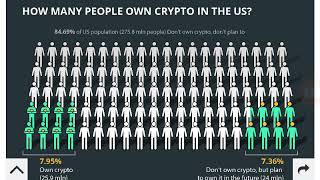
In this video, the creator examines a Cointelegraph poll showing that 84.69% of Americans neither own nor plan to own cryptocurrency, while roughly 8% own it and another 8% plan to acquire it. He frames the low adoption rate through the lens of economic elasticity, arguing that most U.S. consumers view crypto as a non‑essential, elastic good that can be easily substituted by existing financial systems. The discussion then shifts to identifying blockchain use‑cases that are truly inelastic—those that cannot be replicated by traditional infrastructure. He highlights SingularityNET’s AGI token as a decentralized AI platform that would require blockchain to prevent central control, especially as advanced AI and robotics (e.g., Boston Dynamics’ Atlas) threaten to displace up to half of the workforce. To address massive job loss, he proposes blockchain‑based universal basic income (UBI) solutions, referencing his own project, Bitcoin MYK, a Bitcoin fork designed to fund UBI. The video argues that while many see crypto as unnecessary today, impending AI‑driven economic disruption will create an undeniable demand for decentralized, blockchain‑enabled financial mechanisms, making crypto adoption a future necessity rather than a choice. The presenter concludes with typical channel calls‑to‑action.
Chapters
Hey you, welcome back to the channel. And guys, I hope you had a great holiday. We're back here on the channel to talk about how many people own crypto in the United States in this segment. So according to a poll conducted this year on Cointelegraph, from Cointelegraph, 84.69% of the US population, which is roughly about 275.8 million people, don't own crypto and don't plan to. Um, 7.95% own crypto, which is approximately 25.9 million people. 7.36% don't own crypto but plan to own it in the future, which is about 24 million people. So that, that leaves about 84 million people— I'm sorry, 275 million— 0.8 million people that don't own crypto and don't plan to. So let's think about that a moment and let's try to figure out why this is and why the American population, according to this poll, feels this way. So I think it comes down to something in economics we, we tend to look at as the inelastic versus the elastic, right? Um, and what I mean by that is that has to deal with the, uh, situation in which things that you need at the level you need them or don't need them, you're able to make adjustments. And so let's think for a moment about cryptocurrencies, and if we had to navigate in a world without cryptocurrencies, and let's take a scale of maybe 1 to 10. And try to factor on this scale or come up with a number, the, the comfort level you would have in navigating through your present environment without cryptocurrency. Would you be able to do it? Would you lose out on anything? Um, if you're trying to purchase something, would that be easier to do in your current economic system or in the cryptocurrency system? System. If you're on a gaming platform and you wish to play a game on a platform that is over the blockchain versus, say, traditional games online or what have you, gaming boxes, would you, would you have a less user-friendly experience? Would you have a good experience using these gaming modules and platforms outside of the blockchain? So I guess, I guess what we're looking at then, guys, is we're trying to factor here and figure out why Americans in particular in this poll don't feel that they need crypto or need to own it. And I, and I also think that would have a lot to do with the current monetary system in the United States, which is very good, and the banking is very good. And as far as the US dollar, there have been many predictions about the value, uh, the dollar being devalued and the collapse of the dollar, which basically translates basically to the, uh, collapse of the United States. And there have been many predictions made on the collapse of the dollar, and we don't know exactly when that will happen. We don't know if we're talking 10 years from now or 1,000 years from now. And I think that's part of the problem why In the United States, people don't feel they need cryptocurrency, uh, some of these, uh, factors we just touched on. So I, I think the problem is not so much that Americans find they don't need cryptocurrency or don't plan to use it. I think our presentation to them as to why they would need to use it and how they could use it is part of the issue. There was confusion. In my research, I found that the American people do actually need cryptocurrency, but not in the ways that many of us in the cryptocurrency space believe. So let's, let's come up with some ideas. What would probably be, when we think of the elastic and the inelastic, Or when we think of these great needs and great demands over, I can do something else, I can use something else just as efficiently. To bridge that gap, I think we need to understand uses of blockchain technology that cannot be duplicated, that is in great demand and needs to be used outside of these, these other factors that make Americans go, well, we don't really necessarily need this. We can function just fine without it. So there was a company called, uh, Hanson Robotics with a gentleman by the name of Ben Goertzel who decided to create, uh, this company called Singularity.net. Which launched a cryptocurrency called the AGI token, which I believe stands for artificial general intelligence. Now, Ben Gershow is this genius, uh, mathematician, robotics, um, artificial intelligence engineer, and he also is responsible for creating the Sophia robot. Um, that pretty much many of us well know from her many presentations at the United Nations around the world as she goes through these various exhibits in these various technological platforms where they discuss future of AI and robotics, various things like that. So what I'm getting at, guys, is we're talking about why Singularity.net, um, according to my research, and I think a lot of research that you'll soon begin to understand, uh, that is, is needed, uh, that this is probably the only way this can be done. And what are we talking about here? We're talking about super artificial intelligence that many people believe are on the way. So what does that mean exactly? Super artificial intelligence? Well, it basically means this next level of artificial intelligence, or it doesn't even have to be super artificial intelligence. It's just going to be such an advanced degree of artificial intelligence. Of course, we're talking the sophistication of these computer programs and what that will mean, what advantages it could give other governments, other groups of people, other nations, other companies. They could use these advanced artificial intelligence programs to get a gigantic leap on not only just economics but also, uh, national security issues and various things like that. So you could have nations like China and Russia with these super artificial intelligence machines that would put uh, nations like the United States in a position where they would be behind. And there's no degree to what that could mean. These machines could be so smart that they could create ways to get ahead and beat every other nation and disadvantage everyone. Uh, and again, that could be companies or corporations or entities or groups or what have you. How do you combat this? Why is blockchain needed? Well, what blockchain technology does is it allows this to be distributed across the blockchain in a way where this information and knowledge can be shared and not controlled by one central authority. And so when you couple all these factors into, uh, you know, the need for this type of decentralized platform where You can't have it centralized, controlled by governments and various things like that. Then you can kind of see where blockchain would be this, not just a good idea to use, but a necessary, uh, for, for our, our, um, survival type, uh, situation, right? So that's just one use in blockchain, uh, in a company again, it's called Singularity.net AGI tokens. Uh, when I look at blockchain technology, I look at the valuable tokens as things we're really necessarily going to have to use, that it is not a choice. It is not a choice for us to use this, that this is something that we're probably going to have to do at some point in time. So going on, on that same level, what else would be something in that same ballpark? Because I know a lot of people want to say, you know, want to think about the trans— the high-speed transactions, money transactions, right? And of course, many of us are moved to think of that first and deflationary monies and various things like that. But again, this is not a problem in the West, and we don't know how long, uh, it will be before it is a problem. Like I said, it could be 1,000 years. However, artificial intelligence advancements like the one I just discussed, we don't know if that's 5 years off, 10 years off, or 20 years off. But one thing is probably more certain and clear than maybe what you will get with economic collapse of, say, the US dollar. Is that these artificial intelligence revolutions will probably take place before that happens. Because some people are speaking 10, 20 years, probably unlikely to many, many economists are going to come up with a dollar collapse over the next 10, 20 years. Um, so what else? Let's keep going. What else would be one of these inelastic uses of blockchain technology? Again, I'm playing on these economic, these little economic terms to identify resources and how we use them and to what degree and which ones are necessary. And I'm trying to make this comparison with blockchain technology to the point to where we actually have to use it because it's a necessity and not just a good idea, not just a, uh, a way to have a little privacy and hide over here because maybe you want to do something wrong, or maybe you want to escape, skate around the law some kind of way. And I'm not saying, obviously, I'm not, I'm not saying, guys, that's what, you know, why people use cryptocurrencies in the blockchain. Um, that, you know, I— people do value their privacy, and I understand that, and censorship and various things like that. There are also those elements in there, but there are varying levels and degrees to this that make it to the point where, uh, there, there is, I believe, going to come a time with this blockchain technology where one has to be used. There is no choice but to use it. And so the next, the next thing I could come up with is my own personal project, which I— is always seem to be relevant more so these days and not to this and That of course is Bitcoin MYK. And the reason that I feel that we're on the precipice of where this may become a demand and much needed and not a choice is because on the same road of artificial intelligence, as we've discussed, you know, several times throughout the channel, and this is a major concern, major concern that the robotics revolution is going to take about 49% of our jobs. And we're gonna need a viable way to support these displaced workers, which is gonna be like about half of all of us. You're gonna literally, one outta two people you meet are going to be displaced and outta work by some type of artificial intelligence or robots. And in doing this video, I think I'm going to have to make it part of another video, but I originally wanted to show clips and videos of the advancements of robotics. There is actually a robot called the Atlas robot created by Boston Dynamics, and many of you've probably seen it, know something about it. This robot is the craziest thing I've ever seen. I'm going to link it in the description below. This robot is running up falling boxes, hopping from one box to the other without falling down. Now, there is probably a very low percentage of humans that can achieve these type feats, this type agility, this type strength, this, um, in the workplace. And even if they can, then they're— you're in danger of them falling, slipping, hurting themselves. Now you got multi-million dollar lawsuits and workers' compensation payouts. And so if anybody who watches this, that video, if you're still thinking that this is not a problem, that half of the jobs won't be lost and go to robotics, then I really think this will convince you that we're way more advanced even right now in this day and age in this robotic revolution than many of us believe or think. And so what, why is all this important to the blockchain? Well, the options that are going to present themselves is how do we get the new created wealth from this robotics revolution distributed to the people? And some people are going, well, oh, the government's going to have to create these, this basic, these basic need income packages or universal basic income. which I talk about a lot now these days. Not only do I think it's important for mass adoption of the cryptocurrency space and people needing to need it, needing to use it and wanting to use it, I just think it's just a good idea overall, even when we think about the political gravity of the situation, because what you would have is we would have this ongoing division where you would have money forcibly coming from, uh, people to support the program. Now, I, I think personally, if it comes to that and there is no other choice, then that may have to happen. However, I think we can plan for this now and use the blockchain in a way where it doesn't have to happen. Uh, in other words, what we can do is we can still give people the choice through blockchain technology, through the growth of the blockchain in the crypto space, to create viable solutions while it's still their choice to solve this problem. And we could be so far ahead of it that it wouldn't have to come to force by the government, or even the government having to manage this and probably not doing a very good job at it. Government managing projects like this, we found to, in some similar situations, we found to be problematic. And so we wouldn't need to do any of that. This could work on a scale where this can be achieved. So I'm not going to go deep into Bitcoin MYK. Uh, it's other, I have other videos that talk about it where you can, you know, you can find out how our universal basic income plan works. To the cryptocurrency space by use of a Bitcoin fork. Uh, and it, it's a lot of details and information about it. So subscribe to the channel if you're interested and watch those videos. And I think you might like and find some interest in what we're saying with that. But getting back to why people don't care, they don't care to use blockchain technology because they don't need it. Uh, it's just easier. To go and do these fast transactions, whether it's hand-to-hand, whether it's me putting direct cash in your hand, or whether I'm using a Visa transaction, right? Or whatever traditional financial means I'm using to conduct my money. And so that's what's going on with that. But when you put this into the blockchain technology, why they would need to use this to transfer information, whether it be through value of this token or or what have you, or just the use of the blockchain itself coupled to these cryptocurrencies, then I think, or like universal basic income, where there would be this viable need to transfer this value to these displaced workers, um, that's going to be an undeniable reason to use blockchain because you're going to be looking at about 1 out of 2 people that need this. And again, some people are going the way of the government, but if you go the way of the government, think about it's going to— first of all, it's going to be centralized to this one authority and municipality and these one entity and powers. It's not going to be global for everybody. In other words, you might have a good universal basic income program going on in one country and you might have an utter disaster in the next. But if you decentralize the entire thing, it goes all over the world and we provide a solution over the blockchain for this much needed concern. That is not a question of whether it will happen, just the question of when, uh, and the when I think is coming much faster than the why or the where or the how. And so Guys, that's all I want to really say in this video. Guys, if you like content like this, don't forget to like, subscribe. If you love to have conversations like this or blockchain-related conversations, feel free to join us on our Discord chat channel. We'll leave a link in the description. And guys, that's about it. Enjoy the rest of your holiday season, and until next time, take care.
More from Michael







UBI - CIA Agent Explains Why Americans Will Never Get Universal Basic Income?



