
Andrew Yang - 4th Debate " Return Of The Mack"
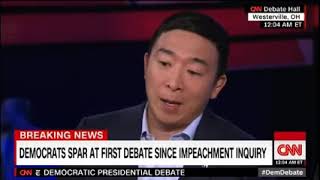
The video provides a post‑debate reaction to Andrew Yang’s fourth Democratic primary debate. The commentator first highlights Yang’s argument that automation is displacing jobs, citing his data‑driven clash with Elizabeth Warren over the impact of technology on the Ohio manufacturing loss. The host then praises Yang’s overall performance, dubbing him the “Return of the Mack” and noting his assertiveness, effective rebuttals, and improved stage presence. The analysis moves to policy contrasts, critiquing Bernie Sanders’s federal‑jobs guarantee as unrealistic and championing Yang’s Freedom Dividend (universal basic income) as a better solution for displaced workers, caregivers, and the elderly. Tulsi Gabbard’s alignment with UBI is presented as a potential foreign‑policy asset, linking her military experience to Yang’s “America‑first” stance. The commentator dismisses the Democratic focus on impeachment, arguing it distracts from the core issue of automation‑driven job loss. Finally, the video shifts to campaign logistics, describing Yang’s strong fundraising quarter and the creator’s own cryptocurrency project, BitcoinMYK, which aims to funnel crypto donations (Bitcoin, Ethereum, Litecoin) to the Yang campaign, explaining how tokens can be earned or mined and converted for campaign contributions. The overall tone is enthusiastic and supportive of Yang, with occasional critical remarks toward opponents and the Democratic establishment.
Chapters
of the Fourth Industrial Revolution and automation. Now we're here in Ohio, and Ohio has lost over 300,000 manufacturing jobs and went 8 points to Donald Trump in the last election. But that's a good story, but it's not the reality. That's what Senator Elizabeth Warren said. Innovation, you know, sounds good, makes a great story, not why we're losing jobs. The studies I've seen say the exact opposite, but I had an exchange with Elizabeth during one of the breaks And I said, I think audibly, I said, I have the data. And so she said to me, I want to see the data. And I was like, fantastic. So hopefully we'll get her the studies that I've been referencing for months now. So this line of questioning is actually going somewhere, I promise.
Welcome back to the channel, Yang Gang. And, you know, I don't think I have to say it. I think you all pretty much know How the fourth debate went. Clearly Andrew Yang has returned as the Mac. Return of the Mac. Uh, I kind of teared up a little bit, uh, during, uh, the debate because for me Andrew Yang had become the man we needed him to be. You know, not tomorrow, not yesterday, but today he had became the man we needed him to be. And, um, I, you know, pretty much during the entire debate, I have to say that I was blown away by how Andrew Yang handled the debate, how his exchange was with the other candidates, how the CNN moderators, uh, Or this time, I think it's safe to say fair. Some of us believe that's due in large part to the Yang Gang, you know, keeping them in check. But it pretty much went fantastic, guys. I was just, I was just so satisfied with what we got, you know, in this debate. You know, just for reference, Return of the Mack, as I got in the title of the video, it's an old hip-hop song. And, you know, people are making jokes about how Andrew Yang's bringing back old hip-hop songs and making them popular again. And it's a great song, actually. It's a great song. It's a song I remember when it first came out that I liked, and I remember my brother saying he was against the song. And he can eat his heart out now. But it's become a part of the Yang Gang campaign, and I think it works appropriately. And Andrew Yang has in my view, actually become the Mac. Now he handled the debate just like a Mac. So let's talk about a little bit. Let's, let's get into some of the, what happened during the debate. Some of the things that I thought were very important and that worked. And I, and I think, uh, when Andrew Yang squared off against many of the candidates this time around, uh, he was very assertive. He was able to get his points across again, you know, due to a lot about how to Um, how the debate was handled as well. Uh, you know, how the moderators, um, were handling the questioning and, uh, you know, like, you know, like I've always said, you give Andrew Yang enough time, he is going to make the case to the American people and that's what's happening. So of course Elizabeth Warren, as we kind of got to see in this, um, in this, uh, basically this CNN, uh, forum here, this post-debate forum, how they were trying to talk about how Elizabeth saying the data, uh, doesn't work out for the automation, uh, uh, uh, case that Andrew Yang's making. But you know, here's the thing, let's, during the exchange between Andrew and Elizabeth, I like how Andrew, Andrew Yang spoke to her and went, you know, American people aren't dumb, right? You know, this, this is when you look at data, right? There is data and then there is actually what's happening. And then together with the data and the application of the data, right? You're able to make a pretty good case as to that data backs up that particular situation, right? So if I were to tell you something like, there is data that says we're in a good economy in relation to past economies, but then I tell you, but the actuality and the reality of the situation is, over 60% of Americans can't afford a $400 emergency if they miss one paycheck from their job, they're pretty much in financial ruin. Then when you combine that data set with what's actually happening, then it becomes harder for that data to back that up, right? So in Elizabeth's case, with a situation like that where during the exchange Andrew goes, well, you know, the reality is American people aren't dumb. They know when they walk in their Walmarts or their McDonald's, they see all these kiosks and systems that have been automated. And then of course the logical progression is, and what happened to those jobs, right? That the people did before, did they go on and get another job or did they become the people who programs those kiosks, right? So a 39-year-old retail worker, it's probably not likely she became the programmer of that kiosk for that, for that, that, automation that's taking place in her, in her, in her job, right? So that probably didn't happen. If she was lucky, she might have went on to become a Zumba instructor or something like that. But it is not hard for the American people to combine the data and see that the acceleration of technology, as this keeps happening, uh, and it keeps happening on and on, which is technology gets better, gets faster, um, that these people aren't going to be able to keep up with the job displacement that they're victims of, right? And then he goes on with the truck drivers, right? And so, I mean, the— it's almost common sense, guys. But anyway, I like how Andrew Yang was just so, so masterfully crafted everything and put it in terms that, you know, the American people can listen at and go, well, yeah, that's, that's pretty much the case. I mean, she's saying one thing, uh, that, that the data doesn't support it, but Hey, I used to walk into Walmart, I'd see like 30 cashiers and now I see 1 or 2. So obviously there's something going on here. Um, you know, and so I thought they were great questions that Andrew Yang got as well. Of course, some of the big highlights, squaring off against Bernie Sanders and the federal job guarantee right now. Um, you know, I can't think of anything. You know, you gotta remember this is America, right? When is the last time that you ever pictured in America at any timeframe in history where most of the Americans were working federal jobs, that most of Americans wanted a federal job, right? It almost seems un-American, doesn't it? And I don't think it really helps Bernie's campaign because see, a lot of Bernie's campaign has been kind of shifted off to the Democratic socialism, basically them trying to say he's a full run amok socialist type, run of the mill type. And now he has this federal jobs guarantee. It sounds like something out of a communist manifesto. I'm just being honest. That's what it sounds like. But it's not going to work well for Americans. Because it forms the narrative that, you know, like Andrew brought out, all Americans want federal jobs, that they want to work for the federal government. Why would you want to? You know, there are a lot of Americans who still aren't sure if they trust the federal government, right? Um, and to kind of put your entire destiny into the federal government's hands because, you know, you're basically saying, well, you know, the federal government is going to supply these jobs, it's just weird to the entire market structure. You know, that you're going to have the kind of the federal government has to keep competing and creating these jobs. So it just doesn't, uh, seem to work well. And universal basic income works a lot better. The Freedom Dividend makes a lot more sense. Of course, Andrew addressed, uh, the idea of, okay, well, everybody who's— who can work, who's capable of that level of work, that type of work, right, goes out and get this federal job, but it only works for people who can go out and work those federal jobs. It doesn't work for people, uh, as Andrew brought out, like his wife who stays home and does, um, more labor-intensive work than many of us ever do because many of us aren't parents. Or even if you are, you probably go off and work and somebody else sees about the children or something to that effect, or your wife does, or whatever the case may be. But a lot of people won't actually do that. And I can tell you, I've tried to babysit several times, and these kids are busybodies. Every minute of the day, every second, you got to be constantly watching them, got to be constantly paying attention to them. And it goes on and on for— it is very labor intensive, a lot more labor intensive than many of the jobs in the marketplace to day. So a federal jobs guarantee obviously will not compensate people in that area, obviously will not compensate people who are taking care of their elderly parents or taking care of, um, elderly people, uh, whether it be for friends or, or whatever the case may be. So there are many areas that could be classed as work that is maybe even harder than the jobs that many Americans do when they complain about, oh, people need to go to work and they need to do something instead of depending on the government. But wait a minute, a lot of people are doing something. It's just that the market hasn't found a way to value their work yet, right? To present them with a check yet. Um, but it's work nevertheless, right? So we have to kind of redefine and reframe what we're saying about jobs and work, especially in this very technological world that we're moving into. Tulsi Gabbard, we, you know, she has this, she makes this point and I just thought this was perfect. Tulsi makes this point that she agrees with Andrew, universal basic income works. Is Tulsi now vying for a safety net in her campaign to be part of the Andrew Yang campaign? And as I've said in earlier videos, it would make so much sense. Because if I did have to nitpick one thing, Andrew, you know, no matter how good he's become in his presence and his domestic policy and his assertiveness now in exchanges with these candidates, the foreign policy still lacks something, doesn't it? Right. And, uh, right, you know, he's making a good case that make your home strong, right? It's very similar to some of the things Ron Paul, I think, was going for. He was saying, leave the, you know, pull out, abandon all the bases, come home, right? Stop meddling in other people's affairs, right? So when Andrew Yang speaks more from a domestic sense of building up America first and making it healthy, and then that being one of the best foreign policy situations you can have, a strong America at home, it does remind me of Ron Paul's policy. And it does to me suggest ideas like that can be great foreign policy, having a strong setting at home, having a great defense, which is better than a good offense, right? Or that good defense is the best offense, right? So I kind of, my mind kind of pulls me there when I think in relation to Andrew Yang's foreign policy. However, having somebody like Tulsi Gabbard who, you know, has been a soldier, has been in these countries, have dealt with some of these foreign dignitaries and presidents and had sit-downs with them, she certainly would work well to strengthen Andrew Yang's foreign policy. And I like that she's on board with the universal basic income, which means she becomes part of his candidate and many of her voters will now move over to Andrew Yang, uh, you know, in the event that she's not gonna win, which is definitely looking like that. But her people move over to Andrew Yang and there's not gonna be any friction. There's gonna be quite a bit of harmony in that cabinet as they're on the same page, right? Just a fantastic debate, you know, kind of getting to the closing when they talk about um, who's a very unlikely friend for, you know, for your campaign. You know, are you gonna, you know, is it gonna end up being somebody like the situation with the Trump administration and Rudy Giuliani and all of the criminal-minded friends that Donald Trump has made during his, uh, uh, campaign, uh, his, uh, his administration, right? And, um, Andrew gives the best answer, right? One of his most unlikely friends is a Trumper who becomes a truck driver, who's a truck driver, rather, but sees that the Andrew Yang campaign is better for his situation. I think his name may have been Fred or something like that. But what could be the best unlikely friendship than to make friends with ex-Trumpers people who don't even support your platform that now become your friends, come over from the most extreme side of the other, uh, side of the aisle and find common ground in your policy and their situations. What a great and fantastic, uh, a story to give about his unlikely friendship. The impeachment came up. Of course, everybody's been talking about how this ridiculous impeachment— I call it ridiculous. Now here's the thing, and I've said this in earlier videos. The impeachment will work when it's time to square off one-on-one with Trump, right? To remind American people of— you potentially have this criminal, right, as your president in the White House, right? That never hurts to have some ammo like that. But the reality of the situation is the impeachment situation, right, as Andrew brought out Number one, it's probably not even likely that Donald Trump's going to be impeached, right? So this is, to me, this all looks like just Democrats spinning their wheels and, uh, trying to, uh, they don't, you know, not having a really solid platform like Andrew has to defeat Trump, kind of spinning their wheels thinking impeachment is going to do it. Donald Trump's probably not going to be impeached, right? And as Andrew brought out, it doesn't go to the root of the problem, which is Donald Trump being the symptom of a problem that hasn't been solved. And that's the automation away of the jobs. Now, Donald Trump's being removed, being impeached— whether you remove Donald Trump and you put in another Republican president, whatever the case may be— until you solve the issues that got Donald Trump elected in the first place, really doesn't matter. Whether he's impeached or not. So for the Democrats to even focus so much energy day after day after day on stuff like this, right, shows the ridiculousness of how our government puts together its priorities, how it forms stories, and how it relates it to the American people, uh, in a way that it really solves a problem. It almost makes me feel like they aren't really problem solvers, right? Now, uh, I also like, uh, what Andrew's surprise was. He said he's going to sit there for 10 hours and, um, answer questions for people who have questions that they just haven't had answered yet. They're going to get a chance to understand Universal Basic Income better, the Freedom Dividend better, uh, and his policies better. And that's the best thing Andrew could be doing, right? You know, uh, although the— I, I will say that the awarding families and kind of running these, uh, these, uh, early tests, getting data from these early tests, I, you know, I will say that was quite important, uh, to— for people to have that effect, to feel the effect of what it means to have the Freedom Dividend. But only a few people are going to be able to experience that, so that's not still going to speak to the masses of the American people, so to speak. Now, although it did raise his Twitter followers, in turn, which raises, uh, basically the donors, which is awesome, needed that, and that works. And so it worked at that particular portion of the election. I am very glad to see that Andrew's taking a more practical approach, that what these people need now is to be educated more about the Freedom Dividend, what exactly it is and why we need it so, so, um, so, so, so severely, right? That we need the Freedom Dividend. That is going to be the surefire way to deal with what automation is going to do to us and to deal with the, with the jobs lost that Donald Trump promised to bring back that he's not going to be able to bring back because they've been automated away, right? So this is giving them a chance to get educated, right? That's going to be more important than giving 10 families $1,000 a month of Unfortunately, although again, I think it worked initially. I'm glad to see Andrews, uh, evolving his platform and moving off into different areas. Very, very important. Um, and I just want to say, uh, you know, I can't put into words— a lot of you guys, I've read, you know, comments across social media. Some of you guys were jumping up and down, happy with joy. I just kind of sat there with tearing up a bit, being proud to see that Andrew Yang, uh, you know, has, you know, in my opinion, now become the strong candidate. He's become the best Andrew Yang he can be pretty much at this point. And I think that's working quite well. Um, I don't see quite the results of the polls yet, but I think we're going to start to see a large shift now in Andrew Yang's polling data. I think everybody else is kind of at a standstill, right? I think like people like who's leading them like Kamala Harris, whether it's Pete Buttigieg, and even Bernie Sanders. I think he's going to start to take away some of their, some of their steam there because I think for what everybody's seen in a lot of this is a great standstill in many of these other candidates' platforms. And the only place Andrew can go is up at this point. I think at the point, at this point, they can only pretty much go down. Like, I don't really see them really gaining anymore. I see everybody now kind of just falling down and Yang gaining against them, right? So I think I really, my prediction is Yang is about to start to suck up all of their votes, right? And I think this debate proved the long-term, you know, staying power of Yang and the progression of his campaign, right? And how it's rising gradually, but it's like a juggernaut. It's not stopping. It's continually moving forward. Um, I just want to say, um, you know, donations are important. You know, he had a— uh, Yang had a very impressive quarter for raising, um, donations. And, um, it's very important that he do that. Now, you know, a lot of you who watch the channel know I talk about a project called BitcoinMYK. Now, uh, it's a cryptocurrency. Now, what many of you all do not understand, don't know about, I haven't really— I don't think really got deep into it, is that The Andrew Yang campaign at this time takes cryptocurrencies as donations, right? So what happens is you can go in like with Bitcoin, Ethereum, and Litecoin. These are cryptocurrencies. It's just kind of like being your own bank, a kind of a change to the monetary system over like 6,000 years that a lot of people are getting into because it's money that can't be inflated, right? For the most part, uh, it's more safer than your bank account or credit cards. And so, uh, as we move into the 21st century, a lot of people are moving into this. Now, the Yang campaign can take donations in Bitcoin, Litecoin, Ethereum, and likes. But what we didn't get a chance to really tell you all about with our Bitcoin project called BitcoinMYK was that we had initially planned to go to the Yang campaign, set this up so that people could receive, uh, or make donations to the Andrew Yang campaign without pulling money out of their own pockets. And how this works is cryptocurrency is a bit complex, but it's able to generate value and money through exchanges. And as people come in and get these cryptocurrencies, they can earn them. In many cases, like with our system, you can earn them free, um, or you can mine them, right? Which kind of— I won't go get deep into detail about that, but there's ways you can get these cryptocurrencies either free or almost free. But what it would allow then to happen is for us to be able to help the Yang campaign raise a lot of donations by accepting Bitcoin MYK and having all of our people in cryptocurrency and a variety of people able to move value into the Yang campaign without pulling money directly out of their own pockets. It's kind of very similar to like how we recently had this Robinhood thing going around where you'll use an affiliate link from the Robinhood wallets or exchange, and you get so much money just by joining. Now this money then translates into value that could be given to the Yang campaign on your behalf, right? Kind of similar to how back on Facebook some years ago, people just by upvoting posts just by voting on polls, uh, you get value and money to those polls, and it can help these people gain recognition, raise millions of dollars for their cause, or what have you. That was the initial idea behind BitcoinMYK in reference to the Yang campaign, and it is still on the radar. But our system has been— a lot of development in our system, and a lot of things have, um, pushed that, uh, off. Now, stop this kind of temporarily from going to the Yang campaign. But I can tell you this, you can get the tokens free, and you get the tokens free, you could then sell them for Bitcoin, which the Yang campaign does take. So I might have to do a whole separate video for this, you know, just to kind of drive that point home, but, and where I kind of show you guys how to do it. But that you can get BitcoinMYK tokens, sell them for Bitcoin, and then donate the Bitcoin to the Andrew Yang campaign, which I think would be an awesome idea. and I'm gonna try to design a way on the website to do that, but look out for that. Uh, go ahead and join our site today. Uh, it's absolutely free to you. You don't have to give any of your real-life information. Give fake emails, fake names. We're not interested in, uh, personal identity. We just want to make sure that the accounts are, uh, unique people and not people trying to game the system. But you can raise value through the system and then donate to the Andrew Yang campaign. So I'm gonna do a video probably tomorrow. I'm gonna talk about that a little bit in detail. But that's all I want to say in this video. If you all like content like this, don't forget to like and subscribe. And until next time, guys, take care.
More from Michael







UBI - CIA Agent Explains Why Americans Will Never Get Universal Basic Income?



