In this video, Andrew Yang addresses a common criticism of his Freedom Dividend (a $1,000 per month universal basic income) – that landlords will raise rents, leading to inflation. He argues that the opposite could happen: a stable monthly cash flow would give renters the financial confidence to pursue homeownership. Yang cites a Forbes article by Lawrence Young that outlines how homeownership fuels the economy through a multiplier effect: homeowners buy and sell multiple houses over their lifetimes, generate demand for lawn care, remodeling, furniture, mortgage services, and local spending, which in turn creates jobs. He explains that mortgage lenders would view the guaranteed income as a lower‑risk borrower, potentially increasing loan approvals. Yang also references a real‑world example of a town offering free housing to attract residents and stimulate the local economy, using this to counter the narrative that UBI is a socialist threat. He briefly mentions his own blockchain‑based UBI project that aims to circulate value locally. The video concludes with a call for viewer opinions and a standard YouTube call‑to‑action.
Chapters
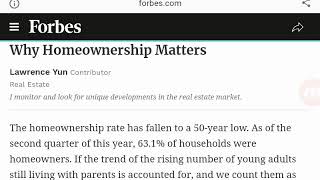
Welcome back, Yang Gang, and I hope you're having a great day. I wanted to talk to you all about the Freedom Dividend and home ownership. I thought this was important because, um, our last video kind of dealt with one of the big issues of, uh, of what comes up as, uh, a negative to the Freedom Dividend, and that is this idea of inflation. So Uh, we kind of go over that and explain some misconceptions about inflation and universal basic income or the Freedom Dividend. And, uh, we invite you all to take a look at that video. But what comes up also a lot— I, I think this video needed its own video, or this topic rather needs its own video— and that is the idea of, uh, uh, one of the big next big issues with the Freedom Dividend or giving everybody $1,000 per month would be that your landlord's gonna wanna raise your rent price 'cause he's gonna say, well, everybody has $1,000, and so why don't we just raise it up? And everywhere everybody goes, they're gonna have to pay more money. Well, the thing is, this actually kinda is a good thing because what it does is it kinda or could possibly create a situation where a house whole full of people getting $1,000 per month are going to just go, well, you know, maybe it's time to just own something. If I gotta pay all this additional money, then renting's probably not in my best interest anyway. But it's more than that. Now you have a new class of people, a large group of people who has a more stable income. And what does that mean for the mortgage companies? Uh, that means that, you know, it's more likely that you're going to get approved for homeownership mortgages, right? But it's more than that. What happens to an economy where people start to make decisions like this and start to buy homes? And taking a look here at Forbes magazine, uh, they, they come up with several great points that talk about, uh, the advantages of home ownership to an economy, or the, the, or the benefits it brings to an economy, and why it's so important to an economy. And this article is done by Lawrence Young, um, and, um, he makes many points. We're not going to read the entire article. I will leave a link in the description of it, but I'm just going to try to highlight some interesting points that I think we should consider. One of such being Ownership is good for the economy. Americans do not view ownership as one and done. They want to constantly improve. So homeowners after 7 to 10 years typically sell their starter home and trade up. For some empty nesters, improvement may mean downsizing. Whatever the case, homeowners do buy multiple homes over their lifetime and in the process contribute to economic growth, and job creation. With each home sale, there are expenditures related to lawn care, home remodeling, new furniture, mortgage origination, moving, and an inducement to build new homes. Some portions of these earned incomes subsequently get spent in the local economy, what economists call the multiplier effect. In the form of eating at restaurants, going to a ball game, or buying a car. In essence, the new job is supported from every 2 home sales according to NAR calculations. So that's pretty interesting, isn't it? So that, in other words, if homeowners tried to do that, or landlords rather tried to do that, raise the rents of all of these people who have this newfound freedom dividend, it could just push them into homeownership, and it could just even make a door open wider for the mortgage companies. They might see this as an opportunity. But as you look at what they term the multiplier effect, you begin to see there's a great deal more to consider about what it's going to do to that local economy. Some of these people might then go on, like they say, they might one-up and just start real estate companies or real estate business. They might remodel, do more builds, build from the ground, give jobs to lawn care personnel, right? The furniture companies in your local area. All of these things are stimulating and pushing this economy forward. Now, it's kind of funny because the argument is that it's always that all this free money's going out. But there's never any, uh, consideration of what money's coming in. If you think of something like an investment, I call it a Freedom Dividend, a reinvestment back into the American people. That's, that, that is my reasoning about it, right? But if you think about an investment, right, money goes out kind of in a free— you could, you can almost say it goes out free because usually when you make an investment to someone to start something, it does not, uh, basically, um, uh, uh, you know, they get the money, you know, from the beginning, you know, and, and so, uh, the startup money, and, and that's it. Now, you know, it's contingent upon them doing whatever agreement was made, but there are certain conditions that could happen, as we discussed in the Freedom Dividend, that could have a type of, uh, well you know, basically have a type of situation where now people are pushed to become homeowners with this, this newfound money. And, uh, we could have a situation like that. So I just think it's kind of important that, uh, we kind of look at the whole picture and look at many scenarios into what can happen. Just saying people get free money and we become some type of socialist regime, uh, in a situation, and we, we become a new Venezuela. I think is a, uh, is a great misunderstanding of how an economy works. I think it's a great understanding of how the Freedom Dividend works. Obviously, it's a misunderstanding of many other economic factors that are going to impact us. But that's all I want to say in this video. I, I love to hear you guys' thoughts and opinions on it. Can we expect a great deal of more homeowners in a, in a situation with an American Freedom Dividend? Um, and just want to invite you to read the rest of the Forbes article about the, uh, what happens when you, uh, with what homeownership, uh, positively, how it positively impacts an economy. Uh, it's kind of interesting. It's not very, very long ago I was watching a news story. There was a particular town in the United States that actually wanted to give people free real estate just to come live in their, uh, towns. They had to stay so many years, I think it was like 5 years they had to, they had to, uh, uh, agree to stay to help to stimulate and to promote their local economies. Now think about that for a second. They want to give you a free home, give you a free place to live, right, uh, in, in some middle of America town somewhere, uh, to stimulate and boost their economy. Now that's free, isn't it? That's, that's free. So if it's always this doom and gloom socialist message of the destruction of an economy, why do we have so many examples of sound economic policies and theories where people give out money, give out land, give out resources in hopes to stimulate and, uh, uh, improve the economy, right? Uh, why do we all of a sudden stop short of that and then go, oh, okay, well, for some reason or another in this particular case, it will work different from those examples, right? What data do we have that that is the case? Uh, and so I find all this very interesting. What data we do have is we have a great data, like, provided here at Forbes about what happens when people become homeowners and, and how how people, how mortgage companies love, happen to love stable income. But that's all I want to say in this video real quick. Check out our own Universal Basic Income project over the blockchain. I'm not going to go through the whole spiel. A lot of you watch the content by now. If you haven't joined yet, you're probably not, but it is there for you. A Universal Basic Income project using blockchain technology gives you value. You can cash to your local economy every day. But that's all I want to say. If you like content like this, Don't forget to like, subscribe, and until next time, take care.