
Andrew Yang - Google Assistant - Idle Threats?
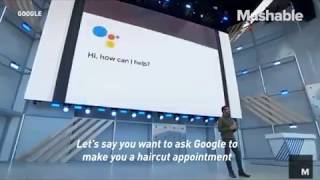
Andrew Yang demonstrates Google Assistant scheduling a haircut by phone, then argues AI job displacement isn't an idle threat. Call centers and telemarketing are already being automated, and unlike past technological shifts that took centuries, these changes happen in years. Yang pushes universal basic income as the solution.
Chapters
It turns out a big part of getting things done is making a phone call. We think AI can help with this problem. Let's say you want to ask Google to make you a haircut appointment on Tuesday between 10 and noon. What happens is the Google Assistant makes the call seamlessly in the background for you. So what you're going to hear is is the Google Assistant actually calling a real salon to schedule the appointment for you? Let's listen.
What's happening out there? Hi, I'm calling to book a woman's haircut for a client. I'm looking for something on May 3rd. Sure, give me one second. Mm-hmm. Sure, what time are you looking for around? At 12 PM. We do not have a 12 PM available. The closest we have to that is a 1:15. Do you have anything between 10 AM and, uh, 12 PM? Depending on what service she would like. What service is she looking for? Just a woman's haircut for now. Okay, we have a 10 o'clock. 10 AM is fine. Okay, what's her first name? The first name is Lisa. Okay, perfect. So I will see Lisa at 10 o'clock on May 3rd. Okay, great. Thanks. Great. Have a great day. Bye.
Hey, you all. Welcome back to the channel. Hope y'all are having a great day. So you know what an idle threat is? Idle threats are, uh, basically when, uh, they're a threat isn't followed through, right? So with the Andrew Yang campaign and the idea that Andrew Yang is kind of created this gimmick to push universal basic income And the concept that, uh, um, uh, that's real far off, we may not need it, um, uh, or, or, or, or it— things may change. It, it becomes this Industrial Revolution type situation, uh, where, uh, we just kind of, um, evolve past that and people— everybody becomes a computer programmer. 1:00:00 And I'm not going to go into that part of the Industrial Revolution and really what happened and the difference between the jump from the Industrial Revolution to flight to space travel and all that. These highly accelerated jumps we hadn't seen over thousands of years. 2,000 years ago in the Roman Empire, they had indoor plumbing. They didn't get indoor plumbing again until about almost 2,000 years later. People were using outhouses, right? So there wasn't this kind of catch up to technology and revolution in that idea. But anyway, you just witnessed something extraordinary. You witnessed an AI, this artificial brain and mind, having this conversation with a real person is scheduling an appointment, which basically accounts for, geez, I don't even know how many telephone jobs appointment takers there is through the workplace all across the country. And we're seeing that now. That really technically means that all of those people can be out of a job at any time. We're talking a lot of people, call centers, right? Call center workers, right? All over the globe, call center workers. Uh, you know, all those buggy telemarketer people who call you and the people who do those jobs, right? Telemarketer jobs. There's a lot of 'em. I know because they call my house all the time. But the people who do those jobs, like how long is it before they could just make that computer, uh, call your house and sell you something? Who would want to do that job anyway? It's tough being a telemarketer, but it looks like to me it'll just be easier to have that computer do that job, right? And all those people who are trying to feed their families on that job are out of work. Do these seem like idle threats to you all? Because what I hear a lot is, oh, this is far off, this is far off, this isn't a real threat. Oh, he's just kind of used this scare tactic to get UBI and just find excuse to give people free money. That's what the rebuttal is to Andrew Yang's campaign and universal basic income. And mentally, many people can't even see the, determine the, see the forest from the trees, right? Because they're kind of in that same mindset of this isn't real, this isn't happening. right? And it's far off. Oh, this could be 10 years off or something like that. So at what period of time through this scheduling does this become something necessary to do something about, right? You know, remember we used to hear these stories like, oh, in 5 years such and such might have a nuke, in 10 years they might have a nuke and we need to do something about it. Uh, let me ask this question. When you're in that place, do you reason in a way— is that, is that a good strategy to reason on an, on an eventuality? Is it a good strategy to use that kind of thought process to reason with it? Okay, so we got 10 years, let's wait to year 9, and then we're gonna— we got to year 9, let's kind of weird, strange reasoning, isn't it? Right? And imagine how disastrous it would be if you wait to the last minute, try to do something about it because you think you got all this time. Nobody can really estimate, right? What we do know is what they have now and what's happening now. And technology moves fast. That means what we just witnessed here— in fact, this video is almost a year old now. That means this conversation you just heard happened over a year ago with this computer. Think that computer, that AI is better or worse, right? I give this example a lot too. This is a very interesting example. Um, I have an uncle who owns a construction business and he's at the point in his construction business right now where there are a lot of people he doesn't even need to work. He's just working these people so they can go feed their families, right? He can just as easy get machines to do their job without risk of them being injured on the job and him having to deal with problems of injury on the job and workers' compensation and all that. They are in a sense more burden to him than him just working a machine, right? Getting a machine. He, on purpose doesn't use machines so they can have jobs. That's not a good job demand, uh, uh, uh, uh, system, is it? That's not a good— it's not— that's not a good way to work. That we don't need you, but, uh, we're just gonna work you anyway so you can feed your family. That's not a good business model. Right? Good business model is generally something like productivity and efficiency. And that's just the way our system has created the work, the how work, how it, how it is. What are your thoughts on that? Right? And we know this is happening, but the idea is don't worry about it right now. Don't come up with a plan right now. The environment is dying and in trouble. Let's not do it today. We got maybe 10, 20 years before it full stop is contaminated and we're all dying, and at which point we can start working on it then. These seem like very serious problems to me, and, and I have no way to gauge this technology, how fast it's moving. I'm gonna stop right there, guys. You all tell me what you all think about what some have declared to be this gimmick, this tactic, which all sounds ridiculous if you really sit down and think about it. But that's all I got for this video, guys. Uh, real quick, uh, doing my, um my Universal Basic Income program over the blockchain, across borders. We believe Universal Basic Income is a basic right to every human being on the planet. Join our website, join the program. It's absolutely free to you. Only, the only thing it does gives you value that we feel you as a person deserve, because we believe value comes out of you into society and not the other way around as a byproduct of materialism. But that's all we got to say in this video, guys. If you like content like this, don't forget to like, subscribe, and until next time, take care.
More from Michael







UBI - CIA Agent Explains Why Americans Will Never Get Universal Basic Income?



