
Andrew Yang - Inflation/Finland/Social Security
In this video, the presenter—who claims a background in investment firms and economics—examines common criticisms of Andrew Yang’s universal basic income (UBI) proposal, arguing that it is not inherently inflationary. He explains that Yang’s plan funds the Freedom Dividend through a targeted value‑added tax (VAT) and closing corporate tax loopholes, rather than printing new money. The speaker critiques the Finnish UBI experiment, noting its limited sample size, focus on unemployed participants, and premature conclusions, and argues that true UBI should be universal and stimulate entrepreneurial reinvestment. He then clarifies that Social Security recipients would receive the UBI on top of their existing benefits, positioning this as a political advantage for Yang. Throughout, the presenter interweaves his personal economic perspective—conservative, pro‑tax fairness—and promotes his own blockchain‑based UBI project that claims to deliver real cryptocurrency value. The video concludes with a call to action to join the crypto platform.
Chapters
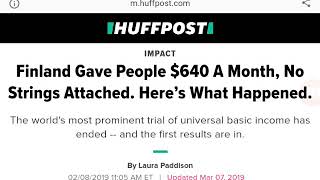
Hey you, welcome back to the channel. And guys, I hope you're all having a great day. I want to talk to you all a little bit about Andrew Yang. We're going to discuss a bit about inflation. We're going to talk about an experiment that took place with UBI in Finland. And some news came across the desk yesterday about Social Security, Andrew Yang clarifying a position, uh, with, uh, Social Security retirement recipients in which, uh, they will be able to now receive both universal basic income and their Social Security, uh, benefits, which I think is awesome. And I think it's going to be quite appealing to our honorable senior citizens. So we got some clarity on that. But let's talk about inflation for a moment. Um, so my background, I've worked for several investment firms. I've been a student of economics, uh, probably since I was about 12 years old. I remember winning a trading competition, uh, having to deal, uh, do with picking stocks and, uh, in school. I remember winning that and getting involved in a lot of economics, money in general, and learning quite a bit, as much as I could about it. And I like learning about money and it felt natural to me. So when we speak about money, a lot of what comes to mind is terms like inflation. When we couple terms like inflation with universal basic income, they somehow start to become synonymous to many people. The understanding is people are going to be receiving this money, they don't have to work, and so there's going to be this unmet demand, uh, and thus that's going to drive the price up. And, and so a lot of people tend to I guess you could say kind of naturally their minds kind of go in that direction. But we're going to dive a little bit more into some of the complexities of how inflation works in a model like universal basic income, some of the misconceptions about it, and we're going to try to give a little bit of clarity to that. So first of all, you have to understand what inflation is, right? Inflation is increased demand and generally more money into the system, right? There's more money being pushed in the system, yet the demand, the supply and demand factors are still quite high, right? So you have a high demand, you have a low supply, but you have now more money into the system, right? So you, you still can't meet the demand, right? Because the supply is still lower than what the demand is. If that, if that makes sense, right? Now where things get mixed up in universal basic income is the assumption that the supply is not available. And so this is the confusion when we start to get people talking about, well, then you're going to go to the store, your soft drinks are going to cost $20 a bottle and this and that. And everybody's going to say, oh, well, he has more money and thus he has more money. So we're going to price gouge now. We're going to charge them up to the roof. But we're about to clarify many of those misconceptions about how inflation works. So in the first part of that, in understanding in Andrew Yang's universal basic income program, right, because I have to be specific because it could be that some universal basic programs, uh, work different, right? They— it could be that people just issue universal basic income, have no idea where the money's coming from to pay for, and thus there might kind of create this inflation-like atmosphere. But in Andrew Yang's plan, for those of all who've taken the time to read it— and what kind of irks me about some YouTubers who get on here and talk about UBI is gonna cause inflation— a lot of these people, it's clear to me they haven't even read Andrew Yang's policy, right? They, they haven't read how he plans to pay for this and where this money's coming from, because Had they have read it, then, uh, they would understand that this is not inflation, but this is using, uh, money, right? And supply. Let's kind of use them interchangeably already in the system, right? So it's not a, uh, increase in the money supply, yet the supply is low and the demand is high. This is the same supply and demand factors that already exist in the system. Uh, and so this— that's vastly different from what many people are, are saying about, uh, universal basic income. Hold on one second, guys. Let me turn down my computer. Sorry about that, guys. I leave my Discord running and all of the messages and beeps get really annoying while I'm trying to speak with you all. But anyway, um, so there is no change to the supply and demand factors to cause What they're running in these kind of doomsday scenarios about what happens in inflation and universal basic income, right? So they're, they're erroneous right there with that. Another thing that gets left out of the conversation is the idea that there's this, all this money that's going out of the economy, but they haven't factored the money that's coming into the economy as a result of universal basic income. If you understand velocity of money, the more rapidly money moves from person to person, right, the more likely another person has a chance to create more money from that. That means like in the case of where now maybe a business who hadn't been receiving X amount of money supply or dollars or capital before they now have more money to create more businesses, to innovate more, and to make a more prosperous economy. Let's take for instance, the idea that people who won't ever get a job, won't ever work, they'll just decide to live off their universal basic income. Let's take in their communities, let's take, let's just come up, make up a number. Let's say, uh, out of 5 people in a particular community that's getting universal basic income, let's say all those people decide not to work and they're just kind of a leech on society. And so they take all that money and what they do with it, where they spend it with their local businesses and shops. So what's happening there now, there's an accelerated drive of of value to their local businesses. Now, whereas that may very well be the case that these people are the leeches of society, that they are nonproductive to society, that they're never going to get jobs, their role in facilitating this movement of money has now got it into the hands of people who will, right? So even though we might have in that example 5 people who never are productive, in the sense of some of us term it, then it moves on to these business creators who now have the opportunity to create something prosperous for that neighborhood, create more revenue in that, in that neighborhood, right? And creating a better atmosphere and surroundings for that entire neighborhood. So Those are factors that get left out. There are many, many examples like this that don't get factored into these studies, don't get factored into inflation. But this is not inflation. It is an error to say that UBI will cause inflation. It is a very much, I would say, ignorance to how the economy really works when you leave out key ideas of what causes inflation. Uh, in the case of Andrew Yang, he has accounted for where every dollar will come from. Now there's another thing that kind of irks me that I hear a lot, and it hears things like, oh, taking money from Amazon, taking money from the rich to supply this, they're the only people working and you're giving it to people that work. Well, first of all, it's not that UBI is taking money from Amazon, it's that Amazon isn't paying their taxes. They're using tax loopholes like many big corporations. And I'm not blaming the companies or the corporations. You know, I'm not some type of socialist hero that just wants to get big companies. In fact, my economic values are quite conservative. But the reality is the tax code does not work. That's why you need a VAT. In order to evaluate a tax, in order to make sure everybody pays across the board. Why would you want a company generating billions of dollars into the economy that can help a country in debt with a deficit? Why would you want them not to pay, uh, taxes, right? You want them to pay their taxes. If they can skirt around paying their tax, So the money that they're not paying is not taking money. It's not stolen money from the rich. These are just people who didn't pay their taxes. Uh, and, uh, these are people who use, uh, lawmakers and lobbyist groups to keep the tax code in a way that they don't have to pay their taxes. It makes sense, right? You would, you would, uh, a business job is to try to make their investors money. Right? But our job is to make sure everybody, uh, is, uh, uh, as, uh, patriotic about the American system and pays their fair share. Now, I think it's a shame that we have to play this cat and mouse game to where, uh, prosperous companies don't just go, you know what, America has given us so much opportunity and made us so great that, you know what, I don't want to avoid paying taxes. I want to Of course, I'm hoping for too much, but at the very least, I would like people to understand that that is not taking money from the rich. These people owe taxes to the American people and they're not paying them, right? And I think it's despicable. Uh, so first off, that's, that's where the money's coming from. It's coming from VAT that are targeted. Now, a lot of people try to make the example, or they try to say things like, Well, this VAT was going to hurt poor people. Not exactly correct. This VAT is going to be catered in a way where it targets higher-ticket items, uh, taxes on higher-ticket items. Now we have a variety of luxury taxes and things like that. Now my honest opinion about paying taxes is everybody should just pay their fair share of taxes. Right? Taxes are taxes. I don't necessarily think it should be a higher tax for a richer group or a lower group. I think you should— as long as you're paying your taxes. The problem has been the tax loopholes that have allowed these big companies not to pay taxes at all. And different from what you would get in a lower income person who may manage to not pay a few bucks in taxes, with big corporations, we're talking billions, if not trillions of dollars that don't get, uh, accounted for, uh, uh, helping the United States government pay its bills. Uh, and so this is a lot of the stuff that gets left out of the conversation, horribly left out. UBI is— there is no evidence that UBI is inflationary unless the inflation existed to begin with, unless the UBI was launched and, uh, there was no way to pay for the UBI in the first place, right? So I would call that mismanagement if, if a country does that. In Andrew Yang's plan, it comes about, uh, primarily from, uh, the, uh, money that already exists in our economy, right? There's no outside money coming in, there's no additional money being printed like maybe in the case of Venezuela where the idea was that we're out of money, let's just print more money. No, it doesn't work like that. Uh, and that's not what's happening under this plan. So for people who talk about universal basic income, I understand many of you all don't study economics. You never maybe took an economics class, but it is not hard to look at counterpoints and try to be clear about some of the things you say about universal basic income. Next thing I want to talk about is Another point that comes up a lot in universal basic income, and that is the experiment that happened in Finland. Finland gave people $640 a month, no strings attached, and here's what happened. Now, I've went through the actual study, not just what people, uh, have quoted that they heard from somebody or a variety of things. And first off, it's only 2,000 people. Right now. This is significant, uh, that in these polls, when you hear a poll and you hear data, that you ask questions like what was involved in the poll, who did the poll, who did the poll target, and a variety of things, because all these details are important. But we see in this poll in Finland, uh, and I don't care what country or nation tried it, there the— from what I've seen, even when Canada tried it All the results are similar. All the results are similar, right? Uh, they take unemployed people. They took 2,000 random unemployed people, right? Or if they're not taking unemployed people, they're taking very low-income people. Uh, and I kind of understand the reasoning behind that— give it to the people who need it the most. But that's not what universal basic income is about. That more so sounds like welfare to me. Right. And I'll never make an argument about welfare being a good thing. That, that's another misconception I think about universal basic income, that it is welfare and only for needy people. Uh, and if you're thinking about universal basic income that way, you're thinking about it wrong. You should be thinking about it more like a dividend for everybody because this is all key because number one, In normal UBI, in the real universal basic income, they're not just giving it to unemployed people. They're giving it to rich people. They're giving it to business creators. They're really giving it to a lot of people. And what are these people doing with the money? They're reinvesting the money. They're, uh, they're doing a lot more than just walking around with no job and trying to live off what some of you term a handout. When you just give it to poor people, when you give it to unemployed unemployed people, when you give it to low-income people, yes, it will mirror a handout. Then it will be that because you have specified a demographic of that. That's not how it needs to work. It needs to work in a full encompassing sense where we have different brilliant minds doing a variety of things with this money and it will yield better results. So besides this, the next part is the study won't be concluded until 2020. So whoever's coming out with it failed in Finland, it failed here and there. Uh, first of all, that's erroneous because it says clear that the results— I'll read it right here. The trial ended in December while final results won't be available until 2020. And they did have preliminary results, Uh, and some, some of their results were quite favorable even amongst just these 2,000 unemployed people. Um, but that's not what UBI is about. And this data to me would be, uh, not good data because again, UBI works— you're going to have people who get this money, who reinvest this money, who don't need this money necessarily just to survive off of. And it's going to be a lot of reinvestment into that. Another thing that got left out is the amount of money it's going to— new money gets introduced in the system, about the amount of crime it's going to reduce, mental illness is going to reduce. And this study does talk about some of that, but it doesn't assign a price tag to it, right? Which means it's a pretty bad study, right? Because it talks about, oh, well, we see it aided somewhat in mental health and health overall and well-being. Well, if it aided in health and well-being, shouldn't that equal lower medical costs, lower healthcare costs, right? Why don't those figures get factored into that? They were only given $640 a month, so that's far beyond, uh, uh, what would be, uh, meeting a person's basic needs and in pretty much every country in the world now, especially in the West. You have to be around $800 to $1,000 to meet that. But you know, in any event, uh, a lot of people take this study and they take the one in Canada that did a similar thing, uh, where they took unemployed people. I think it was 4,000 this time. Same thing, just giving out welfare to people and expecting welfare to be anything other than welfare, because that's a problem with the welfare program today, that it is cyclical and it does keep people trapped in. This has to be a totally encompassing effort, right, uh, process, so that we can have enough velocity of money move around the economy, getting it, getting it to not just people who are trying to survive and live but getting it back to the American taxpayers to use it to innovate and create things, spend their own money instead of the government spending it, basically. And through that idea is what's going to create the prosperity in something like universal basic income. Yes, it's going to help a lot of low-income people and people in poverty. And replace a lot of welfare systems. Yes, it's going to do that. But in order for it to work effectively, it's also going to have to be in the hands of American people to spend the money more properly than I think that the government does it right now, right? Because in government you can get corruption down to a specific group, right? Or you could just get mismanagement of funds that aren't theirs. But if you disperse this money to American people, I believe the overall result to the economy will be a positive one. That, that is my opinion on that. Clearly, I don't think this study is enough to conclude anything about universal basic income does not work. I think it is utterly ridiculous. And the people who are going around saying things like this, I wish you all would study a little bit more about money, about the differences in inflation, and universal basic income. Uh, I very much appreciate if you all would do that. Now moving on to Social Security benefactors, right? Um, so I had did a video not long ago that spoke about, um, our honorable senior citizens and Where's their place in this? And because we weren't clear on the details, a lot of the information I put out was mostly about the overall great effects UBI would have on senior citizens. Maybe they aren't struggling, they're in their golden years, and maybe now they're in their retirement. And maybe they're doing, you know, have enough to survive and maybe have a little something put away to retire on. but they're being bombarded from their communities and their families and their grandchildren and their children, right, who are still in economic distress. And so, um, you know, a lot of the video talked about if they didn't receive, uh, any universal basic income, uh, proceeds, that this would be, uh, still a benefit to them. Because of the world around them, right? Uh, and seniors responded to the video, and, uh, they were as honorable as I thought they were. They didn't really care if they didn't get anything or not. The fact that it was going to make the world a better place for their neighborhoods and their children and their future generations was enough for these honorable senior citizens to step forward and say we're for this. Well, the good news is they don't have to make any sacrifices now. It has been clarified through Andrew Yang's policies that Social Security is a system that we pay into, that in that case it's like an annuity, and this is not a handout, and that because they have paid into this, this should have nothing to do with, uh, being a universal basic income being a factor. And I agree with that 100%. These people are not getting a handout from Social Security. They've paid into it all their lives, and they should receive universal basic income, Social Security recipients, on top of that. Now, I'm not sure about the other Social Security programs under that. I know for the retirees, uh, it is that, uh, and, and, and rightfully so if they paid into it. So now This is great for the Andrew Yang campaign because now senior citizens will have an extra $1,000 a month. Guess what? If they don't need it, they got grandchildren and children and a lot of people in the neighborhood, they can give it to their favorite charities. I would rather they have it and spend it than the government. Uh, and I, I trust they'll do a great job with it. It's their money. It's all the taxpayer money. It's the Freedom Dividend. And so I, I, you know, again, me studying economics all these years, I, I deal with money projects all the time. I'm dealing with one right now, uh, dealing with cryptocurrency. I, I got a history of, uh, credentials for several investment firms. I, I can work for any investment firm in the country right now if I want to. Uh, I think I'm a little bit, uh, more experienced at this than some of you all. To say the things I'm saying about universal basic income and, you know, in the economy in general, right? And, you know, no economist will tell you that universal basic income equals inflation. If a company attempts to go, okay, well, you got an extra $1,000 per month in your pocket, so, hmm, I'm going to now go up on your rent or I'm going to make your products at the local grocery store super high. Well, gen— if you understand competitive pricing, right? Competitive pricing means anytime you attempt to do something like that, and we're in an economy where the supply is being— is there and being met, right? The supply and demand factors are being met. It's not, um, an inflationary economy really, because the capital is still in the economy. Oh, what's gonna happen is somebody's gonna realize that they can undercut you and make a bunch of more money on you trying to overcharge these people, right? Because nothing's really happened to the economy. It's not true inflation. It's not that the demand has overrun the supply. That's not the case at all because the value, right? And the productivity and the labor is still in the economy. Why? Because if you got a robot, that's doing— become more productive, technology has driven the price of products down. It hasn't driven it up because now you got a robot or some type of technology doing the work of 100 men. Now you got 100 men you don't have to pay. What happens to all that value in capital? Well, it goes to somebody like Amazon that now creates a robot that can build a robot. So now you got robots building robots. And so who, who's the worst, the labor output in that, right? Are you still saying that Amazon deserves that because they've created the robot that built the robot? Amazon maybe didn't even create the robot. Maybe they just bought the robot from somebody else and they just start creating more and more robots. So, you know, that, that's kind of ridiculous. One of the most sophisticated robots, Sophia, Uh, you can look her up. Very interesting robots talked in front of United Nations. Saudi Arabia has made her a United— uh, a, um, has made her a citizen of the country. You know what that means? That, that means that you can't come in now and try to, uh, take the IP rights of Sophia. No country— United States can't now come in and say that we're going to take the IP rights of this robot and make this robot do whatever we want. No, because they made this robot a citizen, a recognized citizen in their country. So it won't happen in Saudi Arabia. Now this robot's labor and productivity in theory now can be taxed, which would make sense. And then that taxes can go back into the government, right? They taxes the individual. But to have robots building robots and this monopolistic line of companies like Amazon making billions of trillions of dollars off it. I think it's utterly ridiculous. I see no philosophical difference in that and what you would get with a monopoly on businesses. If I'm a business and I outcompete you, uh, legally and rightfully, I was just better at it, the government will come in and they will make me break up my business. Right? So you're telling me that we can have, uh, robots building robots and one entity just taking all the value and production and money from that, and the government doesn't have a problem with that, but they have a problem with, uh, if I'm a really good business and I just happen to outbeat you fair and square, they're going to come in and break me up just because you're not as good as me and I managed to buy all the businesses around you or own all the all of the, like a Monopoly board? No, they say that's wrong. So this should be wrong as well. You, we have to study economics before we make the statements we're making, guys. Some of you all do not understand, um, how economics works, or you wouldn't be saying half of the things you're saying. Uh, but I'm going to leave that conversation off for another day. Going back to Social Security, this is great for seniors. Uh, I think it's going to garner more votes for the Andrew Yang campaign, going to probably start to pull a lot away from Biden because Biden's been the, the safe play for many seniors. But wait till seniors hear about they're getting an extra $1,000 per month, right? They're living off their Social Security, some of them doing pretty well, but some of them probably struggling and got to pay those extra medical costs. I meet a lot of seniors like that. Now they got an extra $1,000 a month. Help with that, right? Makes a lot of sense, doesn't it? And I think it's going to work well for the Andrew Yang campaign. But that's all I got to say in this video, guys. Let me plug this last part real quick. Doing my own universal basic income project over the blockchain technology, accessible to the globe. It's starting off pretty well, kicking off pretty well. Uh, we're doing some great, um, partnerships with some great businesses. We just listed with the Freedom Exchange. We're on the Steam Engine Marketplace. We're on the Waves Exchange. And we think this is going to be a great product and a great experiment. It's value to you all for joining. You get real value, this cryptocurrency that can be converted to real money, right? So it's just not a game. It's not just fake money. It's not just digital money. You sign up today, you start earning real money, right? So you don't want to throw that away. Want to jump on that. All thousands of you all, all the Yang Gang should be signing up for this, right? Because it's pretty much your mantra already. So want to plug that. Going to leave a link in the description. Try it out, won't cost you anything. It's handing over value to you all. But that's all I want to say in this video. If you like content like this, don't forget to like, subscribe, and until next time, take care.
More from Michael







UBI - CIA Agent Explains Why Americans Will Never Get Universal Basic Income?



