
Andrew Yang - Only Democrat Can Win!
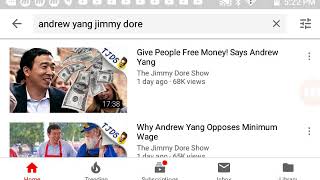
Andrew Yang is the only Democrat who can win because he unites across party lines, unlike Bernie Sanders and Elizabeth Warren whose far-left policies alienate moderates. Yang opposes wealth taxes and the $15 minimum wage, favors universal basic income, and supports Medicare for All.
Chapters
Hey you, welcome back to the channel and I hope you all are having a great Sunday evening. Uh, I'd like to take a moment and speak with you all about Andrew Yang. Um, as I've been doing some of my research and following his campaign, uh, it hit me that, um, when I did the, uh, video, uh, several episodes ago, Andrew Yang will win. Um, I thought it went over quite well. A lot of people I spoke to since that video, from whether it was Trump supporters or, uh, independents, or, uh, even, uh, whatever the case may be, just different American citizens, as it was for all, all of the American people to see that this is what your next president looks like. Um, uh, I thought, I thought the video went over well and I was very impressed with what was happening with Andrew Yang. Unfortunately, although that video was meant for everybody, I think this video here is meant just for Democrats. Now I'm not a Democrat, but in this particular election, in this particular set of circumstances, I believe that Andrew Yang is the best candidate for America. Um, and, uh, he's running as a Democrat and I want to see him succeed. But the problem is I'm finding that many Democrats, um, are not seeing the reality of Andrew Yang's campaign in comparison to some of the ideas many other Democrats they support, uh, are putting out there. And I think this is something we need to talk about. So let's, let's first consider something, and that is, what are the components that makes a good leader? All right, is a good leader a leader for one group of people all the time and that serves that people's, that, that group's needs? Or is a, or, or does a good leader sound something more like this? A person who can unite the entire country, that can unite parties under one banner. Think about some of the greatest figures in history, some of the greatest leaders in history. They generally— what generally precedes them is a similar narrative, right? That they were able to unite some tribe, they were able to unite some people, they were able to unite all the people, they were able to unite all the cantons, they were able to unite all of the world in some ways. Or another. And so these are components in the makings of a good leader. Now here's the problem with what I'm seeing with a lot of Democratic, uh, uh, candidates in their, in their approach to, to the American people in this, this entire election. They have a very myopic, uh, view of what is best and what is good for the American people. Uh, when we take the something like the Constitution, right, and we read the Constitution, it says something to the effect of we have the right to pursue happiness, the right to act, the right to go forward, and the right to go out and make our lives better, right, under the liberty, given the liberty to do that. Um, the problem is under the Democratic banner that has moved, uh, very dramatically out, out of the, uh, generally shared views of the American people. Um, it goes from the right to pursue that to that it is something deserving of them to have, that the government should provide those things. Now, in saying that, there is the idea that exists in the Constitution, that well-being, uh, of citizens, and where that comes as— that's interpreted in many ways, uh, to mean several things. That could be whether that be healthcare or whether that be, uh, making sure every American has a job and employment or whatever the case may be, uh, that there's a— there's a— that can be interpreted to several degrees. right? But we don't seem to have a shared opinion on what exactly, uh, the government should do for American citizens. Thus, we have parties and we have this very, uh, split, uh, uh, um, group of ideas. What we do know and what does matter in this election that's coming up is that we're going to elect a leader, one leader, to be President of the United States. And this leader an idea should be the best leader we can get, not just for one particular group, but for everyone, right? For everyone. So saying all that, I say all that to say this: when we look at the Democratic candidates that are running now and you really listen to what they're saying, is anything that they say Do you think that it can unite people? Does anything that they say, uh, is it a something that they can work together on in unison with another group of people? Or is it such a out there, so far from away from what the other side wants, that is probably no possible way for them to work that out? Because That's what leaders do. That's what good leaders do. And that's what we want. We want a good leader in office. They're able to unite, right? It doesn't really matter, uh, how right or wrong you think something is, right? You know, at the end of the day, there are going to be good Democrats. They're going to be good Republicans. They're going to be not-so-good Democrats. There's going to be not-so-good Republicans, right? Everybody's idea of what should— what is right, what is wrong, what should be social justice, how much is enough, and what should be done— all of those things are going to be considered and identified as a problem in different ways with different people for different reasons. So, so now let's try to put all this together and understand why Andrew Yang works better as, uh, the, the Democratic candidate who can win, and the only one who can win in my opinion, who would even be able to get remotely close to doing this. I know a lot of people love Bernie Sanders. A lot of people love Elizabeth Warren. A lot of people maybe love, uh, Beto O'Rourke. They, you know, Kamala Harris, Cory Booker. A lot of people love a variety of candidates. Joe Biden, right? Um, for different reasons. But when we look at these policies, are they policies that can unite the American people? So let's, let's, let's look at, uh, How Andrew Yang does that as a Democrat and how he does something that none of the other, uh, uh, candidates can do, right? Things that Bernie Sanders cannot clearly do. So when you look at Andrew Yang, uh, what might not resonate, resonate well with a lot of people is that Uh, Andrew Yang is against the wealth tax, right? He's against targeting rich people, wealthy people, and taxing them. And a lot of people say, well, they should be taxed. They're, you know, they're wealthy people and they got more money than I got and they can afford to do more, right? And it should be this way and it ought to be that way. But when you trample on concepts, right, when you target a group and you don't put emphasis on the concept of why things are and how they should be in a proper context, what can happen is that can circle back around, and then the things you find important may not be as important to the people who can make the decision to give or take that away from you as the other people. That's why it's very important that we, uh, have an ideology that is consistent of fairness. And so in that, no, we cannot just have a system that just because you make more money or just because you have more, you should be targeted or treated a certain way. Along this concept, it doesn't work. Now, Andrew Yang understands that. That's why in the universal basic income idea, everybody gets the same amount across the board. This is, drastically different from what we'll get with like Bernie Sanders. Bernie Sanders is almost to a fault may demonize the idea of the wealthy, the wealthy, the wealthy attacks against the wealthy. And in his ideas, and again, I think Bernie Sanders is a decent human being. I think he's a good human being, but I think the political message he's sending is clear. And that is that people with money, wealthy people should be demonized to a degree. And he rallies the people behind that because of the idea that they are the reason that the system is the way it is. And whether we want to go into whether it's factors to that, whether they're true or not, in keeping with the basic concept of justice and fairness, we cannot just have this idea where people just take money from one group to give to another just because in their mindset they have a moral higher authority or higher position to say that is why it should be that way. It just does not work. So Andrew Yang doesn't support any kind of wealth tax. Now, getting back to some of the discussions we had earlier, some of the ideas we had earlier about what makes a good leader, being able to unite people, being able to connect with people across the aisle to unite all, to be a president for all people and not just a myopic viewpoint of, uh, this idea of social justice people may have. Um, Andrew Yang also, uh, opposes the minimum wage. Again, these are things that sound horrible, right? I'm sure it sounds terrible, especially to, to if you're a Democrat, but the reasoning behind that is What happens when you, you make people, uh, pay a higher wage right now? Interesting enough, um, the Jimmy Dore Show that's, um, had Andrew Yang on several times now— I'm just catching up on them, I haven't watched them all, I'm gonna watch them all— but Jimmy Dore, um, is kind of one of these interviewers, he's kind of tough-hitting, and I kind of like that. I kind of like that Jimmy Dore is hitting Andrew tough, and Andrew's trying to come out of some of it, but it's important because Andrew Yang's going to have to be ready because he's going to be getting hit pretty hard as he moves up throughout this election. But of course, Jimmy Dore hit hard on why he's against the minimum wage. But as Andrew Yang explains in this, and as many of us know, the minimum wage when you make— like, if minimum wage gets set to $15 an hour, when you make a job— an employer pay $15 an hour, what do you, what do you think he's gonna do if he needs to hire somebody? Now, a lot of people, the first thing they'll go— like what happened in the show with Jimmy Dore— what Jimmy Dore goes is, oh, you know, that's kind of bullshits, right? Because if I really need you to work, I'm gonna hire you and I'm going to have to pay you that. So I'm going to have to give you the $15 an hour. But how many people have been on a job and seen the exact opposite happen? How many people have been on a job where there have been, they've gotten a raise and now they got to do 5 or 10 extra jobs they didn't have to do before? You know, because that's what happens, right? No, they don't necessarily hire more people. They overburden the workers they have. And so what they're doing then is they're skirting around minimum wage, right? They're making these people the workhorses. Now, you know, also they're going to do all they can to cut back. It also, you know, can hurt mom-and-pop shops who are trying to hire extra people who can't afford to pay that minimum wage. And Andrew Yang explains that a lot of these people will be let go, overburdened, people would be overburdened with jobs they got to do 2, 3 times the same work for the same pay. Um, and, uh, the lower age college to teenage workers that a lot of people don't really consider that serious, but especially in poor groups, you will find that a lot of these teenage workers who are able to get these jobs from employers are able to do so because of the fact that they don't have to pay them as much, but that extra money is sometimes money used back home with their families to help pay bills and a variety of things like that. And so a lot of those things could be hurt. You know, in the interview, Jimmy Dore didn't think so. He thought the employer would just be there enforcing it. He says if he still needs to hire 50 or 100 people, he's just going to keep doing that and paying more money. But the reality is it doesn't necessarily work like that. So that's a lot of why Andrew Yang was against that, but it's probably also better to free float the market and not have that idea of blocking wages from workers. Also, being an African American, it's pretty interesting history that a lot of components of minimum wage was established as a way to keep the African American or the slaves coming out of slavery to the skills they learned trying to survive doing whatever they they could, uh, they would take— they would be willing to do work for a lot less, uh, than the, uh, other Americans. And so they established a minimum wage so that these people would be forced to pay it, uh, to keep them from working, right? So now you got to give it to the— to the— to a non— a non, you know, person who didn't come out of slavery. Um, and, and so the, the very history of the minimum wage is not good. Uh, but don't get me wrong, I'm not for— I'm not against fair wages. I'm not against, uh, workers paying more fair wages, but some of us believe the market kind of naturally does that. As you get more skills, if you don't hire a good worker, another company might see the value in their skills, and now they can produce more and they can compete better, and they end up putting these people out of business who won't pay a more fair wage, right? Um, so Andrew Yang is able to resonate across the aisle on, on these ideas, yet at the same time, uh, being able to support a lot of the social programs, at least an idea. Uh, he supports, of course, Medicare for All, uh, the universal basic income to help Americans by stimulating their local economies, putting money back in there. Now here's my fear, and here's what more likely is going to happen. If the Democrats attempt to run with another candidate, they're going to be one of these far left candidates, right? Like Bernie Sanders, like Elizabeth Warren, who are gonna come with these notions, uh, and it's going to divide the American people, right? You're not going to have a situation like Andrew Yang where he can draw Trump supporters, uh, and a variety of people, uh, you're gonna have the election from 2016 and Democrats are gonna lose. Now, I, you know, I know a lot of Democrats think, well, it's the right thing to do, right? And in a perfect world, that would be true, right? It would be true in a perfect world for the American people to treat all of their countrymen neighborly and fairly. But the problem is, if we need a government to force us to be neighborly and fair to one another, that probably means it wasn't going to happen anyway on a level that we thought, right? And so, um, and so I just think we got to be very careful with that. But I think very dangerous territories. If we try to, if you try to run these very far left Democrats through here with the same stuff they've been talking about in 2016 and left and lost. Now, now the next problem is Trump is a sitting president. Statistically, it's very difficult to beat a sitting president. It's also very difficult to be a sitting president and, uh, who's, uh, partaking of a healthy job economy right now, right? Uh, you know, the statistics are in his favor. So to send people against Trump that are going to get classed as complete socialists and the whole socialist stigma that is negative in the American, uh, uh, viewers' eyes for like the last 80 years Uh, it's not a winning, uh, uh, scenario. It is not. Just take a moment, think about it. You will not beat Trump. Now, um, Andrew Yang, even this universal basic income idea and the Medicare for All that he's supporting, that I think are the right things to do, even those things are straddling the fence, right? But with universal basic income, it's confusing to a lot of the Republican people and people on the other side because some of them have supported to a great degree because the idea is many oftentimes when there is money that needs to be spent, a great bit of, a great part of the conservative mantra has always been that they'd rather the people spend the money than the government. So given the choice, The conservatives will accept money being spent by the American people before they accept the government controlling this money and doing all these programs and a variety of things. It will not work. Uh, it will— they, they, they will— so, so the point I'm making, guys, is that although Andrew Yang is running as a Democrat, he kind of represents these ideas that they can attach to. right? And, and can become, uh, the next president of the United States because he can bring so many different views and ideas together. Now, if you're the all or nothing type person, if you're the go bust or go home type person, then you probably will be going home with nothing, with none of these things, but with Trump for another 4 years and hopefully not another conservative president. After that in the Democratic view, right? Because my view is, you know, I'm going for the candidate who's the best candidate and policymaker for that particular time in that specific time. And, you know, the purpose of this video is not to convince you to go out and necessarily vote for Andrew Yang as an American. You know, your vote, it's about voting for whoever, you know, you, you, you feel is right to vote for. And that's the same thing when we talk about what the Democratic candidates stand for, that those other people on the other side, they have the right to do what they want with their vote, uh, to the best of what they think is right. And, uh, the job of the candidate, the person running for president, is about getting over to them and hopefully getting more people to vote for them. It's not about just being, I'm on this side and this is how it should be, and you're on this side, and there is no way to have that message resonate with people. And again, I think people like Bernie Sanders, I think he's a great individual, and I think he's a good person in his idea of what is right and what is good. But any idea of what is right and what is good Uh, you know, it's up to the American people in this country to make that decision, right? It is not the message of just one, you know, uh, idea, you know. It's— we have to weigh that, you know. It's a lot of good and bad that goes into everything, so we have to kind of find what that is, right? And no, it's not one person's narrative of what that should be. Um, But that's, I think, how we have to look at this, or the situation will be 2016, right? It's a reason 2016 happened. Now, also bear in mind that there's nothing that wasn't said in 2016 that's being said here in 2019, or what will be in 2020. These are the same policies and the same idea. The only new idea I see is Andrew Yang's idea. All of the other things are the same thing we were hearing in 2016. So unless The American people have somehow evolved and adopted and changed that idea. There are no new messages. So basically in my mind what that translates to is this, that pretty much the way these candidates are going now, whether you're Trump or on the Democratic side, somebody like Bernie Sanders, you pretty much got the same people that you always had, right? You're probably not convincing anybody too much of anything. These people are probably pretty much, but I think Andrew Yang is the point in which those things change. But anyway, that's my views, guys. Tell me what you think. Tell me, how do you see this, right? Do you see this like, can we have a Democratic candidate come in with super, these super far left ideas and win this election, right? Let me know what you think. I'm interested to hear it. If you like content like this, don't forget to like and subscribe. And real fast, guys, I always throw this in here, that the universal basic income idea, for me, an idea is a movement. It doesn't stop necessarily with if Andrew Yang wins or loses. This is something some of us see as what should be a basic right coming forth in what will be a technologically advanced world. And, uh, if you believe that too, uh, I, I would invite you all to join my link, um, in the description, uh, in the comment section that talks about a passion project of mine where we create, uh, a world using blockchain technology to provide universal basic income for every citizen of the world, um, void of any government, outside of government, run on, uh computer systems, uh, on sets of decentralized servers that cannot be shut off. Um, and, uh, if you're interested in stuff like that, feel free to join our project or, uh, or comment about or ask questions about it. We, we'd love to hear from you. But that's all I got to say in this video, guys. Uh, until next time, take care and take care of each other.
More from Michael







UBI - CIA Agent Explains Why Americans Will Never Get Universal Basic Income?



