
Andrew Yang - Phase In/ Opt In - My Thoughts
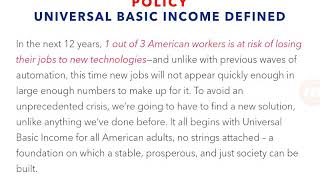
Andrew Yang's Freedom Dividend would roll out gradually to poorest neighborhoods first, funded by a value-added tax and luxury levies on corporations like Amazon. The $1,000 monthly payment covers basic needs only and works alongside existing welfare, not replacing it. Conservatives like Tucker Carlson and Ben Shapiro have backed the idea more than Democrats.
Chapters
Hey you, welcome back to the channel and let's talk Andrew Yang today. So let's, let's talk a little bit about phase-in, opt-in. So I've been, um, looking around the internet a little bit and I found some, a lot of concerned people, uh, about Andrew Yang's campaign and a newly done interview he did. I can't remember the name of the the company he did this interview with, but it was about phasing in how universal basic income, how the Freedom Dividend would work exactly, the process. And words came up like it would be phased in over time and it would be a testing period with it. And so it's this idea that Everybody wouldn't get it, but it would maybe kind of go out in sections, and over time, eventually, everything goes right, everybody would get it. And now the problem with that, and why it created so much ruckus and a lot of concern, Andrew Yang supporters, is that, you know, like many of us probably thought, it would probably just be something to the effect of, uh, we're going to start cutting these Freedom Dividend checks, universal basic income checks, next week. You know, I just got in that, you know, like Andrew Yang just got into office and he's already, you know, cutting those checks, uh, and they're scheduled to go out the following week because, you know, for the most part, his entire campaign is really about the Freedom Dividend. So we're You know, we're waiting on him to do that. All of the people who are part of his campaign, that's the driving force. That's the entire platform. So what's the holdup with that? What is the problem? So that's what's been the ruckus with the entire thing. So let's, you know, look at that a little bit. So it's kind of divided a little bit. Some people, I think like I kind of knew it, generally it's a process to these things and, 1, you know, that, uh, right, you know, kind of similar to, you know, when we had, uh, uh, you know, back when we had, what was it, uh, like Obamacare and a variety of things that didn't go out right away. I think it was a period of time before it went into full effect, right? Um, some people say things like, well, why is it so much trouble? Why don't you just cut the $3-4 trillion check? Because, uh, When there's a war or something like that happening, uh, we don't have any problem finding the money there. So I understand all the concerns, and to a great degree, uh, to a great degree, I agree with them. But, you know, we do, we do have to kind of be realistic about the, um, the mechanics of this thing. Because like, even if, you know, we say something like, well, You know, every time we need to find money for wars and stuff like that and spend trillions of dollars on wars and they don't have trouble. Well, how that works is, remember, wars can last decades. And yes, they spend that much money, but there's a process in how the money is spent. Congress has to, uh, you know, okay a budget and all that stuff. So it's a process to that. This doesn't happen overnight. It can happen over the course of months or years and and a variety of things. So I didn't, you know, so I didn't really kind of have a, like, a picture of universal basic income just going out to everybody, you know, overnight. So I, to me, the phase-in period just kind of felt like a necessary, you know, progression that it would, you know, work to a great degree that way. Now, at the same time, I will say this, um, you know, some people are saying things like, well, to give it, you know, the time for to get the taxes from Amazon and, uh, understand how the, the, the VAT, the value-added tax works, um, and where to, where to implement it. Because there is also this issue of, you know, that, uh, you know trying to make sure that the value-added tax doesn't hurt impoverished people, poor people, uh, that, you know, that they're not affected by that. And so, you know, some ideas, you know, Andrew has proposed, of course we know about, you know, you know, um, targeting, uh, like Amazon and more, uh, much so the like luxury and taxes, like, you know, maybe if you go out and buy a yacht or something like that, and kind of targeting those taxes, uh, at the purchase, right? So you can't try to— they can't try to use tax loopholes and a variety of things, uh, so that these people pay. Because one of the, uh, one of the big arguments as well has been that, uh, it would hurt poor people. And so this, this is something the opposition to Andrew Yang's policies, they just use this one to the end because they know it's a point to try to turn people against Andrew Yang. So they try to oversimplify it like all these poor people are going to be suffering, they're going to have the burden of the tax. But no, what this period of this phase-in period will also allow for is for, uh, the administration to find out where the taxes on the VAT, the value-added taxes, where it needs to really, uh, be focused, right? And so of course that's going to be luxury and items. So it's not going to affect poor people, it's going to still be rolling back to the luxury and items and, uh, the, um, people like Amazon, you know, paying sales, all these sales they're doing, so that they will pay taxes on a variety of things. So there is going to be— need to be a process to that. Now, you know, do I wish they could just go, you know, when they go in the office the next day and say, okay, this is passed, get everybody a check? Sure, sure, I would love that. But, um, you know, I'm— I have to look at as well Uh, you know, as they're implemented, as they start, let's just say it starts in certain regions of the United States. Let's not— now I would imagine that Andrew Yang, he is, um, such a smart guy that when that phase-in period starts, he probably target areas of people who need it the most, right? Like, I, I'm hoping that it would be like that anyway. Like, if you got to have a testing ground, right? When you target maybe the poorest areas in America. And I'd be fine with that. I'd be fine if he does that because you target the people who need it the most, then it's going to affect the crime rate and a lot of these issues. So as long as these testing periods and the phase-in period is to those low, those the worst, like put that in the worst, test out the worst neighborhoods in the world. I'm, I'm okay with that phase-in period, but I kind of hope that helps a little bit. With that phase-in idea that, yeah, you might kind of, you know, need that. This might need to be implemented in certain ways. Like when they started Social Security, I'm not even sure, I don't know the history exactly, but, uh, I'm not sure if Social Security just went boom and everybody was just— it was just there. I had to do some history study, and I was— Social Security started, but I'm not sure if it just popped off like that. But, uh, um, I can kind of understand. I know some people in a disagreement about that, but I also just want to remind you all that, um, you know, the, the, the alternative to that, guys, is the government spending our money. And you know what's wrong with that? Um, we, we, we got to get to a place where we're going to be able to spend our money. Uh, I believe we could do it better. I trust it better in our hands. Uh, I don't think that the government should be directly necessarily spending the money, uh, how, you know, how they see fit, whether it be in our neighborhoods or education. I believe the money should be given to us and we're better at making that decision how that money should be spent, right? So, um, I'm, you know, I'm definitely against that. Now, sadly enough, which is very sad about this whole scenario, is that, and it's actually quite shocking to me, quite shocking what's been happening with the Andrew Yang campaign and the treatment from the Democratic and the liberals, right? It is so shocking to me that Andrew Yang can be backed up by people like Tucker Carlson of all people, you know, on this platform of universal basic income. He goes on Ben Shapiro's show and Ben Shapiro is pretty cordial with him. I mean, it's all, I would almost say, Ben Shapiro would have absolutely no problem if everybody got UBI. But it is so concerning to me, and it's scary as well, to see all these Democrats, all these liberals, all these Democrats, and they are the, the people who oppose Andrew Yang, that they are worse. I'm telling you guys who are the Democrats and liberals watching this, you all are worse than any of the conservatives uh, uh, you and Republicans on this UBI thing. I've heard so far, I've heard the worst stuff from, from Democrats and liberals, the worst. And, and it's crazy because it's almost like Democrats and liberals are just destined to shoot themselves in the, in the foot, right? They, they're, they're just hell-bent on the government controlling and spending all their money and going out here and doing these things. And when the government does it, it seldomly works works better than, uh, what it'll probably work if it was in people's hands. Let me just give you an example. For instance, you know, just looking at the UBI part, not, not even including all the, the other things Andrew Yang plans to do about, uh, education, you know, and all those things. But let me just paint this scenario for you. Um, imagine you're a parent right? So it's just your first family, you and your wife, you're each getting $12,000 a year. That's $24,000 a year between the both of you. Extra, just extra money, just an extra $24,000 a year in your household. And imagine you have a child and you're saying, well, I want to send my kids to college one day. You're able to put aside $24,000 right there. a year, uh, for your kids' college education, right? And that's money you can spend yourself, and those decisions you can make on your own outside of, uh, can we get the government to go over here and spend this much money on, uh, on education or pay for my kids' school or whatever the case may be. And, uh, you know, again, Andrew has, uh, great education policies to go along with this $1,000 a month. But I think it's enough, guys. I think, you know, at what point do we say we need to be responsible for some of this ourselves? Is that not enough? You know, being an African American, you know, I was hoping as well African Americans would jump on Andrew Yang because it looks like Democrats and liberals right now are Andrew Yang's greatest barriers. You know, um, and he actually said in the interview, it was so crazy. He was, they were asking him like when he gets to Congress and he has to work with Congress on universal basic income, how are you going to get this passed? Is Congress going to be able to work with you? Now, funny enough and interesting enough, Andrew Yang started to talk about how much conservatives like the UBI proposal. We know this to be true because we see even Trump supporters jumping ship. Right? So basically what Andrew Yang is saying is when he get to Congress, he's probably not gonna even have a problem with conservatives and Republicans. 'Cause they try to frame the conversation like, oh, he's gonna get there and it's just these Republicans and conservatives looking to knock him down. Is that true? Are we seeing any evidence of that? I'm seeing Tucker Carlson bring him on the show, Ben Shapiro be nice to him, and I'm seeing a bunch of Trump supporters jump ship. That's what I'm seeing. But I'm seeing a lot of Democrats going, oh, well, they're picking at his policies. Right. Uh, and it's kind of the craziest stuff. And we're going to talk about that in a second. But getting back to the African American part now, I, you know, obviously I think if you have an African American family, being an African American, let's say it's me and let's say I have a wife and we're able to put away an extra $24,000 a year. To me, that's a no brainer. That, that's a big win. Right. But here's what I'm understanding about a lot of the atmosphere of African Americans in this election. And the reason I agree with African Americans is because, um, what African Americans are saying is we decided to take a stand on the reparations part, right? And, and that's, that's been big subjects over this campaign. Now, what do I think? The timing is bad. I think the timing is horrible. You know, but I understand that this is, you know, the part where it was, you know, where they wanted to take a stand and stop kicking the can down the road. But do I wish it would have happened during the, you know, Trump's running against Hillary? Yes. Do I wish it would have happened prior to that with Obama? Yes. And George Bush and Bill Clinton? Yes, I do. I wish that would have been the time We took a stand, but we're taking a stand. We're taking this. The timing is just wrong, right? And sometimes you have to take a stand. So I've come to terms with that, right? The African American voters and the African American people, however they want to decide with their vote, they have my blessing and I'm going to support whatever decision they make. I'm only going to say the timing couldn't have been more horrible with this. The wrong candidate is with the wrong candidate. So now let's talk about, um, opt-in. Let's talk about opt-in a little bit. So opt-in, right? The next— and these are all liberal arguments and Democratic arguments. These, these aren't, um conservative. I haven't really— well, you know, the conservatives have, but for the most part, you know, the Trump supporters don't have any problem with it. Just put it that way. So, and I'm hearing it all over the liberal media, the Democratic media, and all the media channels. They're saying, well, how does this help people who are getting, um, already receiving government benefits, whether it be welfare or whether it be, uh, whatever the case is, whatever they're getting, like how does it, how does it help them? What are they getting out of the deal, right? Well, you, we first have to understand what universal basic income is, right? So there was a study done, there was a study done, uh, it was, it was like a global study and they tried to come up with what was the average amount of money that was needed to take care of your basic needs? And in this study, it came out to be something like $800 to $1,000 per month. And this is, this is like a global statistic, right? Meaning if you got about $800 to $1,000 a month, your basic bare minimum whatever is going to be met, right? Now, that's all universal basic income is supposed to be about, meeting your basic needs. No, it's not supposed to, you know, give you a bunch of extra money to spend and live high on the hog or anything like that. This is, this is to make sure you have a right to basic needs, right? That's like when people go on welfare, they get food stamps or whatever it is. What the system is trying to do is facilitate their basic needs so they can survive. That's, you know, that's what the system— no, the system's not supposed to, you know, uh, uh, uh, provide you with a life, you know, to take care of your life. It's not supposed to do that. That's not what universal basic income is supposed to do either. Universal basic income is about your basic needs The basic right to food, water, and shelter, right? Those very basic things. And if you're already getting government assistance, you're already getting that because you're getting some type of government housing and you're getting some type of government food program and you're getting some kind of government income. That is the basic need. There is nothing else. No, it's not. You're getting that and then you're gonna get this $1,000. And then these ideas of people who aren't going to go to work is really going to, you know, those things are really going to be true. They're going to have any reason. So the idea is when your basic needs are met, uh, yeah, your basic needs are met so that you can be somewhat healthy and you can function to get to another place, right? That, that's the idea about it, right? And then, and $1,000 is going to be, do a tremendous lot to help people get there, but they're still going to have to work. Right? No, no, you're, you're not going to get government benefits and $1,000 onto that, you know? So you really won't have to work then. No, it's not the government's job to do that. No, but no, that's it. There's nothing else. Right? So all these people are saying stuff like this are missing the point, but really, you know, I'm just leveling with you guys. Really what I think these people are doing are trying to find reasons and little nitpicks and little things to try to discourage people from voting for Andrew Yang because that's the only thing they have. And the alternative to it, right, is the alternative to it is worse, right? The alternative is worse. It's government spending your money. You're not spending your money. Right. And it is no, no, no benefit. It's really no change to what's already happening to you right now. If you go with the other policies, tell me one thing that will be different in your life if Andrew Yang doesn't get elected, but your other candidates do. What's that one thing that's going to be so different? Because the government doesn't create any jobs. And the government is not going to be able to create any jobs if this, uh, big AI revolution that we know is coming, uh, unless you don't believe in technology at all, unless you can tell me that your computer 10 years ago is the same computer it is today. Um, then, you know, then things aren't going to get better, you know, for you as the alternative to going, hey, you know, well, uh, we don't need to vote for Andrew Yang, or we need to do something else, or he needs to do this. No. Whether it's phase-in and it's, it's a 25% of the country getting something and 75% getting it 4 or 5 years later, or where it's opt-in and it's more people getting $1,000 a month and it's some people who are still getting their government benefits, it's still better than the alternative. But nothing— that's the reality of it. You don't— you, you're not moving from that to a better option. If you are, please show me, tell me in the comments section, how are you moving to a better option outside of Andrew Yang's policy? What I just mentioned, right? I don't see it. Maybe you all can show it to me, but, uh, yeah, that's what I want to say about that, guys. I hope that I've been helpful in helping you to understand something about phase-in and opt-in. Real quick, real quick. Let me, let me plug my product. Uh, Bitcoin MYK, um, UBI using blockchain technology, borderless. Anybody who's a citizen of the world qualifies for our universal basic income program over the blockchain using blockchain technology. How is it paid for? How do you get value just for signing up? Same way you get value with Bitcoin, a decentralized digital cryptocurrency that created value from a computer. Law knows same laws. But, uh, we'll be more than happy to talk to you all about it. Uh, we'll leave a link in the comment section. But that's all I got to say, guys. Uh, guys, I hope you have a great weekend, and, uh, until next time, take care of yourselves and each other.
More from Michael







UBI - CIA Agent Explains Why Americans Will Never Get Universal Basic Income?



