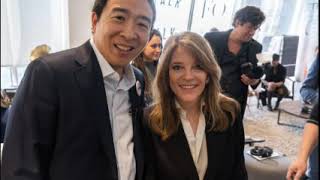
In this solo commentary, the speaker introduces the concept of “spiritual politics,” not as religion but as a political approach that prioritises human well‑being above capital accumulation. Drawing on the 1950s sci‑fi film The Day the Earth Stood Still, the speaker argues that current U.S. politics lacks a vital, humane element. The discussion uses Andrew Yang and Marianne Williamson as contemporary examples of candidates who foreground human needs—universal basic income, health care, prison reform—over profit‑driven metrics like GDP. The speaker contrasts the U.S. focus on GDP with Bhutan’s Gross National Happiness index and invokes fantasy worlds such as Wakanda from Black Panther to illustrate how a society that lacks spiritual maturity cannot responsibly wield advanced technology. The monologue critiques the U.S. prison and economic systems as “locked” cycles that trap people, and calls for a shift toward a political system that values people first, suggesting that Yang and Williamson represent the first steps toward that transformation. The video ends with a typical YouTube sign‑off encouraging likes and subscriptions.
Chapters
Welcome back to the channel, and I hope y'all are having a great day. So, interesting topic today: Andrew Yang, spiritual politics. What does that mean, spiritual politics? So, you know, when we're speaking about, uh, spirit— the, the word spiritual in the context of this video. And we're not, of course, talking about religion, or we're not talking about any cults, or, you know, we're not talking about anything relative to that. But what we are talking about is, I guess, an approach to politics that, for lack of a better word, may be more homeopathic to kind of feel the idea of what's missing from the whole in politics. I remember one of my favorite science fiction movies was called The Day the Earth Stood Still. And not the, not the Keanu Reeves version, the original 1950s Um, and the message of that movie was that— if you haven't seen this, a great movie, one of my favorite movies of all time, great movie even today, and it's a 1950s movie, uh, but the message of that was that, uh, you know, without giving the whole movie away, but aliens visit the Earth and, uh, they come to the conclusion that, you know, how our systems exist our political systems, our world, it just isn't in line with the rest of the universe because it's kind of like a federation of planets and we are a dangerous group of people with a messed up system and they just decide that we're missing something in our system and we gotta go. Um, And the idea that kind of I get from all of that is that in our politics we're missing something very, very important that I think this election— in all the years I've been alive, I've never seen an election like this. This is a very interesting election where it's really kind of come up in this way. And, um, you know, looking at people like Andrew Yang and Marianne Williamson, they've been the more on the more extreme sides of this to kind of drive home that message. And to kind of understand, explain that, if you look at somebody like Andrew Yang, he, uh, and they pick on lovely Marianne Williamson, they just say she's kind of too far out there with her spiritual stuff. But to, to kind of, you know, explain it You know, Andrew Yang, you know, his approach is humans over— human beings are more important than capital in our society, right? Which is— should be normal, should be a normal way of looking at things as human beings. But apparently not. Apparently we've got shifted away from that to the point where we're more concerned about who's getting what, who's doing what. than making sure people have healthcare and don't die on the streets, right? We're more worried about if they work for it or not, if they paid for it or not, and if they didn't, then they shouldn't have access to that healthcare. You know, this is, this is where we're at with this. And we're, we're in a situation where money and our political system is more important than the people in it, right? Uh, now under the Constitution, in the Constitution, the idea of well-being comes up and how the government should, uh, look out for the well-being of its citizens. Um, and, um, you know, but that's not really how American citizens feel today. How American citizens feel today is it's us against the government, right? The government is not looking out for us. The government is its own entity protecting its own interests and own particular groups, and it's basically throwing the rest of us under the bus. So, uh, and a lot of this has come up with these type of, uh, how our minds have now been warped into the ideas that fall under things like the measurement of GDP. Right, and how we measure GDP. And, um, I kind of, you know, uh, like to refer to the country of Bhutan a lot where they don't use GDP. They use the well-being of citizens and the happiness of citizens as the most important measuring device. And that's what I mean by kind of the spiritual politics kind of coming in and adding to the whole something that's been missing. The idea that we don't have that And because we don't have that, you know, we're behind, right? And where I think our political system should be, or maybe where it needs to be, kind of go off of the fantasy a little bit again, 'cause I find so many interesting comparisons in the fantasy worlds and the comic book worlds. But many of you all are probably with the, Black Panther, uh, movie from the Marvel Cinematic Universe, or even a comic book. And I understand what's happening there is there's a very similar theme there to where the nation of Wakanda, which is the most technologically advanced nation on Earth, has cut itself off from the rest of the planet, right? And the reason is being is because what they're saying is they're saying that We lack the spiritual advancement to, to be able to handle technology like what they have. Um, and it's just so very interesting that without that spiritual element— and again, I don't— I'm not trying to define in a religious, uh, uh, sense. It's more of about a human sense and how we value one another. But, um, because we lack it, we're more dangerous when it comes to handling the technology and weapons. And that's why there's always these doomsday scenarios leading to nuclear holocausts and a variety of things, because in our political structure, in the systems we've created, and our thought process and how we approach things, uh, because it doesn't have those certain spiritual elements, we're unable to achieve or reach those certain levels that are necessary. And, uh, you know, one thing that's quite, uh, concerning and, uh, um, you know, very much an indicator how far off we are is that We still at this point can't even convince people that universal basic income and people having their basic needs met, having rights to basic needs, is something that we should have. We don't even think that's a good idea, right? We're still kind of on the paradigm or the idea of the system of capital over human beings. right? Because if that weren't the case, then capital wouldn't occupy a place over human beings, right? And that's what it does. That's what it does in our healthcare system. That's what it does in our monetary system. That's why Americans struggle so hard and they can't afford to even pay their bills after they have worked all week. And, um, for the first time in our elections, we have people like Andrew Yang and Marianne Williamson that come with an approach that I think begins to add to the whole of what our political system needs, right? Because it's just not— it's just not there, you know. It's just— it's this— it's this entity. It's this It's this thing that's moving and it's putting out laws, right? And the laws are in place to lock people up and do a variety of things. And it locks these people up and people come out of these systems of, um, and when I say lock up, I don't mean just literally being locked up like in a prison, but I mean in every sense of being locked up or locked down. Um, and, uh, you're in this vicious cycle. You're, you're literally in like a prison cycle. When you come out of— when some of the inmates come out of prison, it's estimated that 66% of them go back to prison because of the political system. The prison system, it is, it is missing a hole to changing and really rehabilitating our, our our human systems, right? And it's the same way in our economic systems. It's a vicious cycle people are trapped in. And we're unable to, through our political systems and governments, create systems that work and get to the root cause of this. And I believe because we have yet to have got to places like where Marianne Williamson's at, places like where Andrew Yang's at, And I think for the first time, when we're able to see something like that implemented into our system, are we going to begin to really experience the full wholeness and of the type of political system that could possibly work for us. This kind of, for lack of a better word, this type of spiritual political system that values human beings over, over the system itself. But that's all I wanted to say in this video. If you all like content like this, don't forget to like and subscribe. And until next time, as always, take care.