
Andrew Yang - Support Marianne Williamson And Why?
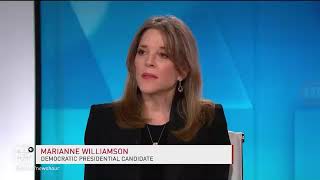
The video opens with a clip of Andrew Yang discussing the need to appeal to voters' emotions rather than just rational arguments to defeat Donald Trump, emphasizing the psychological impact of Trump’s appeal. The host then argues for supporting Marianne Williamson in the 2020 Democratic primary, highlighting her adoption of a universal basic income (UBI) platform inspired by Yang’s proposal. The host compares Williamson’s need‑based version of UBI (targeted at people without income) with Yang’s truly universal model that would give every adult $12,000 regardless of wealth, contending that the latter is more effective for economic stimulus. The discussion expands to the strategic value of having multiple candidates champion UBI to normalize the policy, critiques limited‑scope UBI experiments such as Finland’s, and stresses the importance of a spiritual‑consciousness dimension in politics that Williamson brings. Additional policy ideas include a White House counselor/psychologist to check presidential power. The video concludes with a promotion for the creator’s BitcoinMYK project, a blockchain‑based, free‑to‑join UBI system, and a standard call‑to‑action for likes and subscriptions.
Chapters
one with elected office experience after President Trump. What Democrats want is someone tough enough to beat Donald Trump. And I think anyone who thinks it's as simple as someone tough enough to beat Donald Trump is very naive about the nature of the opponent. There are some people who are going to vote for Trump no matter what. But the presidential election, that is not enough to reelect him. What we have to get to are people who might have voted for him but are at least disturbed enough to be open. And we need all those people who didn't vote to vote and all those people who voted for Jill Stein to vote for us. And the only way to do that is to touch people's hearts. You know, the part of the brain that rationally analyzes an issue is not the same part of the brain that decides who to vote for. Donald Trump has had a psychological effect on people. He has had an effect.
Hey, you all, welcome back to the channel. And today I want to talk about Marianne Williamson. I, I, I said that, uh, if there are other candidates in this race that supported universal basic income, I wanted to cover them on this channel, talk about them, uh, a lot more besides Andrew Yang. Uh, and, uh, Marianne Williamson did, uh, take a version of universal basic income into her platform inspired by, um, Andrew Yang's, uh, version, uh, from his book the war on normal people. And so she gave Andrew Yang all the credit for it he deserved. And from the very beginning, these two have kind of been like two peas in a pod, right? They're probably the only candidates that got together and just had a really good friendly conversation. And you could see a great deal of admiration for one another there. And I just thought, wouldn't it just be amazing if politics really worked like that? People who really wanted to help the country and they saw even in their opponents and the other candidates such a, or carried such a good relationship with them to the point they were willing to work together. And we don't really see that anymore, but it seems to exist between Marianne Williamson and Andrew Yang. So I want to talk about today why we need Marianne Williamson, why we shouldn't throw her under the bus, and why we should be supporting her as well. Um, so first, to try to just understand this thing, we gotta kind of take it back a little bit and recall how outrageous, uh, ideas like universal basic income sounded from the beginning. right? It was a ridiculous notion to give everybody what we deem free money for nothing, uh, because that's basically the surface-level going idea with what universal basic income is. Um, and so this wasn't well received. Nobody would have dared go on a platform like this, but as they saw Andrew Yang making leeway the safe choice was to adapt it. And that's what we're seeing starting to happen with the other candidates. Uh, uh, Tulsi has entertained that. Biden seems to be having conversations about it and kind of open to it and, and seeing something in it, although I don't think he's going to do it. Buttigieg seems like he's kind of, uh, it's interesting, an interesting concept to him. So it's no surprise that as this thing goes on and Andrew Yang gets up high in the, in the polls, um, they're going to see that this works and they're going to want to flip-flop the UBI. Now, the only person so far that it feels really, really— well, I guess I could say two, but I will say this at this point. Of all the people who have adapted this policy, I would say without a doubt Marianne Williamson to me would be the most authentic person who really want to help people and do something like this outside of it being just a political move to become president, besides it being something they're just going to believe in because it's good for their campaign, right? So this is why we need people like Marianne Williamson. We need people like Marianne Williamson as well because it's good to substantiate the value of this platform and have many people not only part of it but running on the platform. What happens is if you have several candidates up there running on a universal basic income platform, not only does it increase our chances of having policies like this come to play, getting the American people acclimated to it— not only American people, but our government, the Congress— uh, to the point where they're, they're going to accept it because every candidate is running on it. So when it goes to Congress, it's going to go through because they're going to see that it was already pushed and we were already acclimated to it from the very beginning. Uh, and that's why it's important that I hope personally everybody starts to, to, to, to use it, uh, and not fight against it. In saying all that and understanding that the more candidates we have, uh, with a dog in that race, or a horse in that race rather if you want to say that, um, uh, we— there are going to be variations of the policies and we kind of see even in Marianne Williamson's policy, that it's inspired by Andrew Yang, but there are some differences. And from looking at her proposals on the website, on her website, it seems like the version that Marianne's, um, proposing, it feels more like a type of the argument of if you need it type situation. As to say that people who are kind of in a financial, uh, need situation, they are the people who can receive it. If you have a job, if you have something like that, you're not going to receive the universal basic income on top of that, as far as I understand it, since I read the policy last. Now, if it's been changed in that, and some of you all know about that, please correct me if I'm wrong. But as far as I know— and remember, this will only go to people who need it— so no, you're not going to be working over here, uh, on a job making $50,000, $60,000 a year, whatever the case may be, and then receiving that additional $12,000 a year. I think with Marianne, if you don't have a job, if you don't have income, if you don't go to work, you're going to receive that $12,000 a year on a need-by-need basis. Now, I think it's fine to have these variations in the policies, and somewhere along the lines we might find out what's going to work. And obviously Uh, it still does represent more money into the economy, more spending into the economy. But the problem is I don't think that approach would be as effective as Andrew Yang's policy, simply because that's been a, a mistake that's been commonly made with universal basic income, and that is that it only goes to the needy people. Uh, in fact, one of the most erroneous reports out there right now, which is the Finland UBI experiment, which most people cite that the full, um, uh, results of the experiment won't be, uh, available to December, uh, of 2019, um, that many are already citing it as a failure. But to understand this, uh, experiment, we should keep in mind that only about 2,500 people were involved in it and And guess where all the money went? It went to low-income people, welfare recipients, and just people in general who were very much in need of this money. Now, what's the problem with that? The problem with that is that feels more like a social welfare program that doesn't really address what universal basic income is. Uh, it's certainly not in Andrew Yang's plan and certainly not in the core ideal of universal basic income. What that talks about is the real idea of universal basic income talks about everybody, rich or poor, gets this. Why is this important? Because if rich people get this money and they're spending more money, they're more comfortable to spend more money because they have more money, then that stimulates the economy. Uh, we also need the innovation of other minds and other people. Some of the best innovations and ideas are going to come from people who aren't in a low-income area, right? So it's not going to just come from one group of people, it's going to come from all groups of people. We have to stimulate the economy and encourage them to do those things. So one major problem has been that many of these universal basic income experiments have only given it to the people they felt needed the most. Whereas that might sound noble, on the grand scale of things, it doesn't provide the economy with the proper stimulus that is probably going to be needed to grow and ever expand an economy, such as in the idea of what Andrew Yang proposed, which I think is going to be the best way to use universal basic income. It's going to also erase the stigma that is just the idea of free money and giving it away, whereas with Marianne Williamson's plan, it seems a little bit more like that. But even so, we already know that the relationship between Marianne Williamson and Andrew Yang, and perhaps her base more likely, of course, more than likely seeing that they're kind of now under the UBI umbrella, and if she drops out, they will latch on to the next UBI platform, which is Andrew Yang. Um, that this, uh, you know, her base and us supporting her base and supporting the, the entire, uh, these— this entire team, what I'm calling them, uh, is going to help in the long run the country. Um, and if Tulsi jumps on board with this, that'd be excellent. I love to see that. I love to see her take a stand on that, and she may very well do that, you know, seeing that, uh, where Tulsi's been kind of being hurt in the polls, such as Marianne as well. They don't seem to be doing as well as Andrew, so they might have to pull some last-minute punches. And, uh, I don't think that's a bad idea to do that at all. Get all this base connected to Andrew Yang so we can push this thing throughout this election process. Um, but we need to support people like Marianne. Remember, supporting her, you are supporting Andrew Yang indirectly, uh, in the UBI platform, which is, which is going to be what we want to do. Um, you know, I just also want to just add right quick that somebody like Marianne Williamson, she talks about raising the consciousness of the American citizen. And, you know, we oftentimes have done our politics in a way where it leaves something to be desired, where we can make laws to stop certain things, to imprison certain groups, and it doesn't stop the problem. And some have speculated and theorized that what is needed is some type of spiritual conscious injection, raising the human spirit on a level unlike ever seen before. So it's great to have finally a candidate who's recognizing some of the shortcomings of our politics. Although we have the mechanical aspects in place, we don't have some of the core spiritual essence parts in place that, uh, together create the whole and make us a better people, right? And so perhaps Marianne's going to bring that. And if she can't get to the presidency along with Andrew Yang, they could somehow create this system. Uh, I think Marianne's going to be very much on board with many of Andrew's policies, like, uh, having a counselor in the White House. You know, right now we got a president who thinks he's the chosen of God Almighty. He's the king of the Jewish people, and he's been sent here by God. Um, and so, uh, you know, it's going to be great to have a White House counselor and psychologist, uh, you know, in the White House to, you know, to kind of keep a check on that, right? Uh, supporting family, uh, marriage counseling. I'm sure Marianne will have no problem with that. Uh, this seems to be Very much part of her MO, helping the person, helping people. And of course, when you help families, families create the cornerstone of civilizations in our country. And so you want to keep them functioning to have a better society. So these are the reasons why we should support Marianne Williamson. But real quick, guys, want to tell y'all about my project, BitcoinMYK.com. Going to help a lot of people, going to hopefully change the world. It's our own universal basic income program using ideas like Bitcoin blockchain technology to give value back to the people of the globe. It is absolutely free to join. You receive value, receive a cryptocurrency token that can be actually traded for your local, uh, currencies that you can go out buy groceries with, pay some bills with, and a variety of things like that you'll be able to do with this project. Provided you all help us get it underway and provided you join. So we hope you do that. Uh, we'll leave a link in the description. But that's all I want to say in this video. If you all like content like this, don't forget to like and subscribe. And until next time, take care.
More from Michael







UBI - CIA Agent Explains Why Americans Will Never Get Universal Basic Income?



