In this monologue, Andrew Yang examines the question of whether advances in robotics, AI, and related technologies constitute a genuine threat to employment. He argues that technology does not appear all at once but diffuses gradually, moving from military or tactical applications to everyday practical use, often with a 30‑40‑year lag between military deployment and civilian adoption. Yang cites concrete examples such as Boston Dynamics robots, a brick‑laying robot capable of laying thousands of bricks per hour, and autonomous truck convoys that could replace human drivers. He contends that the tech threat is already present and inevitable, even if its full market impact is not yet visible, and warns that the public is out of touch with these developments. Yang links this looming displacement to the need for policies like the Freedom Dividend (universal basic income) and criticizes the lack of proactive planning, comparing the tech threat’s perceived seriousness to that of nuclear proliferation or climate change. He ends by urging viewers to consider the timeline of the threat, engage in discussion, and stay informed.
Chapters
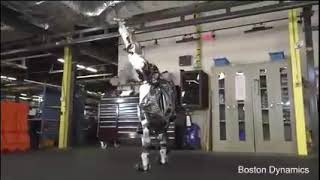
Welcome back to the channel, and I hope you're having a great day. So the tech threat, tech threat to jobs, is it real? You know, we understand the idea of the Freedom Dividend, that technology comes in, takes over 40% of the jobs, and displaces an enormous amount of workers. But is this something that's real? Because I think when people hear things like this, I think they're quite a bit out of touch with "Is this an evident or obvious threat?" And I'll explain it this way. I think a lot of that has to do with how technology emerges with us. It doesn't all come in at once, right? We start to develop it in stages and it becomes part of our daily use, you know, in certain segments. and then it moves on to the point to where we reach a certain, uh, zenith of this technology. Um, it seems like it was, you know, it was always kind of there. Like, we kind of— it's kind of normalized into our— us day by day. And we kind of see it happening when you kind of walk in your Walmarts and, you know, first you're doing the checkout lines and you kind of got the greeter at the door. You know, maybe you might not even need the greeter eventually. Maybe it might be a robot greeter for that too or something. Yeah, I don't know. But the emergence is gradual and because it's gradual, we don't see the effects all at once to, I think, really make us alert to what's happening around us. Obviously the intro video was courtesy of Boston Dynamics. Boston Dynamics is this company that builds these very advanced robotics that are used in various applications. Seems to be that some of the applications that Boston Dynamics seems to be marketing this as is seemingly, you know, more utility, construction, manufacturing, or something. Uh, but it also looks very militant to me, you know. So, um, generally what happens is, uh, in technology you kind of have two areas: the tactical to the practical. Technical mostly dealing with military, uh, practical everyday use. Now what normally happens, or, or what does oftentimes happen, is the tactical goes to practical or the military, uh, production of certain products becomes products we use in our everyday lives. Like GPS was first used by the military, the internet, and so on and so forth, right? Now they become these everyday, uh, things we use, but the military is generally using these, uh, products 30 to 40 years in the future, uh, prior to when we're using it, right? So what you get oftentimes is that you're going to have these applications or these, uh, robots we see now that are actually about 30, 40 years behind what is actually going on. So yes, that means that more than likely the military, uh, has a— some type of humanoid robot that might be 30, 40 years ahead of what we're seeing now, uh, that's released on the market, to the market. If you look at all these various Sophia robots and the like, you can actually buy them. Companies can buy them. Do you think you can buy anything from the military that's used by the military? No. It is also theorized that we have supercomputers, uh, quantum computers, 30, 40 years ahead of what we have use of now. So when we talk about is the tech threat real, I think we can frame it more into that the tech threat is already here and it's very real and it's all already there, but it's just the idea of when it hits the market that might not be immediate, but it is inevitable. Right? So it's going to happen one way or the other. Also, very interesting enough, I was watching this robot that could lay just an enormous amount of bricks per hour, probably thousands or something. And I have family members who are brick masons. And I was telling them about it and they just couldn't fathom that something like that existed. They just kept saying, no, that's not possible. A robot could never lay that many bricks or even think about replacing us in brick masonry. But that's kind of interesting because that also reminds me of what truck drivers used to say. You remember or recall if you watch a lot of truck driver documentaries, Truck drivers years ago would say the same thing. Oh, a robot couldn't replace us. You're going to need a human driver at that, at that, in that truck, right? But now we're learning that you have convoys of these trucks. Maybe you might have one human driver on the road and you, he, he, and you might have hundreds of robots driving trucks. So you're still looking at a great amount of job displacement. And so I think we're very much out of touch, like the public. Even when the public hears these ideas like the Freedom Dividend or UBI and technology being a big push for that, I think a lot of people are just out of touch because they don't see videos like this. They're not aware how technology works. They're not aware that a lot of technology that we do see is already 30, 40 years ahead. Uh, there's an application 30, 40 years ahead of what we're actually using right now, or do see. Uh, right. So, uh, it's very quite interesting. Is the tech threat real? I don't know. Maybe we all have to make up our minds about that, right? Maybe I do a little bit of research and figure out for yourself if that tech threat is real. If, uh, a robot that we just witnessed is That agile. And remember, these are the, these are the robots that they're presenting to us, right? This is not the top secret robot, you know, that maybe looks like us and you can hardly tell it's not a human being. This is what, you know, we're going to see in factories probably, you know, probably any day now, probably tomorrow or in a couple of years. You're going to see moving boxes and walking across factories and doing a variety of things. That's what you're going to see now. But you're not seeing the real advancement of tech that is available and may be released at the market at any time. So it's quite interesting. But, you know, to look at something like this and to go from that to, this is a ridiculous notion that robots are going to take my jobs and robots can do all the things. I mean, the reality of the situation is the agility and the dexterity of this robots. Probably 90% of people I'm talking to on this video right now can't do what that robot just did. And if they can, they probably can't do it consistent because that robot can probably do that same thing 24 hours straight without risk of injury, without getting tired or any of those things. So, uh, is the tech threat real? Um, so many people don't seem to think it's real. They don't put attention to it like it's real. They don't treat it serious like it's real. They don't treat it, uh, as severe as something like nuclear proliferation, right? Or, or many, or, or climate change, or many of these things pending on the horizon that are going to be disastrous. for the human, for, for the Earth and human beings and humankind. Um, but they don't do that with this, uh, AI technology threat, and they don't come up with plans that solve that. My assumption at this point is they're going to wait to the last minute to do something about it or to even make a plan about it, because if they weren't going to do that, Wouldn't they be doing something now at this point in time? But they aren't. So that's just something to think about. Uh, what do you guys think? Is the tech threat real? How far off is the tech threat? If it's 10 years off, if it's 20 years off, at what point in time should we start addressing it and planning for it? If it's 10 years off, should we start at 9 years and start to do something about it? What are your thoughts? What are your comments? I love to hear them. If you like content like this, don't forget to like, subscribe, and until next time, take care.