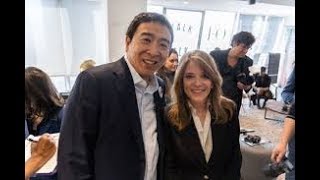
In this monologue the host presents a political commentary on a proposed "dream team" of progressive candidates—Andrew Yang, Marianne Williamson, and Tulsi Gabbard—arguing that their complementary strengths could address the United States' economic, spiritual, and foreign‑policy challenges. The speaker uses the example of Bhutan, the world’s "happiest country," to illustrate a wellbeing‑centric approach to governance, then examines Williamson’s focus on spirituality, reparations, and the moral heartbeat of the nation. Tulsi Gabbard is highlighted for her military background and anti‑interventionist foreign‑policy perspective, especially as discussed on the Joe Rogan podcast. Yang’s platform is framed around universal basic income (UBI), automation, AI, and a domestic‑first strategy that avoids overseas entanglements. The host argues that combining these three figures could form a balanced cabinet that tackles economic inequality, mental‑spiritual health, and global conflict. The video concludes with a call to action: viewers are urged to support a global UBI experiment website, participate in a poll about Yang, and help gather data to prepare for the coming robotics/AI revolution.
Chapters
Hey you, welcome back to the channel. And today we're going to talk Andrew Yang and the dream team. So what is the dream team? We're looking at them. We're looking at them, looking at this beautiful picture of Andrew Yang and Marianne Williamson, right? And, uh, um, we don't have Tulsi in here, but, uh, uh, She's part of that dream team too. So we're gonna talk a little bit about that today. I started thinking, you know, these two look happy together, right? Looks genuine, right? They have a good harmony there, good energy. So I was just doing some research on the country of Bhutan. A lot of people don't know about this country. It has the title of the happiest country on Earth. Why is that? Because their king measures the value of their country and the happiness of the people. You know, at the end of the day, when we try to understand the deficits in America, in the economies, in the foreign policy, in the, uh, uh, problems with, uh, nuclear, uh, proliferation, and all these variety of things, all these means to an end. When we get to the end of all of those things, we're left with, and for what? And we did this for what? And to what end? And one of the reasons behind this And so this is why ideas like Bhutan make a lot of sense. Maybe they get it. Maybe they understand that really all this government is about the wellbeing of the people. But what does wellbeing mean, right? What exactly does it mean? And these are questions a lot of times that politicians don't delve deep into. They just give us a lot of over-the-head political talk that many average people aren't interested in or don't understand or don't care to understand. And someone like Marianne Williamson, she's kind of going there when we go from means to an end, right? She's at the end. And Marianne Williamson, of course, writing all these spiritual books, being in tune with the spirituality of the country, of what's happening with us. I think some of the more important questions that get left out of the conversation, right? And American people, we seemingly care about not just the mechanics of what's going on in the country and under the legal system, what people are doing or should or should not be doing. But there seems to be even an undertone of, what type of person deep down our politicians are. And we seem to care a great deal about that, so much to the point that, uh, you know, uh, you know, not trying to confuse spirituality with religion, but, uh, some people have this concept of, uh, they're kind of weirded out by an atheist president, right? We haven't had one yet. No, nobody's really came out in the open and said they're that. And you you know, you know, they're atheists and whatnot. And if they did, uh, I think many of them, you know, understand that would be political suicide. My point with a lot of that has to deal with, um, has to deal with the heartbeat of the spirit of the nation, right? And so Marianne Williamson weighs in on that. And in the beginning, I didn't really, you know, I wasn't really a I like Marianne Williamson, but I didn't think the country was ready for her type of politics, right? This seems like highly enlightened, highly developed, and evolution, you know, of the citizens of America to actually care about your neighbor and the wellbeing of other people who are suffering, not doing as good, to address the reparations problem and not make excuses about it, but say, hey, we need to do something about it. It's your money. The African-American community. I thought she handled that well. She didn't make excuses about it. She didn't say, let's do this instead of that. Um, and I think she understands that. And, uh, her— I, I think she works well within the, uh, the, the atmosphere of what Andrew Yang's bringing right now. Uh, she's running for president, you know, you got to start somewhere. But generally what happens with these elections is you get a little bit Further down the line, people realize they're not going to win. Sometimes deals are made, right? Sometimes partnerships are formed. Sometimes they may become your running mate, they may become part of your cabinet or what have you. Um, but, uh, I very much like to see that happen with Marianne Williamson. She's a great— seems like a real genuine great person who gets it, and she needs to be someplace in this government dealing with topics and issues we don't generally address, right? And that is, uh, um, uh, the spirit, the spiritual heartbeat of this country, right? Now let's talk about Tulsi Gabbard a little bit. So Tulsi Gabbard was on, um, the Joe Rogan podcast the other day. I, I don't have a picture with all three of them together. I wish I, if I could, I would have tried to put them all three in a picture, but just her and Marianne Wilson, because Andrew Yang and Marianne Wilson, they've actually, I think they're probably they just get along real good. They've met up before and talked together, spoke together before. But Tulsi Gabbard was on the Joe Rogan podcast a few days ago or something like that. She had some very, very good— it's a good podcast, a good show. Uh, she has some very interesting stuff to say about the inner workings of the government and how we get involved in wars, and her being a soldier, the conflict with regime change and a nuclear holocaust being at the most severe situation we could face. The trade wars with China escalating at some point to World War III or something along those lines. A lot of people just, I think they're kind of out of sync with that in America. You know, I think they're probably, they've gotten probably as much out of sync with that in some ways, you know, as now, you know, the concept of universal basic income being a serious topic, right? You know, and, But she had a lot of interesting stuff to say. I'll try to leave a link in the description to that podcast. But that seems to be her strengths there, right? She's good with the foreign policy stuff. And the foreign policy, contrasting that to Andrew Yang, Andrew Yang's idea about the foreign policy is, is a very simple but effective cut-to-the-chase idea. And it really comes down to, we gotta strengthen this country, right? What are we doing over in all these nations trying to police these people, trying to tell these people how to live. At the same time, we're basically, you know, doing— sending money to many nations. You know, I have a— I come from a family that is good people, moral people, good people. And some of my family members are Um, when it comes to politics, I— some of them look at it in a very simple lens, and concepts and ideas like a country in debt and, and can barely take care of itself, sending money to other countries, trying to run other nations in the world— that is just, you know, just— they can't fathom something like that. And, uh, I don't know how we can fathom ideas like that, but we do, and we do it right. We got hungry people here in the United States. We got the opioid crisis, which consequently Andrew Yang kind of got, the internet tried to, specifically the alt-right tried to pull him into, he's protecting white America because they're probably the greatest victims of the opioid crisis, which is a serious crisis to Americans. Andrew Yang has a remedy for it. He has something that actually goes to it and helps it. Some of the economic distresses that correlate to coming from broken homes and families that where it's gonna be more likely people gonna end up addicted to opioids and dying from opioids. Some of that in Andrew Yang's model could be cut down with universal basic income, right? And I believe it would be because the family structure would dynamically change. Based on universal basic income. People don't quite understand that, right? And, uh, what's great about Tulsi Gabbard is in the Joe Rogan podcast, she was— it becomes more and more open to universal basic income. I've seen other interviews where she talks about universal basic income being an option. Now, uh, Tulsi's idea about universal basic income isn't developed yet. They'd have to look into it. She doesn't have a, a, a several-point plan like Andrew has yet, but she's open to it, and that makes her a very good combination to what could be Andrew Yang's cabinet. You know, what could be that dream team, right? But her strengths are in that foreign policy. Now, you know, again, going back to Andrew, his is all about build up the strength internally, and then you could be an example to others, and then you can help others without interfering in their politics, making people hate you because you're manipulating their political system. You're putting in puppet dictators that you can cut deals with easier, and all this corrupt stuff that's going on behind the scenes and then sending troops off to fight in these disasters and trying to brainwash them into believing they're fighting for something else. And Tulsi goes into that and wants to stop that. And we definitely need somebody like her with experience, military experience as well, who can do that, right? And those are her strengths. But her strengths might not be the, you know, internally America, the economic problems. It's not the spiritual problems in America. Again, when I'm spiritual, I'm talking about the spiritual heartbeat. Again, I'm talking about this general idea of how Marianne Williamson approaches it and brings into the paradigm that there might be more important things than just if you can create a better economy or if you can, you know, do these things politically that are part of the problem, right? But maybe not the end of it, right? So she, she brings something to that. But, uh, together, right, these, these guys could be great. I'm impressed with all three of these individuals, right? Uh, and I, and I hope they do start to, to, to, to come together, you know, as this thing goes on and we get to see how this is going to turn out. The dream team, the dream team, you're looking at them, you better believe it. You better believe it. But that's all I got to say in this video, guys. Um, you know, uh, universal basic income, this is a serious, uh, thing. Um, or rather, the rise of technology, robotics revolutions, AI taking all your jobs, an artificial brain that's smarter than you, that's maybe more human than some of you all, uh, on the horizon, coming, a reality, an eventuality, something that can't be denied, right? So We need models for this, right? We need experimentation with this. And you're watching this video right now, I'm assuming that you support universal basic income and you're an Andrew Yang fan, right? We have a website up that's experimenting with universal basic income right now. We need this data. We need to know how this works, uh, so that we're more prepared for this robotics revolution. We don't need to wait till the last minute. Help us to experiment with this so we have more data to work with to get this working. And this is global. So great thing about this, those of you who all watch the channel, some of you great viewers who, uh, want so bad for Andrew Yang to win in our country, although you're not a part of our country, so unfortunately you won't benefit from it, but you want so bad for us to have that and you are bringing your your greatest support to that. And now it's time to give some back to yourself. Join our website. It is global. It is universal for these experimentations and hopefully some benefits back to you all as we build up this system and we start being able to implement universal basic income to all of you all. So get over to the website. We're going to leave a link in the description. Help us get that data. Uh, as well, uh, we're running a poll for some more prizes about Andrew Yang. Is he too nice? We did a video about that the other day. Get over to the website. Talk about, um, if you— how you feel about Andrew Yang. Vote on it if you think he's too nice or if he's fine, uh, and win some prizes doing that. So that's what we got for you all, guys. Guys, appreciate you watching the channel, um, and supporting Andrew Yang. Uh, we're gonna win this thing in 2020, and that's all I got to say in this video. Until next time, take care.