
Andrew Yang - The Wealthy
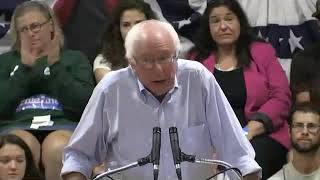
The video opens with a clip of Bernie Sanders warning that wealth in the United States is increasingly concentrated in the top 0.1% and calling the current distribution immoral. The host then shifts to discuss Andrew Yang’s Freedom Dividend (a universal basic income) and argues that the dividend should be paid to every American, including the wealthy, rather than being targeted only at the poor. He explains the dividend concept by likening it to corporate stock dividends that go to all shareholders, regardless of share size, and asserts that every citizen contributes to the nation through taxes and consumption, so all deserve a share. The host critiques Sanders’ rhetoric, suggesting that his focus on attacking the rich and identity politics alienates moderate voters and could hurt Democratic electability against Donald Trump. In contrast, he portrays Yang’s approach as a fair‑tax, non‑punitive policy that simply asks the wealthy and large corporations (e.g., Amazon) to pay their rightful share, thereby funding the dividend without demonising success. He also touches on the legal duty of corporations to maximize shareholder profit, arguing that demanding taxes is not a punishment but a civic responsibility. The speaker claims a universal dividend would foster social unity, avoid creating an “us‑vs‑them” dynamic, and even if the wealthy received $1,000 a month they would likely spend or donate it, producing positive spill‑over effects. Finally, the video promotes the channel’s own blockchain‑based UBI project that aims to distribute roughly $1,000 per month to participants worldwide, inviting viewers to join the platform.
Chapters
in the history of the world. That's where we are right now. How many people in America know that we live in the wealthiest country in the history of the world? Not all that many. You know why? Because they're out there working 50, 60 hours a week. They're worried about how they're going to provide child care for their kids, how they're going to afford to send their college— in too many instances, in the wealthiest country in the history of the world, people are worried about how they're going to put food on the table to feed their kids. The reason that people do not perceive that we are living in the wealthiest country in the history of the world is that almost all of the wealth and much of the income is going to the top 1%. And our job together is to change that reality. There is something profoundly wrong in our country when the top 1/10 of 1%, not 1%, 1/10 of 1% owns almost as much wealth as the bottom 90%. That is immoral, that is wrong. There is something profoundly wrong when we have seen in recent years a proliferation of millionaires and billionaires while at the same time millions of Americans, folks here in New Hampshire, Vermont are working 2 or 3 jobs, and we have the highest rate of childhood poverty of any major country on Earth. That is wrong. That is unacceptable. And together we're going to change that.
Hey you, welcome back to the channel, and I hope you all are having a great day. So today we want to talk about the Freedom Dividend in relation to wealthy people. The wealthy. Uh, for many, it's been hard to stomach why the Freedom Dividend would go to wealthy individuals, uh, people who we generally deem don't need the money. Um, and, uh, many feel it should go to just the people who need it. Um, and so we're going to talk about that today and hopefully get some clarity with that. And hopefully by the end of the video Many people will be in agreement as to why the Freedom Dividend needs to go to every American in the country. So we're going to start with some of the, some basic core ideas about just the idea of a dividend in general. So many of us up until now, when we thought about dividend, we thought about it in relation to corporate stocks, you know, buying stock in a company and and the company stock pays dividends, uh, to the shareholders, um, and these dividends would go out to everybody who participated in that business, that company. Now there would be certain people who held a large amount of shares, you know, they invested a lot of money, excuse me, and they would receive a dividend and Uh, even the person who invested the less amount of money, uh, he would get a dividend. Everybody would still receive a dividend, um, because that's how it works. The structure of a dividend goes to all the shareholders, and as American citizens, in one way or another, we've contributed to the greatness of this country. Right? And some people might say, well, yeah, but some people aren't productive. But the thing is, uh, everybody contributes to America in some kind of way. I mean, if you go to the store and you, uh, you purchase items and you pay sales taxes on items, or whatever the case may be, you know, from the smallest to the largest, as a whole there's a contribution. And so in that very simplified way, everybody has received a dividend. Like, you couldn't then just go, well, even though you're, you're vested, you, you invested in this corporation, in this business, in this country, uh, we're not going to give it to you. We're going to punish you in some kind of way simply because, uh, you don't fit the idea in our mind of who needs it and who deserves it, or something to that effect, right? So in that very, very basic way, that's why everybody needs to receive a dividend. Now in the beginning of the video here, we see this powerful speech done by Bernie Sanders, which I thought was a great speech. I respect Bernie Sanders a lot. I think a lot of what he says is a place I could see our country get to at some point in time in the future. But I think The very positive things, the great things that have driven so many, so many to Bernie Sanders and made his campaign so great and made him do so well up until now, uh, it's also part of his Achilles heel. And it's also part of the problem with what we get with ideas coming from Bernie Sanders. So what the problem is, is that Bernie Sanders, uh, it's kind of fallen, many believe, into this idea of attack and punish wealthy people and identity politics. And that isn't going over quite well for a majority of the American people. Now the good news is it does resonate well with, uh, the Democratic Party and a a lot of core ideas. But we have to keep in mind that Bernie Sanders doesn't represent every American. And I think where we need to get in this election this time around is with an entirely inclusive America that doesn't punish anybody but just gives people what they deserve, right? So because of that, my opinion is we can have a severe issue where Bernie Sanders could possibly get the nomination, the Democratic nomination, but then find himself going up against Trump, being unable to win because of this viewpoint by many Americans that Bernie Sanders doesn't represent them in that, in a way. And sometimes it's not just the idea of things, it's not just what the concept is, it's how you say it. And Bernie Sanders is seen as an enemy of entrepreneurs. And I think the problem with that is that what we have to be careful with is that America has always had the idea of being a place for great prosperity and opportunity and you being able to work hard and go forward to a great degree and make some things work. Now that, that hasn't happened with a lot of people and that's what Bernie Sanders is talking about. But the issue isn't so much about attacking wealthy people, it's about the system itself. You know, in contrast to what Andrew Yang is doing with the Freedom Dividend and how Bernie Sanders targets wealthy individuals, Andrew Yang doesn't target wealthy individuals to give off this idea of punishing people for success. The only thing Andrew Yang does is says, listen, you haven't paid your taxes and you should fairly pay taxes. Just like everybody else does. The poor people pay taxes, rich people should pay taxes. We shouldn't be able to skirt around taxes or be tax exempt in a system where there's a tremendous amount of debt, even though we're the wealthiest country in the world, still a tremendous amount of debt that can be taken care of as long as people pay their fair share. So in a situation like with Amazon, That is used as a prime example. That is part of the problem of not paying taxes. Andrew Yang's policies do not punish the wealthy, big companies that supply jobs and a variety of things. It only says that every American has to pay their taxes and they have to pay them, and that you should too. That's not a punishment. That's just doing what's right. I think the dangers of somebody like, again, like the Bernie Sanders campaign, and I, again, I respect Bernie Sanders, I like him, but my concern is that Bernie Sanders doesn't speak to the core problem, right? You know, he makes a very good moral case to people about, uh, there shouldn't be poverty in America like it is. But Andrew Yang's campaign, in my opinion, makes a better case because what it does is says it shouldn't be poverty to this degree. And the reason it is is because people don't have access to employment and jobs are being automated away. And a lot of it has to do with companies that should pay their taxes not paying their taxes. That is something profoundly different than just kind of creating a situation or looking at, uh, the circumstances in a sense as to say, well, the country is poor and things aren't working out because you're rich, right? Because you're a rich person and you're, you know, these are rich entities or corporations. Another, another thing you have to consider is that targeting the rich and wealthy is a misunderstanding of the legal system and the parameters of how business works. For instance, if you're a shareholder in a company or in corporation and business, the, the management team's job is to put you in the best situation possible to make money, right? And that's— it would— in other words, it's illegal for the company not to make you as much money as possible, to put you in a better situation as possible, right? Um, and these are— this is, this is a legal matter as well. It's not just, uh, about going out there and being greedy and taking everything you can. It is their job to make the best out of your investment as possible. It would be just like if you hired a contractor somebody to do a job, and imagine they're doing a job working at your house or something, and they go, well, you know what, I could give you the best result on this job possible, right? But I'm not gonna do that. I'm gonna give you what the cut— you know, what we feel would be mediocre, just enough to get by, and we're gonna do that, and that's gonna be it. As long as we cover that basis where is just enough being done. So the legal system is set up in a way with corporations in that way for them to maximize profits. Now again, the problem goes back to making sure everybody pay their fair share of taxes, right? Not punishing the success of the companies or the businesses. And what ideas like the Freedom Dividend does is it unites people and draws everybody together because everybody feels they're being dealt with in a fair way. Their capacity, right? I, I, I, I understand the concept of, uh, if a person has more and one person has less, one person struggles. And it would seem that these things are in direct relation to one another. It would seem like because a person's rich, it is the reason why another person's poor. But that's not exactly true, right? It could be many reasons why a person is poor and another person is rich. What we have to do is get to the core ideas as to why this occurs and find injustices as to why it occurs. And where Bernie Sanders makes this a moral argument, I think the immorality lies in when companies like Amazon don't pay their taxes. It doesn't lie in where they have created a great business, a great company, and, and they have created prosperity for the company and their shareholders. That's part of what America is about. The problem is when you do it at the expense of others. When you're wealthy, you're one of the wealthiest companies in the world and have the wealthiest shareholders in the world, it is no reason for you not to be paying taxes, hit with taxes, and paying back into the system that has given you the security to make all those things possible, right? But again, that is something entirely different than, um, framing, uh, a campaign based on the idea of we're all poor because you're all rich. And I'm not saying Bernie Sanders does that exactly, But that's how it resonates with people. That's, that's why Bernie Sanders still resonates as an enemy to entrepreneurs. And that's why I believe him winning the Democratic debate would be so polarizing. You would get these two extremes, Donald Trump versus Bernie Sanders. Another thing is a lot of core ideas in Bernie Sanders, um, uh, campaign already exist in several other candidates. Campaigns, and they don't come across as extreme as Bernie Sanders, right? With this socialist idea that has resonated or that has been attached to him for decades, right? And again, I'm not saying it's true. I'm not saying that Bernie Sanders isn't a champion of the people, and maybe that even the course he's going on would result in a much better America. Not saying that at all. But what we are discussing is what it's going to take to win the presidency and how Bernie Sanders comes off. I don't believe that it's going to resonate with enough Americans to the point where they're going to be willing to have Bernie win the presidency. I think more so we're going to have a very dangerous situation whereby Bernie Sanders being a candidate, Trump could be reelected. Based on these ideas that he seems to treat the wealthy more so as an enemy than a symptom of a broken system that needs to be fixed. So we have to be very careful with how we say things, how we set things up, and how we frame things. Uh, but that's my idea about it. But yes, everybody has to receive the Freedom Dividend because what that does is that does create equality across the board. It unites us. It doesn't have us look at one another as the enemy and then start to create taxes for them that don't exist for the rest of us and create this great division, uh, which really is saying things like we should punish you for being successful. That's what it says in the end, right? It may not say it directly. It may not be perceived that way by many, But in the end, it kind of goes back to that idea, right? And, uh, um, in a spiritual, moral, advanced culture and society— and that's another reason why I respect people like Marianne Williamson. She kind of gets that at those points as well. But I don't think we've evolved quite far enough at this time in history to be able to really take on those centralized core ideas, what Bernie Sanders and Marianne Williamson has. I believe we will, but I don't think we're there yet. And I believe we want— we run a very dangerous chance of pushing those type candidates to battle out with Donald Trump and it not going how we'd like it to go. So that is my fear with that. But I love to hear you all's opinions. Do you think wealthy people should get the Freedom Dividend? I also would like to say, and I'm not defending wealthy people, I just don't want us to get distracted and get pulled off in the wrong lane here. But it's probably more unlikely that wealthy people getting thousands of, getting this $1,000 probably won't even see it as enough to, you know, pay one bill or pay their parking hardly or pay their parking and stuff like that. But it's probably, I would see it more unlikely as they'll just become a little bit more charitable with it. You know, uh, wealthy people, you know, a lot of them do charity drives. That's hobbies they have, especially the wealthy. Like Bernie Sanders is discussing the, the, the 1/10 of the 1%. They will probably more likely end up giving a lot of that money away, giving that $1,000 away, I would think, or one, or, or, or having the idea to spend more because of the psychological effect of receiving that money. Tends to make people want to spend more because they feel they have more. So in that way, I don't think it would really come out as a negative given wealthy people did $1,000 per month at all. Um, but that's my thoughts on it. I'd love to hear you all's opinion on it, uh, how you feel about it. Do you think if Bernie Sanders was to get the nomination that he will present those divisive dangers uh, facing up against Trump and his base in that way. But that's all I want to say in this video real quick. We have our own universal basic income project over the blockchain. This is international, this is global, so this is for everybody. And it's a lot of fun just by participating on our website, doing simple things like browsing the internet or watching videos. You earn real cryptocurrencies that can be exchanged for a dollar in your, uh, native lands and currencies, and you're able to spend that how you see fit or goal is to get it a value going out to every participant of about $1,000 per month. Um, and so we're very excited about that. Would love for all of you all who watch the channel, who subscribe to the channel group, try it out. Head over to the website, give it a try. We'd love to see you guys over there. And it's a chat area. You can also discuss with us live some ideas about the Andrew Yang campaign. You can discuss, uh, ideas about universal basic income, politics in general, or cryptocurrency in general. But that's all I want to say in this video. If you like content like this. Don't forget to like, subscribe, and until next time, take care.
More from Michael







UBI - CIA Agent Explains Why Americans Will Never Get Universal Basic Income?



