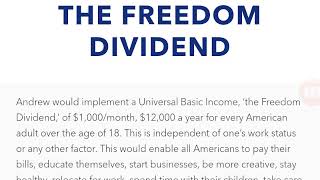
In this video the speaker argues that the Freedom Dividend, Andrew Yang’s branding of universal basic income (UBI), should not be viewed as a handout. He begins by explaining the terminology shift from “universal basic income” to “Freedom Dividend” to avoid the stigma of “free money.” Using Alaska’s Permanent Fund dividend—financed by oil revenues—as a concrete example, he shows how a resource‑based dividend can be universal, non‑means‑tested, and perceived as a rightful share of wealth rather than charity. He then parallels Alaska’s oil wealth with the emerging “new oil” of the 21st century: technology, automation, AI, and robotics, arguing that the productivity gains from these technologies will generate surplus value that belongs to the public. The speaker distinguishes true handouts (e.g., targeted welfare programs with restrictive stipulations, bank bailouts that merely patch failing institutions) from universal dividends that are unconditional and funded by collective wealth. He critiques means‑tested welfare for its perverse incentives and administrative inefficiencies, contrasting it with the simplicity of a universal payment. The video also discusses the fiscal feasibility of UBI, noting that wealthy, resource‑rich nations like the United States can afford it, whereas resource‑poor or developing countries may struggle to fund such programs. Historical analogies—such as Roman universal distributions and corporate dividend practices—are invoked to illustrate that universal payouts are not unprecedented. The speaker concludes by urging a redefinition of “handout” and emphasizing that the Freedom Dividend is money that belongs to all Americans, not charity, and calls viewers to like and subscribe.
Chapters
Hey you, welcome back to the channel. And today we want to talk about, uh, universal basic income is not a handout. So the Freedom Dividend, this is the Freedom Dividend policy here on the Andrew Yang website. The Freedom Dividend represents a phrase that tested better, uh, in contrast to universal basic income. Uh, essentially the same thing, but dividend obviously greatly separates this stigma that goes along with universal basic income being a handout. So let's, um, talk about that today. Why it's not a handout and why it shouldn't be considered a handout and why that is an oversimplified way of looking at universal basic income. And it's also very much a misunderstanding of economics and what is termed handout and what is not. So, um, Let's take Alaska, which is an example that's given quite a bit in Andrew Yang's examples of how the Freedom Dividend would work and why it's not a handout. So if you look at the state of Alaska, which has been a conservative, greatly conservative state, of course we remember governors from Alaska like Sarah Palin, 2008, uh, who, who ran with, uh, the late great Senator John McCain, um, as his running mate against Barack Obama. Um, you know, we, uh, understood that Alaska has an annual dividend that goes out that is paid to, uh, the members of the state because when Given the choice, they prefer the money go to them and they spend their money on their own, which is, which are, which is very much so a very conservative-like approach where people are control and are in control of their money and do a better job at spending their money than the government. Um, so is that a handout then? Is that free money? I don't think the people of Alaska thought it was free money, right? The resource that made this possible was oil. Of course, as we, we know, you know, places that have oil, uh, make that area richer. I, I believe even if you look at some of the Native American reservations that have oil reserves on them, they do a similar thing to what they do in Alaska, which is they share this wealth with the community. This goes on and on all across the world. If you go to parts of the Middle East, same thing. I don't believe there's any concept of free money or handouts or anything like that. Now, this is drastically, I think, different though. Than, uh, what people tend to think of as a handout. And that's generally something to do with the parameters of social programs, uh, the fact that these are needy, poor people, um, that need the aid of the government in some way. Now, the, the differences are, uh, in a universal basic income or something like a dividend, the Freedom Dividend, there are no stipulations as to who gets it. And that's why the argument that many have made about universal basic income and who should get it and who shouldn't get it, those ideas do turn it into a handout. Because if you're saying, well, don't give it to people who make a certain amount of money, then you are creating a handout because you're giving it to certain groups of people and other groups of people who aren't getting it. Doesn't matter if they need it or not. The idea is that this is not a handout. Right, this is— when you do that, you will make it a handout. You will make it a program just for needy or poor people. That's not the idea of what the Freedom Dividend is. That's not the idea of what universal basic income is. It's never been that. Universal basic income has always been for everybody. Um, going back to the Alaska example though, in the Alaska example The resource is oil. Now Andrew Yang's campaign, he uses technology is the new oil of the future. Information, artificial intelligence, robotics, driverless cars, autonomous vehicles. Excuse me. Those are the oil, the new oil, oil of the future. Now again, this is the fallacy that many people make and not being able to separate their brains from what is a handout and free money and what is not. An idea of a handout would be something like a bank bailout where you have a company that is unable to sustain itself. And so you go in and you correct the problem. Now the issue with that is You haven't correct— you haven't fixed what was wrong with the, uh, company in the first place. Only thing you've done is you've put a Band-Aid on an issue. There was a reason why, or there are reasons why businesses aren't sustainable. It meant that they're not meant to work. It means that they do— they do not work. So you just go in to that specific business and you help that specific business by throwing money at it, then that is a handout, right? We're talking about something different with universal basic income. We're talking to— or the freedom dividend. We're talking about the richest nation in the world with probably the most resources, you know, probably per capita we live better than anybody in the country, right? Richest nation in the world. So it is affordable by us. We have the extra resources comparably to how Alaska had the oil. And we have it, of course, from the technology, the robotics, and, um, all of these, uh, replacements that are going to happen with automation. And where does that value and where does that wealth go? And who owns that value and who owns that production? Well, it's not really stolen production now, is it? Because there is an, um, a, uh, non-human-like being, whatever you want to call it, robot, uh, that is not, uh, uh, able to— or another human being is not able to somehow usurp that value away from this thing, right? At the same time, it's taking jobs but it's not paying a personal income tax back to Uncle Sam. So where's all that wealth go, right? Doesn't it belong to the government, which in turn the government is the people, so it belongs to us? Uh, the fallacy that's being made with this thing, uh, we need to stop it and we need to stop it now. Uh, and we need to approach this from an angle where we really, um, where we really take a step back and take time to think about, uh, why this is not a handout and what is a handout. Now, there are government programs that are handouts, and I can give you several of them, um, and they are a problem because people don't get to spend the money to better themselves. The government does it, and the government generally does a poor job of spending money. Right? The stipulations that the government, uh, use, uh, generally have a negative effect more so than, uh, it helps. Like for instance, in the welfare system, as we've underlined quite a bit through the series as well as Andrew Yang has, um, you know, they put these crazy stipulations on you where, okay, if you did receive something like, uh, just, just say $1,000 per month in benefits, uh, then, and if you went out and you, you gotta, um, had the opportunity to have a job that earned $1,000 per month. You know, this is a weird, strange, crazy setup where you're putting a person in a situation to, um, get rid of their benefits to take, um, equal benefits, or not even that, yet at this, at the risk of risking all of their past benefits uh, or their prior benefits, uh, uh, with no safety net, they're gonna always take the safety net, right? More likely. We've been— a lot of us been taught to carry some type of insurance policy. Now, if a person's able to work, should they work? Absolutely, they, they should make a moral decision to work. But that is not helping the system because, uh, the psychology of a human being doesn't quite work that way, right? It doesn't quite work that way. Um, so we have to really, uh, uh, look at this, uh, and go forward with this in a way that's going to make sense for ourselves and the country. Um, So the universal basic income is not a handout, although I will say this about universal basic income. Although it's not a handout, that doesn't mean that it is designed to work well in every place. Um, if you are a nation that is not, uh, resource heavy, then it might not be a good idea to implement universal basic income. in, right? Whereas if you are, uh, it probably will work quite well for you. Uh, and that of course is because if you don't have the resources to pay for universal basic income, then of course, you know, it could be a disaster. Now in our cases, in rich nations like the United States and Many other examples of people who've tried UBI where it could work. Um, you know, those are different examples because those places have, um, the resources to pay for the universal basic income, right? Um, they have money to spare, right? Uh, quite a bit of money. In fact, they have money to waste. Have so much money to waste, uh, they could just throw away pounds and, uh, hundreds of pounds of food a night, right? So, uh, you know, this is the— what we have to look at and understand, and that this is not a handout by the government. A dividend is not a handout. Um, a dividend, if we were looking at it from a business perspective, uh, there are cases— I mean, this hap— this actually happens in companies where a company will borrow money just to pay a dividend to citizens— I'm sorry, to shareholders, right? Uh, you know, a lot of times they do that because they feel at some future time they will be able to pay out the dividend, but they know in some cases it's quite attractive to pay a dividend to shareholders. But there are some cases where they just don't have the available capital to do that, yet they think that's still a good idea for shareholders. And companies do this, and it's not considered a a handout. You know, you're a shareholder in the nation of America. You pay taxes, you contribute to it through one form or another. And if the idea of America giving that, some of that back to the people, I don't think it's a bad idea at all. And yes, everybody should receive it because most people have contributed in some way, whether it be through work or creativity or inspiration, whatever the case may be, much like many other cultures in rich lands, empires of antiquity who've done similar things, great universal basic programs. Rome was one of them throughout their country. These are things that aren't handouts, right? Aren't handouts. We have to change the definition of what a handout is, what a dividend is, and what the future of robotics and automation and AI will do to this nation and the wealth that it will bring in. You know, and again, I don't think universal basic income works for everybody. If you're in a developing nation, right, where maybe you don't have or, You know, what do you— you may not have a certain, um, uh, access to certain technologies, or you might be in a place where you're not facing threats like a highly industrialized nation might face, then universal basic income probably wouldn't be ideal for you. But, uh, this is an example that's tremendously different, and I think we have to put all those factors in to fully understand uh, uh, you know, uh, uh, why a UBI is not only needed but why it should be given and why it's not a handout. So I kind of want to end the video with this, or with that idea, to get in our heads that we are misunderstanding what a handout is. We aren't misunderstanding that this is free money. Nobody ever said it was free money. We're saying that it's money that belongs to the American people. Guys, if you like content like this, don't forget to like, subscribe, and until next time, take care.